This site is supported by our readers. We may earn a commission, at no cost to you, if you purchase through links.
Nothing kills a sewing project faster than flipping your fabric over and finding a tangled mess of loops where clean stitches should be.
Tension problems are sneaky—they often start small, a little puckering here, a loose loop there, until suddenly your seams look like they were sewn during an earthquake.
The good news? Most uneven stitches trace back to a handful of fixable culprits. Once you know what to look for, diagnosing and correcting the problem takes minutes, not hours.
From bobbin winding habits to needle selection, the fixes are straightforward—and entirely within your control.
Table Of Contents
Key Takeaways
- Most uneven stitches trace back to just a few fixable causes: wrong needle size, bad threading, bobbin tension, or dirty tension discs.
- Always re-thread with your presser foot raised — it opens the tension discs so the thread actually seats where it needs to go.
- Match your needle to your fabric every time: ballpoint for knits, sharp for wovens, and swap it out every 6–8 hours of use.
- Cheap or old thread causes problems no dial can fix — consistent diameter and low-lint thread are the quiet foundation of even stitches.
Common Causes of Uneven Stitch Tension
Uneven stitches almost always trace back to something specific — and usually something simple. Before you start adjusting dials at random, it helps to know what you’re actually dealing with.
Once you understand the patterns behind the problem, this sewing fundamentals guide can help you spot tension issues, bunching, and uneven stitches before they get out of hand.
Here are the most common culprits worth checking first.
Incorrect Upper Thread Tension
Upper thread tension is usually the first thing to check when stitches go wrong. If your tension dial sits too high, the bobbin thread gets yanked to the fabric’s topside. If too low, loops pile up underneath.
Use the dial adjustment technique — move one number at a time, test on scrap fabric, and don’t skip tension disc cleaning every ten hours.
Ensuring correct thread tension helps avoid seam puckering.
Improper Bobbin Tension or Winding
The bobbin is sneaky — it causes just as much trouble as the upper thread. Loose bobbin tension? You’ll see thread loops on top. Too tight? Your fabric puckers.
Understanding the causes of bobbin tension issues(https://www.mhthread.com/blog/products/bobbin-tension-too-loose) can help prevent common sewing problems.
Check bobbin case drop: it should slide two inches, no more. Keep winding speed control steady and maintain thread layer consistency for smooth, even feeding.
Small tension screw calibration turns — clockwise or counter — fix most issues fast.
Needle and Thread Compatibility
The needle-thread relationship is like a handshake — it only works when both sides match. Wrong pairing and your stitches fall apart fast.
Three needle and thread compatibility rules to remember:
- Needle Size Matching: Fine Tex 16–35 threads need 70/10–90/14 needles.
- Eye Size Fit: The needle eye should measure 1.4 times your thread diameter.
- Point Type Selection: Ballpoint for knits, sharp for wovens — always.
Thread material pairing and groove depth role matter too. Deep grooves cradle thick threads; shallow ones guide fine threads cleanly.
Machine Threading Errors
Even a perfect needle-thread pair won’t save you if threading errors are wrecking the path.
Check these common missteps:
| Threading Error | What Goes Wrong |
|---|---|
| Presser Foot Timing | Foot down traps thread outside tension discs |
| Take‑Up Lever Path | Missed lever causes loops and birdnesting |
| Tension Disc Seating | Poor seating mimics low thread tension adjustment |
| Spool Orientation | Wrong direction adds drag, twists thread at start |
Follow your Thread Guide Sequence exactly — every guide counts.
Each step in the sequence builds on the last, much like the troubleshooting patterns covered in these sewing error prevention and best practices that help you catch mistakes before they compound.
Fabric Handling Issues
Manhandling your fabric is a silent tension killer. Pulling fabric forward shortens stitches; pushing it back creates dense, elongated clusters.
Slippery fabric slippage is real — silks and synthetics shift easily under standard feet. Match your presser foot pressure to your fabric type: heavy denim needs higher settings, delicate chiffon needs lower.
Proper fabric handling, feeding, and stabilization keep every stitch honest.
How to Identify Uneven Stitches
Before you can fix a tension problem, you have to see it clearly. Uneven stitches leave clues — you just need to know where to look. Here’s what to check.
Visual Signs of Tension Problems
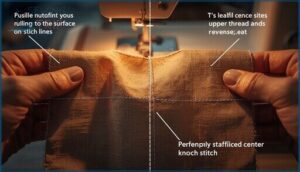
Your fabric tells the story before you even sew a real seam.
Flip your test piece over — bobbin thread exposure on top means your upper tension is too tight.
Upper thread lines showing underneath? Bobbin’s gripping too hard.
Check knot placement at each stitch end; centered knots signal balance.
A quick pull test and tactile check catch fabric distortion ridges and stitch length variation fast.
Looping, Puckering, and Skipped Stitches

Spotting three defects early saves your whole project.
Loops under the fabric? Your tension disc cleanliness matters — lint blocking the discs kills upper thread grip fast.
Puckering usually means stitch length optimization is off, or bobbin tension is fighting your fabric.
Skipped stitches signal needle replacement is overdue.
Check your thread path obstruction, feed dog alignment, and bobbin case edge before anything else.
Checking Stitch Consistency on Test Fabric
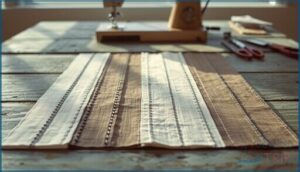
Test fabric is your truth serum — it never lies about what your machine is actually doing.
Cut strips 4 inches wide by 36 inches long, fold them double, and run three quick checks:
- SPI Measurement — aim for 8–12 stitches per inch for medium fabric
- Tension Balance Test — no thread should show on the wrong side
- Stretch Durability Check — pull knit seams hard; good stitches hold
Label each strip with your tension dial setting before sewing.
Step-by-Step Fixes for Uneven Stitches
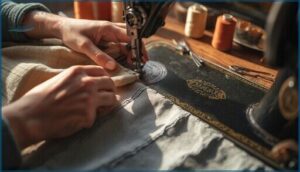
Now that you know what uneven stitches look like, it’s time to actually fix them. Most tension problems come down to a handful of simple adjustments — nothing that requires expert-level skills. Work through these steps in order, and you’ll likely solve the problem before reaching the end of the list.
Adjusting Upper and Bobbin Tension
Think of thread tension like a handshake — both sides need equal pull.
Start with your upper tension dial at 4 or 4.5 for medium fabrics. Dial calibration tips matter here: move one number at a time.
For bobbin screw adjustments, a quarter-turn clockwise tightens.
Thread weight matching and fabric tension balance keep stitch length sync tight. Test both sides every time.
Re-threading The Sewing Machine
Half your tension problems vanish the moment you re-thread correctly. Always raise the Presser Foot Lever first — that opens the tension discs so your thread actually seats inside them.
Follow this order every time:
- Guide thread through the upper path, keeping tension taut
- Slot it into the Take-Up Lever Position at its highest point
- Finish with proper Bobbin Insertion Tips — counterclockwise, clicked in firmly
Threading done right is half the fix.
Replacing or Choosing The Right Needle
Re-threading fixed your tension path — now let’s talk about the tool doing the actual piercing.
A wrong needle wrecks stitches fast. Your Needle Size Guide starts simple: match size to fabric weight. Use this Fabric Needle Matching table:
| Fabric Type | Needle Size | Needle Type |
|---|---|---|
| Silk, organza | 60/8–70/10 | Universal |
| Knits, lycra | 75/11–90/14 | Ballpoint |
| Denim, canvas | 90/14–100/16 | Jeans |
Ballpoint vs Universal matters — ballpoints slide between knit fibers without cutting. Jeans Needle Benefits include a reinforced tip that punches through thick layers cleanly.
Check needle condition every 8 hours; dull needles skip stitches. Needle compatibility with your fabric isn’t optional — it’s your stitch foundation.
Cleaning and Maintaining Your Machine
Your needle’s doing its job — now make sure the machine backing it up is clean. Lint Removal from the bobbin area every one to two bobbins keeps tension steady.
Slide a soft cloth between tension disks for Tension Disk Cleaning. Follow an Oil Lubrication Schedule every 8–10 hours. Feed Dog Care and Storage Protection round out solid sewing machine maintenance.
Preventing Stitch Tension Issues
Fixing uneven stitches is satisfying, but keeping them even is the real win.
A few consistent habits go a long way toward preventing tension problems before they start.
Here’s what actually makes the difference.
Regular Machine Maintenance
Keeping your machine clean is the cheapest fix you’ll never regret. Stick to a Lint Removal Routine — brush the feed dogs weekly and pop out the bobbin case after every few hours.
Follow a Needle Replacement Schedule every six to eight hours of use. Add Hook Oiling Frequency and Tension Disc Inspection to your regular sewing machine maintenance, and uneven stitches become rare.
Proper Bobbin Winding Techniques
Good bobbin winding techniques quietly decide how your stitches behave.
Start with Tension Disc Flossing — run the thread between the discs like dental floss until you feel resistance. Then Thread Tail Anchoring: pull the tail through the bobbin hole and wind 4–5 slow turns before trimming. Apply Even Layer Guidance with light side-to-side finger movement, follow Winding Speed Control at moderate pace, and respect Bobbin Fill Limits at 80–90% full.
Using Quality Threads and Needles
Cheap thread sabotages even your best tension settings. Fuzzy fibers shed particles into your tension discs, and suddenly you’re chasing a problem that isn’t mechanical at all. Thread Fiber Selection and Needle Size Matching work together — pair a 50-weight thread with an 80/12 needle for clean results.
Cheap thread sabotages even your best tension settings — fuzzy fibers cause problems no dial can fix
- Lint-Free Thread Benefits: Low-lint options like Aurifil cut cleaning time and reduce skipped stitches
- Thread Coating Effects: Waxed or silicone finishes reduce drag by 20–30 percent
- Premium Thread Brands: Gutermann and Mettler maintain consistent diameter for stable thread tension adjustment
Smart thread and needle selection isn’t optional — it’s foundational.
Correct Fabric Guiding and Feeding
Guiding fabric well is half the battle. Flat hands on both sides of the needle keep layers feeding straight — no steering, no pulling. Let the feed dogs do their job.
Here’s how each technique affects your results:
| Technique | What It Does | When to Use It |
|---|---|---|
| Hand Position | Keeps seam alignment steady | Every seam |
| Feed Dog Maintenance | Restores consistent fabric feeding | Monthly cleaning |
| Presser Foot Pressure | Balances grip on fabric layers | Fabric weight changes |
| Walking Foot Use | Syncs top and bottom feed | Quilts, knits, layers |
| Differential Feed Settings | Prevents stretch or pucker | Knits, fine fabrics |
Trust the machine — just guide it.
Troubleshooting Persistent Stitch Problems
Sometimes the basics just don’t cut it, and the problem keeps coming back. That’s when it’s time to look a little deeper.
Here are a few more targeted things to check when standard fixes aren’t doing the job.
Advanced Tension Adjustments
When upper tension tweaks stop working, it’s time to dig deeper. Start with bobbin case fine-tuning — turn the tension screw just one-eighth of a turn at a time.
Use a solid tension test methodology: sew along marked lines on scrap fabric, shifting the tension dial at each pass.
Build fabric-specific tension charts for denim, knits, and canvas.
For decorative stitch tension and multi-layer quilting tension, fine-tune both tension discs together.
Inspecting Presser Foot Pressure
Presser foot pressure quietly controls fabric feeding — and it’s easy to overlook.
Too much pressure causes puckering signs on delicate fabrics; too little leads to fabric floating and wandering seams.
Run a pressure dial test on scrap fabric, adjusting one step at a time.
Match your fabric pressure needs to the material — lighter for knits, firmer for denim — and watch stitch quality improve immediately.
When to Seek Professional Machine Service
Some problems go beyond DIY fixes — and knowing when to call a pro saves you time and money.
If you’re dealing with persistent tension failure after re-threading, mechanical noise alerts from the hook area, or a needle hook malfunction that skips every few stitches, it’s time for professional help. Same goes for electrical control issues or expired warranty repair considerations.
Watch for these clear signals:
- Thread loops persist despite full machine maintenance and tension dial adjustments
- Grinding or clicking sounds suggest internal timing misalignment
- Tension discs feel loose even at the highest setting
Don’t fight a machine that needs a technician.
Frequently Asked Questions (FAQs)
Why are my stitches uneven?
Think of your machine as a handshake between two threads. When either side grips too hard or barely holds on, uneven stitches happen.
Bobbin tension, thread path obstructions, and sewing speed variance are usually the culprits.
How to fix uneven tension when knitting?
Wrap your working yarn consistently around the same fingers to build a steady Hand Tension Rhythm. Try Needle Size Selection and Swatch Blocking Methods to even out uneven stitches fast.
How to fix stitch tension?
Dial your tension to 4 or 5, rethread with the presser foot raised, and test on scrap fabric. Match your Needle Eye Size to thread weight for balanced stitch quality.
What are the causes of unbalanced stitches?
Uneven stitches usually trace back to five culprits:
thread tension discs out of balance, bobbin case spring misalignment, wrong needle eye size, presser foot pressure issues, or rough fabric feed dog handling.
Can stitch tension vary between different fabric weights?
Yes, fabric weight directly affects stitch tension. Lightweight fabrics need lower tension around 3 to 5, while heavy fabrics like denim require higher settings between 5 and 6 for balanced stitches.
Does sewing speed affect thread tension consistency?
Speed absolutely affects thread tension. Fast sewing creates inertia effects and fluctuating thread stress, causing speed-induced tension drift.
Above 4,000 stitches per minute, tenacity loss rises sharply.
Rhythm consistency matters more than raw speed.
How does humidity or temperature impact thread behavior?
Both humidity and temperature quietly mess with your thread.
Moisture‑Induced Swelling thickens fibers, shifting Friction Changes and Thread Elasticity Variation.
Heat causes Temperature‑Driven Strength Loss.
Low humidity triggers Static Build‑Up, throwing thread tension off quickly.
Can old or stored thread cause tension problems?
Old thread absolutely can.
UV light damage, storage humidity impact, and dust contamination all degrade thread aging effects over time, throwing off thread tension adjustment and causing skipped or inconsistent stitches mid-seam.
Does presser foot type influence stitch evenness?
Presser foot pressure profoundly shapes stitch uniformity.
Sole design impact, needle clearance, and fabric glide all vary by foot type — a walking foot’s height adjustment alone can transform fabric feeding and stitch quality instantly.
Conclusion
Stitch by stitch, you’ve got this sewn up. Uneven stitches and tension problems aren’t machine mysteries—they’re just small details that compound when ignored.
Clean threading, the right needle, a properly wound bobbin: each one matters more than it looks. Now you know exactly where to check and what to fix.
Your seams don’t have to lie. With the right habits locked in, every project you touch can run smoothly, straight, and confident from start to finish.
- https://www.magnetichoop.com/blogs/news/mastering-your-thread-tension-dial-the-ultimate-guide-to-perfect-stitches
- http://www.melco-service.com/source1/Troubleshooting_Bobbin_Thread.htm
- https://www.istanakancing.com/en/blogs/fashion-trend/causes-of-uneven-stitches-and-how-to-fix-them
- https://www.outfiten.com/if-the-machine-stitches-are-uneven-or-looping/
- https://www.quiltersquestiontime.com/blog/when-quilting-my-quilt-will-not-feed-evenly-and-i-get-uneven-stitch-lengths-what-will-help-me-to-solve-this