This site is supported by our readers. We may earn a commission, at no cost to you, if you purchase through links.
You’ve probably never wondered who deserves credit for the sewing machine sitting in your closet—but the answer involves decades of bitter legal battles, a French tailor whose factory was burned by an angry mob, and at least a dozen inventors whose names history nearly forgot. The simple question of “who invented the sewing machine” unravels into a complex tapestry of overlapping patents, stolen designs, and rival claims spanning multiple continents from the 1750s through the 1850s.
From Charles Fredrick Wiesenthal’s pioneering needle design in 1755 to Elias Howe’s lockstitch advancement and Isaac Singer’s commercial empire, the machine that transformed global textile production emerged not from a single genius, but from a century-long relay race of incremental innovations—each inventor building upon, borrowing from, or outright copying the work of those who came before.
Table Of Contents
- Key Takeaways
- Early Attempts at Sewing Machine Invention
- Breakthroughs in 19th Century Sewing Machines
- Barthélemy Thimonnier’s Chain Stitch Machine
- Elias Howe and The Lockstitch Revolution
- Isaac Singer and Commercial Success
- Patent Disputes and Industry Collaboration
- The Sewing Machine’s Impact on Society
- Modern Advances in Sewing Machine Technology
- Frequently Asked Questions (FAQs)
- Conclusion
Key Takeaways
- The sewing machine emerged from a century-long relay of overlapping innovations across multiple continents—from Charles Fredrick Wiesenthal’s 1755 needle patent through Thomas Saint’s 1790 design to Barthélemy Thimonnier’s 1830 factory and Elias Howe’s 1846 lockstitch—rather than from any single inventor’s breakthrough.
- Elias Howe’s lockstitch mechanism became the technical foundation of modern sewing machines, but Isaac Singer’s commercial genius—combining mechanical refinements with revolutionary installment payment plans and mass production strategies—transformed the invention from patented curiosity into a household necessity that reshaped global industry.
- The 1856 Sewing Machine Combination agreement resolved bitter patent wars by creating an unprecedented patent pool among Howe, Singer, and other manufacturers, establishing cross-licensing structures that accelerated innovation and set enduring precedents in intellectual property law.
- Beyond mechanizing textile production, the sewing machine fundamentally restructured society by compressing garment creation time, enabling women’s micro-entrepreneurship from home, democratizing clothing access through reduced costs, and catalyzing the broader Industrial Revolution’s transformation of labor, gender roles, and consumer capitalism.
Early Attempts at Sewing Machine Invention
Before mechanical ingenuity could stitch together the fabric of industrial progress, countless hands had labored with needle and thread for millennia—yet the leap from manual craft to automated mechanism didn’t happen overnight.
The earliest architects of sewing machinery emerged in the 18th century, threading together disparate ideas that would eventually weave into a revolution.
You’ll discover that these trailblazing attempts, though rudimentary and often impractical, laid the groundwork for the revolutionary devices that would reshape both industry and daily life.
Hand Sewing Origins and Early Tools
Long before the sewing machine revolutionized sewing technology, you relied on ancient stitching methods—your ancestors wielded primitive needles crafted from bone or horn, threading sinew through fabric with hand sewing techniques that date to the Upper Paleolithic.
These fabric tools, alongside thimbles and shears, formed the embryonic foundation upon which inventors like Elias Howe and Isaac Merritt Singer would later build their mechanical innovations, transforming sewing machine history.
Charles Fredrick Wiesenthal’s Needle Patent
In 1755—decades before inventors like Elias Howe would transform sewing machine history—you encounter Charles Fredrick Wiesenthal’s trailblazing needle design patent, which represented the earliest documented sewing innovation aimed at mechanizing stitchwork.
His patent history reveals three critical contributions to thread technology:
These innovations laid the groundwork for modern industrial sewing machine applications in garment manufacturing, transforming production efficiency across the textile industry.
- An improved eye-needle configuration that minimized thread breakage during industrial stitching
- Optimized needle geometry enabling smoother thread pass-through
- Standardized specifications that influenced subsequent sewing machine invention prototypes
Wiesenthal’s work laid foundational groundwork for the broader industrial impact that mechanized sewing would eventually achieve. The development of sewing machines also relies on rigorous scientific study methods to guarantee accuracy and precision.
Thomas Saint’s 1790 Sewing Machine Design
Thirty-five years after Wiesenthal’s needle patent, Thomas Saint introduced a sewing machine design specifically engineered for leather reinforcement and canvas work. This patent documentation landmark in 1790 is credited by historians with embryonic significance, despite scholarly debates surrounding whether Saint’s concept ever materialized into a functional prototype.
Today’s sewing enthusiasts can explore modern machine evolution and personal sewing journeys that trace back to these early mechanical innovations.
The early mechanism details remain tantalizingly incomplete, yet undeniably influential in the invention history of mechanized stitching. The inventor’s notes required thorough language research tools to decipher the original patent descriptions.
Breakthroughs in 19th Century Sewing Machines

The dawn of the nineteenth century witnessed a fascinating proliferation of mechanical ingenuity—a period when inventors across Europe grappled with the tantalizing challenge of automating the needle’s ancient dance through fabric. While Thomas Saint’s embryonic design laid conceptual groundwork in the previous century, the early 1800s brought forth a succession of experimenters whose contributions, though often unsuccessful in commercial terms, threaded together the essential innovations that would eventually transform textile production.
Before Thimonnier’s factory or Howe’s patent revolutionized the industry, several trailblazing figures wrestled with mechanisms that inched closer to a practical solution.
Balthasar Krems and Early Innovations
You’ll find that Balthasar Krems’ work in the late 1830s represents an embryonic stage of sewing machine development—one where pressurized needle mechanics and shuttle system innovations began threading together the fabric of modern Industrial Revolution invention.
His demonstrations in Central European workshops, though never achieving commercial proliferation, wove essential insights about synchronized stitch formation that influenced subsequent sewing innovations across the mechanized textile landscape.
Josef Madersperger’s Unsuccessful Models
You’ll discover that Josef Madersperger’s work between 1814 and 1825 in Vienna embodies the profound automation challenges inherent in early sewing technology advancements—his prototypes struggled with persistent needle design issues, inadequate fabric tension problems, and unreliable feed mechanisms that prevented commercial viability despite his sustained mechanical engineering advances.
These early mechanical hurdles meant that even as Madersperger refined his designs, everyday seamstresses still relied on traditional hand techniques because learning how hard sewing could be with unstable machines discouraged widespread adoption.
His Madersperger failures reveal critical hurdles in sewing machine development:
- Needle configurations that couldn’t penetrate diverse textiles consistently
- Tension systems producing irregular, weak stitches across fabric types
- Feed mechanisms failing to advance material smoothly during operation
- Financial backing never materializing to transform prototypes into market-ready devices
John Adams Doge and John Knowles’ Contributions
You’ll notice that historical debates surrounding John Adams Doge and John Knowles reveal significant attribution issues—archival research and inventor verification through patent records show no credible documentation linking these names to sewing machine invention, unlike the well-established contributions of Elias Howe and Isaac Merritt Singer, whose innovations transformed weaving technology through verifiable contribution analysis.
Modern computerized sewing tools have replaced manual guesswork with programmable precision, building on the mechanical foundations laid by verified 19th-century inventors.
| Name | Historical Status |
|---|---|
| John Adams Doge | No patent or archival evidence |
| John Knowles | Unverified in credible sources |
| Established Inventors | Documented patents and impact |
Barthélemy Thimonnier’s Chain Stitch Machine
While Elias Howe often receives credit in American accounts of sewing machine history, you’ll find that a French tailor named Barthélemy Thimonnier achieved a critical breakthrough nearly two decades earlier—establishing not just a working prototype but the world’s first sewing machine factory in 1830. His chain-stitch machine, though mechanically simpler than later lockstitch designs, demonstrated that automated stitching could move from workshop experimentation to commercial-scale garment production.
Understanding Thimonnier’s trajectory requires examining three interconnected dimensions: the technical innovation that earned him patent recognition, the violent social backlash from threatened artisans, and the enduring commercial obstacles that prevented his invention from achieving the revolutionary impact it deserved.
Thimonnier’s 1830 Patent and Factory
You’ll find Barthélemy Thimonnier’s 1830 patent marked a critical moment in sewing innovations—his chain stitch machine, employing a single hooked needle and thread spool, eliminated the need for shuttles or bobbins.
His Paris workshop became the first factory operations dedicated to manufacturing these devices, demonstrating that industrial-scale production could weave mechanical ingenuity into the textile industry’s fabric during the Industrial Revolution.
Social Impact and Resistance From Tailors

You’ll discover that Thimonnier’s factory ignited fierce opposition—tailors feared the mechanization threatened their skilled labor and economic livelihood during a tumultuous period of social change and industrialization.
The craft preservation battles you should understand:
- Labor unions orchestrated tailor protests in 1830s Paris, with journeymen associations lobbying legislators to restrict machine adoption and protect traditional craftsmanship and sewing standards.
- Demonstrations targeted Thimonnier’s workshops, as guilds viewed the impact of sewing machines on society through an alarming lens—machines symbolized an economic shift that could unravel artisan identities woven into the Industrial Revolution and textiles.
- Public debates framed weaving technologies as existential threats, though some tailors eventually adopted hybrid practices as industrial demand grew relentlessly.
Commercial Challenges and Legacy

You’ll recognize that Thimonnier’s enterprise collapsed under economic pressures—manufacturing costs remained prohibitively high despite cost reduction efforts, patent lawsuits drained resources, and market trends favored competitors who would later achieve mass production success.
Isaac Merritt Singer and the Singer Manufacturing Company learned from these commercial failures, ultimately catalyzing global adoption that reshaped the Industrial Revolution and textiles, magnifying the impact of sewing machines on society with unparalleled economic impact.
Elias Howe and The Lockstitch Revolution
While Thimonnier’s chain stitch machine marked an important step forward, it was Elias Howe Jr. who would fundamentally transform the sewing machine’s mechanical foundation—and in doing so, ignite a firestorm of legal disputes that would reshape the industry’s commercial landscape.
His lockstitch design, patented in 1846, introduced technical innovations that became the bedrock of modern sewing machines, though the path from invention to recognition was anything but smooth.
You’ll find that Howe’s story weaves together pivotal engineering, hard-won legal victories, and the complex dynamics of patent warfare that defined mid-19th century industrial innovation.
Howe’s 1846 U.S. Patent
On September 23, 1846, Elias Howe secured U.S. Patent No. 4,753—a document whose historical significance would reverberate through industrial textile manufacturing for decades.
This patent details a lockstitch mechanism employing a needle with an eye at its point, synchronized with a shuttle that looped bobbin thread beneath the fabric, establishing foundational sewing innovations that catalyzed the transformation of garment production.
Technical Innovations in Howe’s Design
Beyond securing the patent, you’ll find that Howe’s lockstitch mechanism revolutionized mechanization through several interconnected innovations:
- A vertically-threaded needle with an eye-point design creating precise stitch formation
- Synchronized reciprocating needle motion paired with a rotating shuttle for consistent lockstitch production
- An integrated thread tension system controlling both needle and bobbin threads
- A wheel-driven drive train enabling continuous, stable sewing speeds
- Removable shuttle hooks and adjustable presser feet accommodating varied fabrics
These technical breakthroughs transformed textile innovation permanently.
Legal Battles and Patent Wars
Howe’s technical triumphs sparked contentious patent infringement battles—most memorably against Isaac Merritt Singer, whose commercially successful machines violated Howe’s intellectual property rights.
Court rulings consistently favored Howe, compelling Singer and other manufacturers to pay substantial licensing fees.
The ensuing patent law disputes culminated in the Sewing Machine Combination, a pivotal alliance consolidating key patents until their expiration accelerated subsequent innovation across the industry.
Isaac Singer and Commercial Success

While Howe’s lockstitch mechanism laid the technical groundwork for modern sewing, it was Isaac Merritt Singer who transformed the sewing machine from a patented curiosity into a household necessity—threading together mechanical refinement with unmatched commercial vision.
Singer didn’t merely tinker with existing designs; he reimagined the entire apparatus for practical use, establishing a manufacturing empire that would stitch his name into industrial history. You’ll discover how Singer’s innovations and business strategies propelled the sewing machine from factory floors into homes across the globe.
Singer’s Improvements and Manufacturing Company
When Isaac Merritt Singer established the IM Singer Company in 1851, you witnessed the birth of industrial-scale manufacturing brilliance—a convergence of mass production ingenuity, quality control protocols, and marketing strategies that transformed the sewing machine from workshop curiosity into household necessity. His Singer Corporation revolutionized industrial impact through:
- Standardized, interchangeable components that simplified assembly
- Systematic quality control reducing defect rates
- Aggressive patent protection safeguarding innovations
- Factory organization minimizing skilled labor dependencies
Singer’s Payment Plans and Market Expansion
Singer’s groundbreaking installment credit plans—allowing you to purchase machines through manageable monthly payments rather than prohibitive upfront costs—democratized access to industrial efficiency, transforming the IM Singer Company into a global powerhouse while simultaneously managing patent disputes with Elias Howe.
The Singer Corporation’s aggressive retail expansion, establishing branded showrooms and extensive agent networks, catalyzed remarkable market growth through customer financing strategies that redefined consumer credit.
Patent Disputes and Industry Collaboration
Success in the sewing machine industry didn’t come without friction—inventors who’d poured years into their designs weren’t about to watch others profit from their innovations. The courtroom became as important as the workshop, with legal battles threatening to strangle the embryonic industry before it could truly flourish.
What emerged from this contentious period, however, was an unexpected collaboration that would reshape manufacturing and set precedents you can still see in patent law today.
Howe Vs. Singer Patent Lawsuits
The collision between Elias Howe and Isaac Singer ignited a legal firestorm over the lockstitch mechanism—a battle that would reshape Patent Law and Infringement precedents throughout the nascent industry.
In 1851, Court Rulings affirmed Howe’s priority as inventor, compelling Singer Corporation and other manufacturers to acknowledge his Intellectual Property claims, so establishing foundational principles that would govern the Sewing Machine Wars for years to come.
The Sewing Machine Combination Agreement
To untangle the legal knots—and stave off mutual ruin—Elias Howe Jr., Isaac Singer, and other manufacturers forged the Sewing Machine Combination of 1856, a pivotal Patent Pooling agreement that transformed rivalry into Industry Collaboration.
Through Cross Licensing and shared Royalty Structures, you’ll see how Litigation Reduction accelerated the History of Sewing Machines, redefining Patent Law and Infringement for generations.
Expiration of Key Patents and Increased Innovation
By the 1850s and 1860s, Patent Expiration unraveled Howe’s lockstitch monopoly—and with it, an Innovation Surge transformed the History of Sewing Machines into a crucible of Industrial Growth and Technological Innovations in Manufacturing.
You’ll witness how Mass Production techniques and Competitive Pricing, hallmarks of the Industrial Revolution Impact, reshaped Invention and Innovation itself, democratizing machinery once reserved for factory owners while Patent Law adjusted to this proliferating landscape.
The Sewing Machine’s Impact on Society
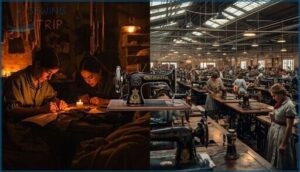
The sewing machine didn’t simply smooth production—it fundamentally rewove the fabric of society itself, transforming industries, households, and economies across the globe in ways few inventions could rival. Its influence extended far beyond factory floors, reshaping women’s daily lives and catalyzing remarkable industrial expansion that rippled through every corner of the modernizing world.
The sewing machine rewove society itself, transforming industries, households, and economies in ways few inventions could rival
Let’s examine how this mechanical innovation became a thread connecting technological progress to profound social change.
Transformation of Textile and Garment Industries
You’ll find that the introduction of mechanized stitching served as a catalyst for mass production across the textile industry—transforming garment manufacturing from embryonic handcraft operations into sprawling industrial scaling enterprises that redefined global trade networks.
This shift accelerated the evolution of garment production through relentless technological innovations in manufacturing and fundamentally reshaped industrialization’s trajectory by enabling standardized, factory-based assembly lines that could meet the escalating demands of rapidly urbanizing populations worldwide.
Effects on Women’s Labor and Home Life
You’ll discover that mechanization of labor through the sewing machine rewrote domestic labor patterns and gender roles—electrification and home appliance evolution allowed you to compress garment production time dramatically, while automation in textiles enabled new micro-entrepreneurial ventures that redefined home economics and family dynamics for women managing industrialization’s opportunities:
- Household budgets benefited from reduced clothing costs through at-home production
- Sewing machine ownership facilitated women empowerment via small-scale income generation
- Technical literacy increased as you mastered tension adjustments and fabric handling
- Credit plans expanded middle-class access to productive home technology
- Labor narratives shifted from purely domestic duties to measurable productive output
Global Adoption and Industrial Growth
By the 1860s, you’ll witness how sewing machines threaded themselves through European textile regions and American factories—Mass Production accelerated garment output while Industrial Expansion and Global Trade networks lowered unit costs, democratizing access for small-scale workshops.
This Technological Advancement in Manufacturing Technology and Automation in Textiles exemplified the Industrial Revolution’s Economic Impact, catalyzing Innovation in Fashion and Mass Production and Consumerism across continents through standardized components and international patent licensing.
Modern Advances in Sewing Machine Technology

The sewing machine didn’t rest on its laurels after revolutionizing nineteenth-century industry—it continued to evolve, threading its way through successive waves of technological innovation that transformed both its capabilities and its reach.
From the electrification of the early twentieth century to the computerized marvels you’ll find in today’s workshops, each advancement has woven new possibilities into the fabric of what these machines can accomplish.
Let’s examine how modern technology has reshaped the sewing machine, tracing its journey from mechanical workhorse to the refined, automated tools that now empower both industrial production and creative expression.
Electrification and Home Use
By the early 20th century, you witnessed electric motors revolutionizing home appliances—and sewing machines stood at the vanguard of this domestic manufacturing transformation. Sewing innovations now featured corded household power, compact frames, and adjustable speed controls that elevated household efficiency beyond industrial origins.
The 1920s-1930s proliferation of electric sewing machines democratized garment production, interweaving manufacturing technology with everyday creativity and accessibility in your own workspace.
Computerization and Automated Functions
As electric power matured, microprocessor integration and firmware updates introduced remarkable precision control—transforming your creative canvas with automated stitching sequences, computerized patterns, and sensor-driven tension adjustments that epitomize industrial automation reimagined for personal innovation.
This technological advancement in manufacturing technology facilitates:
- Real-time fabric thickness detection and automatic needle positioning
- USB or wireless pattern transfer from design software to machine learning-capable systems
- One-click buttonhole routines and thread-trimming automation that simplify complex projects
Influence on Modern Sewing and Crafting
Today’s sewing machines—empowered by sewing automation and digital patterns—reshape the fashion and clothing industry, enabling machine embroidery with precision you’d scarcely imagine decades ago.
Fabric innovation and crafting tools fuel craft trends that merge technological advancement with artisanal expression, democratizing clothing production so independent makers and studios achieve consistency once exclusive to large-scale manufacturing.
Online platforms accelerate skill transmission through pattern libraries and community-driven tutorials that empower your creative vision.
Frequently Asked Questions (FAQs)
Who invented the lockstitch sewing machine?
You’ll find Elias Howe credited with the lockstitch sewing machine—he patented his groundbreaking design in 1846, featuring a needle and shuttle mechanism that intertwined threads beneath fabric, transforming industrial stitching forever.
How did the sewing machine change the world?
The sewing machine catalyzed profound Industrial Impact and Social Change, accelerating Manufacturing in the Textile Industry and spurring Economic Growth through Automation.
It expanded Global Trade networks and precipitated a Cultural Shift that redefined labor, domestic life, and the very fabric of modernizing societies worldwide.
Who invented the Singer sewing machine?
Isaac Singer—the entrepreneur who’d transform domestic manufacturing—patented his pioneering oscillating shuttle design in 1851, founding Singer Sewing Co. and reshaping sewing machine evolution through installment payment plans that democratized industrial impact.
What is a sewing machine used for?
You’ll find these mechanical marvels indispensable for garment creation, fabric repair, and quilting techniques.
Stitching seams with precision, executing embroidery designs, and enabling textile crafting transformed clothing production from laborious handwork into efficient fabrication throughout the garment industry.
Who invented the sewing machine?
You’ll discover multiple inventors wove the sewing machine’s evolution—Charles Fredrick Wiesenthal patented needle innovations in 1755, Thomas Saint designed mechanisms in 1790, Barthélemy Thimonnier created practical models by 1830, while Elias Howe and Isaac Singer perfected lockstitch technology through intense patent history battles.
When did sewing machines come out?
Threading through Industrial Revolution corridors, the first practical sewing machines emerged in the 1830s. Barthélemy Thimonnier patented his chain-stitch design in 1830, while Elias Howe’s lockstitch followed in 1846, revolutionizing textile industry mass production forever.
Who invented the original sewing machine?
You’ll find the embryonic origins of mechanical stitching trace back to Thomas Saint’s 1790 design—though Barthélemy Thimonnier achieved the first practical, patented chain stitch machine in 1830, marking true invention history.
Who invented the sewing machine in 1793?
You won’t find a verified inventor for 1793—historical debates around Patent History reveal that Thomas Saint’s 1790 design represents the embryonic stage of Sewing Innovations, though Invention Origins remain speculative.
Is Singer the first sewing machine?
To set the record straight—no, Singer wasn’t the first sewing machine. Barthélemy Thimonnier patented his design in 1830, and Elias Howe followed in 1846, establishing the machine evolution before Singer’s improvements revolutionized commercial production.
Who invented the sewing machine in 1842?
No single inventor can claim the sewing machine’s patented creation in 1842—this year sits within a continuum of sewing innovations, industrial innovation, and historical debates predating Elias Howe’s key 1846 lockstitch patent.
Conclusion
The sewing machine’s invention was less a single spark of genius and more a slow-burning fuse ignited across continents and decades—each inventor adding their thread to an ever-lengthening seam.
Understanding who invented the sewing machine means recognizing that Wiesenthal, Thimonnier, Howe, Singer, and countless others collectively stitched together modernity itself, transforming not just how you produce clothing, but reshaping labor, gender roles, and industrial capitalism in ways that still define your world today.
- https://www.sil.si.edu/DigitalCollections/trade-literature/sewing-machines/pdf/sewing-machines.pdf
- https://ncert.nic.in/vocational/pdf/ivsm101.pdf
- https://www.britannica.com/technology/sewing-machine
- https://historycambridge.org/innovation/Sewing%20Machine.html
- https://time.com/3985665/sewing-machine-invented/