This site is supported by our readers. We may earn a commission, at no cost to you, if you purchase through links.
Most embroidery projects don’t fail because of the wrong thread or a dull needle—they fail because of what’s underneath.
Stabilizer is the silent foundation of every clean stitch, and choosing the wrong material turns crisp lettering into a puckered mess.
Knits stretch, sheers shift, and even sturdy denim can distort under thousands of needle strikes without proper support.
The right embroidery stabilizer material locks your fabric in place so the design lands exactly where you intend it.
Cut-away, tear-away, wash-away, fusible—each type functions for a different fabric and purpose, and knowing the difference puts you in control of every project.
Table Of Contents
Key Takeaways
- The stabilizer you pick—cut‑away for knits, tear-away for wovens, wash-away for sheers—does more for your final result than your thread, needle, or design ever will.
- Stabilizer weight has to match your stitch count: light designs need 1.5–2.0 oz, heavy designs above 20,000 stitches demand 2.5 oz or more.
- Format matters as much as type—backing goes under the fabric, topping goes over it, and adhesive grips directly, so nothing shifts during stitching.
- How you remove stabilizer is the last thing standing between a good design and a great one—tear inward from the edges, trim cut-away to ¼ inch, and rinse wash-away until the water runs clear.
What is Embroidery Stabilizer Material?
Embroidery stabilizer is the material that holds your fabric steady while the machine stitches.
Without it, even small shifts in your fabric can throw off alignment—a problem explored further in this guide to embroidery machine needle care and stitching accuracy.
Without it, you get puckering, shifting, and designs that look nothing like they should.
Here’s what you need to know about how it works and what it’s made of.
Definition and Core Purpose of Embroidery Stabilizers
An embroidery stabilizer is a thin support sheet placed under or over your fabric during machine embroidery. Its core job is dimensional control — keeping fabric from stretching, puckering, or distorting under repeated needle strikes. Think of it as your design’s foundation.
Without it, stress distribution fails, stitches pull unevenly, and your design integrity collapses. Stabilizer selection determines everything. For projects needing easy removal, consider using tear away stabilizers.
How Stabilizers Improve Stitch Quality and Clarity
Good stabilizer selection directly shapes stitch quality. It holds fabric taut, so puckering prevention happens automatically. Stitch alignment accuracy improves dramatically — intricate patterns stay registered across every color change.
Here’s what a proper embroidery stabilizer actually does for your results:
- Reduces thread break reduction issues on stretchy materials
- Sharpens edge definition enhancement on small lettering
- Boosts color change sharpness between design sections
- Keeps cutaway stabilizer support permanent on knits
- Helps tearaway stabilizer runs stay clean on wovens
For delicate fabrics, water-soluble stabilizers dissolve completely after stitching.(water-soluble stabilizers dissolve)
Difference Between Backing, Topping, and Adhesive Formats
Stabilizers come in three formats, and mixing them up wastes time. Backing sits under your fabric — your first line of defense against distortion. Topping lays over the surface, keeping stitches from sinking into pile fabrics like fleece. Adhesive formats grip directly, no hooping needed.
| Format | Placement Positioning |
|---|---|
| Backing | Under fabric, wrong side |
| Topping | Over fabric, right side |
| Adhesive | Direct surface contact |
Material Composition — Cellulose, Polyester, and PVA Explained
What’s actually inside your stabilizer matters more than the brand. Three materials do most of the work:
- Cellulose fibers handle lightweight woven fabrics with clean tear lines
- Polyester fibers deliver permanent fabric support for dense, high-stitch designs
- PVA polymers dissolve completely in warm water — no residue, no trace
- Blended nonwovens balance tear strength with drapability for everyday embroidery materials and supplies
Main Types of Embroidery Stabilizer Materials
Not all stabilizers are created equal—using the wrong one can ruin an otherwise solid design.
Knowing which stabilizer suits your fabric and design is the difference between crisp, professional results and puckered, frustrated regrets.
Each type fulfills a specific purpose, so knowing what’s available is half the battle.
Here are the four main types you need to know.
Cut-Away Stabilizers — Best for Stretchy and High-Stitch Fabrics
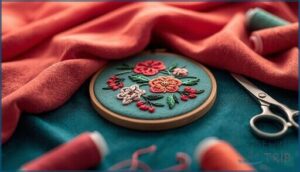
Stretchy fabric is the enemy of clean stitches — and cut-away stabilizers are your fix. Made from 100% polyester non-woven fibers, they grip knits like jersey and fleece without letting go.
Grain direction alignment matters here: orient it perpendicular to the stretch.
| Factor | Cut-Away Guidance |
|---|---|
| Weight-Based Selection | 1.8–2.8 oz for most knits |
| Stitch Density and Stabilizer | Heavy designs need 3.0+ oz |
| Trimming Best Practices | Leave ¼ inch from stitches |
| Fabric and Stabilizer Matching | Knits, fleece, stretch wovens |
For ultra-dense logos, double-stabilizing techniques add extra insurance.
Tear-Away Stabilizers — Ideal for Woven and Structured Fabrics
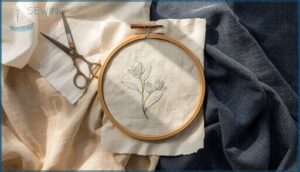
Woven fabrics don’t stretch, so they don’t need permanent backing. Tearaway stabilizer tears clean and leaves nothing behind.
- Soft Tear-Away — use 1.5–2.0 oz for lightweight cotton and voile
- Crisp Tear-Away — choose 2.5–3.0 oz for linen, denim, or towels
- Hooping Tips — cut 1–2 inches beyond your hoop edges
- Removal Techniques — tear inward from edges, one layer at a time
Fabric and stabilizer matching starts here.
Wash-Away (Water-Soluble) Stabilizers for Sheer and Delicate Projects
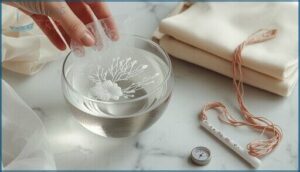
Working on sheer fabrics without leaving a trace — that’s exactly what WashAway Stabilizer does. Made from PVA film, it dissolves completely in lukewarm water, delivering a residue‑free finish every time. Dissolution Temperature matters: keep water below hand‑wash limits to protect delicate threads.
WashAway Stabilizer dissolves completely in lukewarm water, leaving sheer fabrics flawlessly trace-free
| Factor | Detail | Why It Matters |
|---|---|---|
| PVA Film Thickness | Light to medium weight | Matches Fabric Choice for Embroidery |
| Dissolution Temperature | ~20°C or lukewarm | Protects delicate fibers |
| Double‑Layer Support | Stack two sheets | Supports dense designs on sheer fabric |
Use Agitation Techniques — gentle fingertip rubbing — to clear stubborn spots. Smart Embroidery Stabilizer Selection means pairing this with the right Fabric Type for clean, professional results across all Stabilizer Types and Uses.
Adhesive and Iron-on Fusible Stabilizers for Secure Hooping
Adhesive and iron-on fusible stabilizers solve one common problem: fabric that won’t stay put.
Peel‑Stick Benefits kick in fast — just peel, press, and your material floats flat without hoop marks.
Fusible Bond Strength goes deeper, fusing fabric and backing into one layer for precise Hoop Tension Control.
Follow a Fabric Compatibility Guide for Residue‑Free Removal and cleaner machine embroidery every time.
Top 5 Embroidery Stabilizer Products to Consider
Knowing your stabilizer types is one thing — picking the right product off the shelf is another.
There are a lot of options out there, and not all of them are worth your time or money.
Here are five stabilizers that consistently deliver solid results across a range of fabrics and projects.
1. World Weidner Polymesh Plus Stabilizer
If you embroider on light-colored knits, this stabilizer is hard to beat. The World Weidner Polymesh Plus is a 1.5 oz cut-away made from 100% nylon with a diagonal mesh grid.
That grid resists distortion in multiple directions — better than straight-grid backings. It’s translucent, so it won’t shadow through white or pastel fabrics.
Soft after washing, never stiff. Use it on baby tees, performance wear, or jersey.
One layer manages most projects cleanly. Trim the excess and you’re done.
| Best For | Embroiderers who work with light-colored knits like baby tees, jerseys, and performance wear and want a stabilizer that stays invisible and soft after washing. |
|---|---|
| Stabilizer Type | Cut-away |
| Roll Size | 12″ x 10 yards |
| Adhesive | No |
| Fabric Compatibility | Light colored fabrics |
| Washable | Yes |
| Weight | 1.5 oz |
| Additional Features |
|
- Translucent mesh won’t show through white or pastel fabrics — no shadowing, no guesswork
- Soft and flexible after washing, so finished pieces don’t feel stiff or scratchy
- Diagonal grid resists distortion better than straight-grid backings, keeping your design clean
- Can shrink a bit in the wash, so pre-washing before use is a smart move
- Might not cut it for very dense or complex designs that need heavier support
- Requires careful trimming and removal — rush it and you risk pulling the fabric
2. Superpunch Adhesive Peel Stick Embroidery Stabilizer
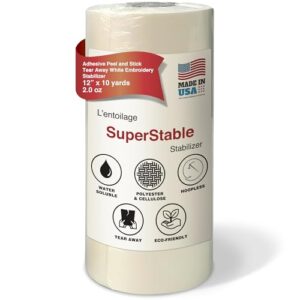
Can’t hoop it? Stick it.
Superpunch Adhesive Peel Stick Stabilizer solves that problem fast. It’s a medium-weight 2.0 oz tear‑away, made in the USA from polyester and cellulose.
Score the paper backing, peel it, press your fabric down, and stitch. No hoop marks, no shifting.
It’s built for small items, seamed garments, and anything clamp‑style setups handle better than a standard hoop. Tears clean after stitching and releases from most fabrics without sticky residue.
Available in a 12‑inch x 10‑yard roll.
| Best For | Embroiderers working on small items, seamed garments, or anything that won’t fit in a standard hoop. |
|---|---|
| Stabilizer Type | Tear-away |
| Roll Size | 12″ x 10 yards |
| Adhesive | Yes, self-adhesive |
| Fabric Compatibility | Knits and stretchy |
| Washable | Yes |
| Weight | 2.0 oz |
| Additional Features |
|
- Peel-and-stick application makes setup quick and keeps fabric from shifting while you stitch
- Tears away cleanly after stitching and releases from most fabrics without leaving sticky residue
- Made in the USA from polyester and cellulose — solid quality for a wide range of fabrics, including knits and stretchy materials
- Not the best choice for heavy designs or thick fabrics that need extra support
- Can leave residue on certain fabrics if you’re not careful when removing it
- Not ideal for projects where zero stabilizer traces are required
3. OESD StabilStick Cutaway Embroidery Stabilizer
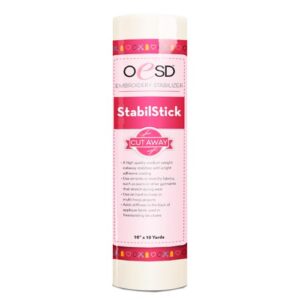
Stretchy fabrics need a different approach — and that’s exactly where OESD StabilStick Cutaway earns its place.
It’s a medium-weight cut-away with a light pressure-sensitive adhesive coating.
Hoop it adhesive-side up, peel the backing, press your fabric down, and stitch.
No slipping, no distortion.
The adhesive holds knits and jersey without tearing fibers.
After stitching, trim the excess and leave the rest — it stays in the garment for lasting support through repeated washes.
Available in 10", 15", and 20" wide rolls at $50.99.
| Best For | Anyone doing machine embroidery on stretchy fabrics like knits and jersey who needs a reliable, no-slip stabilizer that holds up through regular washing. |
|---|---|
| Stabilizer Type | Cut-away |
| Roll Size | 10″ x 10 yards |
| Adhesive | Yes, light adhesive |
| Fabric Compatibility | Stretchy fabrics |
| Washable | Yes |
| Weight | Not specified |
| Additional Features |
|
- The light adhesive makes hooping a breeze — fabric stays put without any slipping or distortion while you stitch
- Knit-friendly design means it won’t stretch or tear delicate fibers during the process
- Stays in the garment after trimming, giving lasting support through repeated washes
- At $50.99, it’s pricier than a lot of other stabilizer options out there
- The roll sizes (10", 15", 20") might feel limiting if you’re working on really large or unusually small projects
- It’s a cut-away, so it’s not the right pick if you need a stabilizer you can completely remove after stitching
4. Sulky Tender Touch Iron On Backing June Berry
Sometimes the problem isn’t support — it’s comfort. That’s where Sulky Tender Touch Iron On Backing June Berry steps in.
It’s a lightweight, permanent cut-away made from soft polyester knit mesh. Iron it onto the back of finished embroidery, and it covers scratchy stitches so nothing irritates bare skin. That makes it a go-to for baby clothes, lingerie, spandex, and sports apparel.
It stretches with the fabric, washes without peeling, and won’t stiffen your garment. Available in an 8" × 9-yard roll.
| Best For | Parents, athletes, and crafters who need soft, stretchy backing for embroidery on baby clothes, lingerie, spandex, or sports apparel. |
|---|---|
| Stabilizer Type | Iron-on permanent |
| Roll Size | 252″ x 8″ |
| Adhesive | Yes, iron-on |
| Fabric Compatibility | Spandex and knits |
| Washable | Yes |
| Weight | 3.52 oz total |
| Additional Features |
|
- Covers scratchy stitches so the fabric feels comfortable against bare skin
- Stretches with the garment and holds up through multiple washes
- Easy to apply with just an iron — no sewing needed
- You have to be careful to iron the right side down, or it won’t adhere properly
- Edges can be tricky to get fully flat on some materials
- May not bond well with every fabric type, so test a small area first
5. HeatnBond Lite Iron On Adhesive

HeatnBond Lite takes a different angle — it’s not about covering stitches or supporting fabric during the stitch-out. It’s about bonding applique pieces before you even thread the needle.
Iron it onto your fabric, cut your shape, peel the liner, and press it down. No pins, no shifting. It won’t gum up your needle or add bulk. At 17 inches wide by 5.25 yards, it manages most projects easily. Perfect for quilts, monogramming, and lightweight applique work.
| Best For | Quilters, monogrammers, and applique enthusiasts who want clean, shift-free results without the hassle of pinning or basting. |
|---|---|
| Stabilizer Type | Iron-on adhesive |
| Roll Size | 17″ x 5.25 yards |
| Adhesive | Yes, double-sided |
| Fabric Compatibility | Quilts and apparel |
| Washable | Yes |
| Weight | 6.6 oz total |
| Additional Features |
|
- Holds fabric pieces firmly in place before sewing — no pins, no slipping
- Won’t gum up your needle or add stiffness to lightweight projects
- Generously sized at 17" x 5.25 yards, so it handles most quilts and wall hangings with ease
- Can dry out if you iron it on and wait too long before stitching
- Best to secure the edges within a day of application or the bond may weaken
- Results depend on your ironing technique — too little heat and it won’t stick properly
How to Choose and Apply The Right Stabilizer
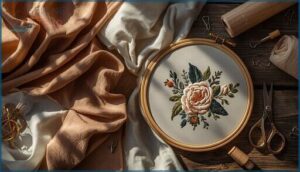
Picking the wrong stabilizer is one of the fastest ways to ruin a good design.
The right choice comes down to your fabric, your stitch count, and how you apply it.
Here’s what you need to know to get it right every time.
Matching Stabilizer Type to Fabric — Knit, Woven, Stretch, and Sheer
Your fabric type drives every stabilizer selection decision.
Knit fabric needs a Knit Cut‑Away — it stays put after washing and keeps designs from warping.
Woven fabrics pair with Woven Tear‑Away, which removes cleanly without residue.
For Stretch Mesh and athletic cuts, use fusible no-show mesh aligned against the fabric grain.
Sheer Wash‑Away manages delicate projects — it dissolves completely, leaving nothing behind.
Selecting Stabilizer Weight Based on Design Density and Stitch Count
Design density drives stabilizer weight selection. Light designs under 10,000 stitches need just 1.5–2.0 oz backing. Medium stitch counts between 10,000–20,000 call for 2.0–2.5 oz. Heavy designs above 20,000 demand 2.5 oz or more.
When a single layer still lets fabric tunnel, layering techniques fix that. Always run a test sew first — it’s your stabilizer selection guide before committing to the final piece.
Proper Hooping and Alignment Techniques for Best Results
Hooping right starts before the needle moves. Cut your stabilizer 1–2 inches beyond the hoop edge, then align the fabric grain perpendicular to the hoop frame — that’s your tension insurance.
Mark center crosshairs on both layers for accurate stabilizer placement.
Tighten like tuning a drum: alternate at 12, 6, 3, and 9 o’clock.
Tap the hooped surface — a crisp sound confirms proper hoop tension.
How to Remove, Tear, or Dissolve Stabilizer After Embroidery
Removing stabilizer cleanly is the final step between good and great.
For tear-away technique, trim excess first, then tear from the edges inward while holding the fabric firm.
Cut-away trimming means leaving 1/4 inch around stitches — no closer.
Water-soluble dissolution needs repeated rinses until the water runs clear.
For adhesive residue cleanup and leftover bits handling, a warm iron, tweezers, or dish soap finishes the job.
Frequently Asked Questions (FAQs)
What can be used in place of a stabilizer?
In a pinch, muslin backing, organdy lace, coffee filter paper, fusible interfacing, or spray starch prep can step in.
Each works differently, so match your substitute to your fabric and design.
Can I use parchment paper as a stabilizer in embroidery?
You can, but you shouldn’t. Parchment tears under dense stitching, causes thread slip, and won’t remove cleanly. For reliable results, always use a proper embroidery stabilizer matched to your fabric.
How do you store stabilizers to prevent degradation?
Store stabilizers cool, dry, and sealed. High humidity ruins water-soluble types fast. Keep them out of sunlight. Label by purchase date. Good storage doubles shelf life and protects your investment.
Can stabilizers be layered for extra-dense embroidery designs?
Yes, you can layer stabilizers for extra-dense designs. Stack a cutaway stabilizer with a floated tearaway underneath for designs exceeding 20,000 stitches. Always test on scraps first to avoid stiffness.
What stabilizer alternatives exist for allergic or sensitive users?
Sensitive skin doesn’t mean you’re out of options.
Plant-based stabilizers, PVA film options, organic cotton backing, and even a coffee filter substitute all work. Sulky vegan mesh is another solid pick.
How does stabilizer weight affect final embroidery texture?
Think of stabilizer weight as the backbone of your design. Get it wrong, and puckering wins. Heavier weights lock in stitch definition; lighter ones preserve drape softness and hand feel.
Can stabilizers be reused after embroidery projects?
It depends on the type.
Cut-away scrap reuse works well for future layering. Tear-away patching stitches scraps into new sheets. Wash-away recycling fuses with heat. Fusible adhesive limits reuse to one project only.
How do stabilizers affect embroidery machine needle selection?
stabilizer choice drives your needle choice.
Cutaway’s density suits a 75/11 sharp for high stitch counts.
Tear-away demands the same — embroidery needles rip it. needle size to stabilizer density every time.
What stabilizer works best for leather or vinyl?
For leather, use a cutaway stabilizer. For vinyl, adhesive stabilizer holds without hoop marks. Add a water-soluble topping over textured surfaces. Float delicate pieces instead of hooping directly.
Do stabilizers expire or degrade over time?
They don’t stamp an expiration date on the package, but yes—stabilizers do age.
Shelf Life Indicators: Humidity Effects, UV Degradation, and Adhesive Decay are your real Shelf Life Indicators.
Store smart, and they’ll last years.
Conclusion
Even the best carpenters blame their tools—until they learn the craft. Embroidery is no different.
Once you understand embroidery stabilizer materials, you stop guessing and start controlling outcomes.
Knits get cut-away. Wovens get tear-away. Sheers get wash-away.
The fabric tells you what it needs, and now you speak that language.
Choose the right stabilizer, hoop it clean, and your stitches land exactly where you put them.
That’s not luck. That’s skill.
- https://allstitch.com/blogs/embroidery-blogs/embroidery-stabilizer-guide-to-choosing-the-right-backings
- https://www.bernina.com/en-US/Learn-Create-US/Embroidery-Tips-Tricks/Choosing-the-right-stabilizer
- https://embroiderylegacy.com/how-to-use-machine-embroidery-stabilizer/
- https://www.toughkittencrafts.com/stabilizer-breakdown-categories-weights-and-types/
- https://blog.sulky.com/stabilizer-basics-water-solubles-heat-away/