This site is supported by our readers. We may earn a commission, at no cost to you, if you purchase through links.
A cover that’s half an inch too tight won’t slide over your machine’s handwheel. One that’s too loose pools on your table like a deflated tent. Both get tossed in a drawer, and your machine sits exposed to dust anyway.
The fix isn’t a better cover—it’s better measurements taken before you cut a single piece of fabric. Width, height, depth, seam allowance, drape ease—each number builds on the last, and skipping one throws off the whole fit.
Get these right once, and your cover will slip on and off cleanly every time.
Table Of Contents
Key Takeaways
- Always measure width, height, and depth before cutting — one skipped number throws off the entire fit.
- Raw measurements aren’t enough; seam allowance, drape ease, and hem allowance all need to be built in before you cut a single piece of fabric.
- Lower the thread stand and remove detachable accessories first — your cover needs to fit the machine as you actually store it, not how it looks mid‑project.
- A quick fit check after sewing saves real headaches — every side should land within ±5mm of your recorded measurements before you call it done.
Measure Your Sewing Machine Correctly
Before you cut a single piece of fabric, you need five measurements from your machine. Get these right, and everything else falls into place. Here’s exactly where to measure.
If you’re making a bag to hold everything, this DIY lunch bag pattern is a great first project to practice getting those measurements spot on.
Lower The Thread Stand
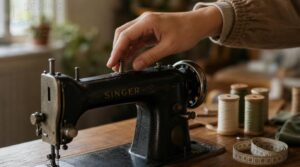
Before you do anything else, lower the thread stand fully. This single step is easy to skip — but it changes your height measurement noticeably.
The stand sits on vertical pins and can extend 6 to 15 inches above the machine body.
Push it all the way down first. That’s your true machine height, and your cover needs to reflect it.
Measure Width Including Handwheel
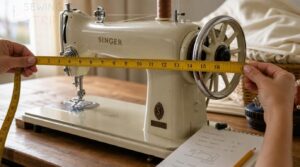
With the thread stand sorted, grab your flexible tape measure. Now it’s time to capture your full machine width.
- Measure from the outermost left edge to the outermost right edge
- Include protruding spokes or rims on the handwheel
- Run the tape in a straight, parallel line
- Take three separate readings and record the largest
- Add 1 inch seam allowance to your final number
Measure Height to Top
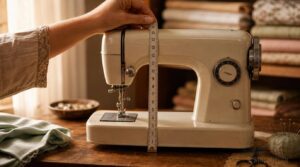
Now that width is locked in, height is next. Measure from the table up to the highest point of the machine housing — not the needle, not the presser foot.
Remove detachable accessories first. Keep the presser foot down. That bare measurement is your baseline.
Leave at least 1 cm of top clearance in your cover so air can circulate freely.
Measure Depth Front to Back
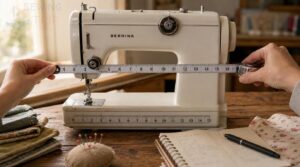
Depth is the measurement from the front face of the machine straight back to the rearmost surface.
Use a rigid metal tape — not a flexible one — to avoid sagging on flat profiles. Measure at both the top and bottom edges. If the readings differ, use the larger one. That’s your true depth for taking accurate measurements.
Remember that width and depth describe the remaining horizontal dimensions of a three‑dimensional figure.
Record Every Measurement Clearly
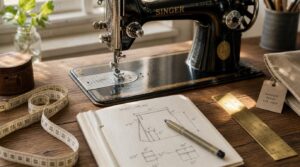
Once you measure your sewing machine, write everything down immediately — memory fails fast.
Use a Label Measurement Sheet with clearly named fields:
- Width (including handwheel), height, and depth on separate labeled lines
- Consistent Units Notation beside every number (inches or mm, never mixed)
- A Tolerance Notation Guide — note ±2mm to catch small errors later
That’s your measurement guide done right.
Add Allowances for Cover Fit
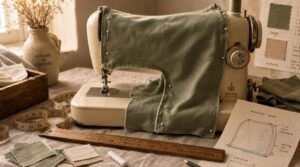
Raw measurements are just the starting point. Before you cut a single piece of fabric, you need to build in a little extra room — for seams, for drape, and for the real shape of your machine. Here’s exactly how to add those allowances so your cover fits right the first time.
A well-maintained machine — one you’ve already threaded and prepped with a mini sewing machine guide — will handle those extra allowances far more cleanly than one running on a dull needle.
Add Seam Allowance
Seam allowance is the hidden buffer that keeps your cover from fitting like a second skin. For the front panel dimension, take your raw measurement and add 5 to this measurement — so 39 inches becomes 44 inches.
For width, add 1 inch. This fabric measurement technique prevents tight, puckered seams and gives you clean, sturdy edges every time.
Add Ease for Drape
Seam allowance manages fit — but ease manages feel. Drape ease adds 5 to 15 percent extra fabric so your cover hangs smoothly instead of pulling tight across the corners.
Ease isn’t about fit — it’s about feel, adding just enough fabric so your cover drapes instead of pulls
- Light cotton needs around 5–8 percent
- Medium-weight canvas benefits from 8–12 percent
- Heavy fabric may need the full 15 percent
Always test with a mockup cover first to confirm even drape on all sides.
Plan Hem Allowance
The hem is your cover’s foundation — get it wrong and the whole thing rides up or bunches at the bottom. Hem allowance is the extra fabric you fold under to create a clean, finished edge.
For light fabrics, plan ½ inch. Medium-weight fabric works best with ¾ inch.
Always mark and test your hem depth on a mockup first.
Adjust for Bulky Machines
Bulky machines need breathing room. If your cover fits like shrink wrap, it’ll snag, stretch, and wear out fast.
- Increase side width by 4–6 cm to clear the handwheel and body.
- Add side seam allowance of 1–2 cm extra for thick fabric bulk.
- Use stretch fabric with 4–6 percent give for easier fitting.
- Reinforce bulky seams with double stitching to prevent tearing.
- Plan rear clearance of 4–8 cm for cord and plug access.
Check Final Cover Size
Done sewing? Don’t skip this last check — it takes two minutes and saves real headaches.
Lay your cover over the machine and run a quick Fit Tolerance Check: every side should sit within ±5 mm of your recorded measurements. Do a Dimension Comparison on all four sides, then confirm Alignment Verification — seams should line up cleanly. Note any shifts for next time.
Top 5 Measuring and Sewing Tools
Having the right tools makes a real difference when you’re measuring and sewing a custom machine cover. A few key items will save you time, cut down on mistakes, and help everything come together cleanly. Here are five worth keeping at your workstation.
1. Fiveizero Complete Sewing Kit
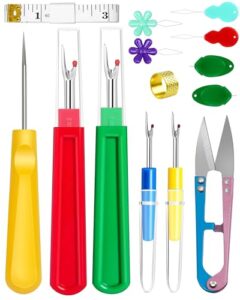
The Fiveizero Complete Sewing Kit is a solid starting point if you’re new to making machine covers. For just $6.99, you get two large seam rippers, two small ones, six needle threaders, a sewing awl, a flexible tape measure, a thimble, and scissors — all in one case.
That tape measure alone earns its keep. You’ll use it constantly when measuring your machine’s width, height, and depth before cutting a single piece of fabric.
| Best For | Beginners and casual sewers who want a complete starter kit without spending much. |
|---|---|
| Price | $6.99 |
| Material | Plastic and steel |
| Compatibility | Universal hand sewing |
| Installation | No setup required |
| Skill Level | Beginner to advanced |
| Primary Use | General sewing tasks |
| Additional Features |
|
- Great value at $6.99 — you get everything in one case instead of buying tools separately.
- Two sizes of seam rippers means you’re covered for delicate fabrics and heavy-duty stuff like denim.
- The tape measure, awl, thimble, and scissors make it a genuinely complete kit for basic projects.
- Plastic construction won’t hold up to heavy, repeated use as well as metal tools would.
- The needle threaders have large eye openings, which can make working with tight or layered fabric frustrating.
- The thimble’s small ring tends to slip, so it may need adjusting often or swapping out altogether.
2. Ckpsms Seam Guide Gauge NG2000R
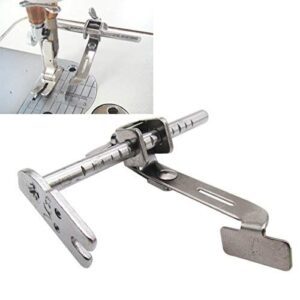
Once your tape measure has done its job, you need something that keeps your seams straight while you sew. That’s where the CKPSMS NG-2000R earns its spot.
It clamps onto your presser-foot bar with a single bracket — no tools needed. The left-right adjustable guide lets you dial in your exact seam width every time. At $6.99 and just over an ounce, it’s a small investment that takes the guesswork out of consistent stitching.
| Best For | Sewers and quilters who want an easy, affordable way to keep their seam lines consistent without marking up their fabric every time. |
|---|---|
| Price | $6.99 |
| Material | Metal and plastic |
| Compatibility | Singer, Brother, Juki |
| Installation | Screw-mount bracket |
| Skill Level | Beginner to advanced |
| Primary Use | Straight seam guidance |
| Additional Features |
|
- Clips onto the presser-foot bar in seconds — no tools, no fuss
- Left-right adjustable guide makes it easy to dial in any seam width
- At $6.99, it’s basically a no-brainer addition to your sewing kit
- Screw sizing can be hit or miss depending on your machine’s bar design
- Fitting it on some models might take a bit of trial and error
- No assembly instructions included, so setup can feel like a guessing game
3. Willbond Universal Sewing Machine Needles
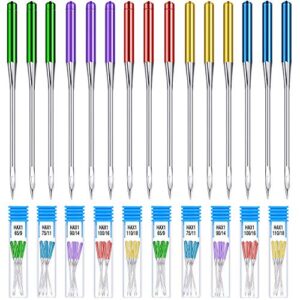
Straight stitches are only as good as the needle behind them. The Willbond 30-needle pack covers five sizes — 9, 11, 14, 16, and 18 — so you’re ready for anything from delicate silk lining to thick canvas outer fabric.
Each size sits in its own labeled tub, color-coded for fast grabbing. At $8.99 for 30 needles, the cost per needle is minimal.
The flat shank fits most home machines, including Singer and Brother.
| Best For | Home sewers who work with a variety of fabrics and want one needle pack that handles everything without constant restocking. |
|---|---|
| Price | $8.99 |
| Material | Iron with titanium |
| Compatibility | Singer, Brother, generic |
| Installation | Drop-in flat shank |
| Skill Level | Beginner to advanced |
| Primary Use | Fabric-matched stitching |
| Additional Features |
|
- Five sizes in one pack means you’re covered from lightweight silk all the way up to denim or canvas
- Color-coded tubs make it easy to grab the right needle fast, especially handy when you’re mid-project
- At $8.99 for 30 needles, the per-needle cost is low enough that you won’t stress about replacing them often
- Some users report occasional bending or breakage under heavier fabrics, so durability isn’t top-tier
- The titanium coating can wear down over time, which may be an issue if you sew in a humid space
- Not suitable for industrial or high-speed machines — strictly for standard home use
4. TOOVREN Needle Threader for Sewing
Once your needles are sorted, threading them shouldn’t slow you down.
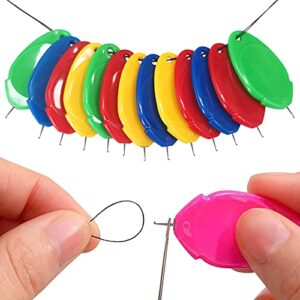
The TOOVREN Needle Threader comes in a pack of 12, stored in a clear plastic box, so you’ll always have a backup ready.
Each threader has a thin steel wire hook that slips through the needle eye and pulls the thread with it.
It works with hand and machine needles alike — genuinely helpful if your eyesight or hands make fine threading frustrating.
| Best For | Sewers, embroiderers, and crafters — especially seniors or anyone with shaky hands or tired eyes who wants threading to feel less like a chore. |
|---|---|
| Price | Not listed |
| Material | Plastic and steel |
| Compatibility | All needle types |
| Installation | No setup required |
| Skill Level | Beginner to advanced |
| Primary Use | Needle threading aid |
| Additional Features |
|
- Comes in a pack of 12, so losing or breaking one isn’t a big deal
- Works with hand needles, machine needles, and everything in between
- Small and light enough to hang on a wall or toss in a sewing kit
- The steel hook is delicate — some users have had it bend or snap after just a few uses
- If your vision isn’t great, lining up that tiny hook with a needle eye can still be tricky
- Struggles with very fine needles (like size 28), so it’s not a guaranteed fix for every project
5. Brewfire Magnetic Sewing Seam Guide
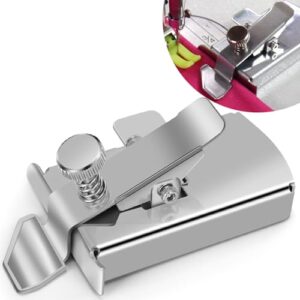
Getting a precise seam allowance every time starts with the right guide.
The Brewfire Magnetic Seam Guide attaches directly to your machine’s metal needle plate — no tools, no fuss. Strong neodymium magnets hold it firm even through thick denim or canvas layers. You can reposition it in seconds to switch seam widths mid-project.
It’s 2.99 × 1.30 in, lightweight, and won’t throw off your machine’s balance. Just place it, sew, and stay consistent.
| Best For | Quilters and sewers — beginner or experienced — who want consistent seam allowances without constant measuring. |
|---|---|
| Price | Not listed |
| Material | Stainless steel |
| Compatibility | Metal throat plate machines |
| Installation | Magnetic, no tools |
| Skill Level | Beginner to advanced |
| Primary Use | Seam width control |
| Additional Features |
|
- Strong neodymium magnets keep it locked in place, even through thick or heavy fabrics
- No tools needed — just set it, move it, and reposition it whenever you need a different seam width
- Works across most machines and doubles as an edge guide and anti-curl helper
- Won’t work on plastic throat plates unless you add a separate adhesive metal plate
- Sliding it across the plate instead of placing it down can leave minor scratches
- Tight curves are tricky — it’s really built for straight seams
Choose Your Cover Measurement Method
Not every cover is built the same way, and that’s actually a good thing. Your machine’s shape, your skill level, and what you want the cover to do all point you toward a specific method. Here are the main approaches to help you figure out which one fits your project.
Simple Box-style Cover
The box-style cover is the most beginner-friendly method — think of it as building a simple open-bottom box that slips right over your machine. You’re working with rectangular panels only: a front, back, two sides, and a top. No curves, no complex shaping.
Measure your machine’s width (including the handwheel), height, and depth. Add ½ inch ease on each side for dust clearance and comfortable removal. Cotton or canvas works best here — it holds its shape and protects against everyday dust without collapsing. Cut your panels, square your corners carefully when sewing, and finish the bottom edge with a clean turned hem. Simple. Solid. Done.
Contoured Template Cover
Unlike the box method, the contoured template cover follows your machine’s actual shape — curves, edges, and all.
- Trace the side profile directly onto cardboard
- Offset by 1 inch for seam allowance and ease integration
- Use cotton or linen as your template material
- Do a test cut on scrap before cutting real fabric
- Check smooth contact by laying the template on the machine
Wrap-around Cover Sizing
A wrap-around cover is basically one long piece that hugs the machine from front to back. Start by measuring front depth — from the front edge over the top to the back.
Add 5 inches for ease and seam extras. Then capture your width inclusion with the handwheel.
Do a final check by draping a tape measure over the machine before cutting.
Pocket and Handle Placement
Pockets and handholds aren’t just nice extras — they make your cover actually functional. Place pockets 1.5 to 2.5 inches from the sewing line on the front panel. Keep handholds at the rear top edge, spaced at least 3 inches from any pocket.
Three things to check before cutting:
- Pocket depth lets you reach controls without snagging
- Handholds clear the needle bar area completely
- Reinforced stitching holds both features through daily use
Common Measuring Mistakes
Small mistakes here can make or break your cover’s fit.
Skipping ease is the most common — measure the machine only, forget to add 1 inch for drape, and the cover won’t slide on. Always convert everything to one unit before calculating.
Misaligned reference points and parallax error can quietly steal up to 0.2 mm per measurement. Double-check every number before you cut.
Frequently Asked Questions (FAQs)
Which singer is best for heavy fabrics?
If you’re sewing heavy fabrics, the Singer Heavy Duty models — like the 4423, 4432, and 4452 — are your best bet. They feature an all-metal frame, powerful motor, and handle denim, leather, and canvas with ease.
What is a 3/4 size sewing machine?
A 3/4 size sewing machine is like a full-size machine’s well-traveled sibling — compact, portable, and surprisingly capable. It’s smaller than standard but bigger than a featherweight, with vintage compact design and standard accessories.
What fabric works best for sewing machine covers?
Cotton and linen are your best options. Cotton breathes and blocks dust well. Linen holds shape naturally. For outer fabric, try medium-weight cotton or canvas. Add a lightweight lining to protect the machine’s surface.
Can I use a serger instead of a sewing machine?
A serger can’t fully replace a sewing machine. It’s great for finishing edges fast, but it won’t sew buttonholes, install zippers, or topstitch. For best results, use both tools together.
How do I add a decorative appliqué to my cover?
Pick a contrasting fabric, fuse interfacing behind it, and pin it centered on your cover’s front face. Satin stitch around the edges. Press from underneath. Done.
Should I line my cover to protect the machine?
Yes, line your cover. A soft lining fabric shields your machine from dust, moisture, and scratches. It also protects internal parts from humidity. A small extra step that adds serious longevity benefits.
How do I secure the cover so it stays on?
Use elastic corner bands to grip the base, non-slip pads underneath, or Velcro strips along the back. Adjustable straps cinch the sides snugly. Magnetic tabs work quietly inside.
Conclusion
Like a tailor fitting a custom suit, precision is everything—and now you have it. You know how to measure your sewing machine for a cover that actually fits: width, height, depth, seam allowance, ease, hem.
Every number you recorded is a decision already made. No guesswork. Loose fabric pooling around the base.
Just a clean cover that slides on smoothly and keeps your machine protected, ready for the next time you sit down to sew.
- https://www.applegreencottage.com/sewing-machine-cover-pattern
- https://www.brother-usa.com/blogs/stitching-sewcial/diy-machine-cover
- https://www.sewingtothemoon.com/blog/diy-easy-sewing-machine-cover
- https://www.loulouandbetty.com/blog/make-a-sewing-machine-cover
- https://www.threadsmagazine.com/2016/02/11/make-a-sewing-machine-cover