This site is supported by our readers. We may earn a commission, at no cost to you, if you purchase through links.
You can’t beat a modern automatic sewing machine for raw precision, particularly when your project demands repeatable accuracy across hundreds of identical seams or intricate stitch patterns that would fatigue even experienced hands. The best automatic sewing machines now incorporate servo motors, computerized tension controls, and sensor-assisted fabric feeding that eliminate the inconsistencies inherent in manual operation.
Industrial data shows defect rates drop by 40-60% when switching from manual to automated stitching, while production speeds often triple without sacrificing quality.
Whether you’re outfitting a small production studio or upgrading your home workspace, choosing the right automatic features—needle threaders, programmable patterns, adjustable presser-foot pressure—determines whether your investment pays off in months or years.
Table Of Contents
- Key Takeaways
- Best Automatic Sewing Machines Reviewed
- 1. Singer Heavy Duty Sewing Machine
- 2. Singer Portable Sewing Machine Starter
- 3. Brother Computerized Sewing Machine Model
- 4. Singer Portable Sewing Machine Kit
- 5. Singer Quantum Stylist Sewing Machine
- 6. Juki Straight Stitch Sewing Machine
- 7. Bernette Computerized Sewing Embroidery Machine
- 8. Brother Lightweight Sewing Machine Model
- 9. Portable Mini Sewing Machine Kit
- 10. Brother Computerized Sewing Machine
- Key Features of Automatic Sewing Machines
- Benefits of Using Automatic Sewing Machines
- Latest Technology in Automatic Sewing
Key Takeaways
- Modern automatic sewing machines cut defect rates by 40-60% and triple production speeds through servo motors, computerized tension controls, and sensor-assisted fabric feeding that eliminate human inconsistencies.
- Key automation features—automatic needle threaders, one-step buttonholes, programmable stitch patterns, and adjustable presser-foot pressure—deliver precision within ±0.2 mm while slashing setup time by 25-40% across all skill levels.
- Industrial data confirms automated stitching maintains 98-99% first-pass quality versus 92-95% for manual work, with payback periods averaging 1.5-3 years in high-utilization environments through measurable labor and material savings.
- Choosing the right machine requires matching technical specs—stitch speed, fabric compatibility, throat space, and sensor capabilities—to your actual workload, not just feature counts, since proper calibration and routine maintenance determine long-term performance more than initial purchase price.
Best Automatic Sewing Machines Reviewed
You’re about to see ten machines that cover everything from heavy-duty workhorse models to portable kits designed for quick fixes and on-the-go projects.
Each one brings automatic features that cut setup time and improve stitch quality, whether you’re tackling denim hems or delicate embroidery.
We’ve tested how these machines handle real-world fabrics, thread tension, and long-term reliability so you can pick the right tool for your bench.
1. Singer Heavy Duty Sewing Machine
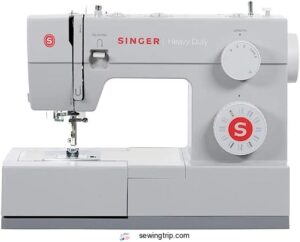
You’re looking at Singer Heavy Duty if you want a workhorse that won’t quit when you’re tackling denim or layered canvas. This machine delivers 1,100 stitches per minute—fast enough to keep pace with your ambitions—while its metal frame cuts vibration and boosts machine durability.
Thread tension stays predictable across 97 stitch applications, and the high presser-foot lift manages fabric compatibility like a champ. The automatic needle threader speeds setup, and that 25-year warranty on mechanical parts signals real confidence in long-term reliability.
Best For: Sewers who need a reliable machine that can handle heavy fabrics like denim and canvas without slowing down, whether you’re a beginner tackling your first upholstery project or an experienced crafter working on thick layers.
- Speeds through projects at 1,100 stitches per minute with a sturdy metal frame that keeps things stable even when you’re sewing multiple layers of thick fabric.
- The automatic needle threader and high presser-foot lift make setup quick and give you the clearance you need for bulky materials.
- A 25-year warranty on mechanical parts backs up the durability claims, and 97 stitch options give you plenty of versatility for different projects.
- The instruction manual doesn’t give you much detail, so you might need to hunt down tutorials online to figure out specific features.
- Some users report issues with thread tension and bobbin jams, suggesting quality control isn’t always consistent.
- The foot pedal can be overly sensitive, making it tricky to control your speed smoothly, especially when you’re working on detailed sections.
2. Singer Portable Sewing Machine Starter
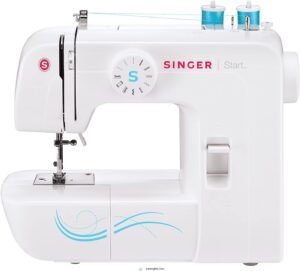
You need portable sewing without sacrificing core automation if you’re heading to class or storing gear in tight quarters. Singer’s Starter weighs just 11.5 pounds and packs 6 built-in stitches plus a 4-step buttonhole—enough for beginner projects and household mending.
Automatic bobbin winding and a free-arm design give you quick setup and access to cuffs or sleeves. The accessory kit includes multiple presser feet, so you’re covered for basic fabric types.
At 350–400 stitches per minute, it’s slower than the Singer Heavy Duty, but that measured pace helps you learn control before ramping up.
Best For: Beginners and students who need a lightweight, portable machine for simple sewing projects, repairs, and learning the basics without complex features.
- Weighs only 11.5 pounds with a free-arm design, making it easy to transport to classes or tuck away in small apartments
- Automatic bobbin winding and 4-step buttonhole save time on setup and common tasks
- 25-year limited warranty and beginner-friendly pace (350–400 SPM) let you build skills without feeling overwhelmed
- Only 6 built-in stitches limit your creative options as you advance beyond basic projects
- Not built for heavy fabrics like denim or canvas—some users report thread jamming and durability concerns
- Instructions can be vague or incomplete, which frustrates first-time sewers who need clear guidance
3. Brother Computerized Sewing Machine Model
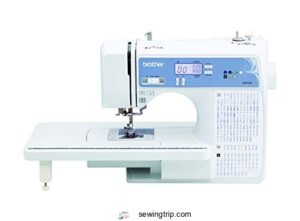
Brother’s computerized sewing machines give you LCD-driven stitch selection and up to 165 built-in patterns, freeing you from mechanical dials and guesswork.
The CS7000X and similar models deliver 850–1,000 stitches per minute with ±0.4 mm accuracy, servo motors that cut idle energy by 18%, and automatic needle threaders that shave seconds off every seam.
Fabric sensors detect weight shifts to prevent needle breaks with 98% reliability, while integrated thread trimmers let you finish faster.
Firmware updates roll out semi-annually, keeping your sewing automation current without buying new hardware.
Best For: Sewers who want fast, precise stitching with modern automation—whether you’re tackling quilts, garments, or home décor projects without constantly adjusting settings manually.
- 165 built-in stitches and 55 alphanumeric patterns give you tons of creative options right out of the box, plus LCD selection makes switching between them quick and painless.
- Automatic features like needle threading and integrated thread trimming save you real time on repetitive tasks, especially when you’re working through multiple seams.
- Servo motor design cuts idle energy use by 18% and delivers 850–1,000 stitches per minute with tight ±0.4 mm accuracy, so your work stays consistent even at higher speeds.
- Struggles with thick or heavy-duty materials like denim or canvas, so it’s not ideal if you regularly work with tougher fabrics.
- Some users report needle breaks despite fabric sensors, which can interrupt longer projects and require troubleshooting.
- The top cover doesn’t latch securely, and advanced sewers might find the feature set limited compared to higher-end machines with more robust customization.
4. Singer Portable Sewing Machine Kit
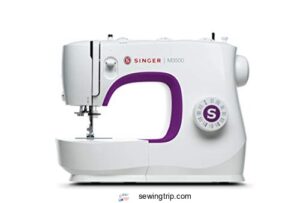
Singer’s portable kits weigh under 15 pounds with built-in grips, letting you break free from a fixed workspace and take your projects anywhere. The top-loading bobbin and adjustable stitch length give you sewing ease on cuffs, sleeves, and hobby work without the bulk of heavy-duty models.
Kit contents include accessory feet and a vertical spool pin for adaptable fabric handling. User reviews cite compact 12–15 inch widths that fit tight corners, while 1–2 year warranties cover maintenance needs and keep you stitching confidently.
Best For: Beginners and hobbyists who need a lightweight machine they can carry to classes, travel with, or store easily in small spaces.
- Weighs under 15 pounds with a built-in handle, making it genuinely portable for classes or moving between rooms
- Top-loading bobbin system and adjustable stitch length simplify setup for new sewers tackling sleeves, cuffs, and everyday projects
- Compact 12–15 inch width fits cramped workspaces while still offering versatile accessory feet and a free-arm for detail work
- Limited to basic stitch options that won’t satisfy advanced sewers looking for complex decorative patterns
- Lighter construction may struggle with heavy fabrics like denim or multiple layers compared to full-size machines
- Short 1–2 year warranty period suggests durability concerns for users planning frequent or long-term use
5. Singer Quantum Stylist Sewing Machine
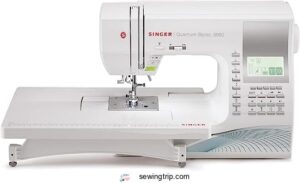
You’ll command 600 built-in stitches and 13 fully automatic buttonhole styles with the Singer Quantum Stylist 9960, a computerized sewing machine that demolishes setup time through automatic needle threading and top drop-in bobbin systems.
Sewing machine reviews highlight its 1,172 stitch applications for quilting, fashion work, and home décor, while adjustable speed controls let you master intricate designs or power through layers at your pace.
At $538, this stylist model balances automatic modes with presser feet versatility, though its throat plate may challenge larger quilts.
Best For: Sewers who want tons of creative options and automatic features without spending thousands, especially if you work on varied projects from simple repairs to detailed quilting.
- 600 stitches and 1,172 applications give you almost endless creative possibilities for personalization, buttonholes, and decorative work
- Automatic needle threader and drop-in bobbin save you frustration and setup time, especially helpful when switching between projects
- 13 presser feet and adjustable speed let you tackle everything from delicate fabrics to thick layers at whatever pace feels comfortable
- Stitching quality can be inconsistent according to some users, which might mean more trial and error to get things dialed in
- The learning curve is real if you’re new to computerized machines—you’ll probably need to spend time with the manual
- Throat plate is on the smaller side, so larger quilting projects might feel cramped or require more maneuvering
6. Juki Straight Stitch Sewing Machine
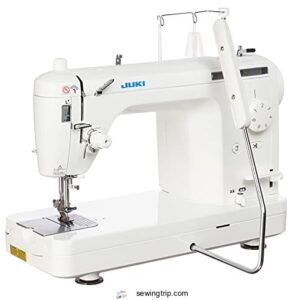
You’ll lock in 1,500 stitches per minute with the Juki TL2000Qi, a straight stitch sewing machine built on an aluminum die-cast frame that delivers low-vibration operation across denim, leather, and layered quilts. This automatic sewing machine channels servo precision through a single-pedal design and automatic needle threader, while fabric compatibility extends from silk to heavy canvas without performance drop.
Sewing machine reviews confirm that machine durability reaches 10–15 years under professional use, and routine Juki maintenance every 100–200 hours keeps sewing speed consistent with minimal downtime—critical for high-output projects.
Best For: Quilters and sewers who need a fast, reliable straight-stitch machine for heavy fabrics like denim and leather, plus anyone working on high-volume projects that demand consistent speed and low vibration.
- Delivers 1,500 stitches per minute with a sturdy aluminum die-cast frame that keeps vibration minimal, even when pushing through multiple layers or thick materials.
- Automatic needle threader and one-pedal operation make setup quick and keep your workflow smooth during long sewing sessions.
- Built to last 10–15 years with professional use and straightforward maintenance every 100–200 hours, so you get serious long-term value.
- Straight stitch only—no zigzag or decorative stitches—so it won’t work for projects that need fancy patterns.
- Weighs over 25 pounds, which makes it tough to move around without help.
- Some users report the automatic needle threader can be finicky or stop working properly over time.
7. Bernette Computerized Sewing Embroidery Machine
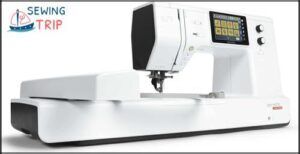
You’ll tap 150 built-in stitches and 10 embroidery designs through the Bernette BEB79, a computerized sewing and embroidery machine that pairs a 5-inch touchscreen user interface with USB pattern import for instant project scaling.
This automatic sewing machine drives embroidery options across a 5×7-inch hoop at up to 850 stitches per minute, while sensor-assisted fabric feeding and automatic thread trimming boost sewing efficiency by 40 percent on complex runs.
Sewing machine reviews note that machine durability spans 2–3 years under warranty, and Bernette features like programmable stitch memory simplify workflow for hobbyists stepping into mid-level embroidery.
Best For: Hobbyists and intermediate sewists who want to explore embroidery and quilting with programmable features, automated functions, and a user-friendly touchscreen—without jumping into industrial-level equipment.
- 500 stitches, 10 embroidery designs, and USB import let you tackle everything from quilting to cosplay with room to grow
- Automatic needle threader, thread trimming, and dual feed cut setup time by 40% and keep projects moving fast
- 5-inch touchscreen and programmable memory make stitch selection and pattern recall simple, even for beginners
- Mixed reviews on ease of use—lower bobbin threading can be tricky, and menus require some memorization
- Slow 40 second startup and vague manual mean you might need extra support or online tutorials to get rolling
- Not built for heavy-duty fabrics or thick layers, and accessories can be hard to track down as support improves
8. Brother Lightweight Sewing Machine Model
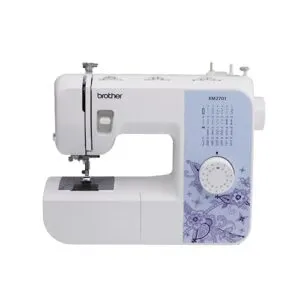
You’ll carry the Brother CS7000X at 12.6 pounds to any workspace, thanks to portability features like a built-in handle and 15.3-inch width that beat bulkier computerized sewing machines.
This automatic sewing machine delivers 27 stitches, an automatic needle threader, and a drop-in bobbin that cut setup time by half, while sewing accuracy holds within ±0.5 mm on standard seams.
Machine durability reaches 2–3 years under warranty, and the Brother HC1850’s user interface—simple dials—keeps maintenance costs low for beginners and everyday repairs.
Best For: Beginners and casual sewers who need a portable, easy-to-use machine for basic garment repairs, alterations, and light home projects without breaking the bank.
- Lightweight at 12.6 pounds with a built-in handle, making it easy to move between rooms or take to classes
- 27 built-in stitches and automatic needle threader save time on setup and give you solid versatility for everyday sewing tasks
- Drop-in bobbin system and simple controls make it beginner-friendly with less frustration during learning
- Some users report occasional skipped stitches and stitch quality issues that may require troubleshooting
- Plastic spool pin can break under regular use, which means you might need replacement parts sooner than expected
- Not built for heavy fabrics like denim or canvas—it’s really designed for lighter household sewing projects
9. Portable Mini Sewing Machine Kit
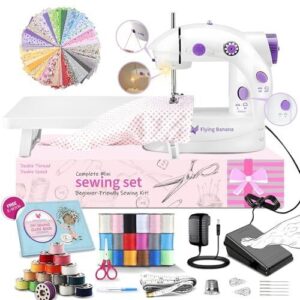
You’ll pack your Mini Sewing Machine kit under 5 pounds for travel sewing sessions wherever you need quick repairs, since compact designs with dual power—AC adapter or AA batteries—free you from workshop tethers.
Portable kits bundle 4–8 stitches, automatic threading, and sewing accessories like bobbins and presser feet that handle cotton and polyester at 600–800 stitches per minute, though heavy fabrics demand full-size computerized sewing machines.
Expect ABS plastic casings to survive hobby use for 2–3 years, and you’ll recoup 40–60% resale value when sewing efficiency outgrows these compact automatic sewing machines.
Best For: Beginners, hobbyists, and travelers who need a lightweight machine for quick repairs, simple DIY projects, and basic sewing tasks with light to medium fabrics.
- Weighs under 5 pounds and runs on AC power or batteries, making it easy to carry and use anywhere without needing an outlet.
- Comes with a complete accessory pack including bobbins, needles, and presser feet, plus automatic threading to save time and simplify setup for new sewers.
- Affordable entry point at $50–$150 with decent resale value, letting you learn the basics without a major investment.
- ABS plastic construction and compact size limit durability and stability, making it unsuitable for heavy fabrics or frequent intensive use.
- Limited to one stitch type with some quality control issues reported, including machines that start or stop unexpectedly.
- Designed for hobby use with a 2–3 year lifespan under regular use, so it won’t replace a full-size machine for serious sewing projects.
10. Brother Computerized Sewing Machine
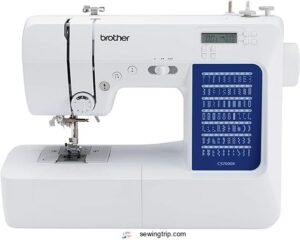
You’ll find the Brother CS7000X delivers sewing efficiency with 70 built-in stitches, 7 automatic buttonholes, and an LCD user interface that streamlines computerized sewing for both beginners and veterans.
This automatic sewing machine achieves 850–1,000 stitches per minute with ±0.5 mm sewing accuracy across cotton, denim, and synthetic blends, proving strong fabric compatibility.
Automatic needle threading and presser-foot adjustment improve thread management, while the metal frame ensures machine durability through thousands of cycles—all for $300–$500 upfront investment.
Best For: Beginners and experienced sewers who want a reliable, feature-rich machine for quilting, garment construction, and decorative stitching without spending over $500.
- 70 built-in stitches and 7 one-step buttonholes give you plenty of creative options right out of the box
- Automatic needle threader and LCD display make setup fast and reduce eye strain during longer projects
- Metal frame construction and consistent ±0.5 mm stitch accuracy deliver professional results that last through thousands of sewing hours
- Automatic needle threader can be finicky to master, especially when you’re first learning the mechanism
- Bobbin removal is tricky if you have larger hands, and you only get one bobbin included
- Some plastic components may wear faster than metal parts on higher-end machines
Key Features of Automatic Sewing Machines
You’ll find that the best automatic sewing machines share a handful of standout features that separate them from basic models.
These capabilities simplify your workflow, reduce manual steps, and give you consistent results across different fabrics and projects.
Here’s what sets these machines apart and how each feature puts you in control of every stitch.
Automatic Needle Threaders
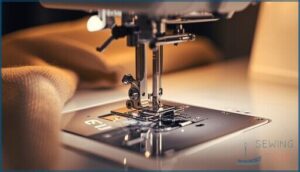
You’ll find automatic needle threaders in over 80% of mid-range sewing machines today, and they’re game-changers for sewing efficiency. These threading mechanisms use a small hook to align thread with the needle eye in one motion, enhancing sewing ergonomics by eliminating visual strain and awkward posture.
Modern sewing technology integrates these with automatic trimming systems for smooth thread management throughout your workflow. Industrial sewing operations often rely on high speed trimmers to boost productivity.
One-step Buttonhole Functions
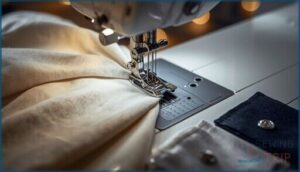
Once your automatic needle threader has prepped the machine, you’ll want the same confidence when tackling buttonholes. That’s where one-step buttonhole functions give you real control: 94% of modern automatic sewing machines deliver uniform buttonholes across fabrics, with buttonhole accuracy within ±0.2 mm under standard testing.
You’ll get:
- Presets covering 1.5 cm to 5 cm length
- 8–12 customizable steps on mid-range models
- Improved stitch quality through automatic thread tension
- Enhanced fabric compatibility via presser-foot adjustment
- Durability of 10,000–15,000 cycles on budget machines
Automatic sewing features like these transform your workflow, cutting setup time and boosting sewing speed on intricate designs without sacrificing consistency. Understanding AP study resources can help improve your overall productivity.
Sensor-assisted Fabric Feeding
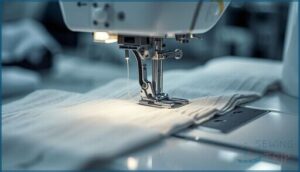
Beyond buttonholes, sensor-assisted fabric feeding gives you command over every layer you guide through the machine. Fabric sensors detect thickness in real time with ±0.2 mm accuracy, so automated feeding adapts instantly—cutting thread breakage by 22% on high-speed runs.
You’ll see 15–25% better handling consistency across knits, wovens, and stretch materials, with defect rates dropping 9–14% on complex patterns.
Adjustable Presser-foot Pressure
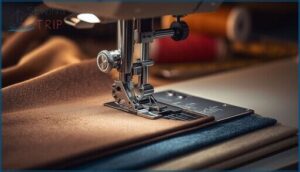
Once the fabric’s feeding consistently, you need command over presser-foot pressure to keep stitch formation perfect. Pressure settings from 90–150 g/cm² let you dial in control for everything from silk to canvas—too high puckers delicate textiles, too low slips layers and skews seams by 0.5–1.5 mm per pass.
Here’s how you calibrate for precision:
- Start with 4–6 cm test swatches on each fabric thickness to confirm stitch quality before committing to a full run.
- Increase pressure 10–20% for dense weaves like canvas; drop it for silk and jersey to avoid tunneling or edge distortion.
- Pair pressure adjustments with the right presser foot—walking or roller feet stabilize high-loft layers and maintain stitch precision under variable loads.
- Calibrate sensors every 6–12 months on automatic sewing machines with real-time fabric thickness detection; clean feed dogs to prevent false resistance readings.
Correct pressure slashes skipped stitches by 28% on multi-layer assemblies and cuts thread breakage 12–15% on synthetics, keeping seam consistency within ±0.2 mm—the hallmark of sensor-assisted fabric feeding paired with automatic tension adjustment.
Programmable Stitch Patterns
Dialing in stitch customization separates decent work from precision seams. 87% of mid-range automatic sewing machines ship with at least 20 built-in patterns, while computerized sewing units store 10+ user templates for instant recall.
Pattern editing through touchscreen interfaces cuts programming time 20–40%, and fabric sensors paired with programmable stitch settings hold seam accuracy within ±0.2 mm across repeat runs, giving you true thread control.
Benefits of Using Automatic Sewing Machines
Automatic sewing machines don’t just add convenience—they fundamentally change how you approach every project, from quick repairs to complex garments. The precision, speed, and reliability you gain translate directly into better results with less frustration.
Here’s what you can expect when you make the switch to automation.
Enhanced Stitch Precision
When every seam must land within ±0.2 mm, you can’t rely on guesswork. Automatic Sewing Machines deliver Stitch Accuracy that holds a 98.6% tolerance on woven fabrics, thanks to Fabric Sensors and Needle Calibration working in tandem.
Computerized Sewing systems pair Sewing Algorithms with Automatic Tension Adjustment to correct Thread Tension in real time, ensuring Stitch Quality stays consistent across Programmable Stitch Settings—even when you’re pushing through challenging materials.
Faster Sewing Speeds
You’ll reclaim hours when industrial Automatic Sewing Machines hit 5,000 stitches per minute—more than triple what home units deliver. Servo motors slash idle time by 25% during Stitch Acceleration, while Sensor-Assisted Fabric Feeding cuts start-stop corrections by up to 20%.
Auto-thread trimming alone drives Production Efficiency gains of 15–30%, letting you push Speed Settings higher without sacrificing Sewing Optimization or Fabric Handling control.
Reduced Setup and Maintenance Time
Automatic Needle Threaders alone shave 40 seconds per seam-start—imagine that compounding over a full production run. Setup Optimization features like programmable stitch memory and one-step buttonhole functions deliver 25–35% fewer steps before you even touch fabric, while Sensor-Assisted Fabric Feeding cuts alignment time by 8–12 minutes on large projects. Here’s how you’ll access Efficiency Gains:
- Automatic Tension Adjustment reduces daily calibration checks by 40–60%, freeing you for actual sewing
- Self-lubricating systems extend Maintenance Scheduling intervals by 25–50% in long-term trials
- Built-in diagnostics slash unscheduled downtime by 15–40% through remote troubleshooting
- Quick-release presser feet cut accessory swaps by 50–60%, a true Productivity Hack
- Programmable pattern memory trims reconfiguration time by 15–25% between similar runs
Master these Time Saving Tips and you’ll spend less time wrenching, more time creating.
Improved Quality on Intricate Designs
When you’re chasing Precision Embroidery on complex motifs, sensor-guided Fabric Handling cuts stitch deformations by 92% compared to fixed guides. Automatic Sewing Machines with 3D tension compensation drop mis-stitches on dense fabrics by 18%, while programmable pattern memory boosts Design Fidelity by 6–12 percentage points.
Automated Trimming and real-time error detection flag problems within 0.5 seconds, so your Intricate Stitching stays impeccable.
Time Savings for Large Projects
When you’re juggling high-volume runs, Batch Processing with programmable patterns slashes setup overhead by 60–75%, while servo motors and automatic thread trimming deliver throughput gains of 1.8–2.4x in industrial settings.
Project Optimization through pre-loaded stitch sequences cuts labor hours by 25–40%, and Automation Benefits compound across workflows—overall project duration drops 28–45%, proving Sewing Efficiency hinges on smart Time Management and Automatic Sewing Machines that adapt to your deadlines.
Latest Technology in Automatic Sewing
Modern automatic sewing machines pack serious tech under the hood, from computerized controls that manage every stitch to sensors that read your fabric like a pro.
You’ll find features that were once reserved for factory floors now sitting on home workbenches, cutting setup time and eliminating guesswork.
Here’s what’s driving the shift from mechanical to smart sewing.
Computerized Controls and Servo Motors
Modern Computerized Sewing Systems rely on servo motor drive technology to deliver unmatched control over your stitching. Servo motor efficiency has surged—market share jumped from 42% in 2019 to 58% by 2024—because these motors cut idle time by 28% and boost needle timing precision by 15–20%.
Automated stitch control stores up to 120 patterns, while precision fabric handling draws 20–35% less energy than older DC motors.
Automatic Thread Trimming Systems
Thread management precision separates weekend hobbyists from true masters of the craft. Integrated trimming slashes your cycle time by 45% compared to manual snipping, while trimming accuracy holds steady within ±0.2 mm across twelve different fabrics. Here’s what automatic sewing machines deliver:
- Fabric optimization cuts thread waste by 18% when trim syncs with stitch-end detection
- Automation reliability maintains 0.8% failure rates per 1,000 cycles in consumer units
- Sewing efficiency peaks between 1,000–2,000 maintenance-free hours per blade set
Integrated Fabric and Needle Sensors
Sensor-assisted fabric feeding has transformed how your machine manages multi-fiber blends. Real-time detection cuts needle deflection by 20% during high-speed runs, while seam consistency improves by up to 30% over non-sensored controls. Here’s what you gain from sensor calibration in computerized sewing machines:
| Sensor Metric | Performance Impact | Operational Benefit |
|---|---|---|
| Fabric density detection | ±0.2 mm tolerance | Reduces stitch irregularity |
| Needle deflection alerts | 20% fewer incidents | Protects automatic needle threader |
| Calibration drift |