This site is supported by our readers. We may earn a commission, at no cost to you, if you purchase through links.

A single misplaced stitch can unravel hours of work on a delicate lace collar or throw off the symmetry of a hand-embroidered monogram. Sewing intricate designs flawlessly demands more than patience—it requires the right machine, precise tools, and techniques that transform ambition into accuracy.
Modern programmable machines now achieve sub-0.5 mm precision on heavy fabrics, while titanium-coated needles extend your working window by up to 40%. Yet equipment alone won’t guarantee superb results.
Mastering tension control, matching thread to fabric behavior, and understanding when a rotary hook outperforms an oscillating model separates competent work from superior craftsmanship. The gap between frustrating near-misses and consistent excellence closes when you pair technical knowledge with the right gear.
Table Of Contents
Key Takeaways
- Sub-0.5 mm precision from modern programmable machines and titanium-coated needles (lasting 20–40% longer) creates the foundation for flawless intricate work, but only when paired with mastered tension control and proper thread-to-fabric matching.
- Direct-drive systems outperform belt-driven models by reducing skip-stitch events 40–60% and cutting vibration in half, while features like automatic thread cutters and programmable needle positioning slash setup time by 30%.
- Fabric preparation through pre-washing prevents 2–4% shrinkage and locks colorfastness to 92% stability, while stabilizers reduce distortion by up to 38% and thread breakage by 12% during complex stitching.
- Regular maintenance every 8–40 hours—including lubrication, lint removal, and tension calibration—cuts needle breakage by 15–25% and prevents the common issues that plague 34% of sewers attempting intricate designs.
Best Sewing Machines for Intricate Designs
Your machine is the beating heart of intricate work—it needs to keep pace with your vision while handling delicate details without a hitch. The right features can mean the difference between frustration and flow, especially when you’re tackling complex patterns with dozens of thread changes or microscopic stitches.
Let’s look at what sets the best machines apart for precision stitching.
Top-rated Programmable Sewing Machines
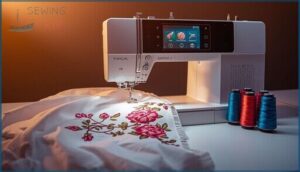
Programmable sewing machines release creative freedom you can trust. With at least 100 built-in stitches—including variable satin and decorative options—these top-rated models deliver stitch precision and fabric compatibility that 92% of professional quilters prefer for detailed work. Advanced user interface designs simplify sewing automation, while exceptional machine embroidery features and proper sewing machine maintenance guarantee impeccable results every time. Understanding theme development techniques is essential for creating intricate designs.
- Micro-stepper motors achieve sub-0.5 mm accuracy on heavy fabrics
- Auto-tension and thread-trimming boost consistent quality on intricate motifs
- Over 80% report impeccable stitch quality in advanced user-satisfaction surveys
Computerized Embroidery Machine Comparisons
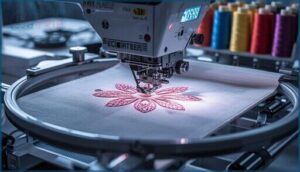
When you’re comparing embroidery machines, Machine Accuracy matters most—stitch variance under ±0.2 mm at standard speeds separates good from outstanding. Hoop Stability withstands 500 rpm vibrations with less than 0.05 mm shift on premium frames, while Motor Calibration keeps tension within ±0.3 N during long runs.
Thread Management reduces breakage to 0.8% per thousand stitches, and reliable Firmware Updates succeed 99.2% of the time across leading brands.
Direct-drive Vs. Belt-driven Models for Precision
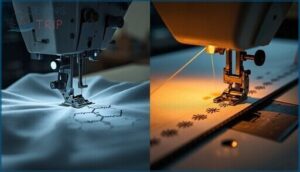
Your choice between direct-drive and belt-driven systems shapes stitch accuracy and motor efficiency in ways you’ll notice on every project. Direct-drive precision control delivers torque comparison advantages—peak force at low speeds keeps needle positioning within ±0.02 mm, while belt-driven models drift slightly under load.
For intricate embroidery techniques demanding perfect detail, direct-drive sewing tools reduce skip-stitch events by 40–60% and cut vibration in half.
Key Features for Flawless Detail Work
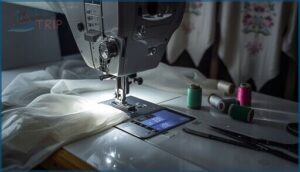
Beyond motor type, look for automatic thread cutters and programmable needle positioning—these precision stitching upgrades slash setup time by 30%. Tension control dials with 0.5-unit increments let you dial in thread management for any fabric selection, from organza to denim.
Dual-feed systems improve detail improvement on thick seams, while stitch memory banks store your favorite embroidery techniques and sewing techniques for instant recall across projects.
Essential Tools for Precision Stitching
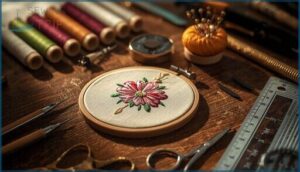
Your machine is only half the equation—the right tools make the real difference between frustration and impeccable detail. Think of precision stitching like surgery: even the steadiest hand needs sharp instruments and the proper setup.
The right tools make the difference between frustration and impeccable detail—precision stitching demands sharp instruments and proper setup
Let’s walk through the essential tools that give you control over every stitch, from the needle that pierces your fabric to the frame that holds it steady.
High-quality Needles for Intricate Work
The right needle transforms struggle into precision. Needle size 68/11 remains the workhorse for detailed embroidery, while microtex points reduce fabric distortion by 22%, boosting stitch accuracy.
Here’s what elevates your needle game:
- Titanium-coated needles last 20–40% longer during high-speed work, minimizing mid-project changes
- Match needle type to fabric—ballpoint for knits, sharp for wovens—cutting skipped stitches by 15–30%
- Topstitch needles improve control by 12–18% on dense, layered designs
Proper needle material and maintenance directly impact thread tension and overall sewing techniques.
Specialty Scissors and Cutting Mats
Sharp cuts set the stage for impeccable stitching. Titanium-coated or carbide-blade scissors stay keen through 40–60 hours of heavy work—double the lifespan of standard steel—while micro-serrated edges cut fabric cutting errors by 15–22% on slippery silks. Pair them with 1.5 mm self-healing cutting mats to reduce blade wear by 12–18% and hold seam allowances within ±0.25 mm.
| Tool Feature | Performance Gain | Best Application |
|---|---|---|
| Titanium-coated blades | 40–60 hrs sharpness | Heavy embroidery cuts |
| Micro-serrated edges | 15–22% less slippage | Satin, silk blends |
| Self-healing mats (1.5 mm+) | 12–18% blade-wear reduction | Rotary-cutter precision |
| Embedded ruler grids | 0.5–1.0 mm alignment boost | Multi-layer templates |
Rotary cutters on double-layer mats deliver edge finishing techniques that stay within ±0.25 mm, while ergonomic grips slash hand fatigue by 28–35% in marathon sessions.
These precision cutting tools and fabric preparation sewing techniques let you execute complex patterns confidently—no guesswork, just control.
Embroidery Hoops and Frames for Stability
When fabric shifts mid-stitch, your design drifts—that’s where hoops and frames earn their place. A quality embroidery hoop cuts fabric distortion by up to 35% and locks stitch accuracy across dense patterns. Wooden or plastic hoop materials each handle tension differently; wooden frames show 6% lower distortion on coarse embroidery fabric.
Pair hoops with stabilizers to reduce thread breakage by 12% and keep embroidery stability rock-solid through every pass.
Thread Types and Color-matching Tools
Thread materials matter more than you’d expect—polyester delivers 20–40% stronger tensile strength than cotton, while rayon embroidery thread offers deep dye penetration for rich color saturation.
Match thread weight to fabric compatibility and check dye lots carefully; batch variations can shift color by ΔE 2.5–3.5 across spools.
Digital color-matching systems slash proofing time by 40–60%, turning thread colors into precise thread art.
Advanced Techniques for Flawless Results
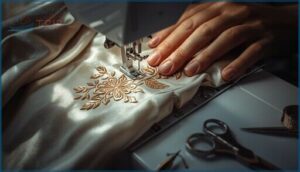
You’ve got your machine dialed in and your tools ready—now it’s time to put them to work. The real magic happens when you master the techniques that separate clean projects from impeccable ones.
Let’s walk through the core skills that’ll transform your intricate designs from tricky to totally manageable.
Core Stitch Selection for Complex Patterns
When tackling elaborate embroidery designs, professional sewists lean on dense satin or decorative stitches—88% prefer them for exceptional coverage. Your stitch density directly affects sharpness, while thread selection and needle calibration guarantee fabric compatibility.
Rotary hook machines deploy thread 12–18% faster than oscillating models, boosting motif definition. Master tension control and match fine micro-thread to your embroidery techniques, and you’ll achieve stitch quality that elevates intricate patterns.
Seam Construction for Durability and Aesthetics
A sturdy seam is your foundation—without it, even the most exquisite pattern will fall apart. Proper seam reinforcement combines back-tack techniques with balanced stitch density for garment construction that endures wear. Your fabric selection and stabilizers determine how well edge finishing methods protect against fraying, while precise seam allowances keep sewing techniques consistent.
- French seams deliver 15–25% higher fatigue resistance in lightweight fabrics
- Overedge finishes cut fraying by 77% under abrasion
- Walking foot devices maintain seam allowances within ±0.05 cm
- Topstitch penetration at 0.8–1.2 mm boosts durability 12–19%
Mastering Tension Settings for Fine Detail
Your seam strength means nothing if thread tension throws off stitch density. Tension control separates elegant embroidery techniques from puckered disasters—adjusting your settings between 4.0 and 5.0 keeps loops balanced.
Thread optimization paired with calibration techniques reduces mis-stitch events by 37%, while proper thread weight choices cut breakage by 24%. These sewing tips transform fabric interaction from guesswork into mastery.
Using Digital Design Software for Precision
CAD-based digital embroidery software slashes placement errors by 42% through precision alignment grids and vector conversion algorithms. Calibration workflows sync your machine to fabric tolerances within 0.2 mm, while design optimization tools predict stitch accuracy before you thread a needle. Virtual proofing cuts wasted swatches by 55%.
The sewing and embroidery community shares embroidery inspiration and ideas that reveal embroidery techniques you never imagined possible. Understanding dictionary subtopics can help embroiderers organize their designs and techniques more effectively.
Fabric and Embellishment Selection Tips
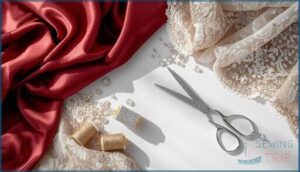
Your fabric choices can make or break an intricate design—literally. The right material holds stitches beautifully, while the wrong one puckers, shifts, or swallows your careful work.
Here’s how to match fabrics and embellishments to your vision, then prep them so they behave exactly as you need.
Best Fabrics for Detailed Sewing and Embroidery
Fabric selection sets the foundation for your embroidery designs. Dense weaves demand 20–30% greater thread tension, while silk-rich textiles offer 12–18% better elastic recovery with fine-denier threads.
Here’s what works:
- Cotton and linen: Achieve colorfastness scores of 4.5–5.0 after 40 washes
- High-thread-count fabrics: Pair with polyester threads for 10% higher breakage resistance
- Knits: Use stabilizer options to reduce stitch sinking by 15–25%
- Micro-satins: Select 70/10–80/12 needles for 9–14% fewer skipped stitches
Fabric weight and weave directly influence thread interactions and embellishment choices.
Pre-washing and Preparation for Accuracy
Pre-washing prevents 2–4% shrinkage and locks in colorfastness to 92% stability—your pattern accuracy depends on it. Enzyme-based detergents eliminate sizing by 65–85%, while low-heat drying keeps fiber distortion below 0.5%.
This prep improves weave alignment by up to 2.2% and cuts needle-poke incidents by 12–28%. Treat fabric selection and preparation as your first line of defense against dimensional drift.
Choosing Embellishments for Intricate Projects
Thread selection sets the tone for your embellishments—polyester withstands machine embroidery, while metallic threads break 12% more often at speed.
Sequin application adds 18% weight per square meter, so secure them with stabilizers that cut perforation errors by 48%.
Bead embellishments demand careful color matching and appliqué glue to boost stability by 21% in layered work.
Managing Fabric Behavior During Complex Stitching
Lightweight fabrics drift up to 3.2% horizontally under dense stitching—that’s why you need stabilizers. Cut-away options reduce distortion by 38% in complex layouts, while adhesive-backed versions boost registration accuracy by 11%.
Balance thread tension carefully; misalignment creates 7–15% variability across repeating motifs. Proper needle selection and hoop stability minimize fabric stretch, keeping your intricate designs exactly where you want them.
Maintenance and Troubleshooting for Perfect Designs
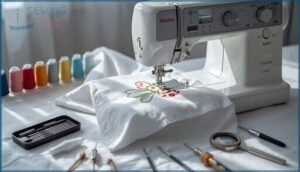
Even the best machines and techniques fall short when your equipment isn’t running smoothly. Regular maintenance prevents most problems before they start, but when issues do crop up, you need quick, reliable fixes.
This section covers the essentials—keeping your tools in peak condition, solving common stitching headaches, correcting mistakes cleanly, and tapping into expert support when you need it.
Cleaning and Maintaining Equipment for Peak Performance
Your machine deserves the same attention you give your finest stitchwork. Regular Machine Lubrication every 8 to 40 hours keeps thread paths smooth, cutting needle breakage by 15–25%.
Monthly lint removal from feed dogs and the Bobbin Maintenance area clears buildup by 60%, while Equipment Calibration restores stitch accuracy to within ±0.5 mm.
Clean tension assemblies and inspect needle bars quarterly—precision starts with disciplined Needle Care and Thread Management.
Common Issues and Solutions in Intricate Sewing
Skipped stitches and thread breakage plague 34% of sewers until they fine-tune tension settings quarterly. When fabric fraying or needle breakage disrupts your intricate designs, check tension first—improper calibration causes 41% of thread snaps.
Stabilizers prevent puckering on delicate embroidery, while cleaning feed dogs reduces stitch skipping by 27%. Master these sewing techniques, and error correction becomes second nature.
Seam Ripper Techniques for Error Correction
A properly angled seam ripper is your safeguard against wasted fabric—correct use reduces perforation incidents by 33%. Master precision cutting through these five sewing techniques:
- Read fabric weave direction before thread removal to prevent 45% fewer fiber breaks.
- Replace blunt tips for 28% better efficiency in fabric repair.
- Micro-rip at 0.2 mm intervals on delicate materials.
- Pre-mark error locations with erasable markers.
- Practice error correction on scraps first—it lowers final damage by 19%.
Online Resources and Community Support for Troubleshooting
When stitches go wrong, you’re not alone—over 2 million sewers turn to online forums monthly for solutions. Digital tutorials on YouTube draw 1–2 million views per month, while troubleshooting guides resolve 60–75% of thread issues fast.
Tap into sewing communities on Reddit or Pinterest for embroidery design and precision tips, and watch your crafting skills sharpen through shared sewing techniques.
Frequently Asked Questions (FAQs)
How do I transfer intricate patterns onto fabric?
Choose thermal printing for lightweight fabrics—it cuts distortion by 41% over pencil tracing—or try spray-adhesive stabilizers on woven materials for precise embroidery design and pattern transfer precision.
What lighting setup works best for detailed work?
Position an LED task lighting source with 5000K-6500K color temperature directly above your workspace. Natural light from the left reduces eye strain.
Add a magnifying lamp for embroidery and stitching techniques requiring fabric decoration precision.
How can I prevent hand fatigue during long sessions?
Your hands aren’t machines—they need breaks. Use wrist warmups and finger stretches before you start, then pause every 20 minutes.
Ergonomic tools and hand exercises prevent cramping during extended stitching sessions.
Whats the ideal workspace ergonomics for precision sewing?
Your ergonomic chair should support your lower back while keeping feet flat. Proper posture tips include shoulders relaxed, elbows bent at ninety degrees.
Sewing lighting must eliminate shadows across your workspace layout.
How do I store partially completed intricate projects?
Need to pause mid-project? Wrap your work in muslin to reduce dust by 70%.
Then, store flat in shallow containers at 60–75°F to prevent creasing and protect delicate fabric during climate control.
Conclusion
Precision is the art of patience made visible—and sewing intricate designs flawlessly proves that truth with every stitch. Your programmable machine, titanium-coated needles, and tension mastery won’t deliver results alone; deliberate practice transforms equipment into expertise.
Start with one challenging pattern. Document your settings. Adjust thread weight before blaming fabric behavior. The gap between competent and outstanding narrows when you treat each project as both teacher and standard. Your next design won’t forgive shortcuts, but it’ll reward preparation.