This site is supported by our readers. We may earn a commission, at no cost to you, if you purchase through links.
If you’ve ever tried to hem jeans on a basic home machine, only to stall at a thick seam, you know the frustration of pushing a tool past its limits. The differences between sewing machine types aren’t just about bells and whistles—they dictate what you can accomplish, how efficiently you work, and whether your results look professional or homemade.
Mechanical models demand hands-on adjustments and regular oiling, while computerized units quietly adapt to fabric density and stitch patterns with a tap of the finger. Understanding these distinctions transforms sewing from guesswork into mastery, letting you match your ambitions with the right equipment.
Table Of Contents
Key Takeaways
- Mechanical, electronic, computerized, specialized, and industrial sewing machines differ in control systems, stitch options, and maintenance requirements, directly affecting project capability and efficiency.
- Computerized models offer automation, sensor feedback, and firmware updates, delivering advanced precision and versatility for complex stitching and embroidery tasks.
- Industrial machines provide higher speed, power, and durability for continuous production, while domestic models prioritize user-friendly features and portability for intermittent home use.
- Matching machine type to your project, skill level, budget, and workspace ensures reliable performance, easier troubleshooting, and professional results across garment construction, quilting, embroidery, and heavy-duty applications.
Overview of Sewing Machine Types
Your sewing machine options break down into five main categories, each built around different mechanisms and capabilities. The type you choose determines everything from your stitch selection to how much control you’ll have over complex projects.
Let’s examine each category so you can match the right machine to your specific sewing needs.
Mechanical Sewing Machines
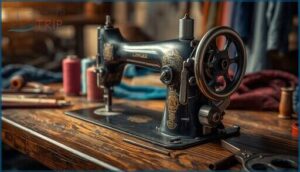
Mechanical sewing machines operate through belt-driven or hand-wheel systems that translate motor power directly into needle movement, giving you straightforward control over every stitch. You’ll adjust thread tension manually using dials, select fabric guidance with presser foot pressure settings, and choose from basic utility stitches via gear-driven cams.
Domestic sewing machine models in this category require regular machine maintenance, including lubrication and occasional belt replacement, but they reward you with reliable performance and simple sewing techniques ideal for garment construction and repairs.
To guarantee clarity in your sewing guides, consider using clear writing techniques to convey complex information.
Electronic Sewing Machines
Electronic controls replace mechanical cams with circuit boards that regulate motor speed, stitch length, and needle position through digital displays and buttons. You’ll access automatic threading, programmable stitch memory, and consistent tension across different fabric weights, features that bridge the gap between basic mechanical models and fully computerized sewing machines.
These electronic sewing machines require stable electrical power and occasional circuit board diagnostics during sewing machine maintenance and repair. Regular maintenance also involves checking for methodological flaws to guarantee peak performance.
Computerized Sewing Machines
Taking electronic sewing machines one step further, computerized sewing machines integrate microprocessors, LCD touchscreens, and machine learning algorithms that adapt auto tension and stitch parameters to fabric density. These features significantly enhance precision quilting and garment finishing.
You’ll find the following innovations in these advanced machines:
- Thread sensors detect breaks instantly, pausing operation before errors compound
- Firmware updates add new stitch patterns via USB without replacing hardware
- Built-in embroidery modules store hundreds of programmable designs in memory
Regular sewing machine maintenance and repair includes lint removal around sensor arrays and updating software for peak performance.
Specialized Sewing Machines (Sergers, Embroidery, Coverstitch)
Beyond general-purpose units, specialized machines tackle distinct tasks you can’t achieve efficiently with standard equipment. Sergers trim fabric edges while forming overlock seams with three to eight threads, enabling sophisticated serger techniques and precise fabric handling.
Embroidery machines execute intricate embroidery designs through digitized patterns and built-in hoops, while coverstitch machines produce stretchy double-needle hems and coverstitch patterns essential for knit garments, demanding careful thread management throughout operation.
Industrial Vs. Domestic Sewing Machines
Your choice between industrial sewing and home units hinges on torque, runtime, and machine frame construction. Industrial sewing machines deliver higher motor power and stitch speed for continuous production, while domestic sewing machine types prioritize portability and user interface simplicity.
- Industrial units run continuously with reinforced frames
- Domestic machines emphasize lower noise level for intermittent use
- Maintenance intervals differ markedly between categories
Key Differences in Features
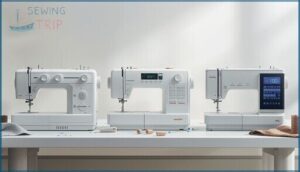
Once you understand the basic categories, the real power lies in knowing what each machine can actually do. The features built into different sewing machine types determine whether you’ll breeze through projects or fight your equipment every step of the way.
The true advantage of any sewing machine lies in its features, which determine whether your projects succeed or become a struggle
Here’s what separates one machine from another regarding capability, control, and performance.
Stitch Variety and Selection
Your machine’s stitch options determine what you can accomplish, from basic straight seams to complex decorative patterns. Mechanical sewing machine types offer 10-20 utility stitches, while computerized models provide 100+ stitch patterns with adjustable stitch length and tension control.
Match stitch types to fabric compatibility—stretch stitches for knits, overlock for edge finishing. Understanding these sewing techniques and tips unlocks your machine’s full potential.
Automation and Digital Controls
Digital controls transform how you interact with modern computerized sewing machines, giving you precision that mechanical models can’t match. Automation interfaces like touchscreens and LCD panels let you select from programmable stitches, adjust parameters instantly, and access connectivity options for firmware updates.
Sensor feedback systems automatically adjust tension, presser foot pressure, and stitch width based on fabric thickness, while sewing automation technology stores your custom sequences for repeat projects.
Speed, Power, and Durability
Your machine’s speed, measured in stitches per minute (SPM), directly impacts throughput—domestic models reach 500 to 1,500 SPM, while Industrial Sewing Machines push 2,000 to 5,000 SPM.
Motor Efficiency and Power Consumption vary widely; servo motors maximize energy use and deliver high control.
HeavyDuty Sewing Machines feature cast-iron frames and reinforced components that pass rigorous Durability Tests, reducing Maintenance Costs through scheduled service intervals and proper lubrication practices.
Accessories and Attachments
You’ll find presser attachments and sewing feet dominate accessory compatibility—universal, zipper, zigzag, and blind hem feet ship with manufacturer-specific shanks that limit cross-brand use.
Extension tables expand your work surface for quilting, while bobbin types and needle kits directly affect stitch consistency.
Specialty sewing equipment, including buttonhole feet and knee lifts, transforms your sewing machine into a multi-functional platform without purchasing additional sewing notions or separate machines.
Typical Uses and Applications
Your choice of sewing machine hinges on what you’re actually making, and each machine type excels in specific applications. Understanding these typical uses lets you match your equipment to your projects, whether you’re hemming jeans or running a garment factory.
Here’s how different machine types perform across the most common sewing applications.
Garment Construction and Alteration
Garment Construction and Alterations demand precision in Fabric Selection, Pattern Making, and Garment Fitting to achieve professional results. Understanding Textile Science helps you match needle size to fabric weight, preventing skipped stitches.
You’ll rely on lockstitch Sewing Machines for straight seams with standard 5/8-inch allowances, while sergers handle Seam Finishing on raw edges.
Sewing Patterns and Sewing Notions guide alteration techniques, like redistributing darts or letting out seams by 1/4 to 1/2 inch for fit adjustments.
Quilting and Home Décor
You’ll need throat widths of 6 to 12 inches to handle bulky quilt layers, with top-loading bobbin systems offering clear view windows for monitoring thread supply during long runs.
Quilting Techniques benefit from 70-plus decorative stitches, adjustable presser foot pressure for multiple fabric thicknesses, and stitch length control ranging from 0.0 to 4.0 mm for precise texture work in Quilt Patterns and Home Decor projects.
Embroidery and Decorative Stitching
You’ll use Embroidery Machines with digitized Embroidery Designs in DST or PES formats, operating at 1,000–1,500 stitches per minute for decorative projects and Quilting and Embroidery applications.
Machine Embroidery requires proper Thread Management, Stitch Density control, and Fabric Stabilizers—cutaway, tear-away, or water-soluble—to prevent puckering.
Embroidery Software manages underlay stitches and pull compensation, while Needle Selection between ballpoint, sharp, or embroidery needles ensures clean decorative stitching on cotton, denim, and woven fabrics.
Heavy-Duty and Commercial Sewing
Industrial Sewing demands machines built for Bulk Production, where Heavy Duty Motors and reinforced Factory Equipment handle Commercial Fabrics like canvas, leather, and Industrial Textiles without stalling.
Your HeavyDuty Sewing Machine or Industrial Sewing Machine operates continuously at higher speeds, featuring enhanced needle penetration, larger bobbin capacity, and specialized presser feet designed for uniform seam quality across diverse Sewing Machine Types and Uses in garment factories, upholstery shops, and textile manufacturing.
Specialized and Industrial Machine Types
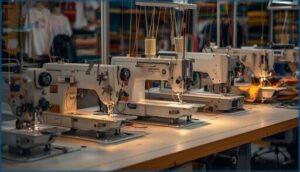
When you step beyond general-purpose sewing machines, you enter the territory of specialized equipment designed to handle specific tasks with precision and efficiency. These machines aren’t built for variety—they’re engineered to excel at one particular operation, whether that’s creating invisible hems or finishing edges at lightning speed.
Understanding the distinct capabilities of lockstitch, chain stitch, blind stitch, cover stitch, serger, and bed-configuration machines will help you identify which specialized tool matches your production needs.
Lockstitch and Chain Stitch Machines
Lockstitch machines interlock needle and bobbin threads beneath the fabric, creating durable seams for woven materials, while chain stitch machines form continuous loops with a single thread, offering elasticity and sewing speed for lightweight applications. Thread tension calibration differs markedly between these sewing machine types and uses, impacting fabric compatibility and maintenance tips for your industrial sewing machine selection.
| Feature | Lockstitch Machine | Chain Stitch Machine |
|---|---|---|
| Stitch Formation | Two-thread interlock beneath fabric | Single-thread continuous loop |
| Thread Tension | Requires bobbin-needle coordination | Single thread path adjustment |
| Fabric Compatibility | Woven, heavy-duty materials | Lightweight, stretch fabrics |
Blind Stitch and Cover Stitch Machines
Mastering fabric finish control demands understanding specialized stitching techniques that separate professional results from amateur work. A blind stitch machine creates invisible hems by interlocking thread with folded fabric edges, while a cover stitch machine produces parallel decorative stitches with secure underside finishing, expanding your sewing machine uses for knitwear and sportswear projects.
Machine configuration differences determine seam flexibility and fabric compatibility:
- Stitch Formation: Blind stitches use chain-looped threads through folded edges; cover stitches employ multiple needles with looping threads
- Thread Tension: Blind stitch machines require precise tension for invisible results; cover stitch machines balance multiple needle tensions simultaneously
- Seam Flexibility: Both sewing machine types create stretch-resistant seams perfect for activewear and knit garments
Sergers and Overlock Machines
Professional edge finishing transforms raw seams into durable, polished results, and sergers deliver that precision through multi-thread overedge construction. Overlock machines trim fabric edges while simultaneously stitching, giving you control over fraying and stretch. Mastering thread management and fabric handling elevates your sewing machine types repertoire beyond standard lockstitching.
| Serger Feature | Function | Your Advantage |
|---|---|---|
| Differential Feed | Controls fabric transport speed | Prevents puckering on knits |
| 3-4 Thread Layouts | Creates tuck-free overedge seams | Professional garment finish |
| Integrated Knife | Trims excess fabric during stitching | Clean edges in one pass |
Serger maintenance demands consistent threading sequences, balanced tensions across all thread paths, and regular looper cleaning to prevent lint buildup that compromises stitch formation on your overlock machine.
Flatbed and Cylinder-Bed Machines
Machine bed types determine your sewing accessibility when tackling different garment shapes and fabric handling challenges. Flatbed sewing machines provide horizontal, stable needle area surfaces ideal for flat seams and large pieces, while cylinder-bed industrial sewing machine designs feature curved stitching zones that let you navigate sleeves, cuffs, and tubular construction with precision unavailable in standard mechanical sewing machine configurations.
Choosing The Right Sewing Machine Type
Selecting the right sewing machine type requires matching the equipment’s capabilities to your specific project requirements, skill level, and practical constraints. You can’t build a solid foundation for any sewing operation without considering factors like budget limitations, maintenance demands, and available workspace.
The following sections break down the key decision points that’ll guide you toward the machine type that fits your needs.
Matching Machine Type to Project Needs
Your project scope determines which sewing machine types deliver true sewing efficiency. Fabric selection drives stitch optimization—woven materials perform well on mechanical to electronic domestic sewing machines, while knits demand serger capabilities.
Project scaling matters: occasional sewing projects suit entry-level units, but small business work requires computerized or industrial sewing machine power. Machine customization through attachments extends versatility across diverse applications.
Considerations for Skill Level and Experience
Your current proficiency shapes which sewing machine types deliver real control and faster skill assessment. Beginners gain mastery with mechanical or electronic models offering automatic threading and basic stitches, shortening the learning curve through straightforward user guidance.
Complex sewing projects demand computerized units with extensive feature prioritization—programmable patterns, adjustable tension, and varied presser feet.
Regular sewing machine maintenance builds confidence across all experience levels, cementing your path from sewing for beginners toward complex techniques.
Budget and Maintenance Factors
You’ll need cost analysis for the full ownership picture—mechanical units start at $100 to $400, electronic models range $200 to $800, and computerized machines exceed $1,000.
Maintenance scheduling every 1–2 years, repair costs for computerized sensors, and budget planning for parts affect your total ownership expenses.
Sewing machine reviews and comparisons reveal long-term value beyond initial price.
Workspace and Storage Requirements
Beyond dollars, your sewing machines need real estate. Domestic sewing machines fit standard desks with 18–24 inches of clearance, while industrial sewing equipment demands reinforced benchtops rated for vibration. Ergonomic setup matters—position your work surface at 28–34 inches high for neutral wrist alignment.
Consider these workspace lighting and organization essentials:
- Storage solutions for bobbins, presser feet, and maintenance supplies within arm’s reach
- Cable management to prevent tripping hazards and accidental movement
- Safety precautions including anti-fatigue mats and proper electrical access
Frequently Asked Questions (FAQs)
How noisy are different sewing machine types?
Noise levels vary by sewing machine type. Mechanical models usually reach 70–85 decibels, while computerized options offer quieter operation at 65–78 decibels. Industrial sewing machines, built for power, often exceed 85 decibels, demanding sound reduction strategies.
What safety features do sewing machines offer?
Ever wondered if sewing machines can protect you from accidents? Modern models include Automatic Shutoff for jams, Finger Guards, Thread Detection alerts, Safety Interlocks, and Emergency Stop buttons—essential for safe operation, maintenance, and repair across all machine types.
Can sewing machines handle stretchy or delicate fabrics?
Sewing machines, with the right Sewing Techniques and features, handle stretchy and delicate Fabric Types reliably.
Use Stretch Stitches, adjust Fabric Tension, select proper Thread Types, and activate Knit Settings for precise Garment Construction and Delicate Handling across diverse Sewing Machine Features and Uses.
How portable are various sewing machine models?
Portability varies across Sewing Machine Types—ultra-light Portable Sewing Machines under 5 pounds suit travel, while midweight models balance Machine Weight and stability.
Compact Designs, Travel Cases, Portable Motors, and smart Storage Options make modern machines easy to transport, unlike bulkier Treadle or Hand Operated Sewing Machines.
What warranty options are available for sewing machines?
Picture the moment—your machine jams mid-project. Warranty Terms, Service Plans, and Extended Coverage vary by brand, with Manufacturer Support and Repair Options depending on use, region, and type.
Always compare Sewing Machines Maintenance and Repair before buying.
Conclusion
Picture a mechanic choosing the right wrench for a stubborn bolt—success hinges on matching tool to task. The differences between sewing machine types work the same way: mechanical models reward hands-on finesse, computerized units simplify complex stitching, and industrial machines power through heavy fabrics.
When you understand each machine’s strengths and limitations, you’re equipped to tackle any project with confidence. Your mastery grows not from guesswork, but from deliberate selection, transforming fabric and thread into something truly your own.