This site is supported by our readers. We may earn a commission, at no cost to you, if you purchase through links.
Your favorite jersey dress splits at the shoulder seam after three wears. The culprit? A straight stitch that snapped under the fabric’s natural movement.
Knit fabrics stretch in multiple directions, and when your seams can’t keep up, they break. That’s where stretch stitch settings become your best friend. These specialized stitches create looped thread paths that move with the fabric instead of fighting against it.
Getting your machine settings right—from stitch width to thread tension—means the difference between seams that last and seams that pop open at the worst possible moment.
Table Of Contents
Key Takeaways
- Straight stitches snap on knits because they can’t stretch with the fabric, while zigzag and triple zigzag stitches create looped thread paths that flex with movement and prevent seam breakage at stress points.
- Match your needle to fabric weight—ballpoint needles (70/10 to 90/14) work for lightweight to medium knits, while stretch needles handle high-elasticity fabrics like Lycra without skipping stitches or snagging fibers.
- Set stitch length between 2.0-3.0mm and width at 1.0-3.0mm depending on fabric weight, then lower thread tension slightly to prevent puckering while maintaining seam strength.
- Polyester thread handles everyday knits, but stretch thread or woolly nylon in the bobbin adds 50-70% more give for high-stress areas like elbows and knees that need extra durability.
Why Use Stretch Stitches for Knits?
Straight stitches might work for woven fabrics, but they’re a disaster waiting to happen on knits. The moment your fabric stretches—whether you’re pulling on a shirt or reaching for something—those seams can pop right open.
Here’s why stretch stitches are your best defense against broken seams and wardrobe malfunctions. They work hand-in-hand with techniques for sewing elastic without puckering or skipped stitches to keep your projects looking professional.
Risks of Straight Stitches on Knit Fabrics
Seam breakage happens fast when you use straight stitches on knit fabrics. Without fabric elasticity, your seams pop at stress points like elbows and knees. You’ll also see fabric distortion, puckering, and stitch misalignment as the material shifts during sewing. Fiber fatigue sets in with repeated flexing, leading to garment failure.
Straight stitches on knits pop at stress points, causing distortion, puckering, and eventual garment failure
Straight stitches simply can’t handle the movement knits demand—that’s where stretch stitch and zigzag stitch become your best friends for seam durability. Ensuring methodological rigor is vital, similar to addressing methodological flaws in scientific studies.
How Stretch Stitches Prevent Seam Breakage
Unlike rigid straight lines, stretch stitch creates a looped path that moves with your fabric. The zigzag stitch and similar patterns distribute stress along the entire seam, preventing puckering and breakage.
Proper stitch density maintains seam integrity while thread engagement on both sides balances tension. This elastic recovery lets your fabric stretch and snap back without tearing—exactly what seam durability demands in knits. You’ll find these principles woven throughout every sewing shirt tutorial that prioritizes long-lasting, comfortable seams.
When to Use Stretch Stitches
Now that you understand how stretch stitches protect seams, let’s pinpoint exactly when to reach for them. Apply stretch stitch whenever you’re working with knit fabrics that demand seam recovery and flexibility: For hemming knits with a professional finish, twin needle stitching delivers parallel top lines and a stretchy zigzag underside that moves with the fabric.
- T-shirts, leggings, and activewear requiring multi-directional fabric elasticity
- Curved seams on stretchy fabric prone to distortion
- Garment construction with topstitching to prevent gaps
- High-stress areas like armholes needing zigzag stitch or triple zigzag
- Any project where straight stitches would create stiff, restrictive seams
These stretch stitch applications guarantee your knit fabric types maintain their natural give.
Essential Stretch Stitches for Knit Fabrics
Your sewing machine comes loaded with stretch stitches designed specifically for knit fabrics. Each stitch fulfills a different purpose, from basic seams to decorative topstitching.
Let’s break down the most useful options and when to reach for each one.
Zigzag Stitch Settings and Uses
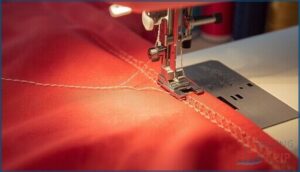
The zigzag stitch is your best friend for knit fabrication because it flexes with fabric stretch instead of fighting it. Set your width between 1.0 and 3.0 mm and length around 0.5 to 3.0 mm for balanced stitch formation. Pair your zigzag with the right ballpoint needle for knits to prevent skipped stitches and fabric damage.
This stretch stitch maintains seam integrity on stretchy fabric while preventing puckering. Test a scrap first—you’ll see how the zig zag stitch adapts beautifully to your knit’s natural give.
Triple Stitch and Lightning Bolt Stitch Explained
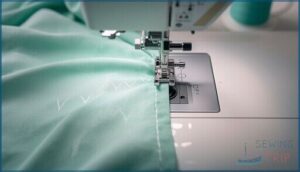
The triple zigzag and lightning bolt stitch both deliver enhanced seam integrity on knit fabrics compared to standard straight stitches. Here’s what sets them apart:
- Triple zigzag distributes fabric stretch across three thread passes, reducing stress on any single point.
- Lightning bolt stitch creates an angular pattern that allows maximum thread engagement while maintaining elasticity.
- Set stitch length between 2.0–3.0 mm for lightweight knits on your sewing machine.
- Adjust stitch tension slightly lower than normal to prevent puckering without compromising strength.
Test both on scraps to find which manages your fabric’s stretch best.
Overlock and Cover Stitch Options
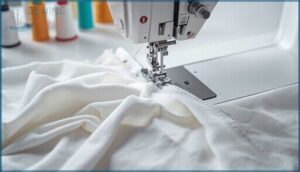
Serger settings reveal professional-grade seams that regular machines can’t match. Your overlocker creates narrow, durable finishes with two, three, or four thread configurations—perfect for stretchy fabrics. Cover stitch machines deliver that wide, flat hem you see on store-bought tees, with a chain underneath that moves with your fabric. Adjust differential feed to eliminate waves and puckering on lightweight knits.
| Stitch Type | Best For | Thread Count |
|---|---|---|
| Overlock | Seam finishing, edges | 2-4 threads |
| Cover Stitch | Hems, topstitching | 2-3 threads |
| Narrow Chain | Decorative seams | 2 threads |
| Wide Cover | Stretch hemming | 3 threads |
Choosing The Right Needle and Thread
Your needle and thread choices can make or break your knit project. The wrong needle will skip stitches or snag fabric, while the wrong thread can cause seams to pop under stress.
Here’s what you need to know about selecting the right tools for stretchy fabrics.
Ballpoint Vs. Stretch Needles for Knits
Your needle selection makes all the difference between smooth seams and fabric damage. Ballpoint needles push knit fabric fibers apart with rounded tips, preventing runs on lightweight jerseys.
Stretch needles feature specially shaped eyes and scarfed shafts that protect stitch integrity on highly elastic fabrics like Lycra blends.
Match your needle material to your fabric’s elastic recovery—smooth knits love ballpoint, while stretchy powerhouses need stretch needles on your sewing machine.
Needle Size Guidelines by Fabric Weight
Match your needle size to fabric weight, and you’ll transform stitch formation from frustrating to impeccable. Lightweight jerseys demand delicate handling, while heavy sweater knits need serious penetration power to maintain seam integrity.
- Light knits (2-4 oz/yd²): 70/10 to 80/12 ballpoint needle for minimal damage
- Medium knits (4-6 oz/yd²): 75/11 to 90/14 stretch needle maintains flexibility
- Medium-heavy knits (6-8 oz/yd²): 90/14 to 100/16 balances penetration and stretch
- Heavy knits (8+ oz/yd²): 100/16 to 110/18 prevents snagging on thick fabric
- Thread compatibility: match needle size to thread diameter for skip-free stitches
Best Threads for Stretchy Seams
Your thread selection makes or breaks seam durability on knits. Polyester thread manages everyday knit fabrication with balanced stretch and strength. For serious stitch optimization, Maxi Lock Stretch Thread gives extra elasticity. Wooly nylon works beautifully in the bobbin for recovery power.
Always run fabric testing with your chosen sewing thread options before committing to an entire garment—each knit behaves differently.
Optimizing Sewing Machine Settings
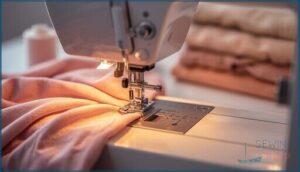
Getting your machine dialed in makes all the difference when sewing knits. You’ll need to adjust a few key settings to match your fabric’s stretch and weight.
Let’s walk through the two settings that’ll give you strong, flexible seams every time.
Adjusting Stitch Length and Width for Stretch
Your sewing machine settings hold the key to professional-looking seams on stretchy fabric. Start with a stitch length of 2.0–3.0 mm for mid-weight knit fabric—shorter lengths boost seam elasticity on lightweight knits, while heavier ones need 2.5–3.5 mm.
Set your zigzag stitch width between 1.0–2.5 mm for lighter materials and 2.0–3.0 mm for stable stretch settings. Always run fabric testing on scraps first.
Thread Tension Tips for Knits
Balanced tension between top and bobbin threads is your first line of defense against puckering. Start with a test swatch on scrap knit fabric before jumping into your main project—medium tension works well for jersey, but drop it slightly for slippery materials.
If you spot loose loops underneath, bump up the needle thread by small notches until both sides look clean and even.
Pro Tips for Sewing Perfect Knit Seams
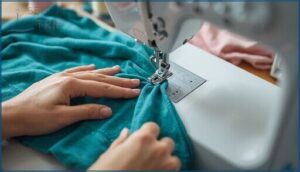
You’ve nailed the machine settings, but impeccable knit seams come down to how you handle the fabric itself. Small adjustments in technique prevent those frustrating puckers and skipped stitches that can ruin an otherwise perfect project.
Let’s cover three game-changing strategies that separate beginner work from professional results.
Preventing Puckering and Skipped Stitches
Nothing ruins a beautiful seam faster than wavy puckering or frustrating skipped stitches. Lower your thread tension by one notch—tight tension compresses knit fabrics and creates that unwanted ripple effect.
Switch to a ballpoint or jersey needle; these glide between fibers instead of piercing them, which prevents skipped stitches. Reduce your presser foot pressure slightly to let the fabric relax naturally under your zigzag stitch for smooth, professional results.
Hemming and Topstitching Techniques
Your hems deserve the same care as your seams. A twin needle stitch creates professional stretch hemming with two parallel topstitch lines that flex with knit fabrics. Set your stitch length to 3.0mm for balanced coverage—shorter stitches risk tunneling, while longer ones look unfinished.
For invisible hems, try a narrow zigzag or coverstitch on your serger for clean seam finishing that won’t pop.
Using Stretch Thread for Extra Durability
When your seams face real-world stress, stretch thread becomes your secret weapon. Maxi Lock Stretch Thread or woolly nylon in the bobbin adds 50-70% more give than standard polyester thread. Test your fabric first—wind it by hand or machine, then run seam reinforcement trials on scraps. Pair it with zigzag or stretch stitch for durability testing that proves itself after repeated washing.
- Your knees and elbows stay comfortable without seam popping
- Thread selection transforms weak spots into lasting construction
- Fabric testing reveals exactly which stitch optimization works best
- You’ll master professional results through hands-on sewing thread options
- Every seam becomes stronger when stretch meets smart technique
Frequently Asked Questions (FAQs)
What presser foot works best for knit fabrics?
Ever feel your knit fabric fighting your sewing machine? A walking foot stabilizes stretch fabrics during seams, while a ball-tip foot glides smoothly over delicate knits. Teflon or nonstick feet prevent skipped stitches on slippery jerseys.
How do you prevent fabric stretching while sewing?
Support stretchy fabric with your hand while feeding it through—don’t pull or push. Lower presser foot pressure to prevent drag.
Add tissue paper beneath edges for fabric stabilization, minimizing seam construction issues.
Can you use regular thread on knit projects?
You can use regular polyester thread on lightweight knits with stretch stitch settings and ballpoint needles, but test fabric compatibility first.
Heavy or high-stretch knit fabric types often need specialized stretch thread alternatives for reliable seams.
Should you backstitch when sewing stretchy seams?
For most knit seams, one or two backstitches at each end provide seam security without adding stiffness.
When using a stretch stitch on stable knit fabric, backstitch alternatives like tying off threads work beautifully.
How do you fix wavy seams on knits?
Wavy seams happen when tension’s too tight or your stitch length is too short.
Loosen the upper thread tension, switch to a zigzag stitch, and increase stitch length to 5–0 mm for smoother results.
Conclusion
Think of your knit seams like a rubber band—they need room to move or they’ll snap. Mastering stretch stitch settings for knits transforms your sewing from “barely holding together” to professional-grade durability.
Your ballpoint needle, optimized tension, and the right stitch create seams that flex with every movement. No more surprise splits mid-wear. You’ve got the technical knowledge; now your knit projects can handle real life without falling apart.
- https://youtu.be/ZnVnFbOC_tk
- https://www.youtube.com/watch?v=UuDbaeUTUXI&list=PLt8xlxgUh83oaeaVC1_0N-4GhmJ_Mlfxb&pp=gAQBiAQB
- https://madamsew.com/collections/marking-tools
- https://academichelpexpress.blog/2024/08/please-use-the-bulleted-points-and-the-rubric-below-to-guide-your-work-your-pa/
- https://www.sciencedirect.com/science/article/pii/S0749208123000268