This site is supported by our readers. We may earn a commission, at no cost to you, if you purchase through links.
Your sewing machine has a dial full of stitch options you’ve probably never touched. Most of us stick to that trusty straight stitch for everything, but you’re leaving some serious power on the table.
Each stitch on your machine exists for a specific reason—whether it’s stopping knit fabric from stretching out of shape, creating invisible hems on dress pants, or keeping raw edges from unraveling into a frayed mess. Learning which stitch to use when transforms your sewing from “making do” to actually controlling how your projects look and hold up over time.
The difference between a homemade look and a professional finish often comes down to choosing the right stitch for your fabric and purpose.
Table Of Contents
- Key Takeaways
- Common Machine Stitches and Their Uses
- Straight Stitch – Seams, Topstitching, Quilting
- Zigzag Stitch – Stretch Fabrics, Edge Finishing, Appliqué
- Basting Stitch – Temporary Seams, Fitting
- Satin Stitch – Decorative Edging
- Overlock/Overcast Stitch – Preventing Fraying
- Blind Hem Stitch – Invisible Hems on Garments
- Buttonhole Stitch – Creating Buttonholes
- Choosing The Right Stitch for Fabric
- Stitch Selection for Different Sewing Projects
- Essential Machine Settings for Each Stitch
- Troubleshooting Common Machine Stitch Issues
- Top Sewing Products for Better Stitch Quality
- Frequently Asked Questions (FAQs)
- Conclusion
Key Takeaways
- Your sewing machine’s stitch dial isn’t just decoration—each stitch prevents specific problems like fabric fraying, seam popping on knits, or visible hems, transforming homemade projects into professional-looking pieces when you match the right stitch to your fabric and purpose.
- Straight stitch handles most seams and topstitching, but zigzag prevents fraying and works on stretchy fabrics, while blind hem creates invisible finishes—these three stitches cover about 80% of what you’ll actually sew.
- Fabric weight determines your stitch settings more than you’d think: lightweight materials need 2.0-2.5mm stitches with fine needles, while heavy denim demands 3.0-4.5mm lengths and larger needles to prevent puckering or thread breakage.
- The difference between fighting your fabric and enjoying the process comes down to three things—matching your needle size to thread weight, adjusting tension for your specific fabric, and swapping presser feet for specialized stitches like buttonholes or edge finishing.
Common Machine Stitches and Their Uses
Your sewing machine isn’t just a one-trick pony. It’s loaded with different stitches, and knowing what each one does will totally change how you approach every project.
If you’re just getting started, these electronic sewing machine tutorials walk you through each stitch type and when to actually use it.
Let’s look at the stitches you’ll use most and when to reach for them.
Straight Stitch – Seams, Topstitching, Quilting
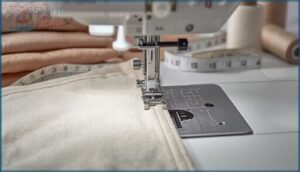
The straight stitch is your foundation stitch—every seam, topstitching line, and quilting project starts here. You’ll set your stitch length between 2.0 and 3.0 mm for seam construction, bump it to 3.5 mm for topstitching techniques, and drop to 1.8 mm for quilting applications.
- Backstitching at start and end prevents your seams from unraveling mid-wear
- Matching needle selection to fabric weight creates crisp, professional topstitch lines
- Consistent stitch length produces uniform seam finishing across woven fabrics
Zigzag Stitch – Stretch Fabrics, Edge Finishing, Appliqué
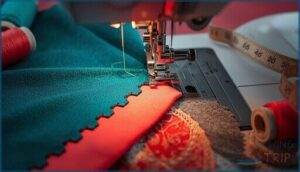
You’ll reach for the zigzag stitch whenever stretch fabric, edge finishing, or appliqué work lands on your machine. Set width to 2.0–3.0 mm and length around 1.5–2.5 mm for knits—this keeps seams flexible without popping.
For fabric edge finishing on wovens, tighten your zigzag settings to 1.0–1.5 mm length. When tackling applique tips, guide your needle just inside the edge to prevent lifting at corners.
It’s worth noting that this stitch is valued for its ability to tightly hold fabric edges together, as explained in the basics of zigzag stitch.
Basting Stitch – Temporary Seams, Fitting
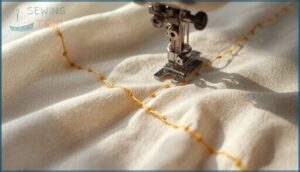
Basting stitches work like a rehearsal for your fabric—long, loose straight stitches that hold layers together so you can check garment fitting before committing to permanent seams. Set your machine to 4.0–5.0 mm stitch length with minimal tension. This temporary fastening lets you test seam allowances, adjust fabric draping, and nail fitting techniques without leaving holes.
Basting stitches are like a dress rehearsal—long, loose temporary seams that let you perfect the fit before committing to anything permanent
For more about how the stitch is traditionally used and recommended, see these techniques for temporary fabric holding.
- Pin bulky velvet layers, then baste along the seam line to prevent shifting
- Baste darts on a bodice, try it on, then tweak before final stitching
- Use contrasting thread so you can spot and remove basting easily
Satin Stitch – Decorative Edging
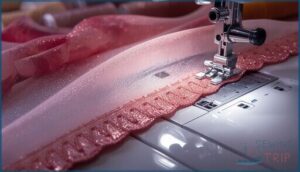
Want glossy edges that make shapes pop? Satin stitch packs tight zigzags (0.4–0.6 mm) side by side until you’ve got a smooth, filled border—perfect for decorative seams and edge finishing.
Stitch density matters: too loose and you’ll see gaps, too tight and fabric puckers. Fabric preparation with stabilizer keeps delicate weaves crisp. Match your fabric choice to decorative stitches for pro results.
Overlock/Overcast Stitch – Preventing Fraying
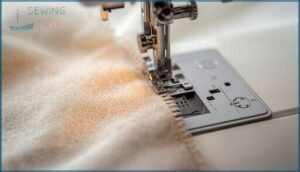
Raw edges unravel fast unless you seal them with an overcast stitch—a zigzag that wraps thread around fabric edges for solid fray prevention. Most machines offer an overlock stitch that mimics serging without the extra equipment.
- Edge finishing: Works on woven and knit fabrics to stop fraying
- Overcast techniques: Use an overcast foot for neat alignment
- Sewing machine settings: Adjust stitch width to match fabric weight
Blind Hem Stitch – Invisible Hems on Garments
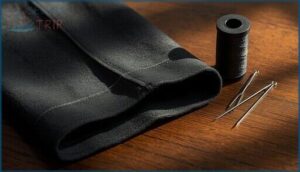
The blind hem stitch puts tiny bites into folded fabric so you don’t see stitching from the outside—perfect when you want invisible hems on dress pants or skirts.
Match your thread color to the fabric and allow at least 1 inch hem allowance. Adjust stitch tension carefully to prevent puckering, and test fabric compatibility on scraps first for garment construction success.
Buttonhole Stitch – Creating Buttonholes
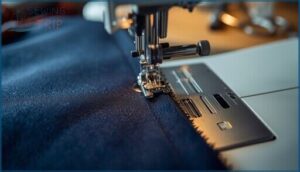
Buttonhole stitch creates a reinforced opening using a tight zigzag pattern around the slit—essential buttonhole basics for any garment.
Most buttonholes work best at 0.5-1.0mm stitch length for dense, secure edges—learn more about how stitch length affects different sewing techniques.
Machine settings usually range from 0.5 to 1.5 mm stitch length, and higher stitch density prevents fraying. Always use interfacing during fabric preparation, test your sewing machine techniques on scraps, and match thread to your fabric for clean, professional buttonholes.
Choosing The Right Stitch for Fabric
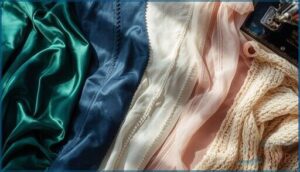
Your fabric choice determines which stitch will give you the best results. Using the wrong stitch can lead to puckered seams, broken threads, or edges that fray after the first wash.
Let’s match your fabric to the perfect stitch so your projects hold up and look professional.
Matching Stitches to Fabric Weight
Getting the right match between fabric weight and stitch selection feels like solving a puzzle—but it’s simpler than you think. Lighter fabrics need shorter stitches and finer needles, while heavier materials demand longer stitches to maintain seam stability without bunching.
- Light fabrics: 2.0-3.0 mm stitch length with size 70/10 needles
- Medium fabrics: 2.5-3.5 mm length with 80/12-90/14 needles
- Heavy fabrics: 3.0-4.5 mm length with 90/14-110/18 needles
- Thread compatibility: finer threads for lightweight, 30-40 weight for heavy
- Tension control: adjust based on fabric weight to prevent puckering
Testing on scraps helps you dial in perfect settings along the fabric grain.
Best Stitches for Knit Vs. Woven Fabrics
Knit fabrics need stitches with elasticity, so narrow zigzag, lightning bolt, or triple stretch stitch options keep knit seams flexible without popping threads.
Wovens rely on straight stitch for seam stability since they don’t stretch much. For woven edge finishing, try zigzag or overcast to prevent fraying. Match your stitch selection to fabric stretch behavior, and you’ll nail construction every time.
Stitches for Delicate and Sheer Materials
Delicate edge finishes demand a gentle touch—you’ll want a fine straight stitch between 1.5 and 2.0 mm on silk fabric sewing projects to keep holes tiny.
For sheer seam techniques that won’t show through, try these lightweight stitch options:
- French seams (6 mm wide) that hide raw edges
- Rolled hems (2-3 mm) for floaty borders
- Narrow zigzag with tension tweaks
- Microtex needles (60/8 or 70/10)
- Tissue paper stabilizers during stitching
Heavy-Duty Stitches for Thick Fabrics
Thick fabrics like denim or canvas need a longer straight stitch—around 3 to 3.5 mm—so you won’t perforate the material.
Triple stretch stitches reinforce stress points on backpacks and work jackets, while a walking foot keeps bulky seam management smooth when layers shift.
Pair heavy thread choices (Tex 70-135) with large needles, and your heavy duty sewing will hold strong without puckering.
Stitch Selection for Different Sewing Projects
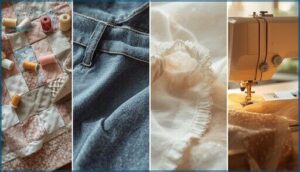
You’ve learned how to match stitches to fabrics, but your project type matters just as much. Different sewing goals need different stitch strategies—what works for a quilt won’t cut it for a cocktail dress.
Let’s look at how to pick the right stitches for the four most common project categories you’ll tackle.
Garment Construction and Alterations
Precision transforms fabric into perfectly fitted garments when you match stitches to construction tasks. For basic garment construction, you’ll rely on straight stitches for side seams and shoulder seams—they’re your workhorse.
When alteration techniques demand taking in side seams, start with long basting stitches for fitting, then secure with straight stitches. Finish raw edges using zigzag or overcast for seam finishing. Use blind hem stitch for invisible hems on trousers and skirts.
Fabric shaping through darts needs straight stitches, while stretch stitch accommodates knit garment fitting without popping threads.
Quilting and Patchwork Projects
Quilting and patchwork projects demand straight stitches for piecing quilt block patterns—I use 2 to 2.5 mm length for secure seams without bulk.
Chain piecing speeds up patchwork techniques beautifully.
For quilting itself, try straight line quilting at 2.5 to 3.5 mm with a walking foot.
Satin stitch appliqué works when you want decorative edges on fabric motifs, while basting holds your batting materials in place.
Home Décor and Craft Applications
Home décor and craft applications let you transform your living space with fabric crafting flair. I love using straight stitches for cushion covers and curtains—they’re sturdy and reliable. Zigzag stitches prevent fraying on table runners and storage bins, while decorative stitches add personality to seasonal projects.
Here are five rewarding home sewing projects you can tackle:
- Cushion Covers And Pillows – Straight stitch seams create durable cushion covers by sewing right sides together with about 1.5 centimeter seam allowances on medium weight cotton.
- Curtains And Window Treatments – Basic curtain panels use long straight stitches along hems, with wider 7 to 10 centimeter bottom hems helping panels hang smoothly.
- Table Linens And Runners – Cloth napkins feature double-fold hems of about 1 centimeter, sewn with straight stitches for washable, durable finishing.
- Soft Storage And Organizers – Fabric storage bins use straight stitched seams and boxed corners with medium to heavy cotton canvas to help bins stand upright.
- Holiday And Seasonal Decorations – Fabric bunting is made by stitching triangle shapes, turning them right side out, and attaching along bias tape with straight stitches.
Embroidery and Decorative Work
Machine embroidery transforms plain fabric into stunning artwork with decorative stitches. You’ll find satin stitch creates smooth, shiny fills for monogramming tips and lettering. Free motion stitching lets you draw custom designs, while twin needle work adds professional parallel lines. Scallop stitch edges delicate items beautifully.
Most modern machines include dozens of embroidery stitches—geometric borders, leaves, and scrollwork that enhance simple projects. Decorative fill stitches like tatami cover larger areas without heavy buildup, preventing fabric tunneling on lighter materials.
| Stitch Type | Best For | Key Feature |
|---|---|---|
| Satin Fill | Monograms, logos | Dense, shiny coverage |
| Free Motion | Custom quilting designs | Complete creative control |
| Built-In Decorative | Borders, edging | Pre-programmed patterns |
Essential Machine Settings for Each Stitch
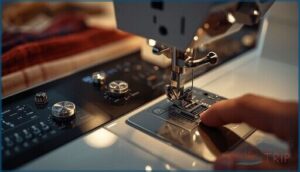
Getting the right stitch pattern isn’t just about picking the pattern—you need to dial in your machine settings too. Each stitch type works best when you adjust length, width, tension, and even swap out your presser foot.
Let’s walk through the essential settings that’ll help you nail every stitch, every time.
Adjusting Stitch Length and Width
Ever wondered why your seams sometimes pucker or look uneven? Getting your stitch length and stitch width just right is key.
Adjust stitch length for fabric compatibility—a longer stitch for thick denim, a tiny one for silk—while stitch width control helps with zigzags or satin stitches.
Quick tip: always recalibrate after tension adjustment for smooth machine calibration and easy stitch troubleshooting.
Thread and Needle Compatibility
You’ll save yourself tons of frustration when you match thread selection to needle sizing. A 60/8 needle pairs beautifully with 80-weight thread for silks, while denim demands a 100/16 needle with hefty 30-weight thread.
Fabric matching matters too—ignoring compatibility issues leads to breakage and skipped stitches. Remember, thread and needle selection work together like dancing partners, so if tension control feels off, check your pairing first.
Tension Settings for Optimal Results
Think of tension settings as the sweet spot where your threads shake hands right in the fabric’s middle. Most medium cottons sing at 4 to 4.5 on your dial—that’s your balanced tension.
Lightweight fabrics? Drop to 2-4 to avoid puckering. Heavy denim needs 4-6 so threads lock deep in those thick layers.
Test on scraps first, adjusting one number at a time until stitch balance looks identical on both sides.
Using Presser Feet for Specialized Stitches
You’ll achieve better stitch precision when you match presser foot types to your sewing machine stitches guide. A satin stitch foot glides over dense zigzag stitches, while blind hem feet keep fabric guidance spot-on for invisible hems.
Overlock feet support edge stitches without tunneling. Walking feet deliver sewing efficiency on quilts by feeding layers evenly. Check foot compatibility with your straight stitch and zigzag stitch settings before you start.
Troubleshooting Common Machine Stitch Issues
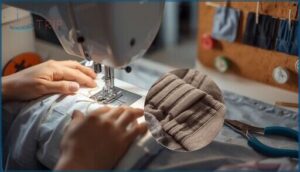
Even the best machines throw a curveball now and then. You might see loops on the bottom, puckered seams, or stitches that skip like a scratched record.
Here’s how to troubleshoot the most common stitch problems and get your machine back on track.
Identifying and Fixing Skipped Stitches
Skipped stitches can feel like your sewing machine is holding a grudge. Here’s how you fix it:
- Check needle alignment tips – Replace bent or dull needles and make sure the flat side faces back for proper straight stitch formation.
- Address stitch timing issues – If your hook and needle don’t sync, you’ll need professional adjustment.
- Improve thread path – Rethread with the presser foot up to prevent catches.
- Fix fabric feed problems – Adjust presser foot pressure and clean feed dogs for consistent stitches.
Resolving Thread Tension Problems
Thread tension problems show up as loops on top or bobbins thread peeking through. Balance your tension settings so threads meet inside the fabric—if bobbins thread shows on top, loosen bobbin settings slightly.
Thread breakage? Match your needle size to thread weight and check for burrs. Remember, heavier fabrics need looser top tension to prevent puckering, while delicate materials require firmer settings.
Preventing Fabric Puckering and Distortion
Puckering happens when tension control overwhelms your fabric or when you ignore fabric grain alignment. Pre-wash fabrics to condition fibers and prevent post-project distortion.
Choose a longer stitch length on lightweight materials—fewer stitches per inch means less stress. Use seam stabilizers on slippery weaves, and always test tension settings on scraps.
Fabric relaxation through steam pressing before cutting helps too.
Maintenance Tips for Consistent Stitch Quality
Beyond adjusting tension settings before you start, machine maintenance keeps your stitch quality rock solid. Replace your needle after two projects—dull points skip stitches.
Clean lint from your bobbin case weekly, then oil according to manual specs. Test on scrap fabric after thread changes to verify tension adjustment. That routine beats fixing wonky stitches midway through your best work.
Top Sewing Products for Better Stitch Quality
You can have perfect technique and still end up with messy stitches if your tools aren’t pulling their weight.
The right machine, presser feet, and thread make the difference between fighting your fabric and actually enjoying the process.
Here are three products that’ll help you get consistent, professional results every time.
1. Brother Metal Sewing Machine
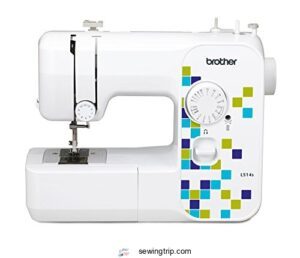
I’ve tested dozens of machines, and the Brother Metal Sewing Machine (LS14S) delivers consistent stitches every time. Its metal frame won’t flex when you’re tackling heavy denim or layered quilts—that means your straight and zigzag stitches stay even across long sessions.
You’ll appreciate the adjustable stitch length up to 5 millimeters and the jam-resistant bobbin system that cuts down frustrating thread snags. At 11.25 pounds, it’s portable enough to move between your sewing room and craft classes without sacrificing the durability you need.
| Best For | Beginners and experienced sewers who need a reliable, portable machine that can handle everything from lightweight fabrics to heavy-duty projects like denim and quilts. |
|---|---|
| Brand | Brother |
| Material | Metal |
| Weight | 11.25 pounds |
| Color | White |
| Primary Use | Sewing & crafting |
| Skill Level | Beginner to experienced |
| Additional Features |
|
- Metal chassis provides stability and durability for consistent stitching, even with thick fabrics
- Jam-resistant bobbin system and adjustable stitch length up to 5mm make it versatile and easy to use
- Lightweight at 11.25 pounds and compact, so you can easily move it between rooms or take it to classes
- Non-standard power plug may require purchasing a separate adapter depending on your country
- Limited long-term user reviews make it harder to assess how it holds up over years of use
- Adapter cost isn’t included, which adds to the overall price
2. Framad Sewing Machine Presser Foot Set
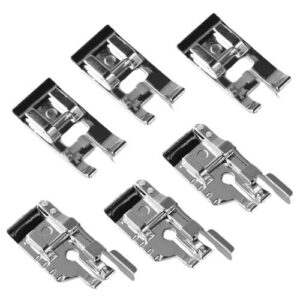
When you swap your presser foot mid-project, you discover stitches you didn’t know your machine could handle. The Framad six-piece set gives you a precision quarter-inch quilting foot with an integrated guide, a zipper foot that slides close to teeth without wobbling, and an overcast foot that mimics serger-style edge finishing on woven fabrics.
I rely on the darning foot for free-motion quilting—it’s clear plastic, so you’ll see exactly where your needle lands. The low-shank design snaps onto most Brother, Singer, and Janome machines in seconds.
| Best For | Sewists and quilters who want to expand their stitching capabilities without buying individual specialty feet—especially if you work on appliqué, binding, or need precise seam allowances. |
|---|---|
| Brand | Framad |
| Material | Zinc alloy |
| Weight | 1.6 ounces |
| Color | Silver |
| Primary Use | Quilting & hemming |
| Skill Level | Basic to advanced |
| Additional Features |
|
- Clear plastic soles on key feet let you see your stitching line in real time
- Quarter-inch quilting foot includes a built-in guide for consistent seam allowances
- Low-shank design snaps on quickly and fits most popular home sewing machine brands
- Only works with low-shank machines, so you’ll need to verify compatibility before ordering
- No storage case included, which means the feet can get separated in your sewing kit
- Limited to six basic functions—missing specialty options like a walking foot or buttonhole foot
3. Gutermann Sewing Thread Set
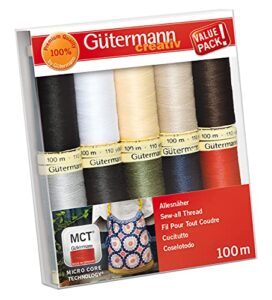
Thread tension fights you when diameter shifts from spool to spool, so I keep Gutermann’s 100-meter polyester set on hand.
The Micro Core Technology holds seams flat on cotton and knits alike, and you won’t see fraying after a dozen washes.
Ten basic colors cover most garment repairs and home décor without digging through bins.
Each spool fits standard cone holders, threads smoothly through tension discs, and the clear storage box keeps dust off when you’re mid-project.
| Best For | Sewers who need reliable, all-purpose thread that works across different fabrics and won’t let seams fail after washing. |
|---|---|
| Brand | Gütermann |
| Material | Polyester |
| Weight | 2.96 ounces |
| Color | Popular |
| Primary Use | All-purpose sewing |
| Skill Level | All levels |
| Additional Features |
|
- Micro Core Technology keeps seams strong and prevents fraying through multiple washes
- Ten basic colors cover most everyday sewing and repair needs without buying extra spools
- Fits standard machines and threading systems smoothly, so you spend less time fussing with tension
- Spools are smaller than some users expect at 100 meters each
- Polyester may disappoint sewers who prefer the feel of cotton thread
- Price adds up quickly if you’re tackling large projects that need lots of thread
Frequently Asked Questions (FAQs)
What are the most useful machine stitches?
Ever wonder which stitches you’ll actually use? Straight stitch takes care of most seams and topstitching, while zigzag prevents fraying and works on knits.
Blind hem creates invisible finishes on pants and skirts.
Which stitches are done by machines?
Most domestic sewing machines can handle straight stitches, zigzag stitches, basting stitches, blind hem stitches, buttonhole stitches, and overlock stitches.
Some sophisticated models also offer decorative stitches, satin stitches, and specialized utility stitches for creative projects.
How do I choose stitch length for curves?
Choose shorter stitches—around 8 to 0 mm—for tight curves so you maintain control. For gentle curves, bump it up to 4 to 6 mm to keep fabric feeding smoothly.
Can I combine multiple stitches in one project?
Most sewing projects actually demand it. You’ll use straight stitch for seams, zigzag for edges, and decorative stitches for embellishment—all working together to create professional, polished results.
Whats the difference between triple stitch and backstitch?
Backstitch creates a continuous line by stitching backward along the seam, producing strong durability.
Triple stitch forms three parallel passes that reinforce edges, adding extra bulk for holding power on heavier fabrics.
When should I use a stretch stitch versus zigzag?
Picture sewing a stretchy waistband versus finishing a cotton quilt edge.
Use stretch stitch for knit seams that need elasticity to prevent breakage.
Choose zigzag for finishing raw edges on woven fabrics and quick seam reinforcement.
How do I prevent decorative stitches from bunching?
You’ll need stabilizer underneath your fabric and the right tension settings. Test on scrap fabric first, then adjust your stitch length shorter and switch to a ballpoint needle for knits.
Conclusion
Here’s the truth most sewers figure out too late: common machine stitch uses aren’t just technical know-how—they’re the difference between projects that fall apart after three washes and garments that outlast your favorite store-bought pieces.
You’ve got the stitches. You’ve got the machine. Now you’ve got the knowledge to match them to your fabric and purpose. Stop second-guessing that dial. Start using it like you mean it.
- https://www.digitizingmadeeasy.com/creative-cutwork-embroidery-with-organza/
- https://www.schmetzneedles.com/needle-know-how/
- https://www.singer.com/blog/sewing-tips-and-techniques/understanding-thread-tension
- https://sewinginspo.com/hand-stitch/overcast-vs-overlock/
- https://northshorecrafts.com/overlock-stitch-on-sewing-machine/