This site is supported by our readers. We may earn a commission, at no cost to you, if you purchase through links.
You can tell when thread tension’s off before you even look closely—the fabric puckers, the stitches pull, or the underside turns into a messy web. Every sewist knows that sinking feeling when a seam looks perfect on one side and disastrous on the other.
The truth is, tension problems aren’t random; they’re the result of tiny imbalances between the top and bobbin threads. Once you understand how those threads interact, you can fix them in minutes instead of hours of guesswork. The key is learning what those clues in your stitches are trying to tell you—and how to respond.
Table Of Contents
Key Takeaways
- Thread tension is simply the balance between top and bobbin threads, and you read it by looking for where the knot sits and whether stitches pucker, loop, or look even on both sides.
- Most tension problems come from setup issues—incorrect threading, wrong or badly inserted bobbin, poor thread or needle, fabric thickness, or presser foot pressure—so you check and fix those before touching any screws.
- To correct tension, you start with the top dial: rethread with the presser foot up, set the dial around the mid‑range, then test‑sew and adjust the dial in small steps until stitches look balanced.
- Long-term tension control depends on habits like regular cleaning of tension disks and bobbin area, using quality thread and the right needle size, testing on scrap for each new fabric, and resetting to default settings when things get confusing.
What is Thread Tension in Sewing Machines
Thread tension is what keeps your stitches looking neat and balanced. It’s the pull between the top and bottom threads that holds each stitch in place.
If you’re having trouble keeping that balance, this guide on fixing common thread tension issues in sewing machines breaks down easy adjustments that make a big difference.
To understand how it all works, let’s look at the main parts that control and affect it.
Role of Top and Bobbin Thread
Think of your sewing machine as a quiet tug‑of‑war. The top thread travels through the Thread Path and upper tension system, then the needle carries it down to meet the bobbin thread. Together they form a lockstitch, and the Stitch Lock Point should sit hidden inside the fabric.
A sewing machine is a quiet tug‑of‑war where top and bobbin threads meet in perfect hidden balance
Your upper tension dial and the tiny Bobbin Tension Screw share the pulling job. When their tension adjustment is in sync, you get balanced tension and a seam that feels smooth, not tight or loose.
For a deeper look at how matching upper and lower thread tensions affects stitch quality, see this guide on achieving balanced stitch tension.
How Tension Affects Stitch Quality
The right thread tension controls where your stitches lock—and that’s what makes them strong and neat.
If tension’s too tight, seams pucker or tiny bobbin dots appear on top. Too loose, and loops form underneath.
Balanced tension keeps both threads meeting inside the fabric, creating a flat, secure seam that holds through wear and washing. You can learn more about common thread tension issues and how to spot them before sewing a full project.
Signs of Balanced Vs. Unbalanced Tension
Balanced tension shows up as clean, even stitches on both sides, with the Knot Position buried neatly between fabric layers and no Fabric Puckering, loops, or thread breaking. Unbalanced thread tension shows as poor Thread Visibility and weak Stitch Consistency that hurt stitch quality.
- Knot Position: knot pulled to top or bottom instead of inside the layers.
- Thread Visibility: dots, lines, or loose loops showing from the opposite side.
- Fabric Puckering: ripples, tunneling, or stiff seams along the stitching line.
- Stitch Consistency: uneven lengths, random loose spots, or repeated thread breaking.
Common Causes of Thread Tension Problems
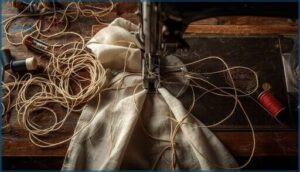
Thread tension problems often come down to a few common mistakes. They can happen when something small is off in your setup or materials.
Here are the main issues to check before adjusting any settings.
Incorrect Threading Path
Improper threading is one of the fastest ways to wreck your thread tension adjustment. When you’re Skipping Guides, letting the thread skim past the tension discs, or dealing with bad Disc Seating or Lever Bypass, your thread path can’t control pull, so loops and birdnests show up.
Always raise the presser foot, check Spool Setup, then rethread slowly, guide by guide, before you Press sew.
Bobbin Insertion Errors
Even a correctly threaded machine will fight you if the bobbin is wrong. Incorrect bobbin orientation — where the thread unwinds clockwise instead of counterclockwise — creates loops on your fabric’s underside. Wrong bobbin sizing adds drag against the case, causing uneven bobbin tension. And overfilled thread winding? It tightens pull until enough thread unwinds.
Always confirm case seating clicks fully before any tension adjustment.
Poor Thread or Needle Quality
Cheap or tired supplies will fight your tension no matter how carefully you dial it in. Uneven thread and Brittle Thread make stitch quality rise and fall across the seam, while Lint Buildup from fuzzy cones chokes your tension path and bobbin area. To steady things, focus on thread and needle compatibility: match needle type and use high-quality thread so you’re not constantly chasing thread breaking.
If you’re unsure which size or style fits your fabric, this guide on choosing the right sewing machine needle breaks it down clearly with examples.
- Frustration when a seam pops for no clear reason.
- Anxiety that your skills are the problem, not the tools.
- Annoyance at stopping every few inches to rethread.
- Doubt about your machine’s reliability and strength.
- Relief when a simple needle change finally calms your stitches.
Fabric Thickness and Type
Fabric weight quietly runs the show. Thick fabric needs higher tension settings so the top thread can pull the bobbin thread into the middle of the layers, especially on denim or canvas, and often a bigger needle type to match.
Lightweight adjustments on sheer woven fabric keep seams from puckering, while knit fabric tension usually drops a bit so the stitch can still stretch with the fabric types you’re using.
Presser Foot Pressure Issues
Presser foot pressure hides in the background, but it can make or break Stitch Quality and cause sneaky tension problems. When pressure is too high, you’ll see puckering, draggy Fabric Feeding, and wavy seams that look “chewed.” Too little pressure gives wandering seams, skipped stitches, and poor Fabric Matching.
As part of sewing machine troubleshooting, try Adjusting Pressure in tiny steps until your tension adjustment finally holds steady.
How to Diagnose Tension Issues
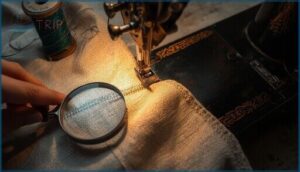
Before you start turning tension dials, it helps to know exactly what’s going wrong.
The good news is your stitches often tell you everything you need to know. Here’s how to read those signs and figure out where the problem starts.
Visual Clues in Stitch Appearance
Think of your stitches as a little roadmap for thread tension. When stitch quality is off, the fabric tells on you: Puckered Seams and tight W ridges mean seam puckering from tension that’s too high, while Loose Loops on top or Bird Nesting underneath point to poor stitch formation and serious balance issues.
Identifying Top Vs. Bobbin Tension Problems
Spotting whether upper tension or bobbin tension is off starts with where you see trouble. If loops or loose top thread collect underneath, your upper tension or Thread Path is the main suspect. When bobbin thread lies in straight stretches on top, that’s a bobbin tension issue.
Watch these Tension Indicators to read Stitch Balance, Thread Interaction, and even how Fabric Thickness reacts to tension adjustment.
Step-by-Step Thread Tension Adjustment
Once you know what’s wrong with your tension, it’s time to make small, careful adjustments. The key is to go step by step so you don’t overcorrect.
Here’s how to bring your stitches back into balance.
Adjusting The Top Thread Tension Dial
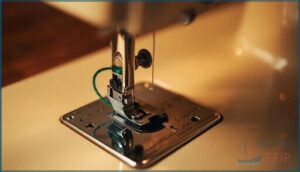
Smooth stitching starts with mastering Tension Dial Basics. Your upper tension dial controls how tightly the thread moves along the Thread Path. To find balanced tension, follow these steps:
- Raise the presser foot.
- Rethread completely.
- Set dial near 4–5.
- Test-sew and observe Dial Number Effects.
- Adjust gradually for Ideal Tension Settings.
When and How to Adjust Bobbin Tension
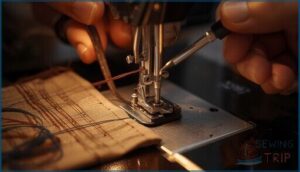
Once your top thread feels balanced, check Bobbin Thread Control if loops or thread breaking persist. Bobbin tension rarely needs change, but when it does, clean the case first.
For minor tension adjustment, turn the small screw one-eighth clockwise to tighten or counterclockwise to loosen. These Tension Adjustment Tips restore proper Sewing Machine Calibration.
Making Small, Incremental Changes
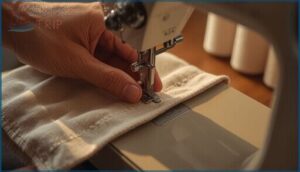
Once your bobbin tension is close, you’re ready for Incremental Tuning. Small increments protect Stitch Quality and Thread Balance, so you don’t chase problems around your seam. Use this simple pattern:
- Change top tension settings one quarter turn at a time.
- Test on scrap with similar Fabric Interaction.
- Watch both sides for loops and puckers.
- Stop when stitches look even and the fabric lies flat.
Resetting to Default Settings
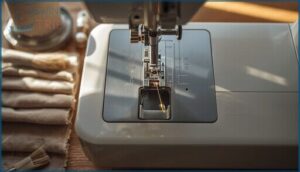
Once you’ve finished fine-tuning, it helps to know you can always “go home.” For most machines, Default Tension is the middle of the tension dial, usually around 4–4.5, which is where Factory Settings aim for basic thread tension and tension balance.
As a simple Reset Process, clean the discs, rethread with the presser foot up, then return your tension settings to that midpoint for fresh Tension Calibration.
Consulting Your Machine Manual

A good sewing machine manual is like your map when tension goes astray. Manual Guides include Tension Diagrams, Symbol Codes, and Fabric Tables that make thread tension clear at a glance. Follow Brand Instructions for precise tension adjustment and regular sewing machine maintenance—these insights turn basic sewing machine troubleshooting into confident, consistent stitch control.
- Peace of mind from clear diagrams
- Smooth stitches without guessing
- Confidence every time you sew
Preventing and Maintaining Thread Tension Balance
Once your tension feels balanced, keeping it that way takes a bit of care. A few small habits can prevent most sewing headaches before they start.
Here’s what to keep in mind to maintain smooth, even stitches every time.
Regular Machine Cleaning and Maintenance
Lint buildup wrecks tension faster than you think. Stick to a maintenance schedule for sewing machine maintenance—your stitches will thank you. Focus on Tension Disk Cleaning (wipe with fabric strip, presser foot up), Bobbin Area Maintenance (brush gently, no canned air), Feed Dog Brushing (sweep lint forward), and Machine Oil Lubrication (one drop on hook post-clean).
Here’s your quick guide:
| Area | Tool | Frequency |
|---|---|---|
| Tension Disks | Fabric strip | Every session |
| Bobbin Area | Nylon brush | Weekly |
| Feed Dogs | Stiff brush | Bi-weekly |
| Hook Race | Machine oil | Monthly |
Plan Service Interval Scheduling yearly for pros. Regular cleaning is your best preventative maintenance.
Choosing Quality Thread and Needles
Strong, stable thread does half the work of keeping thread tension under control. Look for high‑quality thread with good tensile strength and the right Thread Materials and Thread Weights for your project, not bargain cones that fray or shed.
Match Needle Sizes to fabric: size 70 for light wovens, 80–90 for everyday cottons, 100 for heavy denim. Think of Fabric Matching as a three‑way handshake between thread, needle, and cloth—when the needle is too big or the thread weight is off, you’ll see skipped stitches, popping sounds, or frayed thread.
Choose a smooth polyester or corespun thread for most projects, and pair nylon with a sharp or microtex needle only when you need that extra toughness. The right needle and highquality thread glide through the fabric instead of fighting it, so your machine can form even stitches without cranking up tension.
Adjusting for Fabric and Project Changes
Think of your Project Settings as a living checklist that shifts with every fabric selection and seam type. As Fabric Thickness changes, you’ll tweak thread tension, Stitch Length, and even Thread Selection to keep Tension Balance and stitch quality steady, instead of fighting problems later with sewing machine maintenance or rushed tension adjustment.
- Raise top thread tension slightly and lengthen stitches for heavy fabrics or stacked seams.
- Lower tension and shorten Stitch Length for delicate, lightweight cloth that wants to pucker.
- Pair firm presser foot pressure and longer stitches with upholstery or canvas for stable seams.
- Loosen tension and use finer thread for light garments where you want soft, flexible seams.
Checking Tension Before Each Project
Ever notice how skipping Tension Checks can throw off every seam? A quick Preproject Test keeps your thread tension on point. These few steps prevent tension issues before they start.
Start with Thread Verification, then stitch a short test line for Stitch Balance after Fabric Prep.
| Step | Task | Goal |
|---|---|---|
| 1 | Raise presser foot, rethread top thread | Proper thread placement |
| 2 | Clean discs, bobbin area | Remove lint for smooth tension |
| 3 | Sew test rows, adjust dial | Achieve balanced, even stitches |
Top Tools and Products for Tension Fixes
Having the right tools makes fixing tension problems a lot easier. A few key products can help you troubleshoot, test, and fine-tune your stitching with confidence.
Here are some trusted options that can keep your machine running smoothly.
1. StiVerse Polyester Sewing Thread Bobbins
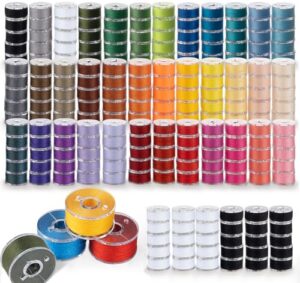
Looking for a simple way to stabilize your tension without fighting your bobbin every five minutes? StiVerse polyester sewing thread bobbins are a smart “control” thread for your machine.
They’re prewound Size A, Class 15 bobbins with 100% polyester 40/2 thread, so the feed is smooth and the pull is consistent. That steady bobbin tension lets you focus on adjusting only the top dial.
Because the thread is strong, low‑lint, and colorfast, it’s ideal for everyday seams, repairs, and light quilting projects.
| Best For | Crafters, sewists, and embroiderers who want smooth, reliable bobbin tension with less hassle during projects. |
|---|---|
| Compatibility | Brother, Babylock, Janome, Singer |
| Material | 100% polyester fiber |
| Use Case | Sewing, embroidery, repair |
| Skill Level | Beginner to professional |
| Fabric Suitability | Knitwear, silk, cotton |
| Included Accessories | 210 bobbins in 36 colors |
| Additional Features |
|
- Prewound bobbins save setup time and keep thread tension consistent.
- 36 vibrant colors plus extra white and black fit different design needs.
- Strong, low‑lint polyester works well on most fabrics.
- Limited color range may not suit complex embroidery designs.
- Polyester thread isn’t ideal for heat‑sensitive or specialty fabrics.
- May not fit every machine—check thread and bobbin compatibility first.
2. Gutermann Sew All Thread Set
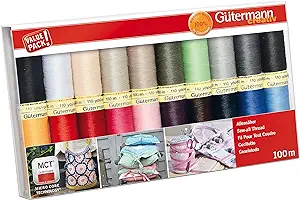
Once your bobbin side is steady, your top thread needs to be just as predictable. That’s where a Gutermann Sew All Thread set really earns its spot on your table.
You get 20 spools of 100% polyester, each 100m long, made with micro core technology that runs smooth and low‑lint, so your tension discs stay cleaner and your stitches stay even.
It manages most fabrics, most seams, and can take hot washing and drying without giving up its strength.
| Best For | Sewers and quilters who want a durable, all-purpose thread set that handles most fabrics and neat finishing with minimal fuss. |
|---|---|
| Compatibility | Universal machine compatibility |
| Material | Microfilament polyester |
| Use Case | Sewing, quilting, decorative stitching |
| Skill Level | Beginner to intermediate |
| Fabric Suitability | All fabrics and techniques |
| Included Accessories | 20 spools of thread |
| Additional Features |
|
- Micro core technology keeps lint low and strength high.
- Works for machine and hand sewing on almost any fabric.
- Withstands hot washing, bleaching, and ironing without weakening.
- Limited to basic colors, so not ideal for vibrant or specialty projects.
- Not suitable for very thick or heavy materials.
- Requires careful use of the right needle size for best tension and durability.
3. Sewing Machine Needles Set
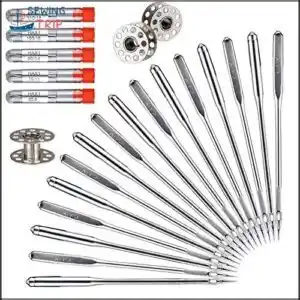
Your thread matters, but so does what carries it. A dull or mismatched needle causes more tension headaches than most sewists realize.
This sewing machine needles set gives you five sizes — 65/9 through 110/18 — so you’re always matching the right needle to your fabric. Ten needles per size, made from high-strength steel, compatible with Singer, Brother, Janome, and more.
Swap to a fresh needle every 8 hours of sewing, and you’ll notice fewer skipped stitches and steadier tension right away.
| Best For | Home sewers and hobbyists who want durable, versatile needles for all kinds of fabric and everyday projects. |
|---|---|
| Compatibility | Singer, Brother, Janome, Varmax |
| Material | High-strength steel |
| Use Case | Quilting, sewing, embroidery, crafts |
| Skill Level | Beginner to experienced |
| Fabric Suitability | Thin, medium, thick fabrics |
| Included Accessories | 50 needles, 5 tubes, 3 bobbins |
| Additional Features |
|
- Includes five popular sizes, making it easy to match needles to different fabrics.
- Made of high-strength steel for long-lasting use.
- Compatible with most household sewing machines, adding convenience and flexibility.
- Not designed for heavy-duty industrial machines.
- May not fit certain specialty sewing machine models.
- Requires separate storage if you want better organization than the included tubes.
4. Towa Digital Bobbin Tension Gauge
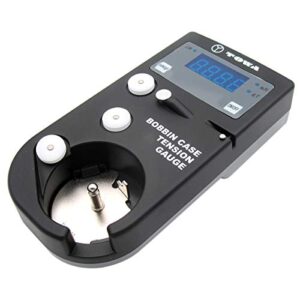
Even with a fresh needle, balanced tension can still be tricky to nail down. That’s when the Towa Digital Bobbin Tension Gauge comes in handy. Its LED display shows exact tension readings for both upper and bobbin threads—no guessing, no loops.
You can preset each bobbin case, store ideal numbers, and check consistency before sewing. It runs on three AAA batteries and fits “L” type bobbins, making it a straightforward tool that keeps your stitches even across every project.
| Best For | Quilters, tailors, and sewing enthusiasts who want perfectly balanced thread tension without constant trial and error. |
|---|---|
| Compatibility | Various sewing machine brands |
| Material | Plastic and electronic components |
| Use Case | Tension measurement and calibration |
| Skill Level | Intermediate to advanced |
| Fabric Suitability | All fabric types |
| Included Accessories | TM-501 bobbin inserts, instructions |
| Additional Features |
|
- Digital LED display gives clear, accurate tension readings.
- Works with both bobbin and upper threads for consistent stitching.
- Compact, battery-powered design is easy to use at home or in the studio.
- Requires 3 AAA batteries, which aren’t included.
- May not fit all sewing machine models.
- Needs periodic calibration for the most precise results.
Frequently Asked Questions (FAQs)
Why does tension differ between sewing machine brands?
What feels “balanced” on one sewing machine mightn’t on another because each brand builds its tension system differently—spring strength, disc design, and default calibration all vary, changing how easily threads lock and form stitches.
How does humidity or environment affect thread tension?
Humidity changes how smooth and stable your stitches feel. In damp air, cotton swells and tightens tension; in dry air, static makes thread drag or snap.
Keep room humidity steady for consistent sewing results.
What’s the best way to test tension after repairs?
Picture you’ve just tuned a guitar; you don’t play a concert first, you strum a few careful chords. After repairs, do the same: use scrap layers matching your project, contrast top/bobbin colors, medium stitch length, and test straight lines plus curves until stitches look balanced on both sides.
Can embroidery settings interfere with regular stitch tension?
Yes, embroidery settings can absolutely interfere with your regular stitch tension. When you lower upper tension for dense embroidery or special threads, then switch back to sewing without resetting, you’ll often see loops underneath, puckering, or random thread breaks.
How do automatic tension systems compare to manual ones?
Automatic tension adjusts thread pressure for you, matching fabric and stitch type instantly.
Manual tension gives complete control, letting you fine-tune settings for tricky materials, specialty threads, or decorative seams when precision matters most.
Conclusion
Once you know the ropes, tension stops feeling mysterious. You’ve seen how the top and bobbin share the workload, what bad stitches look like, and how to react step by step.
Keep your test scraps, adjust slowly, and write down settings that work. Any time a seam misbehaves, you now know how to fix thread tension with calm, clear checks instead of guessing, so each stitch becomes proof of your steady control and growing skill.