This site is supported by our readers. We may earn a commission, at no cost to you, if you purchase through links.
Crack open a sewing pattern book for the first time, and you’ll likely stare at a dense grid of overlapping lines, strange symbols, and numbers that seem to belong in an engineering manual. That confusion is common—and completely unnecessary once you understand the logic behind the layout.
These books follow a deliberate structure: garments grouped by type, each pattern assigned a unique code that connects the illustration to the sheet to the instruction page. Sizes nest together on a single printed sheet, separated by line weight and color.
Once you see how sewing pattern books are organized, the whole system clicks into place.
Table Of Contents
Key Takeaways
- Every pattern book runs on a numbering system that links the sketch, the sheet, and the instruction page — once you see that connection, the whole book stops feeling like a maze.
- Sizes nest together on a single sheet, separated by line weight and color, so tracing only your size line is the move that saves time and prevents costly cutting mistakes.
- The index, yardage tables, and cutting layouts aren’t filler — they’re your shopping list, your fabric plan, and your construction blueprint, all in one place.
- Learning to match an illustration to its pattern number and instruction page is the core skill that separates a confident sewist from someone who’s always guessing.
How Sewing Pattern Books Are Organized
Pattern books follow a clear system once you know what to look for. Every section has a job, and understanding that structure saves you time at the table.
Once you’ve cracked the structure, storing sewing patterns properly keeps your collection organized and ready to use—so you spend less time hunting and more time making.
Here’s how it all fits together.
Overall Book Structure and Section Order
Most pattern books follow a clear, logical flow. You’ll find an Introductory Overview upfront, followed by a Glossary Placement section and a Fabric Terminology Section that define key terms.
A Symbol Legend Layout explains the marks you’ll see on sheets.
The book closes with a Quick Reference Guide and an index.
Think of it as your sewing pattern catalog — a complete Binder System built for fast navigation.
Organization by Garment Type, Collection, or Theme
Once you know the book’s layout, the next step is finding what you need fast. Most books use garment type indexing to group similar pieces together — dresses, tops, skirts, outerwear. Others use seasonal collection grouping or theme narrative cues like "vintage-inspired" or "minimal."
Here’s how pattern categorization generally works:
- Garment sections share silhouette and construction logic
- Seasonal collections follow consecutive pattern numbers
- Theme pages use visual theme icons for quick scanning
- Cross-referencing motifs connect related pieces across sections
Pattern Numbers Linking Sketches, Sheets, and Instructions
Every sketch, sheet, and instruction page shares one consistent numbering system — that’s your anchor. A code like 1234A ties the garment illustration to its pattern piece and its how-to page.
Version suffixes handle view differences without scrambling your pattern organization. Cross-referencing codes make number-based navigation fast across your entire pattern database, turning a crowded book into a reliable, searchable sewing pattern inventory.
Version suffixes and cross-referencing codes turn a crowded pattern book into a searchable, reliable inventory
Differences Between Pattern Books and Single Envelopes
Books and single envelopes solve different problems. A sewing book packs dozens of patterns into one bound volume — better content density, stronger longevity factor, and easier archival storage.
A manila envelope holds one design, giving you a portability advantage for single projects.
Price value shifts too: books cost more upfront but deliver more.
Your pattern labeling system and pattern organization goals should guide which format you reach for.
How Sizes Are Grouped

Size is where a lot of sewers get tripped up, and pattern books handle it in a very specific way. Understanding how sizes are grouped will save you time and keep you from tracing the wrong lines.
Once you’ve got sizing down, pairing the right fabric with your pattern gets much easier—quilting-weight cottons and modern fabric basics are a great starting point for making confident choices.
what you need to know.
Size Ranges Shown on Index or Overview Pages
The index page is your pattern catalog at a glance.
Most books use Numeric Size Bands — think 0–2–4 or 14–16–18 — while others rely on Letter Size Codes from A through G. Some publishers add Color‑Coded Ranges to separate petite from plus.
You’ll also spot Ease Indicators and Bust‑to‑Hip Correlation notes that guide smart size selection before you trace a single line.
Measurement Charts for Bust, Waist, and Hips
Measurement charts are the backbone of smart size selection. Each chart lists three key measurements — bust, waist, and hips — showing measurements the garment is made for, not your body. Here’s what each column tells you:
- Bust – fullest point, with Bust Grading Rules for cup adjustments
- Waist – narrowest torso point, including Waist Ease Values
- Hips – widest point, with Hip Measurement Tolerances built in
- Metric Conversion – inches alongside centimeters
- Body Measurement Tools – tape guidance printed nearby
Multi-size Nesting Within One Pattern
One sheet can carry up to five sizes at once — that’s multi-size nesting, and it’s how modern pattern books pack more into less space.
| Feature | What It Does |
|---|---|
| Color-Coded Size Lines | Separates sizes visually |
| Notch Mapping Techniques | Marks size-specific alignment points |
| Nesting Alignment Rules | Keeps sizes layered without overlap confusion |
| Scale Reference Verification | Confirms correct size before tracing |
| Selective Tracing Methods | Isolates only your size |
Selective Tracing Methods keep your pattern archive clean.
Choosing The Correct Size Before Tracing
Picking the wrong size before you trace is the fastest way to waste an afternoon.
Start with your high bust — High Bust Focus matters most for bodice fit.
Then run these checks:
- Shoulder Width Check: narrow shoulders affect neckline drape
- Posture Impact: slouched posture shifts bust and waist placement
- Fit Comfort Choice: size up for ease, down for structure
Trust your measurements, not the label.
How Pattern Sheets Are Arranged
Pattern sheets are where things get visually busy — fast. single folded sheet can hold dozens of pieces for multiple sizes and views, all printed on top of each other.
what you need to understand about how those sheets are actually put together.
Large Folded Sheets With Multiple Patterns

Open a pattern book and you’ll likely find large folded sheets measuring 24 to 36 inches wide — sometimes stretching 60 inches long. The paper weight is deliberately light and semi-glossy, making tracing clean and easy.
Some sheets include a mini index map in the corner so you can locate pieces fast. Perforated sections help separate pieces without scissors.
Many sewists add laminate protection for long-term use.
Overlapping Lines for Different Sizes and Views
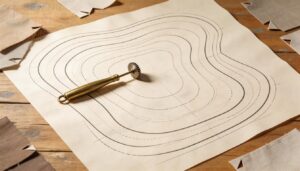
Each size on a pattern sheet lives as its own line — nested inside or outside the others. pattern size grading in action.
view-specific overlaps mean front, back, and sleeve pieces share the same space, with nested seam allowances keeping each size intact. overlapping notches stay legible at every size.
tracing wheel to follow just your size line cleanly.
Line Styles, Symbols, and Color Keys
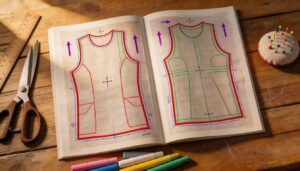
Once you’ve traced your size, the lines themselves become your next puzzle. A solid Line Weight Meaning system separates cutting lines from grain references instantly. Your Color Key Legend maps red to cutting lines, blue to seam allowances, green to lining. The Stitch Symbol Guide covers the rest.
- Bold lines = final cutting edges
- Dotted lines = interfacing or facing shapes
- Zigzag symbols = seam finish guidance
- Purple arrows = grain orientation
- Crosshair marks = center front or back placement
Pattern Piece Numbers, Notches, and Grainlines
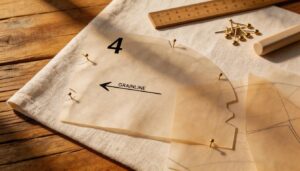
Now that the lines and symbols make sense, pattern piece numbers are your next anchor. Each number appears near the top edge of the piece in bold — linking directly to its instruction page.
Notches mark alignment points at shoulders, waists, and side seams.
The grainline arrow tells you how to orient each piece on fabric.
These three reference markers keep your pattern tracing accurate and your assembly on track.
How Users Locate The Right Piece on a Crowded Sheet
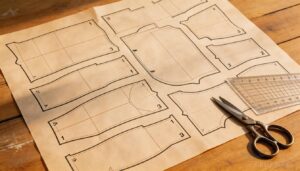
piece numbers as your anchor, finding the right piece on a crowded sheet comes down to reading its built-in navigation. Use the vertical column index along each outline and match bold header markers by size.
Staggered grid offsetting separates nearby pieces, while micro-dash utilization keeps size lines distinct. Check any magnification note at the sheet’s edge when lines cluster tightly.
How Instructions and Indexes Work
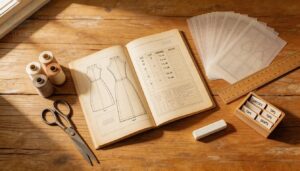
Once you’ve made sense of the pattern sheets, the instructions and index sections are what tie everything together. They tell you what to cut, how much fabric to buy, and in what order to sew.
Here’s what you’ll find inside this part of the book.
Index Pages Listing Pattern Numbers and Project Names
The index is your pattern book’s table of contents and inventory rolled into one. Think of it as a built-in Pattern Inventory Tracker using Numeric Sequencing Rules — pattern numbers run in order, each linked to a project name and page reference.
Use it for quick Project Name Indexing before you sew:
- Locate the pattern number fast
- Check Visual Cue Icons marking multi-size or tracing-required entries
- Note Page Number Referencing to jump straight to instructions
Fabric Recommendations and Required Notions
Each pattern lists fabric recommendations right on the page — your guide to smart fabric selection and fiber suitability before you touch your fabric stash. Fabric weight categories (light, medium, heavy) narrow your fabric inventory management instantly.
Notion pairing details cover zippers, buttons, and interfacing weights. Lining selection notes specify rayon or acetate by garment type. Care instructions flag dry-clean-only fabrics and prewashing needs for your sewing pattern catalog.
Yardage Tables by Size and View
Yardage tables do more work than most sewists realize. Each table pairs size grading with fabric width impact — if you switch from 45" to 60" fabric, your required length drops. Here’s what to track:
- View Comparison: View B often needs more yardage than View A.
- Nap Allowance: Add extra for directional or printed fabrics.
- Quarter Yard Rounding: Always round up, never down.
Cutting Layouts and Fabric Placement Diagrams
Cutting layouts tell you exactly where each piece lands on your fabric. Every diagram maps out Fabric Grain Mapping lines, marks Seam Allowance Markers, and flags Nap Direction for directional prints.
You’ll see which pieces need Fold vs Single layer cutting — a detail that quietly drives Waste Reduction. Treat these diagrams as your garment construction blueprint before any pattern tracing begins.
Step-by-step Sewing Sequence and Finishing Guidance
Think of the instruction pages as your project workflow map. Seam Order is laid out from prep through final stitch — smallest pieces first, then larger ones.
Stitch Types and Pressing Techniques are called out at each stage. Finishing Details like buttonholes and edge work follow fit checks.
Fit Adjustments go back on your pattern tracing for next time.
How to Read a Pattern Book Fast

Once you know how a pattern book is built, using it gets faster. The real skill is knowing exactly where to look and what to skip.
Here’s how to move through a pattern book without losing your place.
Matching The Garment Illustration to The Pattern Number
Every illustration-number link in a pattern book is your fastest shortcut.
Spot the garment sketch, read its number, then match it to the same number on your pattern sheet.
Letter alignment (A, B, C) tells you exactly which version you’re cutting.
Watch for thumbnail cue usage near index entries and color-coded size markers on sheet lines — those keep your pattern categorization accurate from the start.
Finding The Correct Instruction Page
Once you’ve matched your illustration, the instruction page is next — and finding it fast separates a confident sewist from a frustrated one.
- Page Number Pairing links your pattern number to its exact instruction section using a two-digit cross-reference.
- Icon Highlight System and Color Tab Markers flag the right page instantly.
- Margin Note Cues confirm fabric and notions at a glance.
Identifying The Right Size Line on The Sheet
Once you’ve found your instruction page, the pattern sheet is where precision takes over.
Look for the size line at midline positioning — centered on each piece, labeled clearly with its size number. grid intersection points help you confirm alignment. arrow marker guidance points to grainlines. Check the color key for size line labeling, then use scale bar verification to lock in accuracy.
Tracing Only The Needed Pieces
Selective tracing starts the moment you confirm your size line. Mark only view-specific lines using overlay color coding — a quick pass with a colored pencil separates your pieces from the noise.
Follow the master trace line, transfer each notch carefully, and keep pattern pieces separate on your tracing paper. That clean separation becomes your mockup of the garment before a single cut happens.
Avoiding Common Mistakes When Using Pattern Books
Clean tracing prevents most errors — but a few mistakes still sneak through. Size Line Confusion happens when overlapping sizes blur together on crowded sheets. Grainline Misalignment skews your entire cut. Notch Omission causes mismatched seams. Symbol Misinterpretation leads to wrong seam finishes.
Check your Labeling System, cross-reference Fabric Choice Errors against yardage tables, and your pattern reads cleanly every time.
Frequently Asked Questions (FAQs)
Can pattern books be used for fabric shopping?
Yes.
Pattern books include Fabric Choice Guidance, Yardage Calculation tables, Pattern Swatch Suggestions, Stretch Fabric Benefits notes, and Print Alignment Advice — making them a practical shopping reference before you buy a single yard.
How do you store a pattern book long-term?
Ironically, the more you love pattern books, the faster you’ll ruin them.
Keep humidity between 40–50%, use acid‑free archival sleeves, avoid heat and light, and schedule periodic inspection every six months.
Are pattern books suitable for complete beginners?
Pattern books can work for beginners. Look for ones with introductory glossaries, clear labeling, and basic measurement guidance.
Simple terminology and minimal fabric needs make early projects manageable without overwhelming your learning curve.
Can you mix pieces from different pattern books?
Mixing pieces from different pattern books is possible, but it demands careful Seam Allowance Matching and Size Chart Cross-Reference checks.
Always do a Muslin Test Fitting first to confirm fit before cutting your final fabric.
How often do pattern book editions get updated?
Editions update every one to three years for popular lines. Major overhauls happen every three to five years.
Seasonal edition releases drop once or twice yearly. Quarterly errata updates fix small errors between full revision cycles.
Conclusion
You might think understanding how sewing pattern books are organized is only for experienced sewers, but it’s actually within your reach. With practice, you’ll navigate these books with ease.
The system is designed to be logical and efficient. By grasping the layout and notation, you’ll open a world of creative possibilities. Mastering pattern books enables you to bring your fashion ideas to life with precision and confidence, every time you sew.