This site is supported by our readers. We may earn a commission, at no cost to you, if you purchase through links.
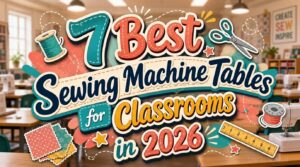
A wobbly table at the wrong height can unravel an entire class period faster than a tangled bobbin thread. Students fighting unstable surfaces spend more time steadying their machines than learning technique—and that’s a problem no curriculum can fix.
The right sewing machine tables for classrooms change that environment completely, turning a chaotic lab into a space where students actually focus on their work. From built-in power stations that eliminate cord clutter to locking casters that keep everything exactly where you placed it, today’s purpose-built options are a serious upgrade from the folding tables most programs still rely on.
These seven models deliver the stability, storage, and smart ergonomics your students deserve.
Table Of Contents
Key Takeaways
- A purpose-built classroom sewing table with locking casters, a steel frame, and built-in cable management eliminates the wobble and cord clutter that pull students’ attention away from actually learning to sew.
- Ergonomic height adjustability (ideally 28–40 inches) is non‑negotiable if your lab serves students of different ages and sizes, since the wrong surface height quietly causes wrist strain and bad posture habits that are hard to undo.
- Smart storage features—locking cabinets, pull‑out machine shelves, and built‑in notion trays—aren’t extras; they’re what keep expensive equipment secure and class transitions from eating up half your lesson time.
- Before buying, match each table’s cutout dimensions and weight rating (305 lbs minimum) to your heaviest machines, because a table that can’t handle your equipment will cost you more in repairs and frustration than you saved upfront.
Best Sewing Machine Tables for Classrooms
Finding the right sewing table for your classroom makes a bigger difference than most people expect. The seven options below cover a range of sizes, budgets, and features worth considering before you buy. Take a look and see which one fits your students best.
If you’re pairing a table with a capable mid-range machine, a comprehensive Singer 9960 review can help you understand exactly what features your students will be working with.
1. Giantex Foldable Sewing Table With Power
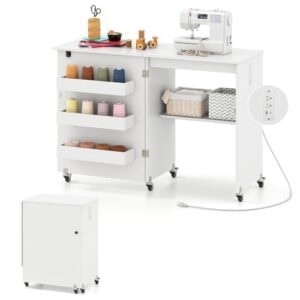
The Giantex Foldable Sewing Table With Power is a smart pick for classrooms short on space. It unfolds to 45.5" × 16" and folds back to 35" × 20" when not in use.
A built-in power strip with two AC outlets, one USB, and one USB‑C port keeps machines and devices running without cord chaos.
Three lockable casters hold it steady mid‑lesson. Three side bins and an open shelf handle everyday supplies comfortably.
| Best For | Crafters, students, and small-space dwellers who need a flexible workstation that can fold away when the day’s done. |
|---|---|
| Tabletop Width | 45.5 in |
| Table Height | 31 in |
| Material | Engineered wood |
| Storage Included | 3 bins + shelf |
| Color Finish | White |
| Mobility | 5 casters (3 lockable) |
| Additional Features |
|
- Folds down quickly to save floor space — great for apartments, dorms, or shared rooms
- Built-in power strip with AC outlets, USB, and USB-C keeps everything charged without a tangle of cords
- Rolls where you need it and locks in place, so it stays put while you work
- Assembly can take 2–3 hours, and the illustrated instructions aren’t always easy to follow
- The tabletop can fold on you if it’s not locked properly — something to watch out for mid-project
- Storage bins are on the smaller side, so bulky fabric rolls or larger tools won’t fit comfortably
2. Vividwood Large Sewing Machine Table
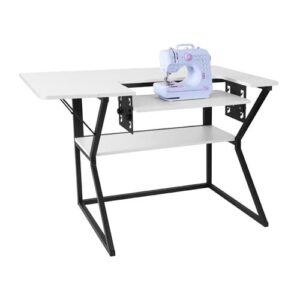
The Vividwood Large Sewing Machine Table steps things up when you need serious workspace.
Its 45.5" × 23.5" main surface gives students room to handle full fabric lengths without crowding, and the 9.5" fold-away side shelf adds extra space when needed.
The adjustable machine platform fits different machine heights, while four floor levelers keep everything steady.
A lower storage shelf keeps supplies within reach.
It’s straightforward to assemble and easy to wipe clean between classes.
| Best For | Students and hobbyists who need a roomy, organized workspace for sewing, quilting, or crafting projects. |
|---|---|
| Tabletop Width | 45.5 in |
| Table Height | 30 in |
| Material | Engineered wood + steel |
| Storage Included | Lower shelf |
| Color Finish | White |
| Mobility | 4 floor levelers |
| Additional Features |
|
- Big 45.5" surface gives you plenty of room to spread out fabric without things spilling off the edge
- The adjustable machine platform works with different machine heights and doubles as a laptop stand
- Lower storage shelf keeps your tools and supplies right where you need them
- High-speed sewing can cause noticeable vibration, especially with the platform set low
- Assembly takes up to an hour and the included screwdriver might not cut it
- The frame may not hold up well under heavy industrial machines
3. Sew Ready Folding Multipurpose Sewing Table
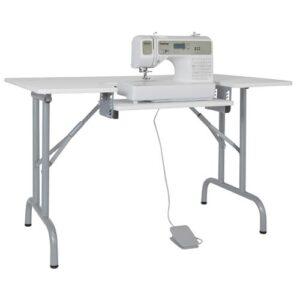
If your classroom space is tight, the Sew Ready Folding Table is worth a close look. Its 47.5-inch wide surface accommodates full fabric layouts comfortably, and the drop-down platform adjusts across six height settings to fit different machines and students.
When class ends, the legs fold flat for closet storage.
One heads-up: tighten all hinge screws during setup. Loose hardware causes wobble — something you don’t want mid-lesson.
| Best For | Teachers and hobbyists with limited space who need a flexible, multi-use sewing or craft surface they can tuck away when not in use. |
|---|---|
| Tabletop Width | 47.5 in |
| Table Height | 30 in |
| Material | Alloy steel frame |
| Storage Included | Drop-down shelf |
| Color Finish | White |
| Mobility | Fold-away legs |
| Additional Features |
|
- Wide 47.5-inch surface gives you real room to spread out fabric or supplies
- Drop-down shelf adjusts to six heights, so it plays nice with different machines
- Folds flat fast — closet, under a bed, behind a door, no problem
- Legs can wobble if hinge screws aren’t fully tightened — check them before every use
- Assembly instructions are confusing, and legs aren’t interchangeable, so it’s easy to install them wrong
- Heavier machines may cause the tabletop to bow, so it’s not built for industrial-weight equipment
4. VEVOR Foldable Sewing Table
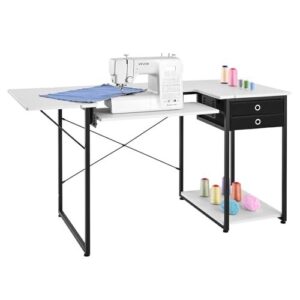
The VEVOR Foldable Sewing Table is a solid pick when you need flexibility without sacrificing workspace. Unfolded, it gives you a spacious laminate surface for machine sewing and fabric layout. When class ends, it folds down to cabinet size — no hunting for storage space.
Pair it with good posture habits and the right setup adjustments from this guide on ergonomic sewing space design to keep fatigue at bay during long sessions.
Three swiveling wheels with two locking casters keep it steady once positioned. The built-in shelves and magnetic door keep notions organized and dust-free between sessions.
| Best For | Sewers, quilters, and crafters who want a versatile workstation that pulls double duty as a desk or art table without eating up permanent floor space. |
|---|---|
| Tabletop Width | 54.92 in |
| Table Height | 29.92 in |
| Material | MDF + carbon steel |
| Storage Included | 3 drawers + shelf |
| Color Finish | White |
| Mobility | Fixed feet |
| Additional Features |
|
- The fold-out side shelf is a game-changer for big fabric pieces — extra surface when you need it, gone when you don’t.
- Three drawers plus an open shelf keep thread, scissors, and notions right where you can grab them.
- The adjustable shelf fits different sewing machine bases and works as a laptop platform too, so the table grows with your setup.
- At nearly 43 lbs, you’ll probably want a second person if you’re moving it around the room.
- MDF doesn’t love moisture, so spills need a quick wipe and occasional sealing to keep the surface looking good.
- The side shelf can shift a bit under uneven load — you’ll want something heavier anchoring it to keep things stable.
5. Best Choice Folding Sewing Table
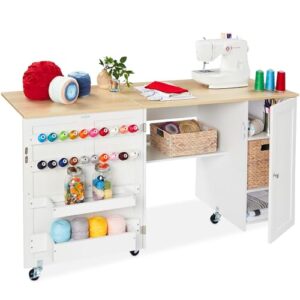
If your classroom doubles as a tight storage space, the Best Choice Folding Sewing Table earns a real look. It unfolds to a generous 62-inch work surface and folds back into a compact side table when you’re done — no wasted floor space.
Built-in pegboard rows and storage trays keep scissors, thread, and notions within reach. Locking casters make repositioning simple. Just note the fixed-height top and MDF build, which don’t match the durability of solid-wood alternatives.
| Best For | Sewists and crafters in small spaces who need an organized, mobile workstation that can disappear into the room when not in use. |
|---|---|
| Tabletop Width | 62 in |
| Table Height | 31.25 in |
| Material | MDF + metal |
| Storage Included | Pegboard + cabinet + trays |
| Color Finish | Natural/White |
| Mobility | Lockable casters |
| Additional Features |
|
- Folds down to a side table, so it earns its floor space even on off days
- Pegboard rows, storage trays, and a three-section cabinet keep everything in arm’s reach
- Locking casters make it easy to roll out, set up, and tuck away without hassle
- Assembly takes a few hours and goes much smoother with a second set of hands
- The fixed-height top means you can’t adjust the surface to match your sewing machine
- MDF construction feels less solid than wood, and the magnetic door catches can be a bit flimsy
6. Adjustable Folding Sewing Table With USB
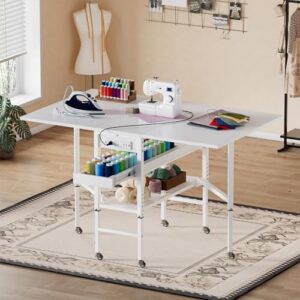
The Adjustable Folding Sewing Table With USB is a smart pick when your classroom needs flexibility without sacrificing function.
It folds down to just 12.2 inches for storage, then opens to a full 50‑inch surface — enough room for cutting and machine work.
Height adjusts from 33.58 to 39.49 inches, and the built‑in AC outlet plus dual USB ports keep machines and devices powered at the station.
Lockable casters let you move it where you need it.
| Best For | Sewers and crafters who need a flexible, space-saving workstation that can move around and keep devices powered without a tangle of extension cords. |
|---|---|
| Tabletop Width | 50 in |
| Table Height | 33.58–39.49 in |
| Material | MDF + steel frame |
| Storage Included | 2 shelves |
| Color Finish | White |
| Mobility | 2 casters + 4 fixed feet |
| Additional Features |
|
- Folds down to 12.2 inches, so it tucks away easily when you’re done
- Height adjusts up to 39.49 inches, making it easier on your back during long sessions
- Built-in AC outlet and dual USB ports keep your machine, iron, and lights all powered from one spot
- Assembly instructions can be confusing, and some users found they needed extra hardware to get it solid
- At its lowest setting (33.58 in), it may still feel too tall for shorter users
- Only one AC outlet means you might still need a power strip if you’re running multiple devices
7. DWVO Folding Sewing Table with Power Station
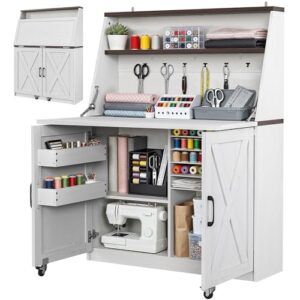
The DWVO Folding Sewing Table earns its spot in a classroom that’s always short on space. It folds to a slim 9.44-inch profile, then opens to a full work surface when you need it.
The built-in power station — two AC outlets plus USB charging — keeps machines and devices running without cord clutter. Locking casters hold it steady during use.
One heads-up: anchor it to the wall if your students load it up.
| Best For | Teachers, crafters, or home sewists who need a flexible workstation that can disappear into a corner when class is over. |
|---|---|
| Tabletop Width | 44.48 in |
| Table Height | 22.24 in |
| Material | Wood + metal hardware |
| Storage Included | Dual shelves + compartments |
| Color Finish | White |
| Mobility | Lockable wheels |
| Additional Features |
|
- Built-in power station (2 AC outlets 2 USB ports) keeps everything plugged in and tidy
- Folds down to under 10 inches wide — easy to tuck away when you’re done
- Locking wheels mean you can roll it where you need it and keep it there
- Assembly can be a headache — instructions are vague and screws strip easily
- The lower shelf might be too short for larger machines like the Juku NX
- At nearly 74 lbs, it needs to be wall-anchored if you’re loading it up with gear
Classroom Table Features That Matter
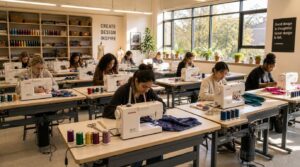
Not every sewing table is built for the demands of a busy classroom, and the difference shows up fast. When you’re managing multiple students and machines at once, certain features go from "nice to have" to absolutely essential. Here’s what to look for before you buy.
Stable, Wobble-resistant Construction
A wobbly table mid-seam isn’t just frustrating — it’s a safety risk. That’s why steel frame design matters so much in a shared lab.
Dual-column legs deliver 30% more lateral stiffness, while corner gussets keep every joint square under daily student use. Combined with precision tolerances within ±0.5 mm, you get genuinely wobble-free, durable construction, your whole class can count on.
Using cold‑rolled steel frames further reduces sway at full height.
Scratch-resistant Work Surfaces
Every pin, ruler, and scissor blade that slides across your table is a small test of its surface — and in a busy classroom, those tests happen hundreds of times a day.
The almond-colored plastic laminate top, bonded to a plywood core and sealed with a UV-cured clear coat, withstands that daily wear without chipping, dulling, or staining.
- Mohs-rated scratch resistance keeps surfaces intact under metal tools
- Moisture and stain resistance maintains the laminate’s color over time
- Matte texture options hide minor scuffs between classes
- Mild soap and water cleans without damaging the finish
That combination of UV finish and high-pressure laminate makes these tables genuinely reliable classroom furniture for home economics labs.
Locking Storage Cabinets
A sewing lab holds expensive machines, sharp tools, and a room full of curious hands — locking storage cabinets make that combination manageable.
Each cabinet features a five-pin keyed cylinder that engages a steel strike plate, while anti-pry door lips resist forced entry.
For shared spaces, Bluetooth and RFID integration pairs with student IDs, and electronic keypads issue temporary codes for guest instructors.
Built-in Cable Management
Locking down your machines is one thing — but loose cables are their own classroom hazard.
Built-in cable management keeps cords routed cleanly along the table’s underside through cable raceway channels, usually one to two inches wide, with snap-on covers that hide wires without tools. A single grommet cord pass at the rear corner guides power and data cables from tabletop to storage below.
Easy-clean Laminate Tops
Cable chaos handled — now let’s talk surfaces.
The almond-colored plastic laminate top on a quality sewing station does more than look clean. It is clean-friendly. The non-porous surface resists coffee, ink, and fabric dye with a simple damp wipe, while edge protection seals the perimeter against moisture seeping into the core — keeping your classroom furniture looking sharp for years.
Ergonomics for Student Sewing Labs
A poorly designed table doesn’t just cause discomfort — it gets in the way of learning. When students are hunched over the wrong height or straining to reach the needle, their focus shifts from the stitch to the ache. Here are the ergonomic features worth looking for in any classroom sewing lab.
A poorly designed sewing table doesn’t just cause discomfort — it gets in the way of learning
Seated Sewing Height
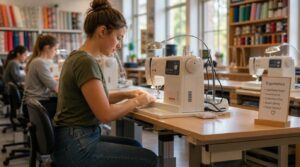
Getting elbow height alignment right is the foundation of a comfortable sewing session. When your forearms rest at roughly a 90-degree angle, wrists stay neutral and shoulders stay relaxed — exactly what your students need during long lab periods.
A good adjustable height table accommodates the full student height range with these seated priorities in mind:
- Ergonomic posture support starts at 28–30 inches for most adult learners
- Adjustable seat height lets shorter or younger students keep feet flat on the floor
- Memory height settings allow instructors to switch configurations between classes instantly
- Variable heights down to 28.7 inches accommodate beginners still building machine control
An ergonomic sewing workstation with an adjustable work surface removes the guesswork, so every student sits correctly from the first stitch.
Standing Cutting Height
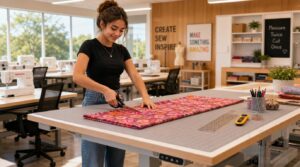
Seated posture sets the stage — but once your students move to cutting, the whole equation changes. Standing calls for a higher surface, usually aligning the tabletop at elbow-to-waist level so arms can press firmly through fabric without hunching.
An adjustable cutting table with a range reaching 40 inches manages this shift cleanly, keeping your lab safe and posture-friendly.
Adjustable Leg Options
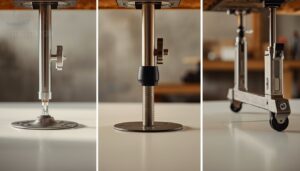
How a table holds its height — and how easily you can change it — makes a real difference across a classroom of students at different stages.
Here are three leg systems worth knowing:
- Threaded leg design lets you fine-tune height by rotating the leg end incrementally.
- Locking collar system secures your chosen position so nothing drifts mid-project.
- Folding leg mechanism collapses compactly for storage between sessions.
Reduced Wrist Strain
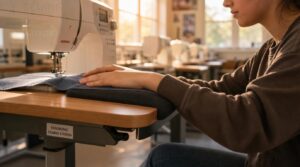
Wrist strain creeps in quietly — and by the time students notice it, bad habits are already forming.
Adjustable height settings position the machine surface at or slightly above elbow height, reducing wrist flexion during long stitching runs.
Wrist resting surfaces with foam or gel blends distribute pressure away from the carpal tunnel, and movement break protocols every 20 minutes help reset posture before fatigue sets in.
Younger Student Accessibility
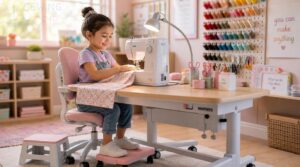
Not every student walks into the home economics classroom at the same height — and your setup should account for that. Portable step stools and pullout shelves bring machines to reachable levels without awkward lifting.
Adjustable footrests, task lighting, and kid-scale tools keep younger learners comfortable and focused, while quiet operation and locking wheels make the student workspace feel secure and steady.
Storage and Safety Considerations
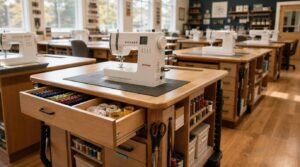
A good classroom table doesn’t just hold a sewing machine — it keeps everything organized and students safe while they work. The right storage features can make a real difference, from keeping machines secure to managing all those notions that somehow end up everywhere. Here’s what to look for.
Locking Machine Compartments
A sewing room without locked compartments is an open invitation for missing machines and tangled cords.
Cam lock systems use a simple 90-degree key rotation to secure each machine housing firmly against a strike plate.
Quality units feature steel reinforcement with corrosion-resistant finishes, and anti-pick features like rotating pins keep compartments tamper-resistant — giving you real peace of mind between classes.
Soft-close Drawer Slides
That satisfying quiet close isn’t just a nice feature — in a busy lab, it’s a safety must.
Hydraulic dampers decelerate each drawer through the final inch or two of travel, preventing slams that could startle students or damage delicate notions. With full extension, side-mounted glides, you get complete drawer access and silent closing that keeps your classroom calm and focused.
Pull-out Machine Shelves
Pull-out machine shelves are what separate functional educational furniture from equipment that fights you every time class starts. Heavy-duty rails with smooth glide action let students deploy their machines quickly and return them just as easily.
- Non-slip coating keeps machines steady during setup
- Variable height settings adapt each pullout shelf to different machine footprints
- Safety stops prevent over-extension at student workstations
Notion Tray Organization
Once the machine is back on its pullout shelf, the real test of a well-designed workstation begins—keeping tools exactly where students can find them. Built-in notion trays give every pin, seam ripper, and thread cutter a home. Modular tray inserts and adjustable compartment sizes let you reconfigure the accessory tray to match each project without any tools.
Color-coded sections and clear storage zones mean students spend less time hunting and more time sewing.
Locking Caster Mobility
Once your notion trays are sorted, the next thing keeping your classroom running smoothly is locking caster mobility. Locking casters let you reconfigure your portable sewing table in seconds — no heavy lifting, no wasted class time. Lock them down, and the table stays put through every stitch.
- Single lock stops wheel rolling only.
- Double lock freezes both wheel and swivel.
- Polyurethane wheels protect floors while supporting heavy school equipment.
Choosing Classroom Sewing Tables
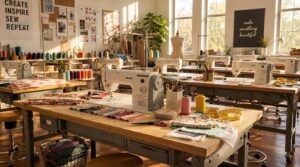
Picking the right table for your classroom comes down to a few key factors that actually matter in daily use. Before you spend the budget, here’s what to look at closely. These five checkpoints will help you make a confident, practical choice.
Match Table to Machines
Before you buy a single table, check that your heaviest machine actually fits it. Each sewing machine’s machine footprint should stay within 20 by 18 inches to align with standard cutout dimensions. The universal 31 × 15.5-inch recess accommodates most domestic and light-industrial models, so confirm your machine qualifies before ordering.
| Machine Type | Footprint (W × D) | Compatible Cutout |
|---|---|---|
| Standard domestic | 18 × 16 in | Universal 31 × 15.5 in |
| Light industrial | 20 × 18 in | Universal 31 × 15.5 in |
| Overlocker/serger | 16 × 14 in | Universal 31 × 15.5 in |
A table’s weight rating matters too — aim for 305 lb minimum so heavier machines and student pressure don’t cause flex or wobble. Good vibration isolation keeps stitching accurate across every seat in the lab.
Compare Footprint and Layout
Once your machines fit the cutouts, think about how the tables fit the room. A compact rectangular footprint keeps rows straight and aisles clear — aim for at least 42 inches between rows.
Single-unit models work in tighter labs; double-unit configurations suit larger spaces and reduce per‑student crowding.
Adjustable footprints and modular sewing furniture let you reconfigure the room grid quickly when class sizes shift.
Check Weight Capacity
Weight capacity is one spec you don’t want to gloss over. Heavy-duty tabletop designs support up to 305 pounds — enough for industrial machines, student pressure, and cutting work combined.
Look for certified load test results and a built-in safety margin of at least 20 percent. A strong leg system with cross-bracing ensures sewing table stability even during high-speed stitching.
Review Warranty Coverage
A limited lifetime warranty is your safety net when classroom wear takes its toll. Before you buy, check what the coverage scope actually includes — frame, tabletop, finish, and functional defects should all be listed.
Key things to confirm:
- Parts coverage for components that fail under normal use
- Claim process requirements like proof of purchase and serial numbers
- Transferability terms if your school upgrades or reassigns equipment
Watch the exclusions list carefully — misuse and unauthorized repairs are commonly denied.
Prioritize Durable School Use
School environments are tough on furniture — machines vibrate, surfaces take spills, and tables get moved constantly. That’s why material longevity matters more than price.
Look for UV-protected maple frames, moisture-resistant laminate tops, and vibration-dampening construction. A heavy-duty tabletop rated for 300+ pounds supports industrial machines without flex.
US-made educational hardware commonly outlasts imports, making it the smarter long‑term investment for your lab.
Frequently Asked Questions (FAQs)
Are sewing tables compliant with U.S. manufacturing standards?
Yes, these tables comply with U.S. manufacturing standards, meeting OSHA guarding requirements, CARB emission compliance, and lead content limits — built domestically as certified, durable classroom equipment you can trust.
Can tables accommodate both single and double classroom units?
Most tables support single or double unit configurations. With locking caster flexibility and a modular design, you can reconfigure your sewing classroom setup quickly — joining tables into dual rows for collaborative work without gaps or wasted space.
How many custom machine insert patterns are available?
Over 4,000 custom insert patterns are available to fit virtually any machine model. Qualifying purchases even include a free laser-cut acrylic insert, making compatibility straightforward for your classroom setup.
Is free shipping available for qualifying classroom orders?
Free shipping applies to orders over $135, covering most classroom furniture shipped within the contiguous United States. Verify eligible products at checkout, as some exclusions apply and seasonal promotions may adjust thresholds.
Conclusion
Steady surfaces shape skilled sewists. When your sewing machine tables for classrooms are built for real student use—stable legs, smart storage, clean cable runs—the whole lab runs differently.
Students stop wrestling with wobble and start actually learning. Every seam they practice becomes more confident, every project more complete.
Choose tables that match your machines, your space, and your students’ reach. The right setup doesn’t just furnish a room; it builds a program.
- https://www.sewperfecttables.com
- https://www.tigheflanagan.com/blogs/news/building-an-adjustable-height-sewing-workstation
- https://gwenstellamade.com/tutorials/making-the-best-adjustable-sewing-and-cutting-table
- https://brooksann.com/diy-professional-sewing-room-table
- https://www.nascoeducation.com/family-consumer-sciences/classroom-furniture/sewing-machine-workstations.html