This site is supported by our readers. We may earn a commission, at no cost to you, if you purchase through links.
The difference between a forgettable embroidery piece and a stunning one often comes down to a single spool. Choose the wrong shade, and even perfect technique disappears into the fabric—or fights against it.
Selecting embroidery thread shades is less about personal preference and more about understanding how color behaves on textured surfaces, under different lighting, and alongside other threads. A gold that glows on cotton can look muddy on fleece. A deep navy that reads crisp on linen can vanish on denim.
The principles behind smart shade selection are learnable, repeatable, and worth knowing before you make your next cut.
Table Of Contents
Key Takeaways
- Your fabric isn’t just a backdrop — its texture, dye, and sheen actively change how thread color reads, so always test on the actual material before committing.
- Build your palette around 4–6 shades using the 60-30-10 rule: one dominant color sets the mood, a secondary adds depth, and a small accent pulls the eye where you want it.
- Run a sample stitch-out under both daylight and LED lighting every time, since the same thread can read as two completely different shades depending on the light source.
- Consistency across production runs depends on disciplined record-keeping — log your thread brand, color code, lighting conditions, and client sign-off for every job you complete.
Start With Color Theory Basics
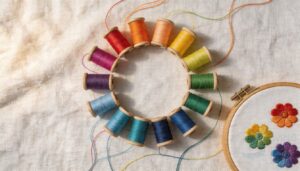
Before you pick a single spool, you need a working grasp of how color actually behaves. Color theory gives you a reliable framework for making smart thread choices every time.
Pairing that knowledge with color-matching thread to your sewing machine brand takes the guesswork out of getting consistent, true-to-life results.
Here are the core concepts worth knowing before you stitch a single strand.
Hue, Saturation, and Value in Thread Selection
Every strong design starts with three fundamentals: hue (the color family, like red or blue), saturation intensity (how vivid or muted a thread looks), and value shading (how light or dark it reads). Together, these form the backbone of hue saturation value in color theory for embroidery.
Nail all three, and your thread selection guidelines practically write themselves.
Consider complementary color schemes to enhance hue contrast.
Warm Vs. Cool Shades in Embroidery
Once you’ve got hue, saturation, and value locked in, color temperature becomes your next decision. Warm colors — golds, corals, ambers — advance visually and glow under incandescent lighting effects. Cool colors — blues, teals, purples — recede calmly, reinforcing color harmony on busy backgrounds.
Here’s how temperature shapes your work:
- Mood Associations — Warm threads feel cozy; cool threads feel crisp.
- Seasonal Color Trends — Warm palettes suit autumn; cool tones reflect spring.
- Cultural Symbolism — Red signals energy; blue conveys trust.
- Color Temperature Pairings — Warm thread on cool fabric creates stunning color contrast.
Using Contrast to Improve Stitch Visibility
Color temperature sets the mood, but visual contrast controls whether your stitches actually read clearly.
Aim for a value step difference of at least two steps on your thread guide. That gap sharpens edge definition techniques like satin and backstitch outlines. Without enough fabric color contrast, even precise stitching disappears. Follow basic contrast ratio guidelines — light thread on dark fabric never fails.
Creating Depth With Light and Dark Values
Contrast keeps stitches visible — but value contrast does something deeper. It builds dimension right into your design.
Think of it like sculpting with thread. Light and dark shades placed intentionally create the illusion of form on flat fabric.
- Use highlight placement on raised or forward-facing areas
- Apply shadow layering where form curves away from light
- Bridge gaps with midtone blend threads
- Build a value gradient from light to dark
- Trust shade variation to strengthen depth perception
Build a Balanced Thread Palette
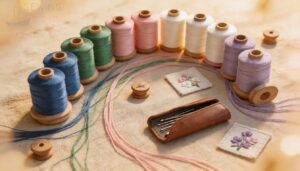
Picking the right shades is only half the job — arranging them into a palette that actually works together is where the real skill lives. strong palette gives your design structure, balance, and a clear visual story from the first stitch to the last.
what you need to know to build one that holds together.
Choosing 4–6 Shades for Cohesion
Four to six shades hit the sweet spot for Palette Size Optimization in embroidery. More than six fragments your design; fewer than four flattens it.
Apply Hue Family Consistency by keeping all shades rooted in one color family. Then use Value Gradient Planning and Saturation Balance to build natural depth.
Think of it as Temperature Pairing Logic — your palette should feel unified, not competing.
Applying The 60-30-10 Color Rule
Think of your palette as a stage: Dominant Shade Emphasis fills 60% of the design, setting the overall mood. Secondary Shade Harmony covers 30%, adding depth. Accent Allocation claims just 10%, drawing the eye to key details.
This Ratio Visualization keeps color harmony principles working together — use it as your Color Balance Checklist when applying the 60-30-10 rule to embroidery designs.
When to Use Monochromatic Palettes
When your design needs to feel polished without visual noise, a monochromatic color palette is your strongest tool. It’s ideal for:
- Brand Identity Consistency across corporate embroidered uniforms.
- Minimalist Design Aesthetic on heirloom or quiet textile pieces.
- Fabric Pattern Overload situations where busy backgrounds need calm thread work.
Strong value contrast keeps Accessibility Contrast Needs met within color harmony — no extra hues required.
When to Use Complementary Palettes
Nothing grabs attention quite like two colors sitting directly opposite each other on the color wheel. That tension is exactly what makes a complementary color palette so powerful in embroidery.
| Design Scenario | Complementary Color Strategy |
|---|---|
| Logo Emphasis | Bold dominant hue, bright complement accent |
| Seasonal Mood | Warm dominant, cool complement at reduced saturation |
| Geometric Rhythm | Alternate the pair across pattern sections |
| Portrait Highlighting | Subtle complement to define facial features |
| Childrens Playful Designs | Light, bright variants of the complementary pair |
Strong color coordination through color theory keeps your color harmony intact without flattening the design’s energy.
When to Use Analogous Palettes
An analogous color palette is your go-to when the design needs to feel unified rather than dramatic. These color harmony techniques in multicolor embroidery shine in mood-driven hue selections like seasonal harmony florals or nature scenes.
Choose analogous colors when you want:
- A subtle gradient across petal or leaf shapes
- Fabric undertone match on midtone textiles
- Smooth tonal flow in landscape or botanical designs
- Brand consistency in soft, professional corporate pieces
- Depth through analogous color palette techniques for embroidery without high-contrast jumps
Adjacent hues create cohesion naturally.
When to Use Split-complementary Palettes
Split-complementary palettes give you vivid Small Detail Drama without the visual clash of direct complements. Pick a base color, then use the two hues flanking its opposite — that’s your split complement.
This Warm-Cool Balance keeps designs lively yet controlled.
Apply Saturation Adjustment to the side colors for Texture Highlighting on satin stitches.
It’s a smart color harmony technique in multicolor embroidery for Brand Storytelling.
When Triadic Palettes Suit Bold Designs
Step beyond split-complementary and you’ll find Triadic Energy — three hues spaced evenly on the wheel. This creates Bold Harmony with built-in Visual Rhythm. Apply the Color Hierarchy using 60-30-10 distribution:
- Dominant hue anchors the design.
- Supporting hue builds depth.
- Vibrant Accent pulls the eye.
It’s one of the strongest color harmony techniques in multicolor embroidery.
Match Shades to Fabric Color
Your thread color doesn’t exist in a vacuum — the fabric underneath is always part of the picture. Getting that relationship right is what separates a sharp, professional finish from one that falls flat.
Thread color never works alone — the fabric beneath is always part of the design
Here’s what you need to know about matching shades to your fabric.
Light Thread on Dark Fabric
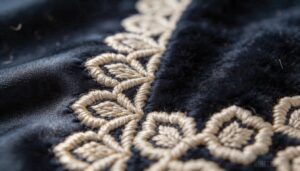
When you place light thread on dark fabric, the contrast does most of the work for you. Fiber reflectivity impact is real — smooth fabrics enhance brightness, while fleece dulls it.
Prioritize stitch length optimization with shorter lengths to close gaps.
Choose ivory over stark white to avoid harsh glare, and manage thread lint on dark backgrounds proactively.
Dark Thread on Light Fabric
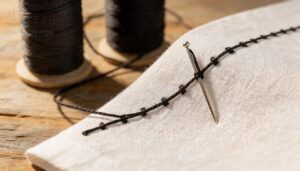
Dark thread on light fabric gives you sharp edge definition — think black backstitch on white linen.
Fabric sheen interaction matters here: smooth cotton preserves crispness, while heathered blends soften contrast slightly.
For bright light visibility, matte dark threads outperform glossy ones by reducing glare.
Prioritize thread sheen choice and color shift prevention through a quick test stitch to confirm your shade reads true.
Using Outline Stitches for Low Contrast
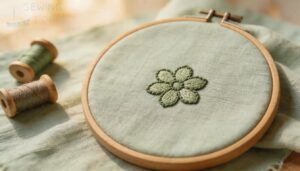
When thread and fabric tones sit close together, a well-placed outline stitch rescues subtle edge definition without forcing harsh contrast.
Thread line weight and stitch density balance both shape how clearly that line reads:
- Match thread shade to the fabric’s undertone for fabric tone harmony
- Choose matte cotton for soft, clean outline visibility tactics
- Apply color harmony principles to keep fills and outlines unified
- Use thread shade identification to select one value step darker or lighter
- Document choices through color palette documentation for repeat consistency
How Fabric Color Affects Sparse Stitching
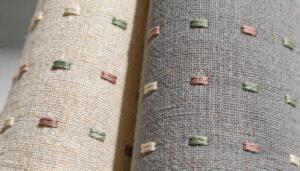
Sparse stitching lets the fabric breathe — but that exposure means fabric color quietly shapes how your thread reads. Undertone shifts from warm creams or cool grays can pull your shade off-target.
Fabric reflectivity impact, fabric texture, and lighting conditions all influence sparse gap clarity. Apply value differential tuning and watch lighting angle effects to keep your shade matching sharp and intentional.
How Dense Stitching Changes Perceived Shade
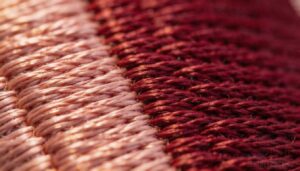
When you pack stitches tightly, thread overlap saturation kicks in — layers of thread stack and deepen the color beyond what the spool suggests. Stitch density impact is real, and it’s easy to underestimate.
Watch for these shade-shifting effects:
- Thread overlap saturation darkens midtones noticeably
- Light scattering effects intensify under bright daylight
- Fabric translucency influence decreases as gaps close
- Angle-dependent color shift alters perceived warmth or coolness
- Underlay and stitch density together can push shades darker
Picking Shades for Small Embroidered Details
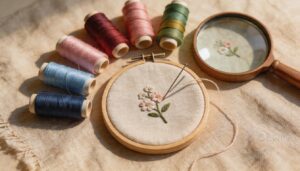
Small details punish poor shade choices fast. Your color palette for miniature work needs high value contrast, not just hue variety — a mid-value thread keeps tiny features readable without halos. Thread Pairing Strategies and Miniature Gradient Techniques matter here.
| Detail Size | Recommended Approach | Key Consideration |
|---|---|---|
| Tiny (under 5mm) | High contrast, single hue | Color Shift Compensation |
| Small (5–10mm) | Analogous thread palette | Thread Twist Consistency |
| Medium (10–20mm) | Embroidery Design Scaling with 3 values | test stitch-out under varied lighting conditions on matching fabric texture |
Consider Fabric Texture and Finish
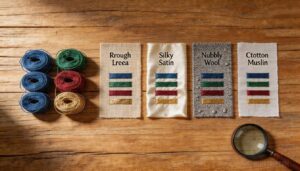
Fabric texture plays a bigger role in your final color result than most people expect. The surface your thread lands on can either lift a shade to its full potential or quietly drain it of life.
Here’s what you need to know before you commit to any thread choice.
How Denim, Fleece, and Leather Affect Color
Your fabric isn’t just a background — it’s an active participant in your color story. Fabric texture and fabric compatibility directly shape how thread shades read in the final piece.
- Denim dye bleed shifts light threads warmer over time, especially when moisture-driven hue change occurs during washing.
- Fleece color dampening softens bright threads; brushed fibers scatter light unevenly, muting vivid saturation.
- Leather surface absorbency pulls dye from threads, subtly altering the shade you carefully selected.
- Heat-induced shade shift on fleece intensifies during drying, affecting nearby embroidery colors.
- Fabric background influence on thread color is strongest on raw denim, where indigo undertones cool every stitch visually.
Why Smooth Fabrics Preserve Thread Sheen
Smooth fabric is a quiet hero for thread sheen. Its even surface enhances surface light reflection, bouncing light uniformly along every stitch.
Friction reduction keeps filaments intact, enabling micro-scratch prevention and gloss retention over time. Heat distribution uniformity protects silk and rayon from color shift.
When fabric texture is flat, the impact of fabric texture on thread visibility stays consistently stunning — your threads simply glow.
Matte Vs. Glossy Thread Appearance
Thread finish shapes how your design reads before anyone looks closely.
Matte threads deliver matte subtlety — a soft, velvety look with no glossy hotspots — making them ideal for intricate details where glare would blur fine lines.
Shiny threads boost perceived brightness but shift color with angle shift.
For visual depth, matte’s fingerprint resistance and consistent tone often win on textured fabrics.
Choosing Rayon, Polyester, Cotton, or Silk
Once you’ve settled on finish, the fiber itself becomes your next decision.
Rayon threads bring high gloss and fluid drape, but lower tensile strength — handle them gently. Cotton threads offer breathable softness and matte subtlety. Silk threads deliver unique sheen characteristics with natural temperature regulation.
Polyester wins on fiber durability, cost efficiency, and care instructions.
Match your thread material and sheen to the job.
Using Metallic and Neon Shades Carefully
Beyond fiber choice, finish type opens a new set of decisions — especially with metallic threads and neon shades.
Limit both to 2–3 accents per design. A metallic thread snag on rough fabric can unravel fine details quickly, so smooth grounds work best.
Use neon outline usage on focal elements only. Apply sealant application at thread starts to reduce fraying. Always make thread density adjustments and test contrast balance under your actual lighting conditions.
Preventing Color Dullness on Textured Surfaces
Textured surfaces like fleece and denim scatter light, making even vivid threads look flat. That’s where surface priming, stitch density, and fiber pile management work together.
Even out raised fibers before stitching, then use dense satin stitches to enhance light scattering control. Add subtle reflective accents — a strand of iridescent thread lifts the whole palette.
Always test under consistent lighting conditions for reliable results.
Test Shades Before Final Stitching
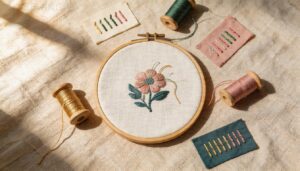
Skipping a test stitch-out is one of the fastest ways to ruin an otherwise solid design. Colors behave differently once thread meets fabric, tension, and light — and you won’t know that until you actually run a sample.
Here’s what to check before you commit to full production.
Doing a Sample Stitch-out First
Run sample testing procedures on your actual fabric, including fabric pre-wash impact checks, before finalizing anything. This single step catches color bleed detection issues, thread breakage monitoring needs, and lighting condition replication gaps early.
- Use sample size optimization: stitch at least a 3-inch patch
- Test on pre-washed and unwashed fabric versions
- Replicate your client’s exact lighting environment during review
Checking Shade Shifts After Stitching
Once your sample stitch-out dries, compare it directly against your original spool under the same light source. Shade shift documentation matters here — note whether the stitched color reads warmer, cooler, darker, or lighter.
Dense fills especially deepen perceived tone through thread fabric interaction. Log every observation with a photo timestamp.
Catching post-processing color change early prevents costly surprises during full production runs.
Comparing Thread Under Daylight and LED Light
Once your stitch-out is ready, evaluate it under both natural daylight and LED lamps — this lighting consistency check reveals metamerism impact, where the same thread reads differently depending on the light source.
Cool LED spectral shift (~6500K) boosts blues and greens, while warm LEDs mute them.
Daylight color fidelity remains your most reliable baseline for visual shift analysis and accurate color calibration.
Spotting Screen-to-thread Color Mismatches
Even a perfectly calibrated screen can fool you — displays set above 1200 nits overstate saturation, causing color mismatches between your digital preview and stitched result. Dial down Screen Brightness Settings and enable Display Calibration to improve Digital Preview Validation.
Always cross-check using thread color cards under consistent lighting conditions, since metamerism shifts shades unexpectedly.
Digital color matching apps help, but Ambient Light Control and a Delta E Tolerance under 3 keep results trustworthy.
Adjusting Tension and Density for Color Clarity
Tension Calibration and Density Optimization directly control how your thread colors appear on fabric — get them wrong, and even a perfect palette looks muddy.
- Thread Stretch Impact shifts stitch length by 2–5%, dulling color clarity
- Fabric Puckering Control requires looser thread tension settings on dense fabrics
- Stitch Uniformity keeps satin and fill transitions consistent
- Stitch pattern optimization with 10–20% density adjustments restores contrast on textured surfaces
- Fabric underlay techniques prevent unintended shade darkening beneath visible stitches
Recording Results in a Color Log
color log is your memory when production demands repeat accuracy.
Log each test with a version number, the exact thread brand and color code, and Shade Shift Notes after stitching.
Record Lighting Conditions — daylight time, LED color temperature, CRI value — plus Fabric Interaction Comments on texture and contrast.
Add Approval Meta, who signed off and when.
This builds reliable color matching guides and ensures color consistency across batches.
Match Exact Colors Across Brands
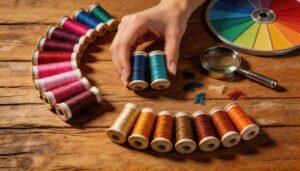
Getting an exact color match across different thread brands is one of the trickiest parts of production embroidery. Whether you’re replicating a corporate logo or recreating a custom palette, the right tools make the difference between close and exact.
Here’s what you need to know to nail it every time.
Using Pantone-to-thread Conversion Charts
A Pantone code is your anchor — it gives you a fixed, universal starting point before you ever touch a spool. Pantone matching removes the guesswork from thread conversion charts and color matching guides.
Follow these steps for reliable Chart Accuracy Validation:
- Pull the Pantone code from your design file first.
- Cross-reference at least two color conversion and substitution pattern sources.
- Apply Chart Versioning — confirm your chart reflects current product lines.
- Test under daylight and LED to assess Chart Lighting Impact on perceived shade.
Substituting Shades Between Thread Brands
Charts get you close — but brands aren’t identical. Dye Lot Consistency and Fiber Blend Influence mean even matching color numbers can shift visually.
Always do a Cross-Brand Swatch test: place candidates side by side on scrap fabric under daylight. Use thread color cards and a color matching guide to confirm value, not just hue.
Log every result for Shade Shift Documentation.
Comparing Physical Swatches With Digital Palettes
Even a perfect cross-brand swatch test has a gap you can’t ignore — your screen.
Here’s how to compare physical swatches and digital palettes accurately:
- Enable Screen Calibration and correct Device Color Profiles before trusting any digital palette.
- Watch for Metameric Effects — two threads matching on screen may clash under different light.
- Make sure Lighting Consistency when checking a color swatch beside digital references.
- Treat Digital Sampling Accuracy as a starting point; always confirm with a color reference chart and physical thread.
Using Color Scanners for Precise Matching
A handheld scanner like the Nix Spectra takes the guesswork out of matching. Run a quick Scanner Calibration Workflow using Multi-Patch Targets to correct sensor drift, then let Ambient Light Compensation neutralize room lighting.
Check your DeltaE Thresholds — anything under 2 is a near‑perfect match.
Pair readings with ICC Profile Integration and tools like Palette Scout Color Matching Guides to lock in accurate, repeatable shades across brands.
Getting Client Approval on Final Shades
Once your scanner readings confirm a solid match, it’s time to loop in the client. A clean client approval workflow for embroidered products keeps everyone aligned and prevents costly surprises.
- Share a Swatch Presentation linking each shade to the sample fabric and substrate
- Send a Digital Mockup showing thread density on the actual design
- Use a structured Feedback Form to capture specific swatch preferences
- Set a clear Approval Timeline with a documented sign-off sheet
- Define your Revision Protocol upfront — rejections trigger a focused 2–3 shade rework
This process locks in brand color consistency in logo embroidery and confirms color matching techniques hold up under real testing thread colors on different fabrics and lighting conditions.
Keep Thread Selection Consistent
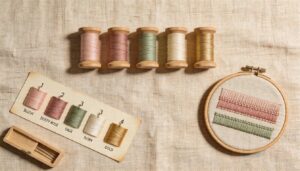
Consistency is what separates a one-time success from a repeatable, professional result. Once you’ve nailed the perfect palette, the real work is making sure you can reproduce it exactly — every single time.
Here’s how to keep your thread selection locked in from the first stitch to the last.
Labeling Spools With Brand and Color Code
A mislabeled spool can unravel an entire production run. That’s why Label Design Standards matter from day one.
Each spool needs Color Code Formatting that includes brand name, color name, and shade number — printed in uppercase on Durable Vinyl Materials that resist oils and humidity.
| Label Element | Format Example | Purpose |
|---|---|---|
| Brand + Code | DMC-3825 | Quick scanning during production |
| Color Description | Pale Pumpkin | Visual confirmation without swatch |
| QR Code Integration | Scannable SKU link | Instant digital log access |
| Spool Orientation Guidelines | Label faces outward uniformly | Reduces misreads on the rack |
| Color-coded Bobbins | Dot matches thread family | Speeds thread organization |
Add a tiny color patch beside the color number for instant visual checks. Consistent brand color consistency across all spools keeps your workflow tight and error‑free.
Organizing Shades by Palette Order
Organizing your rack like a color wheel — warm to cool, light to dark — cuts search time and keeps your eye moving logically across the palette.
- Color Family Grouping: Block neutrals, warms, and cools separately using Palette Block Dividers.
- Hue Ring Sequencing: Follow the color wheel order within each block.
- Sequential Value Arrangement: Place lighter values first, darker last.
- Neutral Anchor Placement: Keep neutrals on a separate inner track for quick grounding.
Reducing Thread Changes During Production
Every thread change costs you time — so group similar shades and stitch them together using Thread Change Scheduling before moving to contrasting colors.
| Strategy | What It Does | Production Benefit |
|---|---|---|
| Optimized Thread Loading | Pre-loads palette in run order | Cuts rethreading downtime |
| Automated Color Sequencing | Batches same-shade passes | Reduces mid-run interruptions |
| Quick-Change Spool System | Swaps bobbins in seconds | Boosts production efficiency |
| Machine Thread Buffer | Holds backup spools ready | Prevents color-match delays |
| Thread Inventory Management | Tracks usage per job | Enables cost-effective thread usage |
Documenting Approved Shades for Repeat Jobs
A good color record is your safety net for repeat jobs. When a client reorders six months later, you’ll thank yourself for keeping a clean Shade ID System with codes, brand names, and batch numbers on file.
- Use a Version Control Process to track shade updates and archive old approvals.
- Build an Audit Trail Logging habit — record who approved what and when.
- Collect Client Signoff Workflow signatures tied to each job order.
Digital Swatch Integration keeps everything searchable, supporting consistent color logs for repeat customers, and ensuring brand color consistency in logo embroidery every time.
Avoiding Mix-ups With Similar Thread Colors
Two spools that look nearly identical can derail an entire run. Use Shade Reference Cards paired with a Digital Color Barcode system to distinguish close shades instantly.
Conduct Batch Visual Checks and Color Consistency Audits regularly, adding Visual Cue Markers — colored tape or labels — to flagged spools. This provides reliable thread color cards for matching and ensures brand color consistency in logo embroidery.
Building Confidence With a Starter Shade System
Think of your starter palette as a foundation, not a final answer. Use a Visual Reference Board paired with a Palette Audit Checklist to run through Color Validation Steps each season.
A simple Decision Tree Flow helps you make faster shade calls without second‑guessing.
These Confidence Building Exercises reinforce everything — from understanding color theory for embroidery to choosing embroidery thread colors with real certainty.
Frequently Asked Questions (FAQs)
How does embroidery thread age affect color accuracy?
Thread ages quietly. UV fading, dye migration, and poor storage humidity all trigger color drift over time.
Check your thread’s lightfastness rating — it tells you exactly how long that shade will hold.
Can washing shrink threads and shift their shade?
Washing can absolutely shrink threads and shift their shade. Dye migration, fiber tension changes, and heat drying effects all alter color fastness.
Cold water benefits your work the most—it slows color fading and limits color bleeding considerably.
Which thread shades photograph best for product listings?
High-contrast shades under balanced lighting conditions photograph best. Smooth rayon and silk threads capture rich RGB colors accurately.
Avoid metallics—reflective glare kills detail. Aim for mid-value tones to retain color gamut across image resolution.
How do cultural color meanings influence design choices?
Cultural Symbolism shapes every design choice you make. Red signals luck in East Asian markets; white suggests mourning there, not purity.
Always research Regional Color Preferences before stitching a single thread.
Conclusion
Like a master painter’s final brushstroke, selecting embroidery thread shades brings your vision to life. With these expert tips, you’re now equipped to harmonize colors, balance palettes, and adapt to fabric nuances.
Your embroidery will pop with vibrancy, depth, and cohesion. As you stitch, remember that thread shades are the threads that weave magic into every piece.
Practice these principles, and your artistry will shine through in every stitch, a proof of your skill and creativity.