This site is supported by our readers. We may earn a commission, at no cost to you, if you purchase through links.
Most sewing books look identical on the shelf. Same glossy cover, same promises, same disappointment once you’re three projects in and the instructions fall apart.
pattern book that actually earns shelf space does something specific: it teaches your hands to think.
The difference between a book you reach for constantly and one gathering dust usually comes down to five things—how its patterns work together, how it manages fit, whether the instructions match your skill level, and how well the visuals and format hold up under real use.
Knowing what makes a sewing pattern book worth buying before you spend $40 to $80 means you stop gambling and start choosing deliberately.
Table Of Contents
- Key Takeaways
- Pattern Variety and Reusability
- Fit Guidance That Saves Time
- Instructions That Match Your Level
- Visuals, Glossary, and Format Value
- High-resolution Diagrams and Close-up Construction Photos
- Consistent Symbols, Arrows, Scale, and Line Weights
- Clear Fabric Cutting, Pinning, and Seam-finishing Visuals
- Glossary With Sewing Terms, Abbreviations, and Symbol Support
- Print Quality, Page Count, Durability, and Price-to-content Value
- Digital Companion Access for Visual Learners and Quick Reference
- Top 6 Sewing Pattern Books
- Frequently Asked Questions (FAQs)
- Conclusion
Key Takeaways
- A pattern book worth buying teaches you a system — a few core blocks that unlock dozens of garments — rather than handing you one-off projects with nowhere to go.
- Strong fit guidance separates great books from shelf decorations: look for real-body photos, tissue fitting steps, and exact ease allowances before you cut a single piece of fabric.
- Instructions should match your skill level before you start, not surprise you mid-project — the best books front-load required techniques, use consistent action verbs, and place troubleshooting notes right where things go wrong.
- Format and visuals aren’t extras — high-resolution diagrams, symbol consistency, a solid glossary, and durable binding determine whether a $50 book earns daily use or collects dust.
Pattern Variety and Reusability
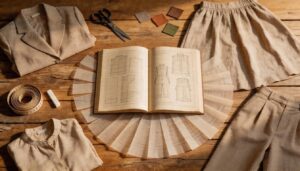
A good pattern book doesn’t just give you one thing to make — it gives you a system. The best ones stretch a handful of base blocks into dozens of wearable garments, covering everything from weekend basics to customized pieces.
Once you understand the logic behind each block, books like these advanced sewing pattern guides shift how you approach fit, ease, and design from the very start.
Here’s what to look for regarding variety and reusability.
Core Garment Blocks for Bodices, Skirts, Pants, and Sleeves
Think of bodices, skirts, pants, and sleeves as your pattern drafting foundation — four core blocks that do the heavy lifting.
Block interchangeability means you’re not starting from scratch every time.
Grading algorithms maintain proportion scaling across sizes, while seamline consistency keeps everything aligned.
Fabric stretch integration and fit adjustments are already built in.
One solid set of blocks. Endless control.
These reusable block templates dramatically cut drafting time and improve fit consistency.
Woven and Knit Pattern Options in One Book
One book covering both woven and knit patterns is a genuine time-saver. You get Pattern Layout Flexibility without juggling two references.
Ease recommendations split by fabric type, Stretch Stability Balance built right in, and Fabric Performance Insights that show how the same block behaves differently across materials. Measurement reference charts and fit adjustments are already calibrated for both.
Less guesswork. More making.
Multiple Style Variations From a Few Base Patterns
A few base patterns go further than you’d think. With Modular Block Design, one bodice block unlocks five distinct looks through Neckline Interchange and Sleeve Variants alone.
Add Layered Overlays or Style Swaps like princess seams and peplums, and the variations multiply quickly.
Good pattern books document every path.
That’s real project versatility — fewer patterns, more creative control.
Project Range That Fits Casual, Formal, and Everyday Sewing Goals
Creative control only matters if the patterns actually fit your life. A book with a Adaptable Wardrobe Mix — pull-on pants, fitted dresses, structured jackets — gives you projected versatility across casual and formal styles without buying multiple books.
That’s your Core Capsule Collection covered. Multi-Occasion Pieces handle Day-to-Night Shift, Seasonal Outfit Sets, tops, bottoms, layers.
Real pattern books and fit-focused manuals earn their shelf space this way.
Drafting Systems That Support Custom Garment Making
A real drafting system does more than print shapes — it thinks with you. The best pattern-making books teach systems built on parametric equation engines, where changing one measurement ripples through the whole draft automatically.
Look for guides covering:
- Body Scan Integration for precise custom tailoring
- Live Fit Adjustment tools before fabric gets cut
- Modular Pattern Library blocks for fast pattern adjustment
- Cloud Collaboration Tools for team-based pattern grading
Fit Guidance That Saves Time
A poor fit can ruin a garment faster than any cutting mistake.
The best sewing pattern books don’t just hand you a pattern — they show you exactly how to make it fit your body. Here’s what strong fit guidance actually looks like.
Real-body Photos That Show Common Fit Problems
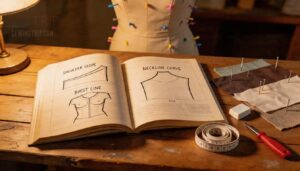
Fit problems don’t lie — and neither do real photos of real bodies. The best fit-focused manuals show exactly what shoulder slope issues, bust wrinkle indicators, neckline gaping, armhole pinching, and back balance distortions actually look like on a dressed human.
Real fit problems demand real bodies — photos that show exactly what’s wrong and where
No guessing.
Pattern books with strong visual guides turn your frustrating "something’s off" moment into a clear, fixable diagnosis.
Tissue Fitting, Measurement Scaling, and Live Alterations

Three methods separate a guessing game from actual fit analysis: tissue pinning strategy, measurement scaling, and live fit evaluation. Start with tissue fitting — pin the unaltered pattern on your body before touching fabric.
Then apply scale ratio calculations and size grading techniques to grade between sizes cleanly. Adjustment sequencing matters here: armhole depth before waist length.
Live alterations in muslin reveal what flat pattern alteration can’t — how fabric actually moves.
Ease Allowances for Bust, Waist, Hips, and Underarm Areas
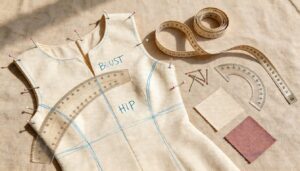
Ease is the breathing room built into every pattern — and getting it wrong ruins the fit before you’ve sewn a stitch. Good books spell out exact ease allowances so your fit analysis starts on solid ground:
- Bust Ease Standards — 3 to 4 inches for fitted wovens
- Waist Ease Guidelines — 1 to 2 inches at the natural waist
- Hip Ease Calculations — 2 to 4 inches at the widest point
- Underarm Ease Tips — 0.5 to 2 inches to prevent binding
Ease Placement Principles matter too. Each zone needs a different amount, so ease allowances aren’t one-size-fits-all — they follow the silhouette.
Muslin-testing Steps Before Cutting Final Fabric
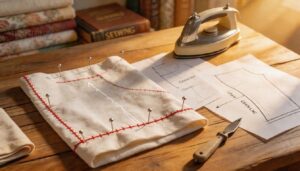
Cut your muslin from the same pattern pieces, mark Muslin Grain Alignment clearly, and baste with long stitches — Basting Seam Visibility makes adjustments obvious.
Try it on, move around, then use Pinning Adjustment Notes directly on the fabric.
After fitting, Pressing Muslin Transfer flattens the seams cleanly before tracing changes back.
Keep it — Reference Muslin Preservation saves you from repeating the same fitting battle twice.
Pattern Markings for Grain Lines, Notches, and Seam Allowances
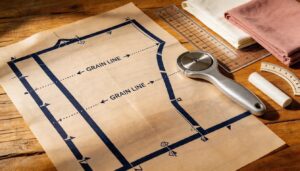
Good pattern markings are a silent language — and a great book teaches you to read it fluently.
- Grainline Arrow Types tell you exactly how to align pieces to the selvedge, so your garment hangs right.
- Notch Placement Strategies prevent mismatched seams before they happen.
- Seam Allowance Calculations and Cutting Line Hierarchy remove guesswork at the table.
Marking Symbol Standardization across woven and knit projects makes every book more reusable.
Instructions That Match Your Level
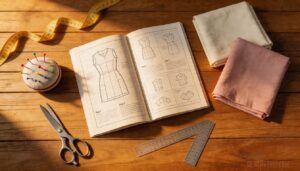
A pattern book can have beautiful photos and solid fit guidance, but if the instructions don’t match where you’re skill-wise, you’ll hit a wall fast. The best books are built so you know exactly what’s expected before you cut a single piece of fabric.
Here’s what to look for concerning instruction quality and skill-level support.
Difficulty Icons or Clear Skill-level Labels
Skill-level indicators are only useful when they’re easy to spot. Look for icon design consistency and label placement strategy — the best books put the label right by the project title, not buried on page three. Color-coded difficulty and standardized level symbols make it faster to scan.
| Level | What It Means |
|---|---|
| Beginner | Straight seams, no closures |
| Upper-level Beginner | Add zippers or facings |
| Intermediate | Curved seams, pattern markings |
| Upper-level | Tailoring, complex assembly |
| Challenging | Multi-technique, long build time |
Beginner Sewing Pattern Books, Intermediate Sewing Pattern Books, and Upper-level Sewing Pattern Books all benefit from visual guides with consistent icon size guidelines — so you pick the right project fast.
Required Techniques Listed Before Each Pattern
Once you know your skill level, the next check is what a pattern actually demands. The best books front-load a Neckline Method Index, Sleeve Construction Summary, Pocket Style Preview, Closure Choice Overview, and Seam Finish Guide before you cut a single piece.
That pre-pattern snapshot tells you exactly what you’re walking into — no surprises mid-project.
Step-by-step Directions With Consistent Action Verbs
That pre-pattern snapshot sets you up — but only if the directions that follow are just as clear.
Look for books where every step uses Sequential Command Structure: one verb, one action, one line.
- Step Numbering Strategy keeps your place mid-project
- Imperative Verb Use — "trim," "press," "align" — removes guessing
- Time Word Integration like "next" and "then" smooths the flow
- Action Line Consistency makes repeated tasks feel automatic
- Step‑by‑step instructions paired with visual guides confirm you’re on track
Troubleshooting Notes Placed Beside Relevant Steps
Clear directions get you halfway there. The other half? something’s about to go wrong.
The best pattern drafting guides place step-specific alerts right beside the risky action — not buried in an appendix. Inline warning icons and visual cue boxes flag symptom-fix pairing instantly: puckering at the underarm, seam distortion at the hip. Consistent note formatting means you always know where to look.
Progression Paths From Beginner to Advanced Sewing Skills
A good book doesn’t just teach — it shows you where you stand. Strong pattern books map a clear skill ladder, from straight seams and basic cutting up through darts, zippers, and expert tailoring.
Technique sequencing matters. Key projects mark real competency benchmarks, so your learning curve feels like progress, not guesswork.
Skill-level indicators, beginner sewing projects, intermediate sewing skills — the best books connect all three without making you figure out the order yourself.
Visuals, Glossary, and Format Value
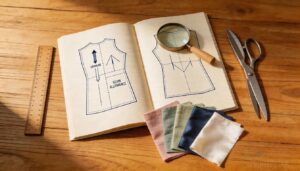
A pattern book’s real staying power lives in its visuals and how the whole thing is put together. Bad diagrams and vague symbols can stop a project cold — no matter how good the instructions are.
Here’s what to look for when evaluating a book’s visual quality, glossary support, and format value.
High-resolution Diagrams and Close-up Construction Photos
Diagrams tell you what to do. Photos show you how it actually looks. gap matters more than most books admit.
Stitch detail close-ups, zipper installation photos, and layered assembly shots turn vague instructions into something you can actually follow.
Fabric grain cues and buttonhole construction images remove the guesswork.
Visual guides and picture guides built around real photographs make visual learning feel less like studying and more like watching someone who knows exactly what they’re doing.
Consistent Symbols, Arrows, Scale, and Line Weights
Symbol Standardization isn’t glamour work — but it’s what separates a book you trust from one you second-guess. When Arrow Clarity, Scale Consistency, and Line Weight Hierarchy stay uniform across every page, pattern drafting guides become genuinely readable.
Thick lines cut. Dashed lines seam. Grid Alignment ties pattern measurements to grain line markings without guesswork.
Visual learning clicks when the visual guides never contradict themselves.
Clear Fabric Cutting, Pinning, and Seam-finishing Visuals
Cutting line clarity is where confidence begins. Good visual guides show grainline arrows, "right side up" labels, and nested layout patterns that save yardage.
Pin placement guides take it further — perpendicular pins on curves, notch-first sequencing, no overcrowding.
Seam allowance shading makes the margin unmistakable.
Finish technique close-ups walk you through French seams, flat-felled edges, and bound seams step by step.
Fabric behavior cues handle the tricky stuff: sheers, slippery silks, directional nap.
Glossary With Sewing Terms, Abbreviations, and Symbol Support
A strong glossary is your silent co-teacher. Without it, you’re guessing — and guessing costs fabric.
Look for these five things:
- Alphabetical Term Index — scan straight to "bias" or "selvedge" in seconds
- Abbreviation Table — decodes SA, FBA, RST, and SG without hunting
- Symbol Iconography — pairs every dart, notch, and grainline mark with plain labels
- Beginner Language — short definitions, no jargon walls
- Cross-Reference Links — connects related terms so your sewing reference guide builds real understanding
Print Quality, Page Count, Durability, and Price-to-content Value
Think of printed pattern books like tools — cheap ones cost you more in the long run. Coated paper and sharp ink sharpness keep grain lines readable.
Binding type matters too; hardcovers survive table abuse better. Page ratio tells you if content is dense or padded. At $12–$31, cost per page adds up fast — buy books that earn every one.
Digital Companion Access for Visual Learners and Quick Reference
digital companion changes how fast you find answers.
Screen Reader Integration and Keyboard Navigation Shortcuts let you jump straight to a heading mid-project — no page flipping. High Contrast UI keeps diagrams readable at a glance.
Searchable Index Feature pulls up one stitch term instantly. Task-Based Guidance beats hunting through chapters.
Instant PDF downloads and digital downloads beat waiting for shipping.
Top 6 Sewing Pattern Books
Some books just keep earning their shelf space — you reach for them every time you start a new project. These six titles cover the range from foundational pattern cutting to complex fabric manipulation.
Each one brings something specific to the table, so here’s what you’re working with.
1. Metric Pattern Cutting Women Wear
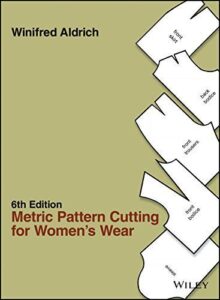
Metric Pattern Cutting for Women’s Wear is a serious drafting reference — now in its sixth edition. At $38.49, it covers bodice, skirt, trouser, sleeve, and coat blocks in full scale.
The updated CAD section and revised sizing charts reflect modern body proportions.
One thing to know: it’s pattern drafting only, no sewing instructions included.
Everything runs metric, so if you think in inches, expect an adjustment period.
Ideal for students and home sewers who want precision without commercial pattern constraints.
| Best For | Fashion students and home sewers who want to draft custom-fit patterns from scratch using a structured, metric-based system. |
|---|---|
| Price | $38.49 |
| Page Count | 256 pages |
| Skill Level | Intermediate |
| Publication Year | 2015 |
| Illustration Type | Step-by-step diagrams |
| Sewing Included | No |
| Additional Features |
|
- Covers all the essential blocks — bodice, skirt, trouser, sleeve, and coat — so you’ve got a solid foundation to work from.
- The sixth edition brings updated sizing and a revised CAD section, keeping things relevant to modern body proportions.
- Metric measurements keep the math clean and consistent, which speeds up the drafting process once you’re comfortable with centimeters.
- It’s purely about pattern drafting — don’t expect any sewing or construction guidance here.
- Some instructions and diagrams can be a little unclear, so you may find yourself hunting for extra references along the way.
- Everything is metric, which means if you think in inches, there’s a real adjustment curve before things click.
2. Patternmaking Guide for Fashion Design
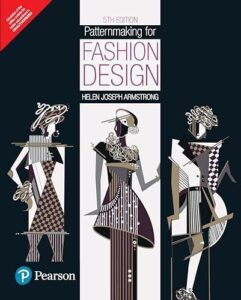
If metric-only drafting isn’t your style, Patternmaking for Fashion Design by Helen Joseph-Armstrong takes a different approach.
At $29.10 for 108 pages, it covers women’s, men’s, children’s, knitwear, and swimwear — all in one softcover.
The three core principles — dart manipulation, added fullness, and contouring — build on each other logically.
Over 1,500 illustrations walk you through each step. Just know it’s patternmaking only. No sewing instructions. Construction is your job.
| Best For | Fashion students, hobbyists, and professional designers who want a single, comprehensive reference for drafting custom patterns across multiple garment types. |
|---|---|
| Price | $29.10 |
| Page Count | 108 pages |
| Skill Level | Beginner to Intermediate |
| Publication Year | 2009 |
| Illustration Type | Color-coded diagrams |
| Sewing Included | No |
| Additional Features |
|
- Covers a wide range of garments — women’s, men’s, children’s, knitwear, and swimwear — all in one book
- Over 1,500 step-by-step illustrations make complex techniques like dart manipulation and contouring easy to follow
- Available as both a softcover and eBook, so you can reference it at home or on the go
- Size range on the pattern block chart is limited, so drafting from exact custom measurements can be tricky
- A few numerical errors (like armhole dimensions) mean you’ll want to double-check your work
- Paper quality is thin and fragile — not ideal if you plan to flip through it often
3. Professional Pattern Cutting and Making Up
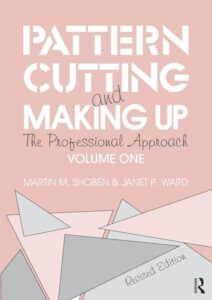
Want both cutting and construction in one place? Professional Pattern Cutting and Making Up delivers exactly that.
At $81.99 for 224 pages, it’s built for CGLI, BTEC, and degree-level fashion courses — but intermediate to experienced home sewers get real value here too. It covers fusible interlinings, outerwear, and making-up procedures with technical depth you won’t find in beginner books.
Fair warning: measurements are metric, and some diagrams run dense. Prior pattern experience helps a lot.
| Best For | Fashion students in CGLI, BTEC, or degree-level programs, plus intermediate-to-advanced sewers who want a serious, all-in-one reference for pattern cutting and garment construction. |
|---|---|
| Price | $81.99 |
| Page Count | 224 pages |
| Skill Level | Intermediate to Advanced |
| Publication Year | 1987 |
| Illustration Type | Technical diagrams |
| Sewing Included | Yes |
| Additional Features |
|
- Covers both pattern cutting and construction in one book — no need to juggle multiple resources
- Great technical depth on fusible interlinings, outerwear, and shaping techniques
- Practical exercises are tied to real garment types, so theory actually connects to what you’re making
- Not beginner-friendly — you’ll want some pattern drafting experience before diving in
- All measurements are metric, so US-based readers may need to convert
- Some diagrams are dense or poorly labeled, which can slow things down if you’re self-studying
4. Pattern Making Primer Sewing Guide
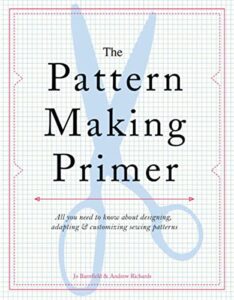
If you’re just getting started with pattern making, The Pattern Making Primer by Jo Barnfield and Andrew Richards is hard to beat.
At $23.99, it packs 192 pages of solid drafting fundamentals — bodice blocks, skirts, sleeves, and trousers.
300 diagrams walk you through tool use, pattern symbols, and core techniques without overwhelming you.
It’s clear, practical, and written for the learner who wants to draft from scratch.
The 2012 publication date shows in places, but the foundational content still holds up.
| Best For | Beginner to intermediate sewists who want to learn how to draft their own garment patterns from scratch. |
|---|---|
| Price | $23.99 |
| Page Count | 192 pages |
| Skill Level | Beginner to Intermediate |
| Publication Year | 2012 |
| Illustration Type | Photos and diagrams |
| Sewing Included | Yes |
| Additional Features |
|
- Covers a wide range of garments — bodices, skirts, sleeves, trousers — so you’re not limited to one category
- 300 diagrams make the techniques easy to follow without needing prior experience
- Clear, accessible writing style that works well for self-teaching or classroom use
- Advanced pattern makers won’t find much new here — it’s built for learners, not pros
- Focuses on drafting from scratch, so there’s little help if you’re trying to alter a commercial pattern
- Published in 2012, and some terminology feels a bit dated compared to current industry standards
5. Pattern Grading Manual and Computer Techniques
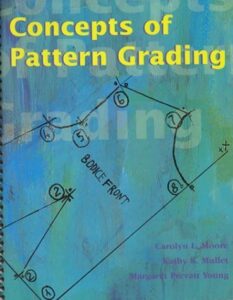
Pattern grading is where most home sewists hit a wall. Pattern Grading for Women’s Clothes by Winifred Aldrich bridges that gap — manual and computer methods, side by side in 304 pages.
You get the theory behind x-y grading orientation, plus real practice exercises at each chapter’s end. Spiral-bound, so it lies flat while you work.
It’s dense — not a weekend read — and the 2001 software references are dated. But the grading fundamentals? Still solid.
| Best For | Garment industry professionals, fashion students, and self-taught graders who want a solid foundation in both manual and computer-aided pattern grading. |
|---|---|
| Price | $15.28 (CD incl.) |
| Page Count | 304 pages |
| Skill Level | Intermediate to Advanced |
| Publication Year | 2001 |
| Illustration Type | Practice exercises |
| Sewing Included | No |
| Additional Features |
|
- Covers grading from every angle — theory, manual methods, and computer workflows all in one book
- Spiral binding means it stays flat on your worktable while you’re actually using it
- Practice exercises at the end of each chapter help you apply what you just learned
- No answer key for the exercises, so you’re on your own when checking your work
- Published in 2001, so the software-specific sections feel pretty outdated
- Dense and text-heavy — beginners might find it a tough first read
6. Fabric Manipulation Techniques Handbook
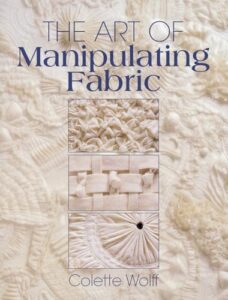
Sculpting fabric into something dimensional — that’s where most books tap out. Fabric Manipulation by Ruth Singer doesn’t.
For $15.28, you get 312 pages covering 150 techniques: pleating, smocking, shirring, appliqué, stitch-and-slash, quilting, and more.
Over 350 hand-drawn diagrams walk you through each method step by step.
It works for all skill levels, and the techniques translate across garments, accessories, and home décor.
If you want one book that shows how fabric truly behaves, this is it.
| Best For | Textile artists, quilters, and sewers who want a deep-dive reference on 3D fabric techniques for garments, quilts, and home décor. |
|---|---|
| Price | $15.28 |
| Page Count | 312 pages |
| Skill Level | Intermediate to Advanced |
| Publication Year | 1996 |
| Illustration Type | 350+ hand-drawn diagrams |
| Sewing Included | Yes |
| Additional Features |
|
- Over 350 hand-drawn diagrams make each technique easy to follow, even for visual learners
- Covers a huge range of methods — pleating, smocking, quilting, appliqué, and more — all in one place
- Works across projects: garments, accessories, and home décor all benefit from the techniques inside
- Black-and-white photos make it hard to see how color and pattern affect fabric behavior
- Published in 1996, so newer synthetic fabrics and modern machine features aren’t covered
- The dense, illustration-heavy layout can feel like a lot to take in if you’re just starting out
Frequently Asked Questions (FAQs)
Are vintage patterns worth money?
Yes, vintage patterns can be worth real money.
Complete, uncut Vogue Designer or Simplicity sets from the 1950s–60s regularly sell for premium prices — especially rare sizes, iconic silhouettes, or mint-condition envelopes with original artwork intact.
What is the golden rule sewing pattern system?
The Lutterloh System uses the golden ratio to draft custom, full-size patterns from a small base template.
Created in 1935, it scales patterns to your bust or hip measurements using a special tape measure.
How do sewing books handle copyright and tracing permissions?
Most sewing books play it safe legally. You can trace for personal use, but sharing or selling copies isn’t allowed.
Finished garments are usually fine to sell — unless the pattern terms say otherwise.
Do authors update books for current fashion trends?
Sometimes. Authors don’t chase every trend, but when a style becomes a market staple, revised editions follow.
Look for "updated edition" on the cover — that’s your signal, the content still reflects how people actually dress.
Are metric and imperial measurements both included?
Most good pattern books include both. You’ll find centimeters and inches side by side — on pattern pieces, seam allowances, and ease charts. No mental math required.
How do second-hand copies compare to new editions?
Used copies save money — sometimes drastically — but condition varies widely. For timeless titles, second-hand works fine. For updated editions with new fitting data, buy new.
Conclusion
Studies show that sewers abandon up to 60% of pattern books within the first three projects—usually because the fit guidance fails them. Knowing what makes a sewing pattern book worth buying changes that ratio entirely.
The right book doesn’t just sit on your shelf looking useful. It trains your hands, sharpens your eye, and builds the kind of confidence that turns a half-finished muslin into a garment you’re actually proud to wear.
- https://www.cochenille.com/my-absolute-favorite-sewing-books-the-top-five/
- https://www.thecreativecurator.com/how-to-read-sewing-patterns/
- https://www.semanticscholar.org/paper/77cf85b19fd1a3ed3c69444d2fc9a86fc21bd9f4
- https://www.goodreads.com/book/show/18290381-the-magic-pattern-book
- https://www.scribd.com/document/556108430/2014-FiberPolymer-TheDevelopmentofanAutomaticPattern-MakingSystemfor-152-34