This site is supported by our readers. We may earn a commission, at no cost to you, if you purchase through links.
Most embroidery disasters trace back to one overlooked layer—not the thread, not the design file, not even the machine settings.
A cotton shirt emerges from the hoop with puckered lettering. A knit polo stretches the logo into something unrecognizable.
The common thread? Wrong stabilizer, or none at all. Stabilizer is the foundation your design stitches into, and without the right type, needle pressure alone distorts fabric with every pass. Backing you choose matters as much as the design itself.
Knowing which stabilizer fits your fabric and stitch count transforms clean, professional embroidery every time.
Table Of Contents
Key Takeaways
- Your fabric type—not your machine—determines which stabilizer you need, so always read the cloth before you pick the backing.
- Cut-away stays put permanently for stretchy knits, tear-away removes cleanly from woven fabrics, and wash-away dissolves completely from sheers—using the wrong one distorts your design.
- Stitch count drives stabilizer weight: under 5,000 stitches, lightweight works fine; past 15,000, go heavier or double up.
- How you apply stabilizer matters as much as which one you choose—proper hooping, grain alignment, and a scrap test before the real run prevent most puckering problems.
Do Embroidery Machines Need Special Stabilizer?
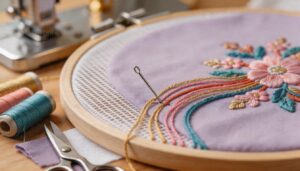
embroidery machines need stabilizer — but not because of the machine itself. The real reason comes down to fabric, stitch density, and how they work together under the needle.
Understanding how stabilizer affects embroidery quality makes it easier to see why the wrong choice can cause puckering, shifting, or distortion before you’ve even finished a design.
what you need to know.
Why Embroidery Machines Need Fabric Support
Every stitch your machine makes drives the needle through fabric thousands of times, creating real needle pressure that tugs and strains the fibers beneath.
Without proper support, that force causes:
- Fabric distortion that warps your design’s shape
- Puckering prevention failures along dense fill areas
- Thread tension shifts that blur clean outlines
Stabilizer keeps everything anchored so your design accuracy stays intact from the first stitch to the last. For stretchy fabrics, cut‑away stabilizers for stretch provide permanent support.
Why The Stabilizer is Chosen for Fabric, Not The Machine
Your machine doesn’t choose the stabilizer — your fabric does. The needle pull impact lands directly on the cloth, not the frame, so fabric tension management starts at the fiber level. Choosing the right embroidery stabilizer means reading your fabric first.
| Fabric Type | Stabilizer Need |
|---|---|
| Knit/Stretch | Permanent cut-away |
| Woven Cotton | Lightweight tear-away |
| Sheer/Organza | Wash-away film |
| Denim/Canvas | Heavyweight cut-away |
When Regular Backing Works Versus Specialty Stabilizer
Regular tear-away accommodates most stable woven fabrics just fine — think cotton, linen, or canvas with low-to-medium stitch counts.
But once you hit the design density threshold (roughly 15,000+ stitches), or you’re working with fabric pile considerations like fleece or terry, specialty stabilizer becomes necessary.
Choosing the right embroidery stabilizer early saves production time and protects color fidelity throughout the design.
When You Can Skip Stabilizer Safely
Skipping stabilizer entirely is rarely the right call, but a few situations come close. On thick canvas or rigid non-stretch fabric with compact motifs and very low stitch counts, a light backing sometimes isn’t worth adding.
Flat display pieces that won’t be washed or worn follow the same logic. Just keep fabric type, fabric stretch, and stitch count considerations front of mind before you decide.
Stabilizer Vs. Interfacing for Machine Embroidery
Stabilizer and interfacing seem interchangeable, but they serve completely different jobs. Here’s the simplest way to think about it:
- Stabilizer governs embroidery performance — it disappears, reduces bulk, or gets trimmed away after stitching
- Interfacing adds permanent body to collars, cuffs, or waistbands — it stays through every wash
- Both together work when a project needs structure and embroidery support
Choosing the right embroidery stabilizer comes down to material compatibility and design flexibility — not structure.
Choose Stabilizer by Fabric Type
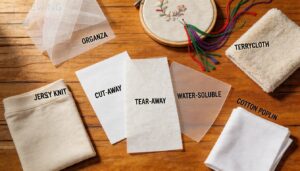
Not all stabilizers are created equal, and the fabric you’re working with should drive your choice every time. Think of it like choosing the right tool for the job — use the wrong one and your design pays the price.
Here’s how to match the right stabilizer to the most common fabric types you’ll encounter.
Cut-away for Knits and Stretch Fabrics
Knit fabrics stretch — and that’s exactly what makes them tricky to embroider.
Cut-away stabilizer is your best tool here because it stays permanently under the stitches, giving lasting support through every wash and wear cycle.
For even more precision, pairing cut-away stabilizer with a self-adhesive backing—as covered in these reverse appliqué hand sewing techniques—keeps everything locked in place from the first stitch to the last.
For lighter knits, soft no-show mesh keeps the bulk vs comfort balance right. Heavier sweatshirt fabric needs conventional cut-away to handle denser designs without distortion.
Tear-away for Stable Woven Fabrics
Woven fabrics like cotton, linen, and denim don’t stretch, so tear-away stabilizer supports them beautifully. It gives your design solid stitch definition during stitching, then tears off cleanly afterward — leaving impressive backside smoothness with minimal fuss.
Tear-away thickness matters here: match your stabilizer weight selection to fabric density and stitch count. Layered backing works well for denser designs, keeping edge clean-up quick and your results sharp.
Wash-away for Sheer Fabrics and Lace
Sheer fabrics like organza and chiffon have almost no grip, so wash away stabilizer is your best friend here. It acts as the stitching foundation for lace embroidery, then disappears completely.
Water temperature controls dissolution speed — warm water works faster and avoids gummy residue. Store it dry, since humidity effects weaken it before you even hoop up.
No-show Mesh for Light Garments
Light-colored polos and soft T-shirts need support that won’t show through the fabric — that’s exactly what no-show mesh delivers. This skin-friendly nylon acts as a transparent support layer, staying permanently under your stitches without casting shadows.
Match your mesh color matching to the garment tone: white for light fabrics, black for dark fabrics.
One layer accommodates most lightweight fabric designs beautifully.
Topping for Towels, Fleece, and High Pile
Terry cloth and fleece have one thing in common — they’ll swallow your design whole if you stitch straight onto the pile. That’s where water-soluble topping saves the day.
Pile flattening techniques and loop suppression strategies work together here:
- Lay wash-away stabilizer flat over the fabric surface
- Stitch through it for design clarity enhancement
- Rinse for complete post-stitch topping removal
Matching Stabilizer Weight to Stitch Density
Stitch count thresholds matter more than most beginners expect. Under 5,000 stitches, a lightweight 1.5–2.0 oz backing usually holds just fine on stable fabric.
Push past 15,000 to 20,000 stitches, and you’ll want heavyweight support — 2.5 oz or more. That density-weight correlation protects your fabric without adding unnecessary bulk.
When in doubt, go one weight heavier than you think you need.
When Dense Designs Need Double Stabilizing
Sometimes one layer just isn’t enough. Dense fills, heavy satin columns, and large motifs create serious multi layer tension that a single backing can’t absorb alone.
That’s where double stabilizing for dense designs earns its place. Layered support strategies spread the stitch density buffer across two sheets, keeping edges crisp.
high stitch density work, double backing benefits every project.
Apply Stabilizer Without Puckering
Getting stabilizer onto your fabric the right way makes all the difference between a clean result and a puckered mess. It’s not just about type you use — it’s about how you apply it.
Here’s what you need to know to get it right every time.
Hooping Fabric and Stabilizer Together
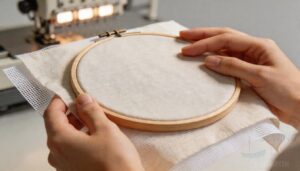
Hooping fabric and stabilizer together is your first real defense against fabric distortion prevention. Lay both layers flat, align them carefully for proper layer alignment, then secure them as one unit.
Leave at least a 2-inch margin sizing on every side.
Balanced tension balance keeps fabric smooth without drum-tight stretching.
Good hoop placement and stitch registration depend entirely on getting this foundation right.
Using Sticky Stabilizer for Hard-to-hoop Items
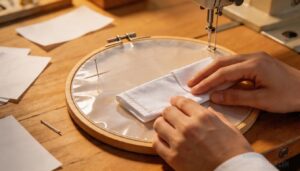
Not every garment lies flat and cooperative in a hoop. Cuffs, collars, and pockets push back — that’s where adhesive-backed stabilizer earns its place.
Here’s how it works for Small Area Hooping:
- Hoop the adhesive stabilizer alone, score the Adhesive Release Paper with a pin, then float your fabric onto the Pressure Sensitive Grip surface
- This Temporary Fabric Support method manages Edge Placement Techniques near seams without distorting the garment’s shape
- Using Sticky Stabilizers for Hooping eliminates forced clamping that warps constructed clothing parts
Fusible Stabilizer for Extra Grip
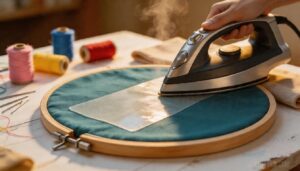
When a stretchy fabric keeps shifting mid‑stitch, fusible stabilizer is your answer. This machine embroidery stabilizer uses a Heat Bonding Technique — you press it onto the fabric’s wrong side with an iron, and the adhesive backing bonds the layers flat. That Grip Enhancement Mechanics approach stops performance wear from rippling under dense stitches.
| Fabric Type | Fusible Weight | Application Tip |
|---|---|---|
| Knit/Jersey | 25–45 g/m² | Press, don’t slide the iron |
| Performance Wear | 45–65 g/m² | Use a pressing cloth |
| Woven Cotton | 25–45 g/m² | Medium heat, firm pressure |
| Stretch Blends | 45–65 g/m² | Flexible Fusible Options work best |
| Lightweight Sheer | 25 g/m² | Test scrap first |
For Adhesive Residue Management, always use a pressing cloth — it protects your iron. Stabilizer adhesion techniques like this beat adhesive spray when you need a permanent, shift‑free bond.
Grain Direction and Stretch Control
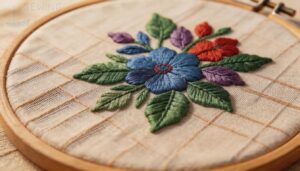
Grain direction is the hidden variable that determines whether your embroidery lies flat or fights back. When you align the stabilizer grain perpendicular to the fabric’s stretch pathways, you’re applying grain alignment principles that counteract anisotropic tension naturally built into knits and directional fabric.
- Match stabilizer grain against the fabric’s greatest stretch direction
- Use cut-away stabilizer for stretch fabrics to prevent post-wash distortion
- Avoid bias stitching over unseated grain — it pulls stitches sideways
- Fabric stretch mitigation starts before hooping, not after puckering appears
- Stabilizer weight and fabric compatibility matter most along cross-grain edges
How to Test Stabilizer Before Stitching
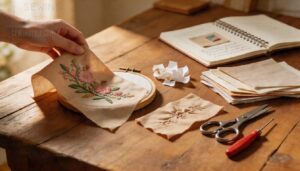
Before committing to a full project, run a Scrap Stitch Test on the same fabric you’ll actually use. Stitch your design—or a dense section of it—on a scrap large enough to hoop properly. Then do a Support Strength Check: watch for shifting, sinking stitches, or puckering the moment the hoop comes off.
A Tear Behavior Test tells you how cleanly the stabilizer releases.
Save each sample with notes on stabilizer weight and fabric type—that’s your personal library for smarter embroidery project preparation and stabilizer selection going forward.
How to Remove Tear-away, Cut-away, and Wash-away
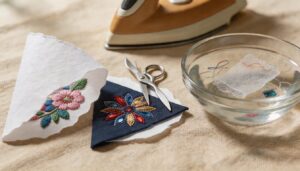
Removing the stabilizer the right way protects everything you just stitched. Each type has its own method — rush it, and you risk pulling threads or distorting the design.
- TearAway Stabilizer – Use gentle peeling from a seam edge, pulling in long, steady strokes
- CutAway Stabilizer – Trim close to stitches, then use dense area tweezers to clear tight spots
- WashAway Stabilizer – Do a lukewarm soak, agitating gently until it fully dissolves
- Warm Iron Softening – Briefly heat adhesive-bonded cutaway on low before trimming
- Post-Removal Pressing – Press from the back with a cloth to smooth any remaining puckers
Common Stabilizer Mistakes and Fixes
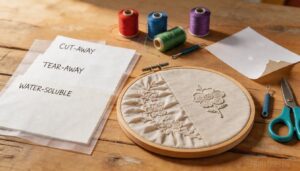
Most stabilizer problems fall into a few familiar traps.
Under-stabilizing puckering is the most common — your fabric pulls inward because the backing can’t hold the thread tension. Over-stabilizing stiffness ruins wearables. Using tear-away on stretch fabrics warps outlines after removal. Sticky stabilizer misuse leaves residue when applied to heat-sensitive materials.
Wrong stabilizer choices — too little, too much, or mismatched to fabric — quietly ruin every stitch
Match stabilizer weight and fabric compatibility first, and layered support issues almost solve themselves.
Top 5 Stabilizer Products
Picking the right stabilizer doesn’t have to feel like guesswork. A few products consistently stand out because they actually deliver — across fabric types, stitch densities, and real-world use.
Here are five worth knowing.
1. World Weidner Polymesh Plus Embroidery Stabilizer
If you embroider on light-colored knits and hate seeing dark backing shadow through the fabric, World Weidner Polymesh Plus solves that problem cleanly.
It’s a soft, translucent cut-away stabilizer built from PolyMesh Plus material, weighing about 1.5 oz — light enough to avoid bulk, stable enough to hold dense stitches in place.
The sheer mesh stays permanently under your design without stiffening the drape.
It’s washable too, just pre-shrink it first so your finished piece doesn’t pucker after laundering.
| Best For | Embroiderers who work with light-colored or delicate knit fabrics and need a stable, low-profile backing that won’t show through the finished piece. |
|---|---|
| Stabilizer Type | Cut-away |
| Adhesive Backing | No |
| Format | 100 sheets (6″×6″) |
| Fabric Compatibility | Light to medium fabrics |
| Needle Impact | Minimal friction |
| Country of Origin | Not specified |
| Additional Features |
|
- Translucent mesh means no dark shadow bleeding through light fabrics
- Soft and flexible — won’t stiffen your fabric or add unwanted bulk
- Works with all major embroidery machine brands, from home machines to commercial setups
- Shrinks in hot water and heat, so you have to pre-shrink before using on anything that’ll be laundered
- Stays in the finished piece permanently, which can affect how delicate fabrics feel against skin
- At 6″ × 6″ per sheet, larger designs need multiple pieces joined together, which adds extra steps
2. Superpunch Adhesive Tear Away Stabilizer
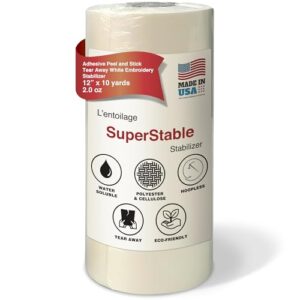
Some pieces just won’t sit still in a hoop — that’s exactly where Superpunch Adhesive Tear Away earns its place. Collars, socks, cuffs, and assembled jackets all become manageable when you hoop the stabilizer first, then stick the fabric directly onto its adhesive surface.
The 2.0 oz weight holds firm through stitching without gumming up your needle.
Once you’re done, it tears away cleanly and leaves no residue.
Available in rolls from 12" × 10 yards up to 20" × 25 yards.
| Best For | Embroiderers working with small, oddly shaped, or already-assembled pieces that won’t fit in a standard hoop. |
|---|---|
| Stabilizer Type | Tear-away |
| Adhesive Backing | Yes, peel-and-stick |
| Format | Roll (12″×10 yd) |
| Fabric Compatibility | Small or irregular items |
| Needle Impact | Does not gum needles |
| Country of Origin | USA |
| Additional Features |
|
- Sticks firmly during stitching and tears away cleanly with no residue left behind
- Needle-friendly formula won’t gum up or slow you down mid-project
- Comes in large roll sizes, so the per-yard cost stays low for high-volume work
- The thin layer tears easily, so you’ll need to score carefully and keep scraps handy
- Adhesion can be hit or miss on very slick or ultra-lightweight fabrics
- Only available in roll form — no pre-cut sheets if you just need a quick small piece
3. OESD StabilStick Cutaway Embroidery Stabilizer
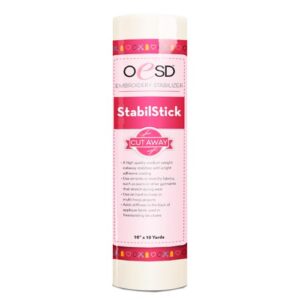
If tear-away works with stable fabrics well, knits and stretchy blanks need something that stays put permanently. That’s where OESD StabilStick CutAway steps in.
It’s a medium-weight cut-away with a light adhesive surface — you hoop the stabilizer first, peel the backing, then press your fabric onto it.
No pins, no spray adhesive. It’s especially reliable for t-shirts, sweaters, and denim.
The adhesive keeps everything aligned through dense stitch counts, and the cut-away backing stays under the design after you’re finished.
| Best For | Embroiderers working with knits, t-shirts, and stretchy fabrics that shift or distort during hooping. |
|---|---|
| Stabilizer Type | Cut-away |
| Adhesive Backing | Yes, light adhesive |
| Format | Roll (10″×10 yd) |
| Fabric Compatibility | Knits and stretchy fabrics |
| Needle Impact | Leaves minimal residue |
| Country of Origin | Not specified |
| Additional Features |
|
- The light adhesive holds fabric firmly in place without pins or spray — big time-saver during setup
- Works great through dense stitch counts and stays under the design after stitching for lasting support
- Knit-friendly formula means your fabric won’t stretch or warp while the machine does its thing
- It’s single-use, so each project eats into the roll and costs add up over time
- The 10-inch width can feel limiting on larger designs — you’ll need to piece it together
- Heavier or textured fabrics might need extra support since the adhesive can struggle to hold them securely
4. Sulky Tender Touch Iron On Backing
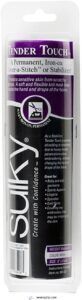
Cut-away manages the stitching itself — but what about the person wearing it? That’s where Sulky Tender Touch earns its spot.
It’s a soft, iron-on backing you fuse over finished embroidery to cover scratchy thread knots on the inside of garments. Made from 100% polyester mesh at just 53 g/m², it stays flexible and moves with stretchy fabrics like sportswear and lingerie.
It’s especially worth using on baby clothes or anything worn close to sensitive skin.
| Best For | Anyone doing embroidery on baby clothes, sportswear, or anything worn against sensitive skin who wants a soft, scratch-free finish on the inside. |
|---|---|
| Stabilizer Type | Cut-away |
| Adhesive Backing | Yes, heat-activated |
| Format | Roll (8″×9 yd) |
| Fabric Compatibility | Stretch and lightweight garments |
| Needle Impact | No needle interference |
| Country of Origin | USA |
| Additional Features |
|
- Covers scratchy thread knots so the garment feels smooth against skin
- Stretches with the fabric, making it great for spandex, lingerie, and athletic wear
- Irons on easily and holds up through multiple washes
- You have to get the adhesive side right before ironing — flip it wrong and it’ll stick to your iron
- Edges can lift on some fabrics, so you may need to trim carefully or go back over it
- Not the best choice for heavy or thick materials
5. HeatnBond Lite Iron On Adhesive

Sulky keeps the back of your project comfortable — but HeatnBond Lite solves a different problem: keeping appliqué pieces exactly where you placed them before the needle hits.
double-sided, heat-activated adhesive on a paper backing. Iron it onto your fabric, peel the liner, position your piece, and press again.
It bonds light-to-medium fabrics permanently without stiffening them or gumming up your needle. Each 17-inch-wide roll gives you plenty to work across multiple projects.
| Best For | Quilters and sewers who want to skip the pinning and basting and get appliqué pieces locked in place before they start stitching. |
|---|---|
| Stabilizer Type | Iron-on adhesive |
| Adhesive Backing | Yes, heat-activated |
| Format | Roll (17″×5.25 yd) |
| Fabric Compatibility | Quilts and apparel |
| Needle Impact | Does not gum needles |
| Country of Origin | Not specified |
| Additional Features |
|
- Bonds fabric without adding stiffness or weight, so your project still feels and moves naturally
- Won’t gum up your needle — you can sew straight through the adhered layers without any fuss
- The 17-inch-wide roll covers a lot of ground, making it easy to work through multiple projects from one purchase
- The adhesive can dry out if you let it sit on fabric too long before bonding, so you’ll want to work through it at a decent pace
- You need an iron and the right temperature to activate it — no shortcuts here
- Not a great fit for heavy fabrics or non-fabric materials where the bond just won’t hold up
Frequently Asked Questions (FAQs)
What interfacing to use for machine embroidery?
Ironically, the "right" interfacing is rarely one-size-fits-all.
Use fusible interfacing for lightweight or slightly stretchy fabrics, woven interfacing when drape matters, and knit interfacing specifically for stretch fabrics to prevent twisting.
How do humidity and storage conditions affect stabilizer performance?
Humidity is stabilizer’s quiet enemy. Moisture softens wash-away types before they even touch fabric, weakens adhesive grip, and causes sheets to curl or clump in storage.
Keep stabilizer sealed, cool, and dry.
Does stabilizer choice change for embroidery on finished garments?
Yes, stabilizer choice does change for finished garments.
The fabric type and design density still drive the decision, but the garment’s construction — already sewn, shaped, and less forgiving — makes proper support even more critical.
Can you reuse stabilizer scraps for future embroidery projects?
Absolutely — and it’s worth building that habit. Cut-away scraps last longest, wash-away pieces can be patched into fresh sheets, and tear-away offcuts work well under small, centered designs.
How does stabilizer impact the final designs washability over time?
stabilizer you choose now determines how your design holds up through every wash cycle later.
Cut-away keeps supporting stitches permanently; tear-away leaves nothing behind, so the fabric carries all the stress alone.
Conclusion
A well-chosen stabilizer is like a steady hand, guiding your embroidery machine to excellence. Do embroidery machines require special stabilizer? The answer is clear: yes.
The right backing transforms fabric, ensuring clean stitches and professional results. By choosing the perfect stabilizer, you’ll achieve immaculate embroidery, every time, and take your creations to the next level with confidence and precision always.
- https://support.oesd.com/article/30-machine-embroidery-stabilizer-basics
- https://blog.bernina.com/en/2023/01/which-stabilizer-for-which-material/
- https://www.hooptalent.com/blogs/news/machine-embroidery-stabilizer-chart-the-ultimate-guide-for-perfect-fabric-support
- https://allstitch.com/blogs/embroidery-blogs/embroidery-stabilizer-guide-to-choosing-the-right-backings
- https://weallsew.com/embroidery-basics-the-machine-embroidery-hoop/