This site is supported by our readers. We may earn a commission, at no cost to you, if you purchase through links.
That pile of thrifted denim, worn-out tees, and forgotten blazers sitting in your "someday" stack? It’s closer to a finished garment than you think—you’re just missing the right machine.
Upcycling clothes demands more than a standard sewing machine can offer: raw edges fray, knit fabrics stretch out of shape, and thick seams fight back. A serger manages all of it, trimming, encasing, and stitching in a single pass.
The best serger machines for upcycling clothes give you professional-grade seams on second-hand fabric without wrestling every stitch into submission. These ten picks cover every fabric type, skill level, and budget worth considering.
Table Of Contents
- Key Takeaways
- 10 Best Sergers for Upcycling Clothes
- 1. Brother Three Quarter Thread Serger White
- 2. Brother 2340CV Coverstitch Serger
- 3. Janome Mod 8933 Serger Lay In Threading
- 4. Singer S0230 Metal Frame Serger
- 5. Singer X5004HD Metal Frame Serger
- 6. Singer Professional 5 14T968DC Serger
- 7. Brother AIR1800 Air Serger Jet Air Threading
- 8. Singer S0100 Metal Frame Serger
- 9. JUKI MO655 Pearl Finish Serger
- 10. American Home Portable Serger Sewing Machine
- Key Features for Upcycling Projects
- Best Serger by Fabric Type
- Serger Vs Coverstitch for Upcycling
- Choosing The Right Upcycling Serger
- Frequently Asked Questions (FAQs)
- Conclusion
Key Takeaways
- A serger beats a standard sewing machine for upcycling because it trims, encases, and stitches raw edges in one pass — saving you time and giving thrifted fabrics a clean, professional finish.
- Differential feed is the single most important feature to look for, since it keeps stretchy, unpredictable thrifted knits from puckering or distorting as you sew.
- You don’t need both a serger and a coverstitch machine to start — a serger handles most upcycling work on its own, and you can add a coverstitch later when your projects specifically demand polished stretch hems.
- Metal frame construction and a sharp, well-sized cutting knife matter most when you’re working through thick or layered fabrics like denim — flimsy builds slow you down and wear out faster under heavy use.
10 Best Sergers for Upcycling Clothes
Not every serger is built with upcycling in mind, so finding the right one makes a real difference in your finished results. Whether you’re working with thrifted denim, stretchy knits, or delicate linens, the machine you pick shapes what’s possible.
If you’re still weighing your options, this roundup of the best sergers for every sewing style breaks down which machines hold up best across fabric types and skill levels.
Here are the ten best sergers for upcycling clothes in 2026.
1. Brother Three Quarter Thread Serger White
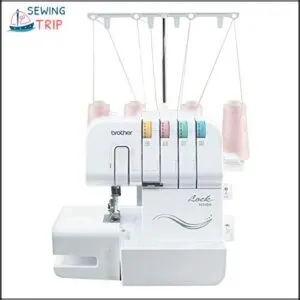
If you’re serious about upcycling, the Brother 1034DX (R1034DX refurbished) earns its place on your workbench.
At 13.9 lb, it’s light enough to move around without drama.
Color-coded threading guides make setup less of a headache, and the differential feed — adjustable from 0.7× to 2.0× — keeps your thrifted knits from puckering.
LED lighting, snap-on presser feet, and 22 built-in functions round out a machine that genuinely processes knits, linens, and denim with ease.
| Best For | Home sewers and upcyclers who want clean, professional-looking edges on knits, denim, and delicate fabrics without spending a fortune. |
|---|---|
| Thread Capacity | 3/4-thread |
| Differential Feed | 0.7x–2.0x |
| Stitch Speed | Not specified |
| Frame Material | Metal |
| Weight | 13.9 lb |
| Color-Coded Threading | Yes |
| Additional Features |
|
- Color-coded threading and 22 built-in stitch functions make it approachable for beginners and efficient for experienced sewers
- Differential feed (0.7×–2.0×) handles everything from stretchy knits to heavy denim without puckering or distortion
- Comes ready to use with thread, needles, two presser feet, and a cover — solid value for a refurbished unit
- Refurbished condition means you might deal with cosmetic wear or a dull blade right out of the box
- Runs louder and vibrates more than higher-end sergers, which gets tiring during long sewing sessions
- Needs oiling before first use and regular maintenance to keep the cutting performance sharp
2. Brother 2340CV Coverstitch Serger
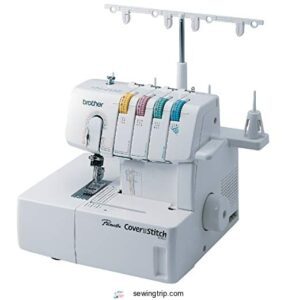
When you need clean, professional hems on your refashioned jerseys and knits, the Brother 2340CV steps in as a dedicated cover stitch machine. It’s not a serger — it doesn’t cut fabric — but that’s exactly the point.
Running at 1,100 stitches per minute with color-coded threading and differential feed, it manages stretch hems on T-shirts, necklines, and cuffs without distorting the fabric. The 3 mm to 6 mm stitch width options give you real flexibility, and the 25-year warranty backs up the investment.
| Best For | Sewists and small garment makers who regularly hem stretch fabrics like jerseys, swimwear, or dancewear and want clean, professional results without fussing with twin-needle workarounds. |
|---|---|
| Thread Capacity | 3-thread (cover stitch) |
| Differential Feed | 0.7mm–2.0mm |
| Stitch Speed | 1,100 spm |
| Frame Material | Metal |
| Weight | 13 lb |
| Color-Coded Threading | Yes |
| Additional Features |
|
- Blazing fast at 1,100 stitches per minute — great if you’re knocking out multiple pieces
- Color-coded threading and lay-in guides make setup way less frustrating
- Differential feed keeps knits smooth and pucker-free
- Left needle thread breakage is a known headache that takes some patience to dial in
- Only does cover-stitch — no serging, overlocking, or anything else
- Releasing fabric after a seam can be awkward until you learn the workarounds
3. Janome Mod 8933 Serger Lay In Threading
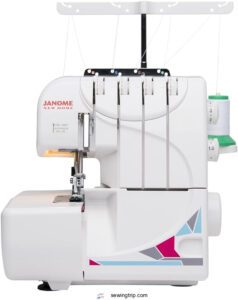
If trimming and finishing are your next move, the Janome MOD-8933 makes that step far less frustrating. Its lay-in threading system uses color-coded guides — green, red, blue, orange — so you’re not squinting at a threading diagram for 20 minutes.
At $329.99, you get 3- and 4-thread configurations, a differential feed that manages stretchy thrifted knits without puckering, and solid metal construction at 14.3 lb.
It’s a dependable workhorse for everyday upcycling projects.
| Best For | Beginners and hobbyists who want a reliable serger for upcycling and everyday sewing projects without the steep learning curve. |
|---|---|
| Thread Capacity | 3/4-thread |
| Differential Feed | Adjustable |
| Stitch Speed | Not specified |
| Frame Material | Metal |
| Weight | 14.3 lb |
| Color-Coded Threading | Yes |
| Additional Features |
|
- Color-coded lay-in threading makes setup fast and way less confusing, especially if you’re new to sergers.
- Differential feed handles stretchy knits and heavy fabrics without puckering or stretching — great for thrifted finds.
- Solid metal body at 14.3 lb keeps things stable at high speeds, so you’re not chasing the machine across your table.
- No free-arm attachment, so working with sleeves or small tubes gets tricky fast.
- The lower looper is harder to thread than the upper, which can frustrate newer users.
- It runs loud at high speeds, and tension can drift over time — meaning you’ll need to check and readjust more than you’d like.
4. Singer S0230 Metal Frame Serger
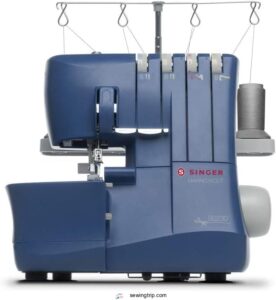
Step up from the Janome, and the Singer S0230 brings serious construction to your upcycling table. Its heavy-duty metal frame keeps things stable at 1,300 SPM — no wobbling mid-seam when you’re refashioning a stack of thrifted jerseys.
Color-coded threading and built-in LED lighting make setup quick, while the differential feed processes stretchy knits without distortion.
The free arm is a quiet bonus for cuffs and sleeves, and the integrated rolled-hem plate saves you a plate swap every time.
| Best For | Home sewers and small-studio makers who regularly work with knits, jerseys, and stretchy fabrics and want a durable, faster upgrade from a basic serger. |
|---|---|
| Thread Capacity | 2/3/4-thread |
| Differential Feed | Adjustable |
| Stitch Speed | 1,300 spm |
| Frame Material | Metal |
| Weight | Not specified |
| Color-Coded Threading | Yes |
| Additional Features |
|
- Metal frame stays rock-solid at 1,300 SPM — no vibrating or creeping across the table mid-project
- Differential feed handles stretchy and lightweight fabrics cleanly, no puckering or distortion
- Color-coded threading guides and integrated rolled-hem plate make setup and switching fast
- No built-in trim collector, so you’ll be picking up fabric scraps as you go
- Physical manual isn’t included — you’re working off a PDF or hunting online
- Struggles with thick leather, and the accessory range is thinner than higher-end industrial models
5. Singer X5004HD Metal Frame Serger
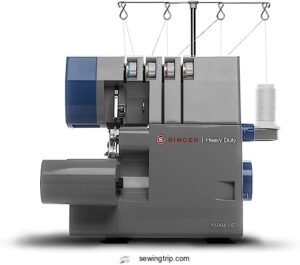
If the S0230 already impressed you, the X5004HD turns things up a notch.
That 60% larger cutting knife is the real standout — it chews through denim, upholstery, and layered thrift flips without dragging or skipping.
The heavy-duty metal frame holds steady at 1,300 SPM, and dual LED lights mean you won’t lose your seam line in dim corners.
With 2-4 thread options and eight built-in stitches, your upcycling projects get serious range — all for $299.99.
| Best For | Sewers and upcyclers who regularly work with heavy fabrics like denim, leather, or upholstery and need a fast, reliable serger that can keep up with high-volume projects. |
|---|---|
| Thread Capacity | 2/3/4-thread |
| Differential Feed | Adjustable |
| Stitch Speed | 1,300 spm |
| Frame Material | Metal |
| Weight | 15.52 lb |
| Color-Coded Threading | No |
| Additional Features |
|
- That 60% larger cutting knife handles thick, layered fabrics in one clean pass — no extra trimming needed.
- Runs at 1,300 SPM with a rock-solid metal frame, so big projects move fast without the machine wobbling around.
- Eight built-in stitches across 2-4 thread configs gives you real versatility for everything from basic finishing to decorative edges.
- Threading this thing is a hassle, and there’s no printed manual in the box — you’ll be hunting for YouTube tutorials to get started.
- The scrap bag is tiny, which gets annoying fast if you’re running through yards of fabric at a time.
- A few users have run into random power-on issues and confusing settings, so expect a bit of a learning curve upfront.
6. Singer Professional 5 14T968DC Serger
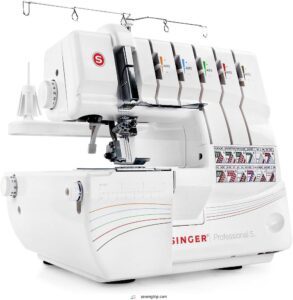
When you’re bouncing between delicate thrifted knits and beefy denim in the same session, this machine doesn’t flinch. The self-adjusting tension system manages fabric switches without manual fiddling, and 2-5 thread capability gives you real flexibility — from airy 2-thread overedges on recycled linen to heavy 4-thread overlocks on upcycled jeans.
Four built-in rolled-hem options are a quiet win for decorative finishes.
At 1,300 SPM with a solid metal frame, it’s built for serious, sustainable refashioning.
| Best For | Sewists and small-batch makers who work across a wide range of fabrics and want one machine to handle both overlocking and coverstitch without buying two separate units. |
|---|---|
| Thread Capacity | 2/3/4/5-thread |
| Differential Feed | Adjustable |
| Stitch Speed | 1,300 spm |
| Frame Material | Metal |
| Weight | 18.6 lb |
| Color-Coded Threading | Yes |
| Additional Features |
|
- The self-adjusting tension is a real time-saver — no fussing with dials every time you switch fabrics.
- 2-5 thread options give you a lot of flexibility, from lightweight rolled hems to beefy overlocked seams on denim.
- At 1,300 stitches per minute with a metal frame, it’s fast and sturdy enough for longer production runs.
- Switching between serger and coverstitch modes takes a while to learn — expect a learning curve if you’re new to sergers.
- The knife mechanism can loosen over time, so you’ll need to stay on top of basic maintenance.
- It’s on the heavier side at nearly 19 lbs, so it’s not the most portable machine if space is tight.
7. Brother AIR1800 Air Serger Jet Air Threading
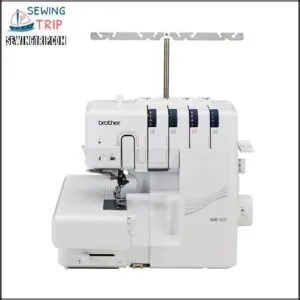
Threading a serger looper used to be the part everyone dreaded — not anymore. The Brother AIR1800’s Jet Air system pushes thread through the loopers with a single button press, so color changes don’t derail your whole upcycling session.
Built-in LED lighting keeps dark denim and deep-dyed thrift finds visible, while differential feed (0.7–2.0 mm) manages stretchy knits without puckering.
At 1,300 SPM with flatlock and rolled-hem options, it’s a smart pick for creative, fabric-forward refashioning.
| Best For | Sewists and upcyclers who work with stretch fabrics and want to skip the looper-threading headache. |
|---|---|
| Thread Capacity | 2/3/4-thread |
| Differential Feed | 0.7mm–2.0mm |
| Stitch Speed | 1,300 spm |
| Frame Material | Plastic |
| Weight | 21.5 lb |
| Color-Coded Threading | Yes |
| Additional Features |
|
- Jet Air threading makes swapping thread colors fast and painless
- Differential feed handles knits and activewear without puckering
- Built-in LED lighting makes dark or low-contrast fabrics much easier to see
- The air-threading system can fail, leaving you to thread it manually
- Only one speed setting — no slowing down for very delicate fabrics
- U.S. voltage only, and the plastic build may feel light for heavy-duty materials
8. Singer S0100 Metal Frame Serger
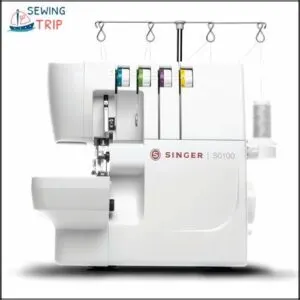
Metal frame construction matters more than most beginners realize — and the Singer S0100 builds its whole reputation around it. At 1,300 SPM with 2–4 thread options and six built-in stitch types, it manages everything from rolled hems on thrifted sheers to flatlock seams on stretch knits.
convertible free arm is a quiet breakthrough for sleeves and cuffs.
Differential feed (0.7–2.0) keeps upcycled jerseys from puckering.
At $279.99, it’s a solid workhorse for anyone serious about giving old clothes a second life.
| Best For | Sewists who want professional seam finishes and are ready to move beyond a basic sewing machine — especially those working with knits, sheers, or upcycled garments. |
|---|---|
| Thread Capacity | 2/3/4-thread |
| Differential Feed | Adjustable |
| Stitch Speed | 1,300 spm |
| Frame Material | Metal |
| Weight | 13.5 lb |
| Color-Coded Threading | Yes |
| Additional Features |
|
- Metal frame keeps things stable at high speeds, so you’re not chasing the machine across your table mid-project.
- Differential feed handles stretchy and delicate fabrics without puckering — a real lifesaver for knits and thrifted sheers.
- The free arm makes finishing sleeves and cuffs way less of a headache, especially on kids’ clothing.
- Threading is genuinely tricky, and some users find the workspace too tight — especially with smaller hands.
- No printed manual in the box, so you’re hunting YouTube videos that don’t always agree with each other.
- A few buyers have reported a missing vinyl cover and occasional pedal issues, which feels rough at a $280 price point.
9. JUKI MO655 Pearl Finish Serger
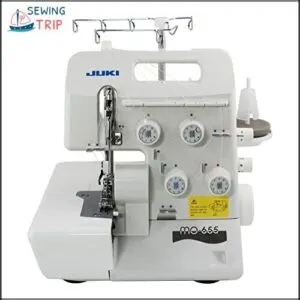
Few machines pull double duty as gracefully as the JUKI MO655. Its pearl-finish silver housing looks sharp on any studio shelf, but what really matters is what’s inside.
You get 2–5 thread options, a blazing 1,500 SPM speed, and a differential feed ratio of 0.7–2.0 — perfect for keeping upcycled knits smooth and puckering‑free.
The built‑in knife system cuts clean through denim and canvas alike, making fabric‑to‑fabric thrift flips genuinely easy.
| Best For | Home sewers and small-studio owners who want one machine that handles everything from delicate rolled hems to heavy denim overlocking without swapping between setups. |
|---|---|
| Thread Capacity | 2/3/4/5-thread |
| Differential Feed | Adjustable |
| Stitch Speed | Not specified |
| Frame Material | Not specified |
| Weight | 21.4 lb |
| Color-Coded Threading | No |
| Additional Features |
|
- Handles 2–5 thread configurations, so you can switch between overlock, flatlock, chain stitch, and rolled hem without buying a second machine
- Built-in lighting and presser-foot lever make long sewing sessions easier on your eyes and your patience
- Works across a wide range of fabrics — lightweight cotton all the way up to denim and canvas
- Threading is genuinely tricky, especially for beginners — expect a learning curve even with the included cheat sheet
- Some units ship with only one tension knob, which makes dialing in multiple thread types more frustrating than it should be
- Quality control can be hit or miss — reports of chain-stitch failures, door misalignment, and oil leaks (especially on refurbished units) are worth keeping in mind
10. American Home Portable Serger Sewing Machine
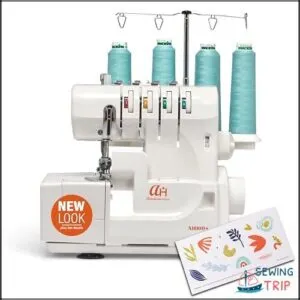
If you’re just getting started with upcycling, the American Home Portable Serger is a genuinely solid entry point. At 14.8 lb with a built-in handle, it travels with you — to classes, workshops, or a cramped corner studio.
The color-coded threading makes setup a breeze, and the differential feed manages everything from thrifted knits to denim without puckering. You get 2–4 thread options, a free arm for cuffs and sleeves, plus a 25‑year limited warranty backing your investment.
| Best For | Beginners and hobbyists who want a portable, easy-to-thread serger for finishing seams, hemming, and upcycling a range of fabrics. |
|---|---|
| Thread Capacity | 2/3/4-thread |
| Differential Feed | Adjustable |
| Stitch Speed | Not specified |
| Frame Material | Metal |
| Weight | 14.8 lb |
| Color-Coded Threading | Yes |
| Additional Features |
|
- Color-coded threading system makes setup quick and far less intimidating for newcomers
- Differential feed handles everything from stretchy knits to thick denim without a fight
- Comes loaded with accessories (rolled-hem foot, extra blades, DVD guide) so you’re not hunting for extras
- No automatic thread cutter — you’re trimming by hand every time
- Louder in real life than the promo videos suggest, which can be a problem in shared spaces
- Swapping out plates and rolled-hem needles is fiddly thanks to the tight interior layout
Key Features for Upcycling Projects
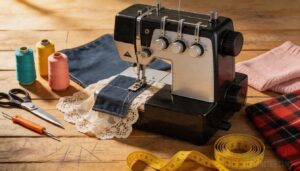
Not every serger is built with upcycling in mind, and the right features can make a real difference when you’re working with thrifted or mixed fabrics. Before you invest, it’s worth knowing which specs actually matter for refashioning projects.
Here are the key features to look for.
Differential Feed for Thrifted Knits
Thrifted knit fabrics are unpredictable — that’s where differential feed becomes your best ally. By adjusting the Front Dog Speed through Feed Ratio Tuning, your serger machine controls Stretch Compensation to keep seams flat.
Use the Swatch Testing Method on 10-inch strips before committing. Pucker Prevention Settings (try 1.5–2.0 on loose jersey) are game-changers for upcycling thrifted t-shirts without sacrificing shape.
Thread Capacity for Seam Strength
Once you’ve nailed your differential feed, thread capacity is the next thing worth thinking about. For upcycled fashion, seam durability isn’t optional — recycled denim needs a solid 4-thread overlock, while lightweight velvet scraps do fine with 2-thread.
Multi Thread Balance, Tex Size Matching, and Thread Ply Count all shape how your seams hold up through repeated wear.
Stitch Density Optimization and smart Bobbin Thread Ratio keep sustainable sewing strong.
Studies show that using a 60 Tex thread yields the highest seam strength.
Stitch Speed for Faster Refashioning
Speed matters more than you’d think when you’re batch-refashioning thrifted tees.
Motor RPM drives Stitch Efficiency directly — machines like the Juki MO-655 hit 1,500 stitches per minute, keeping overlock stitching smooth across long seam runs.
Foot Pedal Dynamics let you ease into high sewing speed gradually, while Thread Tension Sync and Heat Dissipation keep everything stable — so upcycling thrifted t-shirts stays consistent, not chaotic.
Metal Frame Durability
heavy duty metal frame keeps your serger stable when you’re powering through stacks of recycled denim. Models like the Brother 1034DX and Singer X5004‑HD use all-metal construction durability that absorbs vibration without shifting mid‑seam.
metal construction wins for upcyclers:
- Metal frame durability outlasts plastic housings under repeated heavy-duty use
- Weld protection and zinc coating resist moisture management failures over time
- Cut edge corrosion and environmental exposure don’t compromise your durable seams
Knife Performance on Thick Fabrics
When your knife dulls, everything suffers — contact pressure drops, edge wear builds, and your cuts start crushing fabric instead of slicing it.
For upcycling thrifted t-shirts and denim, blade angle and steel hardness determine cutting depth on thick layers.
A sharp knife on a metal frame serger with differential feed keeps seams clean through heavy duty refashioning sessions.
| Factor | Impact | Upcycling Relevance |
|---|---|---|
| Blade Angle | Controls cutting pressure | Slices dense denim cleanly |
| Edge Wear | Reduces cutting depth | Dulls faster on thick seams |
| Steel Hardness | Extends knife life | Manages abrasive thrifted fibers |
Free Arm for Cuffs and Sleeves
Think of the free arm as your serger’s secret weapon for tight spots. When you slide a sleeve or cuff over the built-in free arm — using Arm Extension Mechanics to switch from flatbed mode — the tube stays supported close to the needle. That’s Sleeve Hem Precision in action.
Three reasons it elevates your work:
- Tubular Fabric Handling keeps the garment’s body out of the stitching path
- Cuff Alignment Tips become easier since the narrow arm sits flush inside small openings
- Arm Threading Aid reduces bunching on fitted edges during DIY fashion projects for sustainable wardrobe refashioning
For upcycling thrifted t-shirts with serger techniques, this feature alone transforms frustrating cuff work into something smooth.
Rolled Hem and Flatlock Options
Rolled hems and flatlock stitches are where upcycling gets genuinely creative. With Short Stitch Settings and careful Looper Tension Balance, your serger wraps raw edges cleanly — perfect rolled hem capability for sheer recycled linens.
Flatlock stitches open seams flat, giving you Sophisticated Edge Finishes with Fabric Stretch Management on thrifted knits.
Add Contrast Thread Styling, and your DIY fashion project for a sustainable wardrobe becomes a statement.
Lighting and Threading Assistance
Good lighting isn’t glamorous — but it saves your sanity when you’re re-threading loopers at midnight. A Multi-LED Array with Adjustable Light Temperature lets you see every narrow thread path clearly, whether you’re working with dark denim or sheer linen.
Color-Coded Guides and an Integrated Needle Threader make setup fast, while Air Thread Boost and Jet-air threading offer near self-threading capabilities through quick threading system shortcuts.
Best Serger by Fabric Type
Not every different fabric plays by the same rules, and your serger settings need to match what you’re working with. The right machine for stretchy jersey isn’t always the right one for stiff denim or sheer linen.
Here’s how different fabric types pair with the sergers that handle them best.
Denim and Heavy Cotton Alterations
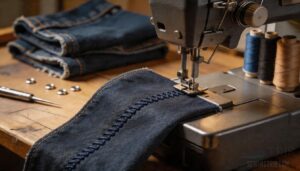
Denim doesn’t forgive shortcuts. When you’re upcycling old jeans, a heavy-duty serger with metal frame durability and differential fabric feed keeps thick seams flat and honest. Watch for these four things:
- Rivet Reinforcement and Pocket Stress Points need strong thread and backstitching.
- Waistband Adjustment often requires replacing the full band.
- Denim Fade Matching stays subtler on dark indigo.
- Heavy-Duty Stitching with high sewing speed and stitch precision locks every edge clean.
Stretch Jersey and T-shirt Repairs
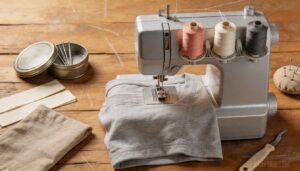
Jersey fabric lives and breathes through movement — lock that stretches down with the wrong stitch, and your repaired tee fits like a cast. For stretch jersey and t-shirt repairs, your serger needs a Ballpoint Needle, Stretch Stitch, and differential feed to keep seams flexible.
| Technique | Tool/Setting | Why It Matters |
|---|---|---|
| Seam closing | Ladder Stitch | Keeps knit loops intact |
| Weak area support | Fusible Interfacing | Stabilizes fraying edges |
| Final step | Repair Pressing | Helps fabric lie flat |
Upcycling old tees also benefits from a rolled hem for clean finishes.
Sheer Linen and Delicate Finishes
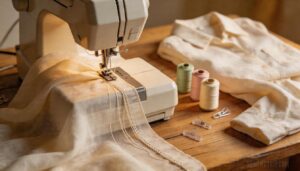
Sheer linen is a whole different animal than jersey. With weights around 150–180 GSM, it’s delicate enough to pucker if your tension is even slightly off.
Your serger’s adjustable tension and differential feed keep those fine rolled hems clean without pulling.
Linen finishes like Schreiner luster, silicone softening, stone-washing technique, anti-wrinkle coating, and water-repellent finish all respond beautifully when serger machines handle upcycling thrifted t‑shirts at a gentler pace.
Mixed-fabric Thrift Flips
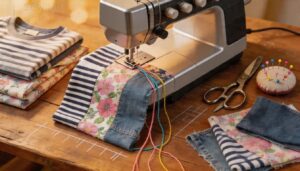
Mixed-fabric thrift flips are where things get genuinely fun — and a little tricky. Sorting by fabric weight balance before you cut keeps your panel placement intentional rather than random.
Your serger’s differential feed manages seam overlap between knits and wovens without rippling. Four-thread overlocks lock down color coordination across panels cleanly.
Upcycling thrifted t-shirts with serger techniques like trim waste management makes every scrap count.
Ribbing, Cuffs, and Sleeve Edges
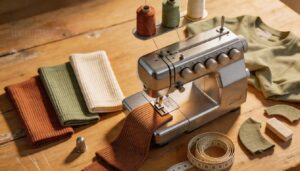
Cuffs and sleeve edges reward serger stitch adjustments for stretch fabrics — especially when upcycling thrifted t-shirts with serger techniques on rescued ribbing.
- Match rib weight to your garment’s thickness
- Cut ribbing smaller for natural cuff elasticity
- Use quarter stitching to distribute stretch evenly
- Apply stitch direction toward the sleeve for a flat finish
- Finish with an edge roll hem for clean, professional results
Decorative Hems for Refashioned Clothes
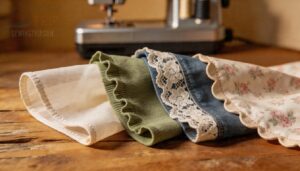
Once your cuffs are finished, decorative hems are where upcycling thrifted t-shirts with serger techniques gets genuinely fun. Use the rolled hem technique for narrow hem finishes on sheers, or stretch knits into a lettuce hem for that wavy, ripple effect.
Lace trim, ribbon trims, scalloped edges, and frayed edges all transform tired thrift-store pieces — wide decorative edges included — into something worth wearing again.
Serger Vs Coverstitch for Upcycling
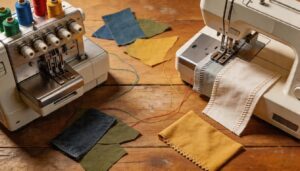
Choosing between a serger and a coverstitch machine can make or break your upcycling workflow.
Each one has a distinct job, and knowing which to reach for saves you time, thread, and a lot of frustration. Here’s a breakdown of where each machine shines and how to set up your workspace for the best results.
What a Serger Does Best
A serger is your upcycling workhorse — it performs Raw Edge Trimming, Seam Reinforcement, and Integrated Edge Finishing all in one pass.
| What It Does | Why It Matters |
|---|---|
| Overlock stitch | Secures seams on thrifted knits |
| Differential feed | Prevents stretch fabric puckering |
| Rolled hem | Creates clean decorative edges |
| Multi-Thread Stitching | Adds durability to recycled denim |
| Stitch speed | Speeds up bulk refashioning |
Quick Setup and smart fabric handling make it indispensable.
When Coverstitch is The Better Choice
When your upcycled knit needs a hem that moves with the body, coverstitch earns its spot at the table.
| Use Case | Why Coverstitch Wins | Needle Configuration Impact |
|---|---|---|
| Stretch hem durability | Loops flex without snapping | Two or three-needle setup |
| Activewear seam flexibility | Manages repeated stress | Three-needle for high-stretch |
| Elastic integration | Holds flat, stays comfortable | Two-needle works beautifully |
| Decorative topstitch aesthetics | Clean, polished factory finish | Looper side faces outward |
Coverstitch versus overlock machine differences come down to this — the Brother 2340CV excels at upcycling thrifted T-shirts using serger techniques, where standard stitches would fail.
Overlock Seams Vs Cover Hems
Think of it this way — overlock machines handle the messy inside work, while a coverstitch machine delivers the polished outside finish.
| Function | Best Machine |
|---|---|
| Edge Finish + Blade Trimming | Overlock |
| Visible Hemming + Stitch Stretch | Coverstitch |
Coverstitch versus overlock machine differences shape every upcycle decision. Looper arrangement determines whether you’re sealing raw edges or creating rolled hem capability with clean, flat visible hemming.
Do You Need Both Machines
Honestly, you probably don’t need both — at least not right away. A serger manages most upcycling work solo: seaming, edging, even a lettuce hem or narrow hem on thrifted t-shirts. Budget considerations, space constraints, and your project frequency should guide that call.
A serger alone handles most upcycling work — buy the second machine when your projects demand it
| Factor | Serger Only | Both Machines |
|---|---|---|
| Workflow Efficiency | Good for most | Smooth switching |
| Learning Curve | Lower | Higher |
| Coverstitch Function | Limited | Full stretch hems |
Best Setup for Garment Remodeling
Your workspace shapes your results more than any single machine setting. A Stable Table cuts vibration, Ergonomic Seating saves your back during long sessions, and Tool Organization keeps your rhythm going.
| Setup Element | Why It Matters |
|---|---|
| Fabric Pre-treatment | Prevents shrinkage surprises |
| Seam Alignment Guides | Keeps edges consistent |
Threading and tension adjustments, differential feed benefits, and serger stitch adjustments for stretch fabrics all perform better when your space works with you — especially for upcycling thrifted t‑shirts with serger techniques and garment remodeling.
Choosing The Right Upcycling Serger
Not every serger fits every upcycler, and the right pick depends on more than just price. Whether you’re a seasoned thrifter tackling heavy denim, there’s a machine built for your workflow.
Here’s what to look for before you commit.
Best Picks for Beginners
Starting your first DIY fashion project for a sustainable wardrobe doesn’t have to feel overwhelming. The best sergers for beginners combine an intuitive interface with clear threading diagrams and adjustable stitch width so setup feels manageable, not intimidating.
Budget-friendly sergers under $500 — like entry-level Brother models — offer lightweight design and easy-to-follow threading instructions that keep your focus on the creative work, not the machine.
Best Options Under $500
Budget-friendly sergers under $500 punch well above their price tag. The Brother 1034DX delivers solid price-to-performance with color-coded threading for smooth ease of setup, while the Singer S0230’s built-in free arm adds real versatility.
Both models offer weight efficiency that doesn’t sacrifice durability. For upcycling thrifted t-shirts with serger techniques, either machine gives beginners a strong, capable start.
Portable Vs Heavy-duty Models
Your workspace footprint matters as much as your budget. Portable sergers win on transport ease and setup speed — ideal for small apartments or classes. Heavy-duty serger options for thick fabrics offer vibration stability and cutting power, ensuring clean seams through denim and layered thrift flips. Match the machine to where — and how often — you actually sew.
Easy Threading and Tension Control
Threading a serger shouldn’t feel like diffusing a bomb. Air Threading systems like Brother’s AIR1800 push thread through automatically, while Lay-In Threading with color-coded guides makes setup genuinely fast. Separate tension dials let you fine-tune each thread independently — small adjustments, big results.
When upcycling thrifted t-shirts with serger techniques, dialed-in threading and tension adjustments in sergers mean clean stitches every single time.
Accessories Worth Buying
The right accessories turn a good serger into a great one. Stock your kit with these game-changers:
- A cone stand and low-lint thread for smooth, tangle-free feeding
- A blind hem foot and rolled hem plate for clean, professional finishes
- Small snips for trimming threads close to seams
- A lint brush for keeping loopers clear between projects
Warranty and Long-term Value
A serger that lasts five years beats a cheaper one that quits in two. Warranty Length and Coverage Scope vary widely — Brother’s 25-year chassis coverage and Singer’s 25-year machine-head protection signal serious machine durability. A Transferable Warranty adds Resale Premium when you upgrade later.
| Feature | Why It Matters |
|---|---|
| 25-year chassis warranty | Structural confidence for heavy upcycling use |
| Service Network access | Authorized repairs without surprise costs |
| Transferable coverage | Boosts resale value on budget-friendly sergers under $500 |
| Component-specific terms | Protects electronics separately from the frame |
Affordability means nothing if repair bills pile up — sewing machine warranty coverage is your real safety net.
Matching Features to Your Projects
Match your serger’s features to what you actually make. For upcycling thrifted t-shirts with serger techniques like lettuce hem or flatlock, adjustable tension and differential feed are non‑negotiable.
Serger stitch adjustments for stretch fabrics rely on thread capacity and knife size selection.
Air jet threading saves setup time, while thread color coding keeps configurations clear.
Portable power options work well for smaller, spontaneous refashion sessions.
Frequently Asked Questions (FAQs)
Can sergers handle vintage or pre-washed fabrics?
Yes — sergers handle both vintage and pre-washed fabrics well.
Test fabric fragility first, adjust knife adjustment and thread tension tweaks as needed, and use differential feed to keep delicate edges smooth.
How do you maintain a serger between upcycling projects?
Clean lint after every project, oil moving parts, swap dull needles, check knife sharpness, and store your machine covered. Good maintenance keeps thread tension smooth and every upcycling stitch clean.
What thread types work best for upcycled garments?
Polyester thread is your safest all-around bet — strong, slightly stretchy, and colorfast. For knits, reach for stretch thread. Heavy denim needs high-tenacity poly. Cotton suits natural-fiber projects beautifully.
Conclusion
Ironically, the key to reducing waste lies in a machine that cuts fabric. Investing in one of these top serger machines for upcycling clothes can transform thrifted finds into unique garments.
With the right serger machines for upcycling clothes, you’ll create professional-grade seams, giving new life to old favorites. This approach makes sustainability a breeze, one stitch at a time, effortlessly.