This site is supported by our readers. We may earn a commission, at no cost to you, if you purchase through links.

That polyester thread you bought fifteen years ago might still stitch perfectly—while the cotton you picked up last spring could already be showing signs of strain. Embroidery thread shelf life isn’t a fixed number stamped on a label; it shifts depending on fiber type, storage conditions, and how much UV, humidity, or heat the spool has absorbed over time.
Cotton degrades faster than polyester by decades. Rayon can lose its integrity within five years under poor conditions.
Knowing what you’re working with before you thread the needle saves your project from broken strands, faded color, and weak seams at the worst possible moment.
Table Of Contents
- Key Takeaways
- How Long Embroidery Thread Lasts
- Signs Thread Has Expired
- What Shortens Thread Shelf Life
- Store Thread for Maximum Life
- Cotton Vs Polyester Vs Rayon
- Test Thread Before Stitching
- Pick Thread for Your Project
- Top 5 Thread Care Products
- Repurpose Old Thread Wisely
- Frequently Asked Questions (FAQs)
- Conclusion
Key Takeaways
- Polyester thread outlasts cotton and rayon by decades — lasting 15–50 years with proper storage — making fiber type the single biggest factor in how long your thread stays stitch-ready.
- Heat, humidity above 50%, UV light, and temperature swings are the four storage conditions that silently cut years off your spools before you ever thread a needle.
- Before starting any project, run a quick tug test, bend test, and visual check for fading or fuzz — expired thread snaps, crackles, or smells musty, and catching it early saves your work.
- Old thread that’s too weak to stitch still earns its keep as tailor’s tacks, basting stitches, craft stuffing, tassels, or string art — don’t toss it until you’ve considered the second life.
How Long Embroidery Thread Lasts
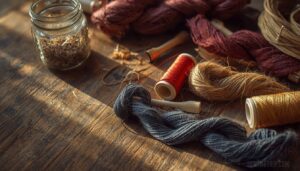
embroidery thread ages the same way — and that difference matters more than most crafters realize.
Just like thread, the needle you choose directly affects how your embroidery holds up over time.
Your fiber type is the first thing that determines how long a spool stays stitch-ready. Here’s how each one holds up over time.
Cotton Thread Shelf Life
Cotton thread usually lasts 5–10 years with proper storage — up to 12 under ideal conditions. But skip the basics, and you’ll see trouble much sooner:
- Light exposure bleaches dyes within months
- High humidity triggers mold; dry air causes brittleness
- Temperature swings weaken cotton fibers fast
Colorfastness testing, humidity sensor use, and temperature stabilization methods are your best tools for extending cotton thread’s life. For longer durability, consider polyester thread longevity.
Polyester Thread Shelf Life
Polyester thread is the long-haul champion here.
While cotton maxes out around 12 years, polyester’s Chemical Resistance Profile means it shrugs off moisture, mildew, and mild solvents — giving you a Thread Longevity Metric of 15–50 years with proper storage techniques.
UV degradation is still a threat, so humidity control for textiles and your Spool Rotation Schedule matter.
| Storage Factor | Polyester Impact |
|---|---|
| UV degradation | Slow fade over years |
| Humidity control for textiles | Resists mold well |
| Silica Gel Efficacy | Extends life considerably |
| Mechanical Fatigue Testing | Holds tension longer |
| Thread lifespan estimation | 15–50 years |
Rayon Thread Shelf Life
Rayon thread doesn’t have the staying power of polyester — not even close. Expect roughly 5 years under proper storage techniques, and that’s if you’re careful.
UV degradation can strip color within 2–3 years of light exposure.
Packaging Airtightness and Light Blocking Strategies are non‑negotiable here.
Poor Moisture Barrier Materials speed up the Fiber Oxidation Rate fast, making Shelf Life Forecasting nearly impossible without consistent conditions.
Silk and Nylon Thread Lifespan
Silk and nylon both outlast rayon by a wide margin. Silk care matters here — quality mulberry silk holds tensile retention for 10–20 years when humidity and temperature stay stable. Nylon, boosted by coating treatments and fiber blend influence, can last 15–25 years.
Watch for microcrack formation from thermal expansion or light exposure:
- Store below 75°F
- Keep humidity between 40–60%
- Run The Tug Test yearly
Unopened Vs. Regularly Used Spools
An unopened spool’s factory seal is your first line of defense — that packaging airtightness keeps moisture ingress out for one to two years. Once broken, humidity starts working immediately.
Used spools risk spool core deformation from repeated unwinding, creating tension snags. Practicing smart stock rotation — oldest opened spools first — is one of the best practices for storing embroidery thread and extending thread lifespan.
Signs Thread Has Expired
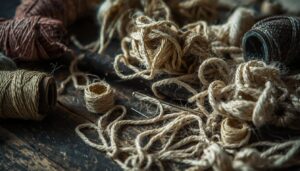
Thread doesn’t announce when it’s past its prime — it just starts letting you down mid-project. Before you thread your needle, it’s worth knowing what "expired" actually looks like up close.
Here are the most common signs your thread is telling you it’s done.
Fading or Dull Color
Color doesn’t lie — dull thread is expired thread.
Sunlight Fade Factors hit cotton and rayon hardest, with UV damage stripping up to 40% of color within six months of light exposure.
The Dye Oxidation Process also quietly dulls stored spools over time.
Watch for:
- Washed-out or uneven color across the spool
- Fading Prevention Strategies ignored near windows
- Heat Induced Fading from warm storage spots
- Airborne Pollutants shifting hue in urban spaces
Lightfastness of dyes varies by fiber, so check chemical exposure history too.
Fuzz, Fraying, or Uneven Thickness
Run your fingers along a spool — if it shreds or fuzzes easily, that’s Surface Fiber Loosening, telling you something’s wrong.
Abrasion Fuzz Build-up raises Thread Diameter Variation, causing skipped stitches and puckering.
Knot-Induced Fraying, fraying, and tangling signal weak spots from poor winding or rough handling.
Evaluating thread condition before use in projects means checking for uneven thickness — Uneven Spool Tension makes frayed, faded, or brittle thread obvious fast.
Brittleness and Snapping
Thread that snaps the moment you pull it has lost its molecular mobility — cold or age locks fibers into rigid crystalline structures where crack propagation happens fast. High fiber crystallinity leaves no room to flex, so stress concentrators like tiny kinks trigger sudden breaks.
When thread loses molecular mobility, even a tiny kink becomes the crack that breaks it
Frayed, faded, or brittle thread snapping during machine quilting is your clearest warning. Test before stitching — thread brittleness and thread breakage prevention start with catching these signs early.
Sticky Texture or Mildew Smell
sticky spool is a red flag you can’t ignore. Moisture stickiness happens when humidity above 50% seeps into fibers, leaving thread clumped and tacky to the touch.
That same damp environment feeds thread mold growth, producing a mildew odor that spreads to neighboring spools fast.
Your sensory inspection should catch both signals before you stitch.
- Check for sticky residue on the spool surface or between wound layers
- Smell each spool — mildew odor means active fungal contamination
- Isolate affected spools immediately; mold transfers to adjacent thread
- Use silica gel packs inside airtight containers for antifungal storage and spool ventilation
Weak Spots From Old Winding
Old winding creates more damage than most stitchers realize. Irregular winding tension causes microcracks along the fiber, leading to fraying and tangling mid-stitch.
Uneven impregnation leaves dry pockets where moisture hides, while slot dust accumulation and enamel abrasion weaken individual strands over time.
These are classic signs your thread has gone bad — and key factors influencing embroidery thread degradation, you shouldn’t overlook.
What Shortens Thread Shelf Life

Thread doesn’t just age on its own — your storage environment does most of the damage. A few common culprits can quietly cut years off your spools before you ever pick up a needle.
Here’s what you need to watch out for.
UV Light and Sun Exposure
Sunlight is one of the fastest ways to ruin good thread. UV damage causes up to 40% color loss in cotton and rayon within just six months of direct light exposure — and window UV transmission means indoor spools aren’t safe either.
Reflective surface exposure from snow or water amplifies sunlight fading rates.
UV filtering sprays and UV protective coatings help slow thread degradation considerably.
High Humidity and Mold Growth
Humidity is just as sneaky as UV light. Once moisture climbs above 50%, mold growth on thread becomes a real risk — and mold can take hold in as little as 24–48 hours.
Cotton and silk absorb moisture fast, making proper storage methods for sewing thread non‑negotiable.
Use humidity monitoring tools to stay informed, and choose mold‑resistant spools or containers with mold inhibition additives for reliable thread preservation.
Dry Air and Brittle Fibers
Too little moisture is just as damaging as too much. When humidity drops below 35%, dry air pulls moisture from cotton and rayon fibers, triggering a moisture equilibrium shift that leaves them stiff and unforgiving.
Over time, microcrack formation weakens the surface, and elasticity loss indicators like snapping or crumbling appear. Cool, dry, and dark storage with proper humidity control prevents this brittle fiber handling nightmare.
Temperature Swings in Storage
Dry air cracks fibers — but temperature swings bring a different kind of damage. Daily shifts between 5°C and 25°C cause thermal expansion and contraction that weakens fiber bonds over time.
Moisture cycling and condensation control become serious concerns when spools sit in poorly sealed spaces.
Watch for these signs your storage environment is failing:
- Tacky spool surfaces after warm spells
- Condensation on spool cores from humidity spikes
- Color fading on polyester from repeated heat exposure
- Brittleness in nylon after cold-then-warm cycles
- Coating cracks on decorative metallic threads
Insulated cabinets, temperature alarms, and a stable range of 18°C–22°C protect thread quality long-term.
Solvents, Detergents, and Alcohol
Chemical exposure is one of the sneakiest shelf-life killers. Ethanol, isopropanol, and household detergents break down dye bonds and weaken fiber structure on contact — cotton and rayon are especially vulnerable.
Managing chemical exposure to embroidery thread means keeping spools away from cleaning stations entirely. Detergent compatibility matters too: even mild surfactants cause gradual color loss.
For safer storage, green solvent options like ethyl lactate cause less long-term damage.
Store Thread for Maximum Life
Good storage isn’t complicated, but the details matter more than most people think. A few simple habits can add years to your thread’s usable life. Here’s what actually works.
Keep Spools Cool and Dry
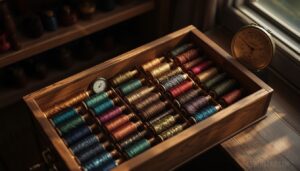
Think of your thread stash like a wine cellar — temperature stability and humidity control are everything.
Keep spools in a cool dry and dark space between 60°F and 75°F, where thermal insulation stays consistent and temperature swings won’t weaken fibers.
Aim for 40–50% humidity. Smart cool zone placement — away from vents and windows — gives your threads true archival storage longevity.
Use Opaque Sealable Containers
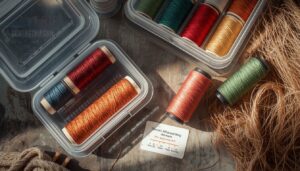
The right container isn’t optional — it’s your thread’s first line of defense. Opaque covers and plastic storage boxes block UV light completely, preventing dye fading that ruins cotton and rayon in months. Skip Ziploc bags for long-term storage; they can’t match airtight storage containers with silicone-gasket lids.
Here’s what makes a container actually work:
- Container Material Choice — High-density polyethylene thread boxes resist cracking and won’t leach chemicals onto fibers.
- Seal Integrity Checks — Press the lid fully until you feel the gasket engage; a loose lid undermines the purpose.
- Stackable Organization Systems — Flat-based containers double your shelf capacity without tangling spools.
- Moisture Indicator Use — Drop a color-changing humidity card inside so you know conditions at a glance.
- Labeling Best Practices — Label the outside with fiber type and color number, so you’re not opening containers constantly and breaking the seal.
Add Silica Gel or Dehumidifiers
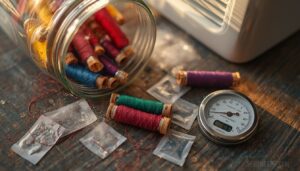
Silica gel is your moisture problem solved in a packet. For silica gel usage, follow smart Gel Placement Strategies: distribute multiple small packets evenly around spools rather than one large pack.
Monitor Indicator Color Monitoring signals — orange turning green means it’s time for Regeneration Procedures at 120–160°C.
For high-humidity rooms, Dehumidifier Capacity Planning and Humidity Sensor Integration protect thread longevity and prevent mildew reliably.
Store Away From Windows and Chemicals

Windows and chemical fumes are threads’ worst enemies — UV exposure bleaches dyes within months, while solvents silently weaken fibers you can’t see breaking down.
- Use Window-Free Storage areas like interior closets or dedicated cabinets with Air-Circulating Cabinets that allow gentle airflow.
- Place spools in Non-Reactive Bins on Chemical-Resistant Shelving, far from cleaners or adhesives.
- Maintain Separate Chemical Zones to protect storage conditions from contamination.
Label Spools to Reduce Handling
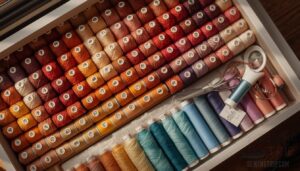
Every time you handle a spool unnecessarily, you risk fraying the ends. Color-coded tags on each spool let you identify fiber type and shade at a glance — no unwrapping needed.
Add a QR code inventory link and batch number tracking for full traceability.
Use durable label material with standardized label placement on the outer rim, and organize by color and type on thread racks for smarter inventory management for embroidery supplies.
Cotton Vs Polyester Vs Rayon
Not all embroidery thread is created equal — and fiber type makes a bigger difference than most crafters expect.
Cotton, polyester, and rayon each hold up differently under washing, heat, and everyday wear. Here’s how they compare across the factors that matter most.
Durability Differences by Fiber
Not all thread is built the same. Fiber Elasticity Differences, Abrasion Wear Levels, Mold Susceptibility, and Thermal Expansion vary widely across cotton thread, polyester thread, and rayon thread.
| Fiber | Key Durability Factor |
|---|---|
| Cotton (natural fibers) | Moderate abrasion, shrinks with heat |
| Polyester (synthetic fibers) | High strength, mold-resistant |
| Rayon | Stretches, frays easily |
| Silk/Nylon | Soft but wears faster under friction |
Dye Stability also differs — polyester holds color longest.
Wash Resistance and Colorfastness
Durability tells half the story — wash resistance tells the rest. Polyester wins here: dispersed dyes and dye fixatives keep colors locked through 50+ wash cycles. Cotton fades faster unless treated with reactive dyes or enzymatic finishes. Rayon? It bleeds early without resin finishes.
| Fiber | Wash Resistance |
|---|---|
| Polyester | Excellent — colorfast, minimal fading |
| Cotton | Moderate — improves with reactive dyes |
| Rayon | Low — needs enzymatic finishes |
| Silk | Fair — cold wash benefits apply |
Cold wash benefits every fiber. Stick to pH-neutral detergents and skip bleach entirely. Run a rubbing crocking test — if color transfers onto your fingernail, expect bleed in the wash.
Strength for High-speed Embroidery
Wash resistance sets the foundation — now speed puts your thread to the real test. Polyester’s high tenacity and high twist thread construction manages machine tension and speed considerations for best thread durability. Its tensile strength exceeds 6.5 N, making spool friction reduction and servo speed optimization far more manageable.
| Thread | Speed Performance |
|---|---|
| Polyester | Excellent — high tenacity, consistent |
| Cotton | Moderate — breaks under rapid tension |
| Rayon | Poor — low thread break strength |
| Nylon | Good — strong needle thread compatibility |
Tension management matters most here.
Outdoor and Marine Project Needs
Speed manages indoor stress — outdoor and marine projects are a different beast entirely. Salt air, UV exposure, and constant moisture will chew through cotton and rayon fast. For UV resistance and outdoor embroidery durability, UV-Stable Polyester and Marine-Grade Nylon are your go-to options.
| Thread | UV Resistance | Marine Suitability |
|---|---|---|
| UV-Stable Polyester | Excellent | High |
| Marine-Grade Nylon | Good | High |
| Cotton | Poor | Very Low |
| Rayon | Very Poor | Not Suitable |
| Silk | Poor | Not Suitable |
Thread durability for outdoor and marine projects depends heavily on moisture effects on cotton and rayon threads — both absorb water and weaken quickly. Pair corrosion-resistant needles with a salt-resistant coating for best results.
When Softer Threads Wear Faster
Softer fibers feel luxurious, but that flexibility comes at a cost. Rayon thread and silk thread both sacrifice durability for their smooth finish — meaning fraying and tangling show up faster under stitch tension.
Cotton thread sits in the middle.
Thread coating wear accelerates when needle size match is off, and poor dye saturation leaves threads frayed, faded, or brittle sooner than expected.
| Fiber | Wear Speed |
|---|---|
| Rayon | Fastest |
| Silk | Fast |
| Cotton | Moderate |
Test Thread Before Stitching
Before you thread your needle, take two minutes to check what you’re working with. Old thread can look fine on the spool, but snap mid-stitch, leaving you with broken designs and wasted time.
Here’s how to test it properly before committing to your project.
Visual Inspection for Fading
Hold a suspect spool up to a lamp for a quick Backlit Color Check — it’s one of the most revealing Signs Your Thread Has Gone Bad.
UV light degradation strips dye unevenly, so scan for Hue Uniformity Mapping across the full length.
Watch for a Glossiness shift from shiny to matte, Spotting Dye Bleed patches, or dull zones from Light Exposure.
Light‑Angle Reflection at 45° confirms color fading fast.
Tug Test for Strength
Once you’ve checked color, it’s time to stress-test what you can’t see. Cut an 18-inch (forearm length test) strand and pull steadily with both hands.
Good thread resists; weak thread snaps fast.
Angle Consistency matters — always pull straight, not sideways.
For reliable thread strength readings, test three samples per spool.
Inconsistent results signal Sample Length Variability or uneven aging.
Trust the snap, not the guess.
Knot-pull Test for Weakness
The knot-pull test reveals what a basic tug can’t — hidden weakness inside the fiber itself. Tie a simple overhand knot in a forearm-length strand, then pull steadily.
Natural cotton shows greater knot weakness than polyester or nylon in knotted thread tests, so fiber influence matters. If it snaps at the knot, don’t risk it on your project.
Bend Test for Brittleness
Brittleness is thread aging’s most deceptive warning sign. Bend a short segment sharply between your fingers — if it cracks immediately, material degradation has already set in. This simple three-point bending check mirrors how engineers assess flexural strength: you’re reading a tiny load deflection curve with your hands.
Evaluating thread condition before use in projects catches what eyes miss:
- Bend a 2-inch length at a 90-degree angle
- Listen for crackling — healthy thread flexes silently
- Check the fracture surface for dry, splintered edges
- Test at room temperature; cold air masks true brittleness
- Flag frayed, faded, or brittle strands immediately
Check Needle Size and Tension
Wrong needle size is one of the most overlooked causes of thread breakage — even strong threads snap when the needle eye size doesn’t match. mismatched eye slices the fiber during every stitch.
For thread feed smoothness and stitch density control, pair fine threads with sizes 60–80 and heavier ones with 90–110.
Variable tension adjustment starts here: test on a scrap first.
Pick Thread for Your Project
Choosing the right thread isn’t just about color — it’s about making sure your work holds up to whatever you’re putting it through. The fabric, the washing frequency, and the environment all push you toward different fiber types.
Here’s a breakdown of the best thread for each situation.
Best Thread for Frequent Washing
Polyester thread is your best bet for anything that sees the washing machine regularly. Its colorfast dye chemistry keeps shades true through 50-plus cycles, while polyester longevity and nylon shrink resistance mean seams stay tight and flexible.
Cotton thread loses up to 20% tensile strength with repeated washing — so save it for low-wash projects where post-wash flexibility and thread durability matter less.
Best Thread for Towels and Denim
Towels and denim demand different things from thread, but both reward smart fiber blend performance choices.
For towels, a 40 wt cotton-wrapped polyester thread hits the sweet spot — moisture absorption stays comfortable while polyester thread durability withstands repeated laundering.
On denim, reach for core-spun polyester; thread weight selection around 40–50 wt keeps topstitching flat without puckering.
Match needle compatibility to your thread weight, and color matching strategies become straightforward.
Best Thread for Uniforms and Workwear
Workwear puts thread through the wringer — washing, friction, heat, and outdoor exposure all at once. That’s where polyester thread earns its place.
- Abrasion Resistance — Core-spun polyester withstands repeated wear without fraying seams
- Heat Tolerance — It feeds smoothly through high-speed machines without sticking
- Moisture Management — Polyester dries faster than cotton on moisture-prone uniforms
Needle compatibility matters too — pair with the right size for clean, durable stitches.
Best Thread for Decorative Embroidery
Decorative embroidery is where sheen variety and fiber flexibility really matter.
Rayon gives you rich color gradient and high gloss on dark fabrics, while silk offers metallic luster with a smooth, luxurious feel.
Choosing the right thread type for specific projects means matching thread weight to your design’s detail level — fine threads suit intricate motifs, heavier ones fill broader areas beautifully.
Best Thread for Outdoor Projects
For outdoor projects, your thread needs to fight sun, moisture, and heat — all at once. UV-Stabilized Polyester and Marine-Grade Nylon are your best options here.
- UV-treated polyester thread retains 90% color after 1,000 hours of light exposure.
- Abrasion-Resistant Coatings protect outdoor awning thread from friction and fraying.
- Waterproof Thread Design with Heat-Resistant Spools combats the impact of humidity and UV on thread quality.
Top 5 Thread Care Products
The right tools can make a real difference in how long your thread stays in good shape. From storage solutions to sealers, a few well-chosen products go a long way toward protecting your investment.
Here are five worth keeping in your craft supplies.
1. Metrosene Premium Sewing Thread Set
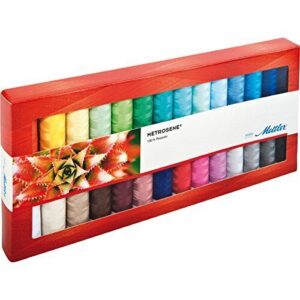
The Metrosene Premium Sewing Thread Set gives you 28 popular colors on 100% polyester spools — each holding about 164 yards.
That’s a solid foundation for most sewing and embroidery projects.
The mercerized finish produces smooth, low-lint stitching with minimal tension adjustments needed.
It withstands machine washing, dry cleaning, and heat without losing its shape or color.
Keep in mind, though: the color range won’t cover every specialty shade, and some users report breakage under higher tension settings.
| Best For | Home sewers and hobbyists who want a reliable, versatile thread set covering everyday colors for apparel, quilting, and home textile projects. |
|---|---|
| Primary Material | 100% Polyester |
| Volume / Length | 164 yd per spool |
| Finish / Color | 28 assorted colors |
| Country of Origin | China |
| Primary Use | Sewing & stitching |
| Moisture Resistance | Machine washable |
| Additional Features |
|
- 28 popular colors in one organized tray — great for having the right shade on hand without hunting for individual spools.
- Low-lint, heat-resistant polyester holds up through machine washing, dry cleaning, and ironing with no fuss.
- Minimal tension adjustment needed, so it plays nicely with most sewing machines right out of the box.
- The color range skips niche and specialty shades, so it may leave some fabric collections without a good match.
- Some users report the thread roughing up or snapping under higher tension — not ideal for heavy-duty seams.
- Marketed as "Made in USA" on some listings, but it’s actually manufactured in China, which may matter to some buyers.
2. XACTO Number Two Precision Knife Safety Cap
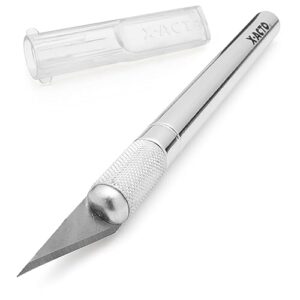
Precision trimming is part of good thread care — and that’s where the X-ACTO No. 2 Knife earns its place in your kit.
The aluminum handle keeps it lightweight at just 22.68 grams, while the fine-point blade makes clean cuts through paper, cardboard, and thin materials without fraying edges.
The integrated safety cap protects the blade between uses and shields it from lint and debris.
Always cap it after use — a nicked blade makes ragged cuts, not clean ones.
| Best For | Hobbyists, crafters, and students who need precise, clean cuts in paper, cardboard, film, or light materials for projects like dioramas, 3D-print cleanup, or polymer clay work. |
|---|---|
| Primary Material | Aluminum |
| Volume / Length | 9 inches overall |
| Finish / Color | Silver |
| Country of Origin | USA |
| Primary Use | Cutting & crafting |
| Moisture Resistance | Not applicable |
| Additional Features |
|
- Lightweight aluminum handle at just 22.68g makes it easy to control for detailed, fiddly work
- The easy-change blade mechanism means quick swaps with no fuss
- Integrated safety cap keeps the blade protected between uses and makes it safe to toss in a bag
- The blade can loosen when cutting thicker or denser material, so you may need to stop and re-tighten mid-project
- The safety cap fits loosely for some users, which isn’t great if you’re counting on it for protection
- You’re locked into size 2 replacement blades — wrong blades can strip the threads and hurt performance
3. Beacon Fabri Tac Permanent Fabric Glue

When a seam lifts or an appliqué starts peeling, you need something that holds — fast.
Beacon Fabri-Tac bonds cotton, denim, lace, leather, and canvas with a clear, waterproof formula that dries in about 10 minutes and sets fully within 24 hours.
The precision tip gives you control on small areas, and it won’t leave visible glue lines.
It’s also washable once cured, so your repairs survive the laundry cycle without cracking or lifting.
| Best For | Crafters, sewers, and DIYers who need a strong, invisible bond on fabric, leather, or mixed-material projects without breaking out a needle and thread. |
|---|---|
| Primary Material | Liquid Adhesive |
| Volume / Length | 4 oz (113 mL) |
| Finish / Color | Crystal clear |
| Country of Origin | USA |
| Primary Use | Fabric bonding |
| Moisture Resistance | Waterproof formula |
| Additional Features |
|
- Dries crystal clear, so no ugly glue lines showing through your work
- Waterproof once set — repairs hold up through washing and outdoor use
- The spray nozzle gives you decent control for smaller, detailed areas
- Can get stringy and web-like if you use too much, especially on narrow edges
- The thick formula takes some patience to spread evenly on delicate or super flexible materials
- May irritate sensitive skin, so gloves are a good idea
4. Mod Podge Gloss Glue Sealer
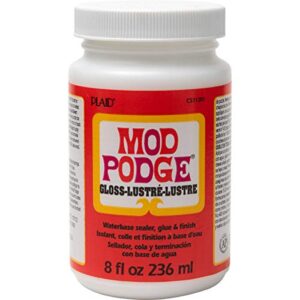
Mod Podge Gloss Glue Sealer pulls triple duty — glue, sealer, and finish all in one bottle.
For thread-based crafts like string art, decoupage wraps, or decorative fringe, that matters. Apply it with a brush over your finished piece, and it dries clear to a high-gloss coat in about 15–20 minutes.
Full cure takes 24 hours. It’s non-toxic, water-based, and cleans up with soap and water — making it a practical pick for mixed-media projects where thread meets paper, wood, or fabric.
| Best For | Crafters and hobbyists who want an all-in-one solution for decoupage, mixed-media, or classroom projects without juggling multiple products. |
|---|---|
| Primary Material | Water-Based Liquid |
| Volume / Length | 8 fl oz (237 mL) |
| Finish / Color | Clear gloss |
| Country of Origin | USA |
| Primary Use | Decoupage & sealing |
| Moisture Resistance | Moisture-resistant coat |
| Additional Features |
|
- Does three jobs at once — glues, seals, and finishes — so you’re not buying separate products
- Dries clear with a nice glossy coat that looks polished and professional
- Non-toxic and easy to clean up, which makes it great for kids and classroom use
- You need to brush carefully — too thick and you’ll get runoff or visible brush strokes
- Not built for heat or moisture, so it’s not a fit for anything that needs to be washed or gets steamy
- Thick layers take longer to dry than expected, which can slow down multi-step projects
5. Golden Heavy Gel Gloss
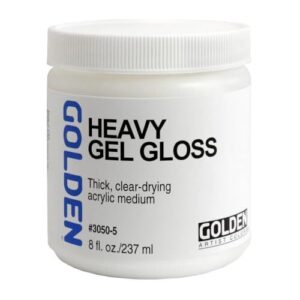
Golden Heavy Gel Gloss is the heavy lifter in this lineup.
Made by Golden — an employee-owned company with over 40 years behind them — this thick, clear-drying acrylic gel does more than seal thread work.
It locks decorative strands into place on collage panels, string art, and sculptural wraps while drying to a glossy, flexible film that resists moisture, chemicals, and UV light.
It won’t yellow over time, and the 8 fl oz jar gives you enough to finish most medium-scale projects.
| Best For | Artists who want to thicken, extend, or sculpt with acrylics — especially for collage, string art, and textured 3D work. |
|---|---|
| Primary Material | Acrylic Gel |
| Volume / Length | 8 fl oz (237 mL) |
| Finish / Color | Transparent clear |
| Country of Origin | USA |
| Primary Use | Acrylic art medium |
| Moisture Resistance | Water resistant when cured |
| Additional Features |
|
- Dries clear and glossy with a flexible finish that resists moisture, UV, and yellowing over time
- Works as both an adhesive and a sculptural medium, so it pulls double duty on mixed-media projects
- Made by a trusted, employee-owned brand with 40 years of experience in professional-grade materials
- The thick consistency can be tricky to work with for fine details or thin glazes without extra mixing
- Only plays nice with acrylics — oil and watercolor painters need to look elsewhere
- The 8 fl oz jar goes fast on bigger projects, which can make it pricey at scale
Repurpose Old Thread Wisely

Old thread doesn’t have to end up in the trash just because it’s past its prime for serious stitching. There are actually clever ways to put it to work without worrying about strength or durability.
Here are five practical ways to repurpose old thread wisely.
Temporary Basting Stitches
Old thread doesn’t have to be wasted. Temporary basting is the perfect second life for spools past their prime — stitch length can be long and tension kept loose, since these stitches aren’t load-bearing.
Use contrasting colors for easy removal, and don’t stress needle selection too much here.
Even thread with a shortened lifespan provides edge protection and layer alignment without breaking a sweat.
Tailor’s Tacks and Marking Stitches
Tailor’s tacks take that same logic one step further. Instead of holding layers together, they transfer precise marks — dart points, notches, pocket placements — using small loops that lift away cleanly.
Contrast thread choice matters here: pick a color your fabric can’t ignore. Use a fine needle for Hidden Side Placement, keep Loop Tension Control loose, and lean on Marking Color Coding to track different pattern features at a glance.
Stuffing for Crafts or Pillows
When thread’s too weak to stitch with, don’t toss it — stuff with it. Coil expired thread loosely and use it to fill small crafted shapes, pincushions, or decorative pillows alongside Polyester Fiberfill, Kapok Fillings, or Bamboo Fiber for added bulk. Thread degradation doesn’t disqualify it from filler duty.
Memory Foam Scraps and Buckwheat Hulls work similarly — padding roles where strength simply doesn’t matter.
Tassels, Fringe, and Beads
Expired thread still has serious decorative potential. Rayon and silk scraps drape beautifully into tassels, while cotton holds structure for fringe. Tassel Construction Methods, Fringe Length Variations, and Bead Placement Techniques all tolerate thread degradation gracefully — strength simply doesn’t matter here.
Try these five ideas:
- Wrap bundled strands into tassels using Metallic Thread Shine for jewelry accents
- Cut Fringe Length Variations from 1–4 inches for layered hem trims
- Thread 2–8 mm beads onto tassel cords for Bead-Infused Fringe
- Use crystal beads with silk scraps for high-sparkle earring tassels
- Apply Proper Storage Methods for Sewing Thread to salvage usable color before crafting beads out of thread
String Art and Decorative Wraps
String art gives old thread a second life worth framing. Wrap strands around nails spaced 0.5–1.5 cm apart using Nail Placement Techniques for clean geometry.
Color Gradient Planning extends fading thread’s visual value. Material Backing Choices — wood or foam core — prevent warping.
| Technique | Best Thread Type |
|---|---|
| Geometric wraps | Cotton or polyester |
| Sculptural decoupage | Rayon or silk scraps |
Sealant Finishing Options lock everything in place.
Frequently Asked Questions (FAQs)
What happens if a spool of thread is too old?
Like milk left on the counter, old thread quietly turns.
Fiber fatigue sets in, thread elasticity loss follows, and stitch quality degradation ruins your work before you notice the signs of thread degradation.
What can I do with old sewing thread?
Old thread still has plenty of life left for creative repurposing.
Use it for DIY jewelry charms, textile collage art, miniature toy hair, handmade gift tags, or fabric patch reinforcement — smart upcycling sewing supplies for home decor.
Can you use old thread to make fringe?
Yes — if the thread still passes a quick flexibility test and holds its color consistency, it works fine for fringe.
Polyester holds up best; rayon and cotton show faster thread degradation, so test before committing.
How do you know if a thread is too old?
Brittleness, gloss diminishment, and surface cracking are your first clues.
If the thread snaps under light tension, shows elasticity loss, or feels sticky, it’s expired. Trust those signs of thread degradation every time.
How long before a thread goes bad?
Embroidery thread doesn’t technically expire, but its quality can degrade over time. Cotton fades in 2–5 years, polyester holds strong for 5–10, and rayon usually declines within 1–3 years.
How to tell if a thread has gone bad?
Check for fading color, fuzzing, brittleness, sticky texture, or a musty smell. These are clear signs of thread degradation. A quick tug reveals Thread Elasticity Loss — snap it if unsure.
Can expired thread damage an embroidery machine needle?
Old, brittle thread can absolutely damage your needle. Fiber shedding, tension spikes, and thread debris from expired sewing thread accelerate needle wear — and in worst cases, cause needle breakage mid-stitch.
Does thread color affect how quickly it degrades?
Yes, color affects degradation speed. Bright reds and yellows fade faster than blues or greens due to lower dye photostability.
Colorfast treatments slow this, but UV exposure and dye migration still drive color fading mechanisms in synthetic threads.
How does altitude impact embroidery thread storage?
Altitude brings lower air density and bigger humidity swings, raising condensation risk inside containers with weak seal integrity.
temperature stability for threads matters most — cool, consistent conditions protect fiber quality better than elevation alone ever could.
Can freezing temperatures permanently ruin thread fibers?
Freezing can permanently damage thread fibers. Ice crystal damage disrupts fiber microstructure, and freeze-thaw brittleness weakens tensile strength over time. Natural fibers like cotton and silk suffer moisture-induced cracking most.
Conclusion
A hobbyist once discovered her decade-old polyester thread outlasted three newer cotton spools she’d stored near a sunny window.
That gap isn’t luck—it’s fiber chemistry and storage discipline working together.
Understanding embroidery thread shelf life means you’re not guessing when a project matters most.
Test before you stitch, store with intention, and match your thread to the job.
The right thread, properly kept, won’t let you down at the seam.