This site is supported by our readers. We may earn a commission, at no cost to you, if you purchase through links.
The wrong needle doesn’t just slow you down—it ruins the project. A standard needle pushing through double-layered denim flexes under pressure, skips stitches, and snaps without warning, leaving you to re-thread and start over. Denim and other heavy wovens demand a needle built for the resistance they push back with.
Features like reinforced shafts, medium ball points, and enlarged eyes aren’t just marketing language—they’re the difference between seams that hold and seams that pucker. These specialized components prevent bending, ensure smooth fabric penetration, and accommodate thicker threads, directly addressing the challenges posed by dense materials.
Choosing the right sewing machine needles for denim and heavy fabrics comes down to matching size, construction, and thread to your fabric’s weight and the number of layers you’re sewing through. This precise alignment guarantees durability, clean stitch formation, and frustration-free sewing.
Table Of Contents
Key Takeaways
- Matching needle size to fabric weight is non-negotiable — lightweight denim calls for a 90/14, medium-weight needs a 100/16, and anything heavy or multi-layered demands a 110/18.
- A reinforced shaft, medium ball point, and enlarged eye are not extras — they’re the three features that keep your stitches clean and your needle intact through dense, stacked fabric.
- Skipped stitches aren’t bad luck; they’re your needle signaling a mismatch between size, thread thickness, or layer count, and sizing up one step almost always fixes it.
- Replace denim needles every 6–8 hours of heavy use, test on folded scraps before committing to a seam, and pair your needle with heavy-duty polyester thread to keep tension stable and seams strong.
Top 4 Denim Needle Options
Not every needle can manage denim without bending, skipping, or snapping mid-seam. The right one depends on your fabric weight, thread type, and how your machine manages thick layers.
A portable sewing machine suited for denim repair also needs enough motor strength to drive that needle cleanly through multiple stiff layers.
Four options consistently deliver clean results on denim and heavy fabrics.
1. SCHMETZ Jean Denim Sewing Needle
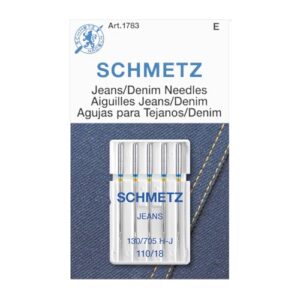
The SCHMETZ Jean Denim Sewing Needle in size 110/18 is built for projects that punish lesser needles. Its medium ball point glides through dense fabric layers without snagging yarn or pulling threads, ensuring smooth stitching on challenging materials.
The needle’s reinforced blade resists deflection at thick seam crossings, maintaining precision under pressure. Additionally, chrome plating extends its working life, making it durable for extended sessions of heavy-duty sewing.
Weighing 5.67 g per 5-needle card, it fits standard home machines with a flat shank, offering versatility for tasks like canvas work, heavy denim, and multilayer quilts. This makes it a reliable workhorse for demanding projects.
| Best For | Sewers working with thick, tough materials like denim, canvas, or multi-layer quilts who need a needle that won’t bend, skip, or break mid-project. |
|---|---|
| Needle Length | 1.5 inches (38mm) |
| Pack Count | 5 needles |
| Machine Compatibility | All standard home machines |
| Heavy Fabric Use | Denim, canvas, duck cloth |
| Breakage Resistance | Reinforced construction |
| Needle Series | Jean & Denim 110/18 |
| Additional Features |
|
- The medium ball-point tip glides through heavy fabric without snagging threads or pulling the weave apart.
- Reinforced construction holds up at thick seam crossings, so you get clean, consistent stitches even on the gnarliest layers.
- Works with standard home machines from Singer, Pfaff, and others — no special setup needed.
- Too much needle for lightweight or delicate fabrics — you’ll want something finer for silk or chiffon.
- Push the feed rate too fast and you’ll still stress the needle, reinforced or not.
- The 110/18 size can feel bulky in tight, high-density stitch areas where a smaller needle would do a cleaner job.
2. Schmetz Jean Denim Sewing Needles
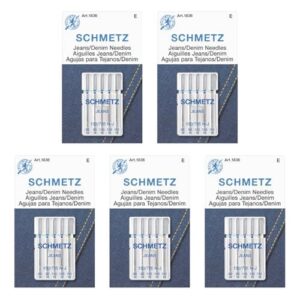
If the 110/18 feels like more needle than your project needs, the SCHMETZ Jean & Denim assorted pack offers a versatile alternative. This set provides 25 needles across five cards, with sizes tailored for lightweight through heavy denim.
Each needle features chromium plating and a reinforced blade, ensuring durability remains consistent even in smaller sizes. The modified medium ball point maintains uniformity across the set, eliminating the need for adjustments when transitioning between fabric weights mid-project.
This combination of reliability and adaptability makes it a practical choice for projects demanding flexibility without compromising performance.
| Best For | Sewers who regularly work with denim, canvas, or thick layered fabrics and want a versatile needle pack that handles a range of weights without constant trips to the store. |
|---|---|
| Needle Length | 1.5 inches (38mm) |
| Pack Count | 25 needles |
| Machine Compatibility | All standard home machines |
| Heavy Fabric Use | Denim, canvas, twill |
| Breakage Resistance | Reinforced construction |
| Needle Series | Jean & Denim assorted |
| Additional Features |
|
- 25 needles across assorted sizes means you’re covered from lighter denim to heavy multi-layer projects
- Reinforced blade and chromium plating hold up well through tough, repetitive stitching
- Works with standard home machines and fits easily into your rotation without any setup hassle
- Exact size distribution isn’t listed, so you might not get the specific sizes your project needs
- The medium ball point isn’t a great fit for leather or delicate fabrics that need a sharp tip
- Not compatible with industrial machines, so it’s strictly a home-sewing option
3. Singer Heavy Duty Sewing Needles Size 100
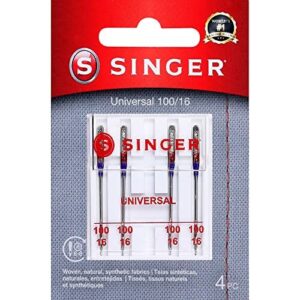
Singer’s Heavy Duty Size 100/16 needles take a different approach than the SCHMETZ assorted sets. You get five cold-forged steel needles designed for dense wovens like denim, corduroy, upholstery, and heavy wool. Their sharp point ensures precision in tough fabrics.
The enlarged eye accommodates medium to heavy thread without snagging, while the T-shaped head simplifies threading, even mid-project. These features prioritize durability and ease of use.
Color-coded silver tops enable quick needle selection. The needles are compatible with Singer, Brother, Janome, Bernina, and most standard home machines, offering versatility for various sewing setups.
| Best For | Sewers who regularly work with heavy fabrics like denim, upholstery, or thick wool and want a durable needle that won’t quit mid-project. |
|---|---|
| Needle Length | 4.52 inches (115mm) |
| Pack Count | 5 needles |
| Machine Compatibility | Singer, Brother, Kenmore, Janome, Juki, Bernina |
| Heavy Fabric Use | Denim, upholstery, leather |
| Breakage Resistance | Cold-forged steel |
| Needle Series | 100/16 (ISO 110/18) |
| Additional Features |
|
- Cold-forged steel holds up well against dense, tough fabrics without bending or snapping
- The enlarged eye and T-shaped head make threading way less frustrating, especially with thicker thread
- Color-coded silver tops and broad machine compatibility make these a practical everyday pick
- Some users have reported needles breaking earlier than expected despite the heavy-duty build
- Packaging inconsistencies—like getting fewer than 5 needles or mismatched size labels—have been an issue
- The dual sizing labels (100/16 vs. 110/18) can cause confusion when shopping or reordering
4. Singer Universal Heavy Duty Sewing Needles
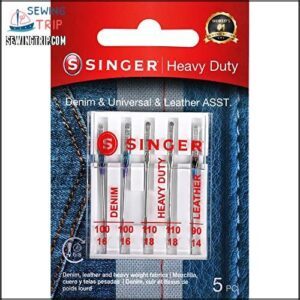
The Singer Universal Heavy Duty set offers a full range in one slim case, ideal for projects requiring various sizes. It includes five needles—one 90/14, two 100/16, and two 110/18—color-coded blue for denim and brown for leather.
For upholstery projects, pairing these heavy-duty needles with proper technique makes all the difference—see how to master curved upholstery needle stitching for best results.
At $6.99, it covers lightweight through heavyweight fabrics without extra purchases.
Featuring universal shank compatibility, it works with Singer, Brother, Kenmore, and most other home machines straight out of the box.
| Best For | Home sewers who regularly work with heavy fabrics like denim, canvas, or leather and need a versatile needle set that covers multiple thicknesses. |
|---|---|
| Needle Length | 4.52 inches (115mm) |
| Pack Count | 5 needles |
| Machine Compatibility | Singer, Brother, Kenmore and more |
| Heavy Fabric Use | Denim, corduroy, leather |
| Breakage Resistance | Heavy-duty design |
| Needle Series | 90/14, 100/16, 110/18 assorted |
| Additional Features |
|
- Three sizes in one pack means you’re covered for most heavy-duty projects without buying multiple sets
- Color-coded needles and a labeled case make it quick and easy to grab the right size
- Works with Singer, Brother, Kenmore, and most other home machines right out of the box
- Only five needles total, so frequent sewers will burn through the pack fast
- Sizes top out at 18, which won’t cut it for serious industrial or ultra-heavy materials
- Using the wrong size for your fabric can lead to skipped stitches or breakage, so there’s a small learning curve
Choose The Right Needle Size
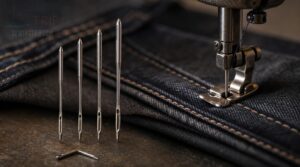
Needle size is the single decision that determines whether your stitches hold or your machine struggles. Get it wrong and you’re dealing with skipped stitches, snapped needles, or puckered seams — none of which you have time for.
Here’s how to match the right size to what you’re actually sewing.
Size 10–12 for Lightweight Denim
Lightweight denim — usually 8–12 ounces per square yard — requires a size 10–12 denim needle to complement its finer weave. Pair this with a 2.5 mm stitch length and medium thread weight matching the fabric’s body for clean stitching.
Check foot pressure settings and ensure fabric grain alignment before beginning. Maintain a needle maintenance schedule to prevent dull points from causing skipped stitches.
Account for modest lightweight denim shrinkage when planning seam allowances.
Size 14 for Medium-weight Denim
Medium-weight denim — roughly 12 to 16 oz per square yard — is where a size 14 denim needle earns its place. This heavy material demands clean penetration without distorting the weave.
Pair it with a 3.5–4 mm stitch length and heavy-duty polyester thread, and you’ll handle waist compatibility, hip fit, and varied inseam lengths without skipped stitches.
Size 16–18 for Heavyweight Denim
When denim hits 14 to 22 oz per square yard, sizes 16–18 are your only real option.
SCHMETZ Jean Denim Needles (110/18 and 16/100) are heavy fabric compatible and built for denim projects where lesser needles snap.
Pair them with mid-to-heavy thread blend choices, mind your denim grain alignment, and follow stitch length guidance of 4–5 mm for clean, durable results.
90/14, 100/16, and 110/18 Explained
Those three numbers aren’t random — they map directly to shaft diameter specs and a US sizing chart that tells you exactly how much muscle a needle brings to dense fabric.
The 90/14 measures 0.90 mm, handling 8–12 oz denim cleanly. Step up to SINGER Regular Point 100/16 at 1.00 mm for heavier weaves.
SCHMETZ Jean Denim Needles 110/18 reach 1.10 mm — built for heavy-fabric feed where strength rating and needle lifespan both matter.
Matching Needle Size to Fabric Layers
Layer count changes everything. One layer of 12 oz denim behaves nothing like three layers stacked at a seam. Matching needle size to fabric weight and thickness keeps penetration depth consistent and stitch length scaling smooth.
- Single layer, lightweight: size 10–12
- Single to double, medium-weight: size 14
- Two to three layers, heavy denim: size 16
- Dense stacks, canvas, upholstery: size 18
When to Size Up for Skipped Stitches
Skipped stitches are a signal, not a mystery. Excess layer count at seams raises needle deflection, triggering upper tension spikes that break the stitch loop. A thread‑eye mismatch amplifies this fast. Slippery surface feed compounds it further. Sizing up — say, 100/16 to 110/18 — restores clean penetration, aids skip stitch prevention, and keeps needle breakage in denim projects from derailing your work.
Skipped stitches aren’t bad luck—they’re your needle telling you to size up
Needle Size for Canvas and Upholstery
Canvas follows the same logic as denim — weight dictates size. Your Canvas Weight Guide starts at 90/14 to 100/16 for 7–12 oz fabric, then steps up to 110/18 for 15–24 oz or layered fabric.
Upholstery Needle Tip geometry matters too: a reinforced shaft manages dense weaves cleanly.
Match thread thickness pairing and practice needle life optimization by replacing after every heavy project.
Needle Size for Topstitching Denim
Topstitching denim demands more from your needle than regular sewing. You’re feeding thick thread through dense layers, so Eye Ratio matters — the thread bulk match between your thread and needle eye determines whether stitches form cleanly or shred mid-seam.
Size 100/16 accommodates medium denim, while size 110/18 provides the layer penetration and stitch length adjust control required for heavyweight topstitch work.
Compare Needle Types and Features
Not all needles are built the same, and those differences matter more than most sewers realize. The right combination of features can mean the difference between clean seams and a frustrating pile of broken thread.
Here’s what to look for across the key features that separate a capable denim needle from one that’ll let you down mid-project: point type, shaft construction, and eye size.
Denim Needles Versus Universal Needles
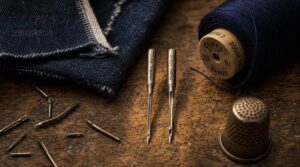
When dense denim meets a universal needle, you’ll feel the difference — skipped stitches, shredding thread, frustration. Denim needles win on three fronts:
- Needle durability — reinforced shafts resist bending through thick seams
- Thread match — larger eyes handle heavy-duty threads without tension spikes
- Needle point geometry — sharper tips cut dense weaves cleanly
Universal needles cost less upfront, but the cost analysis shifts quickly when you’re replacing them every other seam.
Sharp Points for Dense Woven Fabrics
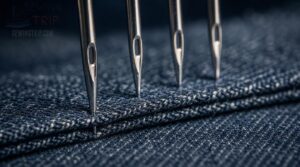
Sharp point needle geometry takes over where universal needles fall short on dense heavy material like denim.
The fine tip minimizes fiber displacement, cutting through tight weaves cleanly instead of pushing yarns aside. This reduces resistance during stitching.
This results in smaller holes with better hole healing, eliminates surface snags on the fabric face, and ensures consistent piercing efficiency across every layer being sewn.
Medium Ball Points for Denim Seams
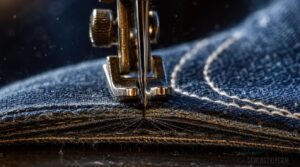
Where a sharp tip cuts through fibers, a medium ball point glides between them — and that difference matters on denim seams. The rounded tip delivers puckering reduction along dense seam lines, neat thread holes, and stability in curved seams without distorting the fabric edge.
This design also ensures better layer feeding ease and resistance to thread breaks, making the ballpoint needle a reliable choice for most denim projects.
Reinforced Shafts for Break Resistance
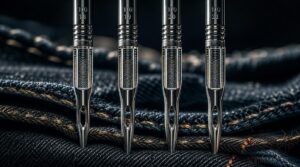
When a needle bends mid-seam, the entire project suffers. Reinforced steel construction addresses this by distributing stress across a wider shaft cross-section, acting as the needle’s backbone under pressure. This design ensures durability you can feel.
The needles’ toughness stems from four key innovations:
- Steel mesh reinforcement absorbs peak loads before failure
- Carbon fiber overlay adds torsional stiffness without bulk
- Ceramic fiber inserts resist heat and friction during dense layers
- Post-cure heat treatment locks the reinforced design together permanently
Enlarged Eyes for Heavy-duty Thread
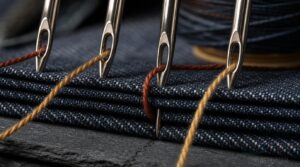
What separates a frustrating sewing session from a clean, confident one often comes down to the needle eye. A large needle eye gives heavy-duty thread room to flow, delivering thread glide and friction reduction that keeps tension stable across thick seams.
The burr-free eye design prevents shredding, enables high-speed threading, and maintains thread tension stability. These features ensure consistent performance through every dense layer, even in demanding materials like denim.
By optimizing thread flow and minimizing resistance, such needles enhance efficiency and reliability, making them ideal for thick seams and heavy fabrics.
Chromium Plating and Durability
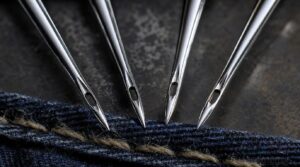
Chromium plating is what separates a needle that lasts from one that gives out mid-project. Chrome-plated needles reach hardness levels of 60–70 HRC, delivering serious friction reduction as the tip drives through dense denim layers.
The coating adhesion bonds tightly to reinforced steel construction, providing corrosion protection and stress management against repeated heavy use. That’s needle durability you can actually count on.
Flat Shank Compatibility With Home Machines
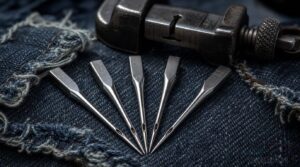
Most modern home machines accept flat shank needles without adapters, but shank verification is still worth doing before you buy. Pull out your machine manual and check for needle bar height specs. Inspect the clamp alignment slot—it should have a straight horizontal groove.
Adapter necessity only arises with vintage or low-shank machines. These may require additional components for compatibility.
Heavy-duty denim needles fit standard flat shank clamps across most domestic models, ensuring broad usability without modifications.
Best Needle Features for Thick Seams
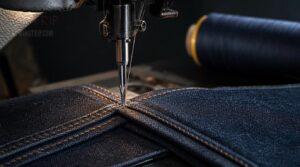
Thick seams don’t forgive weak tools. The right needle combines several features that work together so your stitches stay clean through every dense layer.
- Tapered Needle Tip — pierces cleanly without spreading threads
- Low-Friction Coating — chromium plating reduces heat and wear
- Reinforced Steel Construction — resists needle deflection under pressure
- Optimized Groove Depth — guides thread for balanced stitch tension
- Multi-Layer Feed Compatibility — flat shank holds steady across thick seams
Prevent Breakage and Skipped Stitches
Even the right needle won’t save you if the rest of your setup is working against it. Breakage and skipped stitches usually come down to a handful of fixable habits, not bad luck.
Here’s what to get right before you run a single seam.
Use Heavy-duty Polyester Thread
Heavy-duty polyester thread is your strongest ally against skipped stitches and seam failure on denim. Its moisture stability and UV resistance ensure predictable tension, whether sewing outdoor gear or upholstery.
Chemical compatibility ensures durability through washing and wear. For colorfastness retention and consistent results, pair it with denim needles and store thread in cool, dry conditions.
Match Thread Thickness to Needle Eye
Thread selection for heavy fabrics starts with one rule: your needle eye diameter should run about 40 percent larger than the thread diameter. This Eye-Thread Ratio prevents fraying and skipped stitches before they start.
Follow this Thread Diameter Guide:
- Size 14 eye pairs with 90-weight thread
- Size 16 eye suits 100-weight denim thread
- Size 18 eye accommodates bonded nylon or heavy topstitch thread
When thread eye wear builds up from mismatched sizing, you’ll feel it in your tension immediately. Forcing thick thread through a tight eye damages both—swap needles before your seam suffers.
Adjust Tension for Thick Denim
Once your thread path ratio is dialed in, tension becomes your next control point. Set upper tension to 4–5 on most home machines for thick denim, then run a tension test swatch before committing. Thread path smoothness matters too—any snag between spool and bobbin throws off your machine tension settings fast.
| Fabric Weight | Upper Tension Setting | Stitch Length Ratio |
|---|---|---|
| Lightweight denim | 3–4 | 2.5 mm |
| Medium denim | 4–5 | 3.0 mm |
| Heavyweight denim | 4–5 | 3.5–4.0 mm |
| Canvas/upholstery | 5–6 | 4.0–5.0 mm |
| Multiple layers | 5–6 | 4.5–5.0 mm |
Adjust stitch length first—longer stitches reduce tension strain during heavy material feeding. Then fine-tune tension disk adjustment in small steps. Presser foot pressure affects how evenly fabric moves, which directly impacts thread tension management across long seams.
Use a Walking or Even-feed Foot
Even with tension dialed in, layers still shift if your foot doesn’t grip evenly from both sides. A walking foot solves that — its built-in Feed Dog Sync moves fabric top and bottom together, eliminating the bunching that breaks Denim Needles mid-seam.
Choose based on your visibility needs:
- Open Toe variant for topstitching visibility
- Closed Toe for standard seam control
- Layer Grip on thick overlapping seams
- walking foot attachment with guide bar for parallel lines
- Foot Maintenance — clear lint after every dense denim session
Pair it with your heavy‑duty needle and balanced presser foot pressure for clean, straight results.
Sew at a Controlled Moderate Speed
Speed is your hidden variable. Rushing through dense denim spikes Motor Heat Management, throws off Fabric Feed Sync, and forces the needle to deflect instead of pierce.
Hold a steady Pedal Consistency—moderate, controlled—and your Stitch Length Control stays uniform. Pair that rhythm with tuned presser foot pressure and proper fabric feed adjustment, and skipped stitches become rare.
Test Stitches on Folded Fabric Scraps
Testing on folded fabric scraps is your folded seam’s preview before committing to a full project. Fold a double layer of your denim, match your planned needle and thread combination, then run a scrap stitch density check at real seam stress points.
This multi-layer feed test exposes tension issues, folded edge stability problems, and needle breakage reduction opportunities early.
Keep marked test logs by needle size for your denim projects.
Replace Needles After Heavy Use
After 8–12 hours of continuous heavy-fabric work, your needle’s wear indicators tell a clear story — dulled tips, micro-bends, and plating wear that quietly sabotage your seams. Keep a needle replacement schedule for thick material projects to mitigate this.
Run a quick inspection checklist before each session, as matching thread compatibility to a fresh needle preserves stitch quality.
Stock extra needles so replacement frequency never stalls your momentum.
Store Needles by Size and Type
A disorganized needle stash wastes time and risks mix-ups between your size 90/14 and size 110/18 options.
Use a labeling system with clear pouches, color-coded bins, or foam inserts to separate sizes and types at a glance. A magnetic board keeps frequently used packs accessible.
Whether you’re storing a pack of 5 or a bulk 50-piece pack, these needle storage solutions protect tips and prevent confusion.
Frequently Asked Questions (FAQs)
What needles are good for sewing thick denim?
For thick denim, reach for a heavy-duty needle with the right tip geometry and shaft flexibility — the SCHMETZ Jean Denim Needles 110/18 or SINGER Regular Point 100/16 are solid starting points.
Can denim needles work on canvas and sailcloth?
Denim needles handle canvas and sailcloth well. Their point geometry and reinforced shafts resist needle deflection through layered canvas.
Enlarged eyes support thread strength across dense, tightly woven sailcloth without skipping stitches.
How often should I replace denim sewing needles?
Replace denim needles every 6–8 hours of stitching. Track wear with needle lifespan logs, run a burr inspection routine every few seams, and swap at each project to protect stitch quality.
What thread works best for heavyweight denim projects?
For heavyweight denim, polyester core-spun thread is your strongest choice.
Its heavyweight thread weight, waxed thread finish, and colorfast denim thread properties resist breakage and fading, keeping seams tight through repeated wear and washing.
Does needle coating affect stitching on thick fabrics?
Coating friction shapes every stitch. Titanium coating and nonstick coatings reduce heat buildup, protecting against fabric scorching.
Chrome-plated needles extend needle lifespan and support seam consistency across dense, multilayer fabric runs.
Conclusion
The right tool cuts through the noise—and through six layers of denim without skipping a stitch. Choosing the correct sewing machine needles for denim and heavy fabrics isn’t guesswork; it’s about matching size, point type, and thread to exactly what your fabric demands.
Size up when layers are stacked, replace needles before they fail, and test before committing to a full seam. That preparation is what separates clean, durable work from frustrating restarts.
- https://help.singer.com/en-US/choosing-the-right-singer-machine-needles-389061
- https://www.schmetzneedles.com/products/jeans-denim-twin-sewing-machine-needle?utm_source=openai
- https://www.sewing.org/files/guidelines/22_115_sewing_machine_needle_charts.pdf
- https://www.schmetz.com/mm/media/web/7_tochtergesellschaften/bilder_18/schmetz/pdfs_4/nadel_abc/Schmetz_Nadel_ABC_EN_2024.pdf
- https://www.threadsmagazine.com/project-guides/learn-to-sew/machine-needle-know-how