This site is supported by our readers. We may earn a commission, at no cost to you, if you purchase through links.
A seam splits on your favorite jacket the night before a trip, and suddenly you’re staring at a sewing kit held together by three mismatched spools and a needle you can’t thread in dim light.
The thread fails most repairs before the needle ever touches fabric—wrong weight, wrong material, wrong color, and the fix either puckers, snaps, or screams "patched" from across the room.
Choosing the right sewing thread sets changes that entirely. The right set gives you tensile strength for denim, the softness for voile, and neutral tones that disappear into any garment.
Table Of Contents
Key Takeaways
- Matching thread weight to fabric type — not just color — is what separates a repair that lasts from one you’ll redo in a week.
- Polyester handles everyday garment fixes well, but heavy materials like denim, leather, and canvas need bonded nylon or extra-strong thread to hold under real stress.
- Needle size isn’t optional — pair it wrong with your thread weight and you’ll get shredding, skipped stitches, or puckered seams no matter how careful your technique is.
- A small core kit of five neutral thread colors covers most repairs, but investing in a larger set pays off fast if you’re mending regularly or working across different fabric types.
Top 6 Thread Sets for Mending
Not every repair needs the same thread, and picking the wrong one can mean re-stitching the same seam twice. These six sets cover the range from everyday garment fixes to heavy-duty outdoor gear, so you’re not buying more than you need.
Each set pairs well with a Singer sewing machine with stitch length adjustment, giving you the control to match thread tension and stitch size to the job.
Here’s what made the cut.
1. Gutermann Sew All Thread Assorted Colors
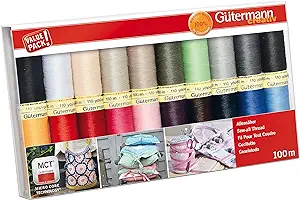
Gutermann’s Sew All set gives you 20 spools — each 100 meters — across a solid range of everyday colors, so you’re rarely scrambling for a match.
What makes it worth keeping in your kit is the Micro Core Technology: a microfilament polyester core that feeds smoothly, resists lint, and holds tension without drama.
It manages machine and hand sewing equally well, survives a 95°C wash, and pairs cleanly with standard 70–90 needle sizes.
A dependable all-rounder for daily garment repairs.
| Best For | Home sewists, quilters, and beginners who want a reliable everyday thread set without hunting down individual colors. |
|---|---|
| Material | 100% Polyester |
| Primary Use | Machine & Hand Sewing |
| Color Options | 20 Assorted Colors |
| Package Contents | 20 Spools |
| Durability Rating | Standard |
| Price Tier | Mid-range |
| Additional Features |
|
- 20 spools in assorted basic colors means you’ve got a match for most everyday projects right out of the box.
- Micro Core Technology keeps things running smoothly — low lint, consistent tension, and far fewer thread breaks.
- Works for both machine and hand sewing, and holds up through hot washes and ironing without falling apart.
- Each spool is only 100 meters, so bigger projects or bobbin-heavy work will burn through them faster than you’d like.
- The thread can lose its sheen after pressing, leaving a slightly dull finish on visible seams.
- High-speed machines may need a bit of tension tweaking to stop the occasional twist-up.
2. Selric Heavy Duty Bonded Nylon Thread
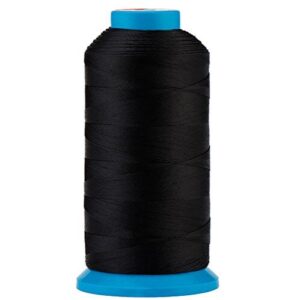
When everyday polyester isn’t enough, Selric’s Heavy Duty Bonded Nylon steps in. Made from 100% Nylon 6,6 with a bonding coat that prevents strands from unraveling mid-seam, this thread is engineered for demanding applications like leather, canvas, upholstery, and high-stress gear.
At size 210D/3—equivalent to Tex 70—it delivers serious tensile strength with minimal stretch, ensuring seams remain tight under heavy loads.
The 1,500-yard spool, available in 22 colors, guarantees ample supply for large-scale repairs or projects.
| Best For | Anyone working with heavy-duty materials like leather, canvas, upholstery, or horse blankets who needs a thread that won’t quit under pressure. |
|---|---|
| Material | 100% Nylon 6,6 |
| Primary Use | Heavy-duty Upholstery |
| Color Options | 22 Colors (Black Listed) |
| Package Contents | 1 Spool |
| Durability Rating | Heavy-duty |
| Price Tier | Mid-range |
| Additional Features |
|
- Incredibly strong — holds up on demanding projects like watch bands, shoe work, and thick fabric garments without snapping or fraying
- The bonding coat makes for smooth, clean stitches and cuts down on needle friction significantly
- 1,500 yards across 22 color options means you’ve got plenty to work with and can actually match your project
- The thickness and coating make it genuinely tricky to thread through small needles and tie off the first knot
- That slightly "fluffy" texture can look out of place on fine or detail-heavy work where you want a crisp finish
- Colors can vary between spools, so double-check you’ve got the right one before you start — a mismatch mid-project is a headache.
3. Singer Black All Purpose Sewing Thread
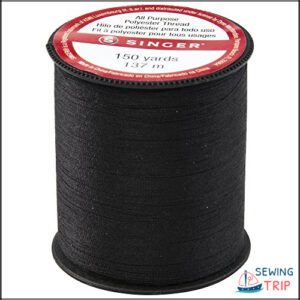
Not every repair calls for heavy-duty bonded nylon. Sometimes you just need a reliable everyday thread that won’t let you down mid-seam. That’s where Singer Black All Purpose Sewing Thread earns its place in your kit.
Each 150-yard spool delivers 100% colorfast polyester that handles denim, cotton twill, and upholstery without complaint — by hand or machine.
The matte black finish disappears into dark fabrics, and the color holds through repeated washing and ironing without fading.
| Best For | Home sewers and crafters who regularly work with dark or black fabrics and need a dependable all-purpose thread for everyday repairs and machine sewing. |
|---|---|
| Material | 100% Polyester |
| Primary Use | Hand & Machine Sewing |
| Color Options | Black Only |
| Package Contents | 1 Spool |
| Durability Rating | Standard |
| Price Tier | Budget |
| Additional Features |
|
- Works with both hand and machine sewing, so you’re not locked into one method
- Blends seamlessly into dark fabrics — no visible stitching where you don’t want it
- Holds up well on heavier materials like denim and upholstery
- Only comes in black, so you’ll need separate spools for any other color
- The small spool size makes it pricier per yard compared to bulk options
- Strength is average — not the best pick for seriously heavy-duty or high-stress projects
4. New Brothread Polyester Embroidery Thread Kit
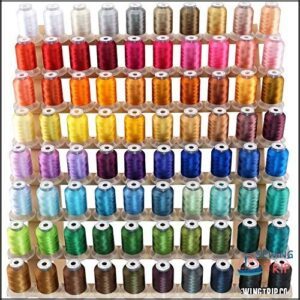
New Brothread Polyester Embroidery Thread Kit steps in with 80 distinct spools — including two white and two black — ensuring you’re never hunting for a match mid-project.
Each spool is built to last, making this kit a smart pick for quilters who want reliable color variety — explore top-rated sewing threads for quilting to see how polyester stacks up against other options.
Each spool runs 500 meters at 40 wt, balancing fine detail and strength. The 100% polyester construction ensures durability, resisting fading through commercial washing and bleaching.
This makes it ideal for embroidered workwear, uniforms, or projects demanding resilience.
| Best For | Hobbyists, beginners, and designers who need a wide color range for garments, uniforms, or linens that go through frequent washing. |
|---|---|
| Material | 100% Polyester |
| Primary Use | Machine Embroidery |
| Color Options | 80 Distinct Colors |
| Package Contents | 80 Spools |
| Durability Rating | High Color Fastness |
| Price Tier | Mid-range |
| Additional Features |
|
- 80 distinct colors in one kit — plenty to work with without buying extras
- Polyester holds up well against commercial laundering, bleaching, and harsh chemicals
- Works with popular machines like Janome and Brother right out of the box
- No storage rack included, so you’ll need to figure out organization on your own
- Some users report occasional thread breakage, which could be frustrating for high-volume work
- Color matching uses conversion charts, so exact color accuracy isn’t always guaranteed
5. StiVerse Mini Sewing Kit With Case
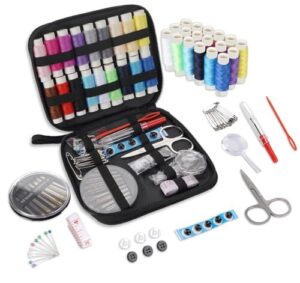
When you’re caught mid-trip with a popped button or unraveling hem, the StiVerse Mini Sewing Kit earns its place in your bag. It packs 18 thread colors, 30 needles in a dedicated needle case, scissors, a seam ripper, tape measure, and even a magnifying glass — all inside a 600D Oxford fabric case barely 5.6 inches tall.
It won’t replace your full kit at home, but for lightweight emergency repairs on the road, it takes care of exactly what you need.
| Best For | Travelers, beginners, and hobbyists who need a compact, all-in-one kit for quick clothing repairs on the go. |
|---|---|
| Material | Top-grain Cowhide Leather |
| Primary Use | Leather Crafting |
| Color Options | Dark Brown Only |
| Package Contents | 1 Leather Sheet |
| Durability Rating | Oil-tanned Durable |
| Price Tier | Budget |
| Additional Features |
|
- Comes with 18 thread colors, 30 needles, and a solid range of accessories — more complete than most mini kits
- The 600D Oxford case with a shoulder strap keeps everything organized and easy to carry
- Small enough to toss in a purse or backpack without taking up real estate
- Needle packaging can be tricky to open, making it easy to spill or lose needles
- Thread quantity is limited, so it won’t hold up for bigger or heavier sewing jobs
- No info on component durability — scissors and other tools may not last with heavy use
6. Gutermann Extra Strong Black Thread
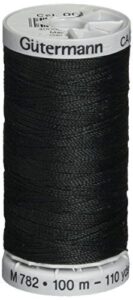
Gutermann Extra Strong Black Thread delivers 100% polyester performance on a 110-yard spool, designed for heavy-duty tasks. It handles denim, canvas, leather, and upholstery without fraying or losing tension mid-seam, ensuring reliable results for high-stress projects.
Washable up to 200°F and fade-resistant, this thread withstands repeated wear and laundering, maintaining integrity through demanding use. Its durability makes it ideal for repairs requiring long-term resilience.
The tradeoff? It only comes in black, limiting color-matching options. However, for applications where strength matters most, this constraint is rarely an issue.
| Best For | Anyone who needs a tough, reliable thread for heavy-duty projects like denim, leather, upholstery, or outdoor repairs where strength matters more than color variety. |
|---|---|
| Material | Mixed (Polyester + Accessories) |
| Primary Use | Light Repairs & Travel |
| Color Options | 18 Colors |
| Package Contents | Thread + Accessories Kit |
| Durability Rating | Light-duty |
| Price Tier | Mid-range |
| Additional Features |
|
- Handles high-stress materials like leather, jeans, and upholstery without fraying or losing tension
- Holds up through repeated washing at high temps and resists fading over time
- Works across a wide range of fabrics, from lightweight technical nylons to heavier everyday items
- Only comes in black, so color-matching for visible seams on other colors isn’t an option
- Too heavy-duty for delicate fabrics that need a finer, lighter thread
- Not ideal for very thick materials like heavy outerwear canvas where a true heavy-weight thread would be a better fit
Best Thread Materials for Repairs
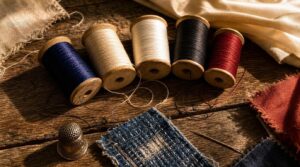
Not all thread is created equal, and the material you pick can make or break a repair. Each type has its own strengths depending on the fabric, the stress it will face, and whether the fix needs to disappear or stand out.
Five thread materials worth knowing before you start.
Polyester Thread for Everyday Garment Mending
Polyester thread is the workhorse of everyday mending — and for good reason. When weighing Polyester vs Nylon vs Cotton, polyester excels in general repairs due to its reliable stitch consistency and seam flexibility through countless wash cycles.
For delicate fabrics, consider using soft natural sashiko thread to ensure gentle repairs.
- Elasticity balance lets seams move without snapping
- Thread glide keeps machine feeding smooth and tangle‑free
- Wash durability retains color and strength after repeated laundering
- Synthetic thread durability outperforms cotton at stress points
Nylon Thread for Heavy-duty Repairs
When a seam gives out on leather, canvas, or a backpack strap, nylon is the thread you want holding things together. Selric Bonded Nylon Thread delivers industrial-grade performance — its Oil-Resistant Coating keeps the thread running clean through thick layers, while Cold-Climate Flexibility prevents stiffness in freezing conditions.
| Feature | What It Means for You |
|---|---|
| Thread Tensile Strength | Holds under hard pulling without snapping |
| Denier Range Options | Match thread weight to fabric thickness |
| Spool Yardage Capacity | More thread per spool for bigger repairs |
| Industrial Needle Pairing | Size 90–110 needles prevent shredding |
| Nylon vs Polyester Thread Properties | Nylon wins on abrasion and stretch |
Cotton Thread for Lightweight Natural Fabrics
Cotton thread is the quiet specialist of fabric mending — built for lightweight naturals like muslin, lawn, and voile. Its soft handfeel will not stress delicate fibers, and the breathability benefits show clearly in summer garments.
A mercerized finish boosts strength and color vibrancy without stiffening the thread. Just pair it with a fine needle, and mind cotton thread limitations on high-stress seams.
Light fabric fraying can occur if edges aren’t finished.
Poly-cotton Thread for Durability and Softness
When neither pure cotton nor polyester quite fits, poly-cotton thread splits the difference beautifully. Its polyester core manages thread durability and tension, while the cotton wrap delivers a soft hand feel and aids heat dissipation during faster stitching speeds.
This cotton layer also reduces seam puckering on medium-weight fabrics and bolsters strong color retention. These qualities make it a reliable middle ground for choosing the right sewing thread for repairs.
Sashiko Thread for Visible Reinforcement Stitching
Sashiko thread takes visible mending somewhere purposeful. Around 0.8 mm thick, it runs through multiple fabric layers in a single pass, building bold stitch geometry that distributes stress evenly.
Traditional indigo patterns rely on 100% cotton fiber for that matte finish and color variety that holds after washing.
Tension control matters here — consistent running stitches keep the fabric reinforcement clean and durable.
Thread Weight and Needle Matching
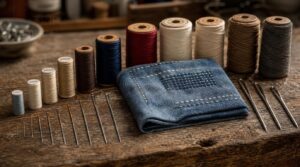
Thread weight and needle size aren’t just technical details—they’re what separate a repair that holds from one that unravels after two washes.
Getting this pairing right takes a little know-how, but once you understand the logic, it clicks fast.
Here’s what you need to know before you thread the needle.
What Thread Weight Numbers Mean
Thread weight numbers operate on an inverse weight scale — a lower number means thicker thread. For example, a 30 wt thread is heavier than a 50 wt. Ply count also influences bulk: a 50/3 is bulkier than a 50/2.
While weight and denier measurements vary by region, both systems align on one principle: lower equals thicker, stronger, and better suited for heavy repairs.
Tex Sizes for Standard Repair Thread
The Tex system measures grams per 1,000 meters—so a higher number means heavier thread. For standard repairs, Tex 27 to Tex 35 covers most everyday garment work. A Tex conversion chart or denier equivalence guide helps when labels don’t match.
For fabric-specific Tex decisions, testing suitability on a scrap first prevents puckering.
Medium repairs usually land between Tex 60 and Tex 90.
Heavy-duty Thread for Denim and Canvas
When denim or canvas is the job, heavier thread is not optional. Tex 70 to Tex 90 withstands multi-layer stitching without seam failure under load. Bonded polyester or nylon offers serious abrasion resistance at stress points like pocket corners and knee seams.
Thread coating technology—wax or resin—ensures smooth stitching, while denim color matching preserves the original indigo look.
Tension optimization prevents puckering through dense layers, maintaining structural integrity in heavy-duty applications.
Needle Sizes for Thick Repair Threads
Needle size selection becomes non-negotiable when working with Tex 60 and above. Matching thread weight to needle size begins with sizes 100/16 to 110/18 for most heavy-duty repairs, while 125/20 is reserved for extra-dense fabrics.
Needle Eye Shape, Needle Shank Strength, and Needle Point Types all significantly influence fraying. Proper alignment of these components ensures smoother stitching and reduces fabric damage during demanding projects.
A needle threader compatible with thick thread is an essential tool, eliminating unnecessary frustration when handling bulky materials.
Scrap Testing Thread, Needle, and Tension
Before you commit to any repair, run a quick scrap test on fabric that matches your project’s weight and weave. Sew a straight line and a small zigzag — your Stitch Integrity Check — then tug both sides gently.
Use the Loop Detection Method to spot tension problems underneath. This step ensures no hidden issues compromise your work.
Proper Tension Calibration, Needle Eye Fit, and Fabric Swatch Selection together confirm thread durability and seam strength before thread breakage ruins real work.
Choosing Colors and Kit Sizes
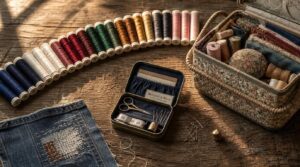
Getting the right color and enough thread matters more than most people expect. Whether you’re patching a single seam or keeping a full repair kit stocked, the options below cover both ends of that spectrum.
Here’s what to know before you choose.
Essential Thread Colors for Basic Repairs
You don’t need a rainbow to cover most repairs — just the right five. A neutral palette of black, white, navy, grey, and beige manages the majority of everyday mending.
Skin tone matching with tans and taupes makes cotton and linen repairs nearly invisible.
Add contrast accents, seasonal hues, or specialty shades like burgundy when color matching thread to richer fabrics matters.
Mini Spools Vs Full-size Spools
Spool size shapes how your whole kit works — not just how much thread you carry.
- Portability advantages: Mini spools (250–300m) keep compact sewing kits light for travel convenience on the go.
- Bulk cost efficiency: Full-size spools (3,000–5,000m) cost less per meter, ideal for DIY repair projects.
- Tension consistency: Wider full-size cores support steadier thread feeding for longer seams.
- Storage space impact: Minis fit neatly into travel-friendly mending solutions; full-size spools need dedicated organizers.
- Repair kits pairing: Many starter sets combine mini spools with compact bobbin holders for maximum efficiency.
Color Matching for Invisible Mending
Getting the color right is half the repair. Test candidate threads under natural light — artificial lighting shifts hues enough to fool you. Lay multiple shades on a fabric swatch and use color cards to narrow your pick.
Shade-feathering at the stitch edges softens any slight mismatch. Always check dye lot consistency across spools, ensuring uniformity in hue and tone.
Match thread texture to fabric surface so the repair disappears completely, maintaining seamless visual and tactile integration.
Larger Thread Sets for Frequent Repairs
If you’re constantly restocking mid-project, a larger thread set fixes that before it starts. Bulk spool economics mean fewer interruptions and better inventory turnover over time. Look for these features:
- 250–1,000-yard spools reduce refill efficiency gaps on heavy-duty repairs
- Quick-access organization via labeled compartments speeds color matching
- Wide color variety enables precise matching across garments
- Thread weight and needle size matching guides are often included
- Eco-friendly packaging adds sustainability benefits of repairing over discarding
All-in-one Kits for Beginners and Travel
Bulk spools handle volume — but if you’re packing light or just starting out, DIY all-in-one sewing kits for beginners are worth every inch of luggage space they save. Travel-friendly mending solutions come with compact case design, an essential needle range (sizes 9–18), and a color-coding guide for quick fabric matching.
| Feature | Budget Kit | Full Travel Kit |
|---|---|---|
| Spool Count | 5–8 colors | 24–48 colors |
| Multi-tool Integration | Basic scissors only | Scissors, seam ripper, tape |
| Refillable Spool System | No | Yes, sold separately |
Compact sewing kit design fits 7–9 inches across — easy for a carry-on or camp bag.
Durable Repair Techniques and Care
Even the best thread won’t save a repair if your technique is off. How you stitch, treat, and store your materials makes the difference between a fix that lasts years and one that unravels after a few washes.
Here’s what actually holds things together.
Backstitching for Strong Hand-sewn Repairs
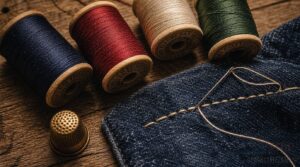
When a seam gives out under pressure, backstitch is your most reliable fix. Unlike a simple running stitch, it locks into itself with every pass — making it nearly machine-strong by hand. Focus on controlling stitch length and managing fabric tension to avoid puckering.
Backstitch locks into itself with every pass, making it nearly machine-strong by hand
Always reinforce start and end points with extra stitches at seam stress zones. That’s what prevents repairs from unraveling.
Preventing Thread Breakage and Shredding
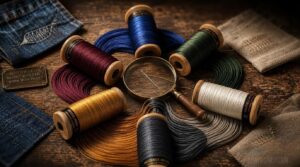
Even strong repairs fall apart when thread keeps snapping mid-stitch. Most breakage traces back to skipped steps: poor Spool Cap Seating lets thread unwind unevenly, while skipped Guide Alignment Checks creates friction that shreds fibers fast.
Balanced Tension Settings matter just as much — too tight, and tensile strength works against you. Check Needle Eye Smoothness regularly, and match Needle size selection for different thread weights to avoid fraying.
Waxing Thread for Leather and Canvas
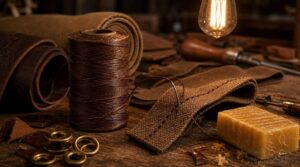
Wax composition makes a real difference when stitching through leather or dense canvas. A beeswax or synthetic blend coats each pass, cutting friction and boosting knot security. Pre-waxing needles further smooths the path.
Paxcoo Waxed Thread manages both leather stitching and canvas repair well, delivering seam waterproofing in wet conditions.
Plan for a slight darkening effect, and schedule wax reapplication after heavy use.
UV-resistant Thread for Outdoor Gear
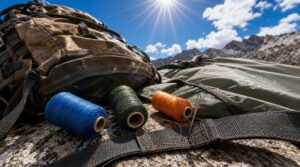
Outdoor gear takes a beating from the sun, and standard thread won’t hold up. UV-resistant thread is built with UV stabilizers that slow down dye breakdown and preserve seam strength. Look for options with strong lightfastness ratings—ideally retaining 80 percent color after sun exposure testing.
Weatherproof seams and color longevity depend on these features, as UV protection relies on threads engineered to resist degradation.
Choosing the right thread is critical, as UV degradation quietly weakens your stitching over time.
Storing Repair Thread Sets Properly
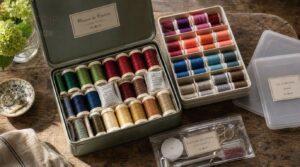
Good storage is the quiet partner to good repair work. Keep your thread in airtight containers — a metal tin storage box works especially well — and toss in a silica gel packet to handle humidity control. A simple labeling system and smart spool organization save real time when you’re mid-repair.
- Block UV shielding with opaque lids
- Separate specialty threads to prevent color bleed
- Label spools with purchase date
- Use divided trays for spool organization
- Store a compact sewing kit in sealed bags for field-ready sewing supplies
For portable needs, seal field-ready supplies in compact bags.
Frequently Asked Questions (FAQs)
Can old thread weaken a repair over time?
Fiber degradation, UV aging, and moisture absorption quietly rob old thread of its tensile strength — long before the seam shows it.
Mechanical fatigue and poor storage conditions do the rest.
How do you fix skipped stitches while sewing?
Skipped stitches usually result from a dull needle or mismatched needle size.
To resolve this, check your bobbin tension, re-thread the machine, and run a scrap test while adjusting stitch length until stitches catch cleanly.
What thread works best for stretchy knit fabrics?
For stretchy knit fabrics, polyester thread is your best elastic thread choice — it manages stitch stretchability well. Pair it with a ballpoint needle for clean knit seam recovery without snags.
Is hand-sewing or machine-sewing stronger for repairs?
Machine sewing wins on seam durability and repair speed, but hand stitching holds its own where tool accessibility matters.
Match stitch tension to your fabric, and fiber fatigue will not catch you off-guard.
How many yards does a typical repair project use?
Most repairs fall between 10 and 50 yards. Small hem fixes need around 10 yards, while heavy-duty repairs on denim or canvas can push past 40 yards depending on stitch density and fabric type.
Conclusion
Every repaired seam tells a quiet story—thread pulled taut, fabric held together by a choice made before the needle moved. The right sewing thread sets for repair and mending don’t just fix what’s torn; they decide how long that fix lasts.
Match weight to fabric, color to garment, and material to the stress it’ll face. Build your kit with intention, and the next time something splits, you won’t scramble—you’ll simply stitch.
- https://www.maggieframes.com/ar/blogs/embroidery-blogs/embroidery-with-sewing-thread-essential-techniques-for-machine-embroidery-success
- https://www.mh-chine.com/blog/products/best-thread-for-mending
- https://www.seasonedhomemaker.com/all-about-thread-weight/
- https://slowstitch.club/en-au/products/visible-mending-kit-2025
- https://www.sewingpartsonline.com/blogs/education/ultimate-thread-reference-guide-2