This site is supported by our readers. We may earn a commission, at no cost to you, if you purchase through links.
A broken thread mid-seam isn’t bad luck—it’s your needle sending a message. Most sewists troubleshoot tension first, adjust presser foot pressure second, and never think to question whether their needle and thread are even compatible. That mismatch quietly causes more skipped stitches, puckered seams, and frayed threads than any machine setting ever will.
The relationship between needle and thread is mechanical, not instinctive. Too small an eye, and the thread shreds against the metal with every stitch. Too large a needle, and delicate fabric develops holes it was never meant to have. Matching needle to thread weight solves problems before they start. Everything that follows shows you exactly how.
Table Of Contents
Key Takeaways
- Needle and thread must match by weight — too small an eye shreds thread, too large a needle damages delicate fabric before you sew a single seam.
- Point shape matters as much as size: sharp for wovens, ballpoint for knits, reinforced for denim, and triangular-tip for leather and vinyl.
- The dual number on a needle (like 90/14) tells you both the metric shaft diameter and the Singer size — bigger numbers always mean a thicker needle.
- Test every needle-thread combo on a scrap first, and replace your needle every 4–8 hours of sewing to keep stitch quality consistent.
Match Needle Size to Thread Weight
Getting needle and thread to work together isn’t guesswork — there’s a straightforward logic to it. The size of your needle has to match the weight of your thread, or you’ll fight skipped stitches and breakage all day.
A solid needle and thread pairing guide takes the guesswork out entirely, so you spend less time troubleshooting and more time actually sewing.
Here’s what to know before you thread up.
Use a Needle-thread Compatibility Chart
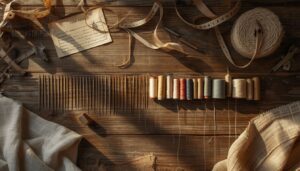
A needle and thread pairing guide takes the guesswork out of every project. Think of it as your cheat sheet — it links needle sizes to thread weights so the eye fits the thread cleanly.
Use visual color coding to spot matches fast.
Always do data accuracy checks before starting, and keep your chart updated as you add new thread weights to your kit.
Choosing the correct needle eye size(https://www.jjneedles.com/needles-guide) ensures the thread passes smoothly.
Pair Fine Thread With Smaller Needles
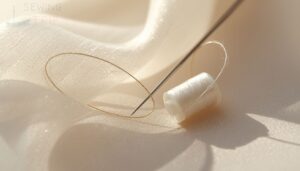
Fine thread — 60 to 100 weight — needs a small eye to stay controlled. Pair it with a size 65/9 to 70/10 needle.
Micro-Point Needles work beautifully on chiffon and silk, giving you Seam Flatness Boost and Stitch Density Control without snagging.
Proper Thread Tension Balance follows naturally. That slip-free threading keeps stitches even and tight every time.
Match Heavy Thread With Larger Needles
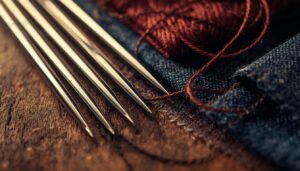
Heavy 30-weight threads need room to move. Size 90/14 to 100/16 needles give them that space — reducing heavy thread friction and preventing breakage through dense fabrics like denim or canvas.
- Polished needle coatings cut friction so thread feeds smoothly
- Needle eye length matters — short eyes snag thick filaments
- Thread tension management keeps seams from pulling or puckering
- Stitch quality testing on scraps confirms your match before committing
Balance Eye Size With Thread Thickness
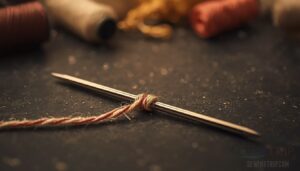
The eye is where friction starts. Aim for an eye diameter about 40 percent larger than your thread — that’s your Eye Clearance Guideline in action.
Too tight, and Thread Friction Reduction fails completely.
Thread Twist Compatibility also matters: a coated or multi-ply thread needs smooth Eye Shape Influence to pass cleanly.
Your needle size chart covers Matching Needle Size to Thread Weight, but eye fit seals the deal.
Choose Needle Points by Fabric
Needle size gets you halfway there — but the point shape closes the deal. The wrong tip can snag a knit, shred silk, or leave holes in leather, no matter how perfectly sized your needle is.
Needle size gets you halfway there, but the wrong point shape can snag, shred, or pierce no matter how perfect the fit
Here’s how to match point type to what you’re actually sewing.
Pairing the right needle with the right fabric also means thinking about your thread—check out what serger thread is and how it differs from regular thread to avoid tension issues and skipped stitches.
Sharp Needles for Woven Fabrics
Woven fabrics have no give — so sharp points are non‑negotiable. A Microtex needle’s tip geometry optimization lets it pierce tightly woven cotton, silk, or sateen cleanly, without dragging fibers sideways.
Scarf polishing effects reduce thread snagging mid‑stitch, while needle coating technologies manage heat buildup in long seam runs. Always match needle size to thread weight, and choose needle type based on fabric weave density for clean, pucker‑free results.
Ballpoint Needles for Knits and Stretch
Knit fabrics move — and your needle has to move with them. That’s where ballpoint needles shine.
Their rounded tip slides between yarn fibers instead of piercing them, protecting knit fabric stretch.
The ballpoint needle eye is slightly elongated, and the scarf depth impact is reduced, which helps thread tension control stay consistent.
Match needle size to thread weight — smaller for lightweight jersey, larger for fleece — and your ballpoint needles for knits and stretch fabrics will hold their edge longer, boosting needle longevity.
Denim Needles for Dense Layers
Denim is unforgiving — thick folds can snap ordinary needles mid-seam. That’s why denim needles exist.
Their reinforced shafts resist bending through dense layers, while shaft length optimization keeps penetration consistent.
The eye groove design reduces friction, so heavy 30-weight threads pass cleanly without thread breakage.
Match needle size to thread weight — usually size 90/14 — and replace every 2–3 projects for real needle longevity.
Leather Needles for Hides and Vinyl
Leather and vinyl don’t forgive the wrong needle. The triangular point design — also called LR leather — slices cleanly through hides instead of tearing them.
Pair it right with these essentials:
- Match needle size to thread weight: size 110/18 provides heavy waxed thread compatibility best.
- Choose a heavy-duty needle shaft for multi-layer leather goods — it resists bending.
- Practice vinyl needle maintenance by wiping residue after each session.
Leather needle durability depends on both fit and care.
Decode Needle Size Systems
Needle size labels can look like a secret code at first glance. Once you crack it, though, picking the right needle becomes second nature.
Here’s what you need to know to read those numbers with confidence.
Read Metric and Singer Sizes
Two systems label needles — metric (NM) and Singer — and mixing them up wastes time. Historical size standards differ by region, so regional label variations and packaging color codes can confuse even experienced sewers.
| Metric (NM) | Singer Size | Best For |
|---|---|---|
| 70 | 10 | Light fabrics |
| 80 | 12 | Medium fabrics |
| 100 | 16 | Heavy fabrics |
Conversion between metric and Singer needle sizes is simple once you see them side by side.
Understand Numbers Like 70/10 and 90/14
That slash in "70/10" isn’t a fraction to decimal conversion — it’s a two-system label in one. The first number is metric (shaft diameter); the second is the Singer size. Think of it as ratio scaling between two naming traditions.
- 70 = 0.70mm shaft diameter
- 10 = Singer equivalent size
- 90 = 0.90mm shaft, Singer size 14
- Larger numbers always mean thicker needles
Compare Sizes Across Brands
Brand measurement variance shows up in needles too — not every size 90/14 is exactly alike. Cross-brand size charts help you spot those differences.
Think of it like international size conversion for clothing: the label matches, but the fit type comparison reveals small gaps. When in doubt, your best shopping size strategy is to test a few brands and note which runs true.
Match Sizes to Tex and Weight Labels
Once you’ve sorted brand quirks, the next puzzle is reading Tex and weight labels. Tex measures grams per 1,000 meters — higher number, heavier thread.
Here’s your quick Needle Size Scaling reference:
- Tex 18–30 → Nm 60/8–70/10 needles
- Tex 40–50 → Nm 75/11–90/14 needles
- Tex 60–75 → Nm 90/14–100/16 needles
Use Standardized Size Charts to match thread weight measurements and conversions across suppliers.
Pair Threads With Project Types
Not all projects need the same thread, and that’s actually a good thing. Once you know your project type, picking the right thread and needle becomes much easier.
Here’s how to match them up.
Everyday Garment Sewing
For everyday garments, your best starting point is a size 80/12 needle paired with 40-weight thread. This combo works with cotton, linen, and poplin cleanly — keeping seam allowance crisp and hem styles neat.
| Fabric | Needle Size | Thread Weight |
|---|---|---|
| Cotton poplin | 80/12 | 40-weight |
| Linen | 80/12 | 50-weight |
| Light synthetics | 75/11 | 50-weight |
Match needle size to thread weight, and stitch density stays consistent throughout.
Quilting and Topstitching Projects
Quilting stacks layers — top, batting, backing — so your needle and thread work harder than in garment sewing. For most quilt topper designs, 50-weight cotton thread with a 75/11 or 80/12 needle keeps stitches balanced across those layers.
Topstitching patterns need slightly heavier thread — try 40-weight — with a 90/14 topstitch needle. Always adjust stitch length to 3.0–3.5mm for clean layer bonding.
Upholstery and Home Decor Sewing
Upholstery demands more from your setup than most projects. Fabrics rated for 20,000+ double rubs need thread and needle combinations that can take the stress.
Here’s a quick guide:
- Use 30-weight nylon thread with a size 16 needle for sofa cushion reinforcement and heavy seams.
- Match needle size to thread weight — a 90/14 supports decorative stitch patterns on medium home decor fabrics.
- Check colorfastness testing ratings before choosing upholstery thread types; fading thread ruins the whole piece.
Outdoor, Marine, and Heavy-duty Work
When salt air and sun are your biggest enemies, your thread choice becomes a safety decision. Polyester thread with UV resistance holds up where cotton fails fast.
| Project | Needle Size | Thread Type |
|---|---|---|
| Marine canvas | 110/18–130/21 | UV‑Resistant Thread |
| Heavy-duty sewing | 100/16 | 30-wt polyester |
| Outdoor gear | 90/14 | Tex 70 polyester |
| Salt-water corrosion zones | 110/18+ | Tenara/Lifetime thread |
| Canvas with Marine‑Grade Needles | 120/19 | Tex 92 nylon |
Fix Mismatches and Test Pairings
Even the best needle-thread combo fails sometimes — and that’s okay. Knowing what to look for makes fixing the problem fast.
Here’s how to spot, solve, and prevent the most common mismatches.
Spot Thread Breakage From Small Needles
Thread breakage almost always points to one culprit: a needle that’s too small. When the eye clearance is too tight, thread gets pinched and shreds. Friction heat builds fast at high speeds, weakening the fiber.
Always do a burr inspection before inserting any needle. Then run a tension check and confirm your feed dog alignment is smooth.
needle size to thread weight fixes most breaks instantly.
Identify Skipped Stitches From Wrong Points
Skipped stitches are sneaky — they often come down to the wrong needle point type, not your thread. A sharp point punches through knit fibers instead of sliding between them, breaking the loop the hook needs to catch.
Watch for these common culprits:
- Hook timing issues from a bent or improperly seated needle
- Needle eye burrs disrupting thread flow mid-stitch
- Fabric feed instability caused by mismatched presser foot pressure
Matching needle size to thread weight, combined with correct needle point types, eliminates most skips immediately.
Prevent Seam Puckering With Better Matches
Puckered seams usually mean something’s off with your needle-thread pairing. When you match needle size to thread weight correctly, fabric moves smoothly without bunching.
Adjust your presser foot pressure and feed dog calibration to support even feeding.
Fabric stabilization techniques — like spray starch or interfacing — prevent distortion.
Tension adjustment strategies and smart seam finish selection keep seam quality tight and thread breakage minimal.
Test on Scraps Before Sewing The Project
Always test your combinations on scraps before touching the main fabric. A quick scrap tension test catches thread breakage, troubleshooting issues early.
Sew a short seam, then check stitch length consistency and do a seam width verification against your pattern markings. Try an edge finish trial too.
Finish with a durability pull test — tug the seam gently. No surprises later.
Replace Dull or Bent Needles Regularly
Even after a perfect scrap test, a worn needle can undo everything. Make needle inspection a habit — check for bent tips or burrs before each project.
Replace needles every 4–8 hours of sewing. Dull needles skew stitch quality fast, causing snags and breakage.
Discard used ones safely in sharps containers. Smart needle maintenance is what keeps your results consistent.
Frequently Asked Questions (FAQs)
How to match needle size to thread?
Think of your needle as a doorway — the thread has to fit through it cleanly.
Match needle size to thread weight using Material Compatibility Charts, and your stitches will lock in perfectly every time.
Can I reuse a needle for multiple projects?
You can, but it’s risky. Oils and residue transfer between projects, weakening the tip.
A worn needle snags fabric fast. When in doubt, swap it out — fresh needles are cheap insurance.
How does needle brand affect stitch quality?
Does brand really matter? Yes.
Schmetz and Singer needles offer better stitch uniformity, eye smoothness, and plating durability. That means less heat buildup and fewer skipped stitches — noticeably cleaner stitch quality, run after run.
Do specialty threads need special bobbin thread?
Yes, specialty threads do need special bobbin thread. Metallic threads cause metallic bobbin lint buildup, so use a lightweight polyester bobbin. Always test bobbin tension adjustments on scraps first.
How does thread color affect needle choice?
Thread color doesn’t change needle size selection. What matters is thread material.
Metallic thread needs a topstitch needle. Polyester thread runs fine through standard sizes.
Use contrast visibility for decorative topstitching as your style guide, not your needle guide.
When should I use a double or twin needle?
Use a twin needle for parallel topstitching and double-needle hems. It feeds two threads at once, giving you clean, professional lines.
Perfect for knit hems — just pair it with a ballpoint style.
Conclusion
Think of your needle and thread as partners—when they’re mismatched, every stitch shows the strain. Matching needle to thread weight isn’t a technicality you skip; it’s the foundation everything else builds on.
The right pairing stops breakage, prevents puckering, and protects your fabric before a single seam runs.
You now have the knowledge to make that call confidently. Trust the chart, test on scraps, and let your stitches speak for themselves.