This site is supported by our readers. We may earn a commission, at no cost to you, if you purchase through links.
Quilters a century ago didn’t waste a single scrap. When fabric cost more than time, those narrow leftover strips—too thin to use alone, too good to discard—got stitched onto a foundation piece until something beautiful emerged from what almost became trash. That instinct never left quilting.
The string piecing quilt technique carries that same logic forward: sew your scraps onto a stabilizing base, strip by strip, and watch a structured block take shape from chaos. This method transforms discarded remnants into purposeful design, honoring the resourcefulness of the past.
Your scrap bin isn’t a problem. With the right approach, it’s the whole point—a source of creativity and sustainability, proving that even fragments can build something extraordinary.
Table Of Contents
- Key Takeaways
- What is String Piecing?
- Top 5 String Piecing Tools
- Prepare Fabrics and Foundations
- Make a String Quilt Block
- Step 1: Choose Your Finished Block Size
- Step 2: Cut The Foundation Piece
- Step 3: Place The First Diagonal String
- Step 4: Sew With a Quarter-inch Seam
- Step 5: Flip and Press Each Strip
- Step 6: Add Strings to Both Sides
- Step 7: Trim The Block Square
- Step 8: Remove Paper Foundations Carefully
- Step 9: Arrange Blocks Into a Quilt Layout
- Step 10: Join, Press, Quilt, and Bind
- Frequently Asked Questions (FAQs)
- Conclusion
Key Takeaways
- String piecing turns even the narrowest fabric scraps into structured quilt blocks by sewing them onto a stabilizing foundation strip by strip.
- Your foundation choice — paper for precision, muslin for softness, stabilizer for stretch — shapes the whole block before you sew a single seam.
- Five core tools (a non-slip ruler, angle ruler, self-healing mat, piecing sheets, and fabric glue stick) make the difference between frustrating cuts and clean, accurate blocks.
- One block at a time is all it takes — most beginners can finish a small string quilt in two focused days with pre-cut materials and a simple color plan.
What is String Piecing?
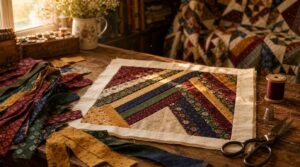
String piecing is one of those quilting techniques that transforms leftover scraps into something genuinely beautiful. It has endured for over a century, and quilters still embrace it because of its effectiveness.
From string quilting to improv piecing, there’s no shortage of creative ways to turn those leftover scraps into something worth keeping.
Here’s what you need to know before beginning.
Definition of String Piecing in Quilting
String piecing is exactly what it sounds like — sewing narrow fabric strips, called strings, onto a foundation to build a quilt block. This foundation piecing method stabilizes each strip as you work, preventing stretch and keeps your string quilt square.
Rooted in a waste-reduction ethos, the technique turns scraps into something beautiful through improvised block formation and smart color contrast strategy.
A generous spray of starch to stiffen fabric before piecing improves handling and stitch accuracy.
How String Piecing Differs From Strip Piecing
Think of strip piecing like baking from a recipe — same measurements, same result every time. String piecing? More like cooking from memory.
- Strip piecing joins uniform fabric strips for clean, repeatable blocks
- String piecing embraces edge irregularity and mixed scrap widths
- Strip piecing demands stitch consistency; strings tolerate slight shifts
- String piecing offers design flexibility and genuine waste reduction
Both use fabric strips — the approach just changes everything.
Why Quilters Use Narrow Fabric Scraps
Narrow scraps aren’t leftovers — they’re material waiting for purpose. Quilters reach for them because they offer real fabric waste reduction, turning trimmed edges and binding remnants into something meaningful. Thin strips also ease alignment, lying flat with less bulk.
And the storytelling potential? A shirt from Grandpa, a curtain from your first apartment. Fabric scrap utilization makes every quilt personal.
Every quilt tells a story — Grandpa’s shirt, your first apartment’s curtains — stitched together in fabric and memory
Best Projects for String Piecing Blocks
Baby Quilts and crib-sized play mats come together fast using 6- to 9-inch blocks.
Bed Quilts let you go bold with repetition.
Wall Hangings and Gallery Decor shine in 24-inch block grids.
Seasonal Gifts like pillow covers or mini quilts make DIY quilt projects feel genuinely thoughtful — and totally doable.
Common String Quilt Layouts and Effects
Diagonal Chevrons give your quilt a sense of motion, with strips zigzagging like a river current. Lattice Intersections create a tiled, structured feel, while On-Point Diamonds add elegance. Log Cabin Radiance expands outward from a glowing center, and a Mosaic Irregular Grid works beautifully with fabric scraps.
Explore additional layouts like diamond, diagonal, or rectangular designs, as well as honeycomb patterns or double wedding rings for striking visual results.
Top 5 String Piecing Tools
Before you cut a single strip, it helps to have the right tools in your hands. Nothing slows down a project faster than reaching for the wrong ruler or a mat that slides around.
Here are the five tools that’ll make your string piecing smoother from the very first seam.
1. Omnigrip Non Slip Quilting Ruler
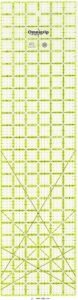
The Omnigrip Non-Slip Quilting Ruler (6" × 24") is a solid go-to for string piecing, offering reliability for precise quilting techniques.
Its neon-green lines show up clearly on both light and dark fabrics, eliminating the need to squint during cuts. This ensures accuracy regardless of fabric color.
The patented non-slip backing keeps it securely in place as your rotary cutter moves, requiring no extra grips to prevent sliding.
Hatch marks at every ⅛ inch provide the precision string strips demand, allowing for meticulous measurements.
The numbering works from both ends, accommodating both left-handed and right-handed users seamlessly.
| Best For | Quilters and patchwork enthusiasts who need a reliable, easy-to-read ruler for precise cuts on any fabric color, whether they’re left- or right-handed. |
|---|---|
| Primary Use | Quilting & patchwork cutting |
| Material | Plastic with non-slip coating |
| Price | $31.86 |
| Handedness | Left & right-handed |
| Washability | Not applicable |
| Unit Count | 1 ruler |
| Additional Features |
|
- Neon-green markings show up clearly on light and dark fabrics, so measuring is quick and easy
- Built-in non-slip backing keeps the ruler steady without needing extra grips or accessories
- Bidirectional numbering works for both left- and right-handed users, with hatch marks every ⅛ inch for precise cuts
- Only imperial markings — no metric option for those who prefer centimeters
- Plastic build isn’t as tough as metal, so it may not hold up as well under heavy repeated use
- Some buyers have reported receiving damaged rulers, suggesting packaging or quality control could be better
2. Omnigrid 3 by 18 Angle Ruler
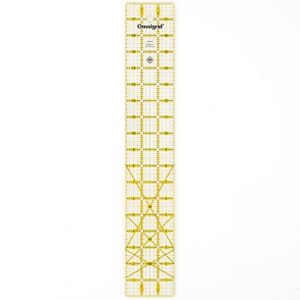
The Omnigrid 3×18 Angle Ruler is the one you reach for when strings need to go on a slant. At just 3 inches wide, it fits comfortably on your mat without crowding your workspace.
The black-and-yellow grid shows up clearly on any fabric — dark or light — and the built-in 30°, 45°, and 60° angle markings make diagonal cuts simple to line up.
Laser-cut edges keep your rotary cutter tracking smoothly.
Left- or right-handed, it works either way.
| Best For | Quilters, sewists, and crafters who regularly make diagonal cuts and need a reliable ruler that works on both light and dark fabrics. |
|---|---|
| Primary Use | Quilting & sewing cuts |
| Material | Premium acrylic plastic |
| Price | Not specified |
| Handedness | Left & right-handed |
| Washability | Not applicable |
| Unit Count | 1 ruler |
| Additional Features |
|
- The black-and-yellow grid shows up on pretty much any fabric color, so you’re not squinting to find your lines.
- Built-in 30°, 45°, and 60° angle markings take the guesswork out of diagonal cuts — no separate tools needed.
- Laser-cut edges guide a rotary cutter cleanly, and the sturdy acrylic won’t flex mid-cut.
- Despite what’s advertised, the non-slip feet aren’t included — you may need to add grip dots or just press down firmly.
- 18 inches is fine for most cuts, but if you’re working with wide fabric pieces, you’ll hit its limit fast.
- The black-and-yellow grid is fixed, so on certain mid-tone fabrics the contrast isn’t as crisp as you’d want.
3. Crafty World Self Healing Double Sided Cutting Mat
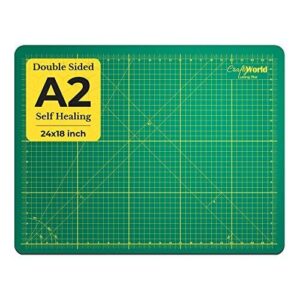
Every cut you make deserves a solid surface underneath it. The Crafty World Self-Healing Double-Sided Cutting Mat provides an 18 × 24 inch workspace designed to reseal after each slice, ensuring your mat remains smooth and your blade stays sharp longer.
The double-sided design offers two grid layouts on one mat, enhancing versatility for various projects.
A non-slip backing prevents sliding during use, guaranteeing stability mid-cut.
One thing to note: air it out first. That initial vinyl smell is real, so allow time for it to dissipate before use.
| Best For | Quilters, crafters, and hobby enthusiasts who need a large, reliable cutting surface for fabric, paper, and detail work. |
|---|---|
| Primary Use | Cutting surface protection |
| Material | Polyvinyl Chloride (PVC) |
| Price | Not specified |
| Handedness | Universal |
| Washability | Cleanable surface |
| Unit Count | 1 mat |
| Additional Features |
|
- Self-healing surface keeps the mat smooth and extends blade life over time.
- Double-sided with grid markings on both sides, so you get more versatility out of one mat.
- Non-slip backing holds steady while you cut, no shifting or sliding mid-project.
- Strong vinyl smell right out of the box — you’ll want to air it out before using it.
- The surface can be a bit slippery for fabric, so you may need to apply extra pressure or use a grip aid.
- Keep it away from heat and direct sunlight, or it can warp — flat storage is a must.
4. June Tailor Perfect Piecing Sheets
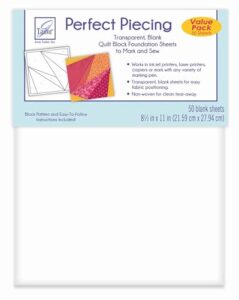
Lining up tiny fabric scraps gets so much easier when you can actually see through your foundation. The June Tailor Perfect Piecing Sheets (model JT-1420) are transparent, non-woven sheets you can run through your inkjet or laser printer to get exact block patterns — no hand-tracing needed. Each pack holds 50 sheets for $24.99.
After stitching, they tear away cleanly with minimal distortion. To use, feed them one at a time through your printer and maintain a stitch length of 1.5 mm or shorter for easy removal.
| Best For | Quilters who work with small or intricate block patterns and want precise fabric alignment without the hassle of hand-tracing. |
|---|---|
| Primary Use | Quilt block foundation |
| Material | Non-woven paper-like sheet |
| Price | $24.99 (50-pack) |
| Handedness | Universal |
| Washability | Not applicable |
| Unit Count | 50 sheets |
| Additional Features |
|
- See-through sheets make lining up fabric pieces a breeze, especially for tiny or detailed blocks
- Prints on inkjet, laser, and copiers — works with whatever you already have
- Tears away cleanly after stitching, so your fabric stays put and undistorted
- Pricier than regular printer paper or basic specialty sheets
- Getting every last bit out of very small pieces can be tricky
- Some printers need sheets fed one at a time to avoid jams
5. Dritz Fabric Glue Stick
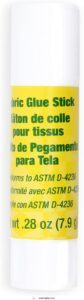
A dab goes a long way with the Dritz Fabric Glue Stick. Before sewing your first strip, use it to tack the strip in place — no pins shifting, no frustrating slippage.
It’s water-soluble, so it washes out completely after quilting.
The twist-bottom tube gives you control for small areas like trims or appliqué edges. At $6.68 for 0.28 oz, it’s an affordable helper.
Store it in the fridge to keep it from drying out too fast.
| Best For | Quilters and sewists who want a clean, pin-free way to hold fabric pieces in place before stitching. |
|---|---|
| Primary Use | Quilting & sewing basting |
| Material | Solid glue stick adhesive |
| Price | $6.68 |
| Handedness | Universal |
| Washability | Water-soluble formula |
| Unit Count | 1 glue stick |
| Additional Features |
|
- Washes out completely after sewing, leaving no residue behind
- Gives you solid control for small, fiddly areas like appliqué edges and trims
- Easy on the wallet at $6.68 — a little goes a long way
- Dries out fast if you don’t store it in the fridge
- Small 0.28 oz size gets used up quickly on bigger projects
- May not bond well with every fabric type
Prepare Fabrics and Foundations
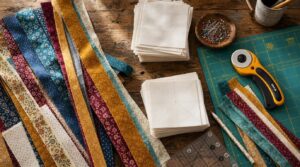
Good prep work is half the battle in string piecing. Before you sew a single seam, you’ll want to get your fabrics sorted and your foundations ready to go.
Here’s what you need to know.
Best Fabric Types for String Piecing
Not all fabric plays nicely with string piecing — and your choices here matter more than you’d think. Fabric weight consideration is real: go too heavy and your blocks get stiff; too light and they shift while sewing.
- Quilting cotton — cotton weave benefits include stable seams and easy handling
- Percale or broadcloth — low stretch, crisp edges, great for precise alignment
- Lightweight linen blends — linen blend texture adds character without bulk
How to Sort Scraps by Color and Size
Once your fabrics are chosen, sorting scraps keeps String Piecing from becoming a tangled mess. Begin with Color Family Bins — warm, cool, and neutral groups.
Within each bin, apply Intensity Gradient Sorting (light, medium, dark). This ensures harmonious combinations when piecing.
Use Size Category Stacking to separate strings from chunks, maintaining consistency in strip widths. Additionally, practice Fabric Type Segregation for cottons versus blends to manage texture and drape differences.
A simple Weekly Sorting Routine — just 15 minutes — keeps everything ready to grab and sew, preventing overwhelming buildup.
Recommended Strip Widths for String Quilts
Now that your scraps are sorted, strip width shapes everything — texture, color pop, and even how fast a block comes together. Here’s your width selection guide:
- Narrow width benefits — 1–1½" strips create dense, intricate collages.
- Medium width balance — 2–2½" fabric strips move fast and blend easily.
- Wide width impact — 3½" strips make bold, graphic statements.
- Variable width strategy — Mix varying widths for that handcrafted, spontaneous feel.
Paper Foundations Versus Fabric Foundations
Your foundation choice shapes the whole build. Paper offers alignment precision and tight seam allowance control, making it ideal for intricate angles and tiny scraps.
Muslin serves as a permanent foundation, enhancing drape and softness, but demands careful measuring.
Paper costs less upfront, keeping material costs low. However, the trade-off is that paper foundation removal can feel tedious.
Both options excel when aligned with your project’s needs.
How to Size Foundation Squares Correctly
Getting the size right from the start saves a lot of frustration later. Cut your foundation squares ¼″ larger than your finished block — that’s your quarter-inch allowance built in. For a consistent grid sizing, cut oversized paper foundations, then trim after sewing.
Always run corner-square testing and diagonal verification before adding a single string.
Uniform blocks make assembly so much easier.
When to Use Muslin, Paper, or Stabilizer
Each foundation material has its sweet spot. Muslin durability excels when projects require repeated pressings, as its heat-resistant properties prevent tearing.
For precision in tight corners, paper edge crispness delivers unmatched results, ensuring sharp, clean lines.
When working with stretchy or delicate fabrics, stabilizer weight matching is critical: opt for tear-away or cut-away stabilizers based on your fabric’s density to maintain integrity.
A hybrid backing technique combines materials when a single solution falls short, offering tailored support for complex projects.
Pressing and Trimming Strips Before Sewing
Before cutting your fabric strips, press each one flat—wrinkles lead to crooked seams. Set your iron to high heat for cotton, lower for delicate fabrics. Press from the center outward to ensure even smoothing.
Grab your rotary cutter (keep that blade fresh—cutter maintenance matters) and a ruler for clean ruler alignment. A sharp blade and precise tools are essential for accuracy.
Trim frayed edges and square up your strip; this guarantees your seam allowance stays consistent every time.
Make a String Quilt Block
This is where it all comes together. Building your first string quilt block is easier than it looks once you break it into small, manageable steps. Here’s exactly how to do it.
Step 1: Choose Your Finished Block Size
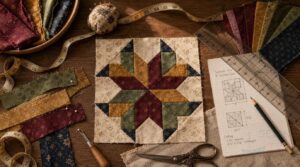
Block size math sets the tone for everything — your layout, your scrap optimization, even your border width calculation. Start here before cutting a single strip. Common options are 6", 8", or 9" finished blocks.
An 8 x 8 block is a great middle ground for quilt dimension planning and visual rhythm balance — not too fussy, not too fast. Test one block first.
Step 2: Cut The Foundation Piece
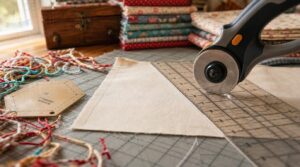
Your foundation piece is the skeleton of every block — get this right, and the rest falls into place.
- Cut your foundation ¼" larger than your finished size (8½" for an 8" block).
- Use a rotary cutter with precise ruler placement on a clean cutting mat.
- Mind grain direction alignment — whether you use a fabric foundation or paper foundation, stability matters.
- Trim bleed edge margin cleanly; reusable cutting templates keep every piece consistent.
Step 3: Place The First Diagonal String
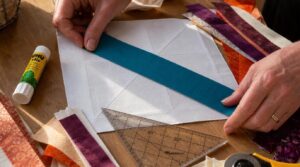
This is where your block finds its backbone. Place your first string diagonally from the top-left corner — your diagonal angle measurement sets the tone for every strip that follows. Choose a contrast color choice that pops against your foundation. Perform a quick foundation visibility check to confirm edges are clear, then anchor with a glue stick. That’s your diagonal layout locked in.
Step 4: Sew With a Quarter-inch Seam
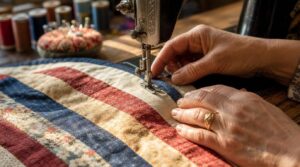
Now your first string is anchored — time to stitch it down. Attach your quarter-inch presser foot, then run a slow test stitch on scrap fabric. Check thread tension and needle positioning before working on your block. This ensures precision from the start.
Consistent seam allowances keep everything aligned later. For chain-sewing multiple blocks, re-checking your seam allowances every few blocks prevents errors. Such vigilance saves significant time and frustration.
Step 5: Flip and Press Each Strip
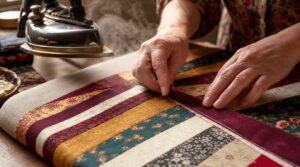
Once that seam is stitched, fold the strip open with your fingers and flip it away from center. Then iron press along the edge — smooth, light strokes, no heavy leaning.
Use steam control carefully; too much heat stretches things sideways. Keep your seam allowance flat and your edge alignment crisp against the fabric foundation.
That pressing rhythm matters. Let it cool before moving on.
Step 6: Add Strings to Both Sides
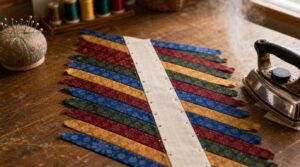
Now that your center is pressed and flat, build out by adding strings to both sides of the diagonal, working away from the center. Maintain a consistent quarter-inch edge seam on every strip.
Focus on side string symmetry: ensure even tail continuation at each end and parallel braid alignment as you progress. Press each addition flat before sewing the next strip to maintain precision.
Step 7: Trim The Block Square
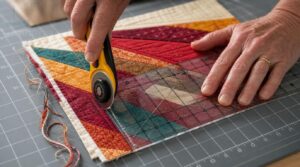
Once both sides are covered, it’s time to clean things up. Lay your block on the cutting mat and line up your ruler using a ruler alignment technique — matching the ruler’s grid lines to your intended finished size plus seam allowance.
Apply steady edge pressure control, then make clean, confident cuts with your rotary cutter. Consistent block sizing starts here.
Step 8: Remove Paper Foundations Carefully
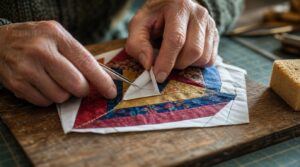
Now comes the satisfying part — paper foundation removal. Flip your block stitched side up and begin with a steady peeling technique, working from the center outward.
Use fine-tip tweezers to access tight corners without snagging. For stubborn spots, apply dampening assistance — a barely damp sponge gently loosens fibers.
Once clear, verify post-removal alignment using your cutting mat, then conclude with a final press.
Step 9: Arrange Blocks Into a Quilt Layout
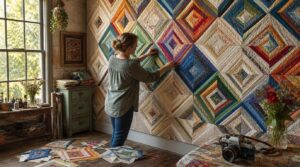
Now is the time to step back and experiment with your blocks before committing to a single stitch. Pin them to a design wall and explore block rotation—even a 90-degree turn can dramatically shift the visual flow.
Spread colors evenly across the quilt in thirds for balanced color distribution. Experiment with diagonal or diamond layout options to introduce dynamic movement.
Photograph each arrangement to compare compositions and refine your vision.
Your quilt block layout shapes the entire design.
Step 10: Join, Press, Quilt, and Bind
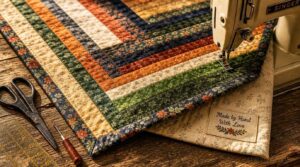
Join rows with careful seam alignment, then press each seam to one side to reduce bulk.
Follow a center-out quilting sequence with a walking foot.
Use mitered binding techniques for clean corners. Final squaring keeps edges straight.
Label the back — your string quilt construction techniques deserve a proper signature.
Frequently Asked Questions (FAQs)
Can string piecing be done entirely by hand?
Yes, string piecing works beautifully by hand. With smart needle choice, thread conditioning, and stitch length control, you can sew anywhere — no machine needed. It’s a genuinely portable, beginner-friendly approach.
How do you fix uneven or puckered string seams?
Check your tension adjustment first — slightly increase needle tension and test on scrap fabric. A walking foot prevents shifting.
Press each seam flat. Trim edges square.
Use a stabilizer if fabrics creep.
What batting works best for string quilts?
For string quilts, low-loft cotton batting is your best bet. It keeps seams crisp, boosts fiber breathability, and holds up through washing.
Wool or an 80/20 blend works great too for added warmth.
How do you calculate yardage for string quilt backing?
Measure your quilt top, then add 8 inches for drop allowance on each side.
For standard 42-inch backing fabric, a horizontal seam yardage approach usually requires about 4 yards for a 60-inch square top.
Can beginners finish a string quilt in one weekend?
A weekend feels too short — until you actually try it.
With pre‑cut materials, simplified colorways, and efficient pressing, most beginners finish a small string quilt in just two focused days.
Conclusion
That scrap you almost threw away? It might become the piece everyone asks about. The string piecing quilt technique doesn’t just rescue leftovers—it turns your most random scraps into something with real structure and intention.
Every strip you sew down is a small decision that builds toward something larger than you planned. Start with one block. Press it flat, trim it square, and see what happens. The next one gets easier. So does the next.
- https://my2.modafabrics.com/2018/12/string-piecing-past-and-present
- https://www.antiquequiltdating.com/String_Quilts_Match_the_Economic_Times,_Past_and_Present.html
- https://www.diaryofaquilter.com/how-to-foundation-paper-piece-quilts/
- https://my.modafabrics.com/inspiration-resources/string-pieced-quilts-past-and-present
- https://worldquilts.quiltstudy.org/crazyquiltstory/scraps