This site is supported by our readers. We may earn a commission, at no cost to you, if you purchase through links.
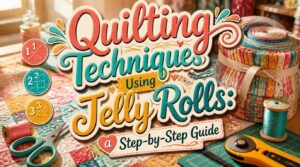
Forty strips, one bundle, zero excuses for a boring quilt. That’s the magic of a jelly roll — a tightly rolled stack of precut 2.5-inch strips that turns hours of cutting into minutes of sewing. Quilters love them for a reason: the color coordination’s already done, the math’s already simple.
Pick up any jelly roll and you’re holding roughly 2.75 yards of pre-matched fabric, ready for piecing. No measuring fatigue, no mismatched prints — just strips, a rotary cutter, and your imagination.
Mastering quilting techniques using jelly rolls means unlocking faster builds without losing precision. From Rail Fence blocks to a full Jelly Roll Race, your next quilt starts right here.
Table Of Contents
Key Takeaways
- A jelly roll bundle gives you 40 precut 2.5-inch strips (about 2.75 yards of coordinated fabric), eliminating cutting and color-matching work before you even start sewing.
- Having the right tools—a sharp 45mm rotary cutter, accurate quilting ruler, and quarter-inch presser foot—directly determines how precise and frustration-free your piecing turns out.
- Proper strip prep, including checking width, removing lint, sorting by color value, and pressing without stretching, prevents the misaligned seams and wavy blocks that ruin a quilt later on.
- Techniques like strip piecing, the Jelly Roll Race, Rail Fence, Log Cabin, and quilt-as-you-go each offer a different balance of speed, pattern complexity, and finishing flexibility for your project.
What Are Jelly Rolls for Quilting?
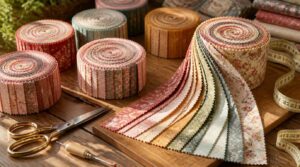
Before you cut a single strip, it helps to know exactly what you’re working with. A jelly roll might look like simple fabric candy, but there’s real method behind those rolled-up strips. Let’s break down what makes them tick—size, count, edges, and everything in between.
Once you’ve got the basics down, this step-by-step guide to quilting for beginners shows you how to turn those strips into your first finished project.
Jelly Roll Strip Dimensions
Two and a half inches. That’s the magic number for jelly roll strips, running about 42 inches long down the bolt. Manufacturer tolerances shift things slightly, so always double-check width before cutting.
A standard bundle yields roughly 2.75 yards of usable fabric—handy for yardage estimation when calculating finished dimensions for your next quilt project. A standard package contains forty fabric strips.
Fabric Counts and Collections
Forty fabric strips, one coordinated fabric collection—that’s the real draw of a jelly roll bundle. Designers build these around matching prints, so warp-weft ratios and weave structure stay consistent strip to strip.
Quality matters here: good yarn quality and tighter thread density mean better fabric durability once you’re piecing and washing finished blocks, not just prettier stacks on your shelf.
Pinked Edge Considerations
Look closely and those zigzag edges aren’t just decoration—they’re doing real work against fraying. Edge fraying resistance depends on fabric weave density, so tightly woven cottons hold up better than loose weaves.
Press pinked seams toward the seam allowance for cleaner results. Quilters using jelly rolls should check pinking blade maintenance occasionally—dull blades leave ragged, unstable edges fast.
Precut Versus DIY Strips
So, precut or DIY? Jelly rolls win on time efficiency—no cutting, no sorting, just sew. DIY strips give you full color control, mixing collections for a scrappy look precuts can’t match.
Precision-wise, factory-cut fabric bundles beat hand-cut strips for consistency. DIY risks more fabric waste from miscuts. Storage’s simpler too: precut fabric strips stack neat, ready to grab.
Best Projects for Jelly Rolls
From table runners to bed quilts, jelly rolls flex to fit your skill level and ambition. Beginners love strippy placemats and simple pillows; pros chase Trip Around The World or Log Cabin patterns.
Want modern flair? Try cushion covers or wall hangings. Curious about quilt as you go? Stitch panels straight to batting—no big assembly needed. Specialty jelly rolls even handle curved piecing and medallions.
Essential Tools for Jelly Roll Techniques
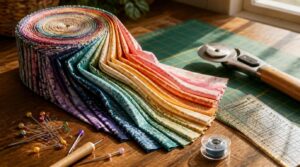
Before you cut a single strip, let’s talk gear. The right tools turn jelly roll quilting from fiddly into fun—and save your fabric in the process. Here’s what belongs on your sewing table.
Rotary Cutter and Mat
Sharp blades make straight strips. A 45mm rotary cutter is your workhorse here, paired with a self-healing mat that resists gouging and keeps cuts smooth.
- Check blade sharpness before each session
- Keep guard locked when not cutting
- Cut away from your body, always
- Replace dull blades promptly—ragged edges mean trouble
- Wipe mat clean to prevent snags
Precision cutting alignment depends on stable, debris-free surfaces.
Before strip-piecing your fabrics, give your cutting mat and ruler a quick wipe-down, since stray threads can throw off the precise segments needed for these rail fence baby quilt sewing tips.
Quilting Rulers for Accuracy
A good quilting ruler earns its keep on measuring increment accuracy — those crisp ⅛", ¼", and ½" lines keep your 2½-inch strips honest. Look for precision angle guides (45° and 60°) for triangles, plus ruler grip features that stop slipping mid-cut. Clear acrylic shows fabric beneath.
For acrylic ruler maintenance, wipe clean, store flat, and check for warping often.
Quarter-Inch Presser Foot
Want quilt blocks that actually match at the seams? A quarter-inch presser foot is non-negotiable for jelly rolls. It locks your seam allowance in automatically, with guide markings supporting pivot point precision on corners.
Check your foot compatibility guide first—low shank versions differ from high shank. Result: less reducing fabric distortion, more confident piecing throughout your jelly roll quilt tutorial.
Needles, Thread, and Clips
Cotton thread—the unsung hero of jelly roll piecing. It matches your fabric’s fiber, reducing stress on seams.
For your machine, pair a universal sharp needle (size 80/12) with a 2.0–2.5mm stitch length.
- Cotton thread for natural fabric compatibility
- Spring-loaded clips for tidy thread tails
- Needle threaders for fast, frustration-free starts
Worn needles snag fabric—swap them often.
Olfa Quick Change Cutter
Ever fumble a blade swap mid-project and lose your rhythm? The Olfa Quick Change cutter fixes that with a single-click mechanism—no washers, no fuss.
| Feature | Benefit | Why It Matters |
|---|---|---|
| Tungsten carbide blade | Stays sharp longer | Clean strip piecing |
| Ambidextrous design | Switch hands freely | Less fatigue |
| Split blade cover | Safer changes | Confident cutting |
Its ergonomic handle keeps long jelly roll sessions comfortable, cut after cut.
How to Prepare Jelly Roll Strips
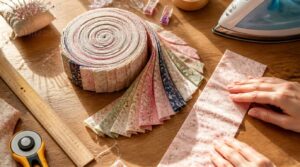
Before you make a single cut, your jelly roll needs a little prep work. Skipping this step is how strips end up crooked, linty, or stretched out of shape. Here’s exactly what to check and do before you start sewing.
Check Strip Width First
Before you cut a single strip, grab a ruler. Jelly rolls promise uniform 2½-inch strips, but precut doesn’t always mean perfect.
- Measure at three points: center, one-third, two-thirds
- Use a seam gauge for quick readings
- Flag anything off by more than ⅛ inch
- Log measurements for consistency
- Check for warping along the length
Catching width variation now saves your seam alignment later.
Remove Lint From Edges
Once your strips pass the width check, look closer—pinking creates lint, and lint creates fraying down the line.
Run a lint roller over both sides, or wipe with masking tape wrapped sticky-side-out around your hand. A fabric shaver lifts stubborn clusters without chewing fabric. Brush along the grain, then press lightly to set fibers. Clean cutting mats and separate washing keep future strips lint-free, protecting your seam allowance from bulk.
Sort by Color Value
Lint-free strips are clean, but are they organized? Group by color family first, then sort each pile by value—light to dark.
Use a light table or natural light to spot true differences. Aim for a smooth gradient, like high-value reds drifting into burgundies, so neighboring strips flow instead of clash.
Press Without Stretching Fabric
Once your gradient’s set, the iron becomes your next tool—and your biggest risk. Heat that flat, don’t drag it. Lift instead of sliding to avoid stretching those bias edges.
The iron is your biggest risk—lift instead of sliding to keep bias edges from stretching
Light steam relaxes fibers without soaking them; press corners individually with a small mat for square, true edges. Let strips rest flat before handling—patience keeps your dimensions honest.
Store Strips Neatly
Pressed and ready, your strips deserve a real home—not a drawer where chaos reigns. Try transparent bins with color value grouping, so light-to-dark sorting stays visible at a glance.
A vertical hanging system prevents bending and saves space. Keep a quick fabric inventory log for your jelly rolls and precut bundles. Good textile organization isn’t fussy—it’s what makes your next quilt start fast.
Best Jelly Roll Quilting Techniques
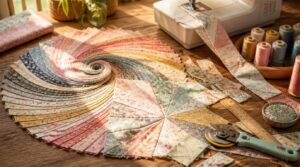
Once your strips are prepped, the real fun begins. Jelly rolls work with all kinds of techniques, from quick and simple to a little more involved. Here are five methods worth adding to your quilting toolkit.
Basic Strip Piecing
Basic strip piecing is the foundation everything else builds on—master this, and every other jelly roll technique gets easier.
Sew your 2½-inch strips together lengthwise, keeping a scant ¼-inch seam allowance to avoid cumulative error. Press seams to one side for strength.
5 things that go wrong without practice:
- Wavy strip sets
- Misaligned sub-cuts
- Stretched bias edges
- Inconsistent block sizes
- Frustrated quilters
Jelly Roll Race Method
Speed is the whole point here. The Jelly Roll Race sews strips corner-to-corner at a 45-degree angle, trimming each seam to a quarter inch and creating those signature scrap triangles as you go.
Keep your diagonal seam accuracy tight and scant seam consistency locked in, and the chevron pattern effect emerges almost by accident. Forty strips, one continuous chain—rapid assembly at its finest.
Rail Fence Blocks
Four strips, side by side, sewn into one tidy panel—that’s Rail Fence at its simplest.
Strip arrangement drives the pattern geometry: sew, press, then cross-cut into squares for instant visual symmetry.
- Sew four strips together
- Press seams flat
- Cut into equal squares
- Rotate blocks to form the zigzag
Cutting accuracy here makes or breaks your quilt blocks.
Log Cabin Blocks
Center square selection sets the tone—pick one bold strip to anchor your block before adding logs in a spiral. Build log spiral patterns clockwise, pressing each strip outward.
Try the Courthouse Steps variation for opposite-side logs, or use color gradient placement for that classic light-to-dark glow. Jelly rolls make strip piecing this technique fast, precise, and endlessly customizable.
Quilt-As-You-Go Panels
Why piece an entire quilt top before quilting it? Quilt-as-you-go panels skip that wait.
Use your jelly roll strips to piece small panels, attach batting with spray baste, then join panels edge-to-edge with minimal seam bulk. A walking foot quilts each panel as you build—coordinate colors across panels, then bind the edges for a finished quilt without wrestling bulky layers.
Step-by-Step Jelly Roll Quilt Construction
Now it’s time to turn that jelly roll into an actual quilt. No guesswork here—just five clear stages that take you from a stack of strips to a finished project on your bed. Here’s exactly how that process breaks down, start to finish.
Choose Quilt Size
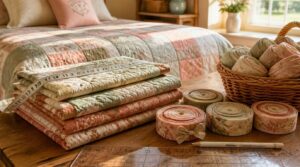
How big is the bed you’re covering? That answer drives everything else in your jelly roll quilts project.
- Twin: 70×90 in
- Full: 85×90 in
- Queen: 90×95 in
- King: 108×95 in
- Cal King: 102×92 in
Mattress depth matters too — deeper mattresses need extra drop. Aim for a 7-9 inch drop on queens, more on kings, before planning your quilt top.
Plan The Strip Layout
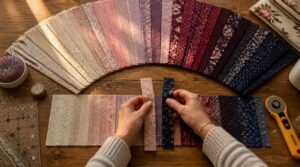
Once you know your size, spread those strips out and study them before stitching anything. Sort by color value progression — light to dark — so the eye flows smoothly across the quilt.
Place high-contrast pairs where blocks meet for punch. Keep strip order consistent row to row; it saves headaches later and cuts fabric waste, since you’re not second-guessing placement mid-sew.
Sew Consistent Seam Allowances
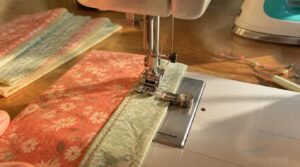
Layout’s planned — now stitch with discipline. Lock your quarter-inch presser foot in place and let it guide every pass; a magnetic seam guide adds backup precision.
Press seams to one side as you go, never open mid-build. For slippery fabrics, starch first. Grade bulky junctions where seams cross, and keep curved edges eased gently, never forced.
Sub-Cut Strip Sets
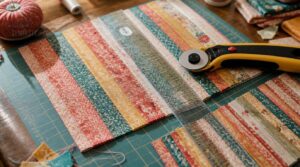
Once seams are sewn, square one edge of the strip set before your first cut — this single step keeps every piece true. Align your ruler to seam lines, not raw edges, and maintain consistent unit width throughout. This prevents cumulative errors down the line.
Sub-cut units take their names from final spots (think nine-patch units), turning long strips into ready-to-sew modular pieces.
Bind and Finish Quilt
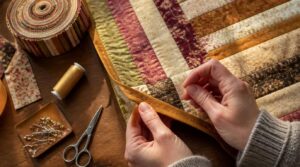
Wrap up your quilt top with a proper quilt binding, and you’ve earned the finish line. Cut 2.5-inch binding strips, attach with a quarter-inch seam, then fold to the back for hand or machine stitching.
- Use mitered corners for sharp, professional edges
- Press as you sew to avoid bulk
- Check stitching for gaps before calling it done
A facing works too, but binding gives that classic, durable edge quilters love.
Frequently Asked Questions (FAQs)
What size quilt can you make with a jelly roll?
One bundle, 40 strips, holds the power to become a lap quilt near 50×64 inches — or scale toward queen size with two to three rolls, borders pushing dimensions to roughly 86×93 inches.
What are the most popular jelly roll quilt patterns?
Rail Fence, Log Cabin, the Jelly Roll Race, and Hot Cross Buns dominate quilter favorites. Chevron layouts add visual punch too.
Each pattern transforms precut strips into stunning quilts using straightforward piecing—no complex skills required, just patience and a hot iron.
How do you store leftover jelly roll strips?
Think of leftover strips as seeds saved for next season’s garden — store them right, and they’ll bloom again. Try vertical bin organization by color, clear box stacking by collection, or pouch drawer sorting for precut fabric bundles needing extra care.
Can jelly rolls be mixed with yardage fabric?
Yes, absolutely. Coordinated fabrics from your jelly roll bundle look great with yardage — match color value and print scale, pre-wash both to prevent shrinkage mismatches, then calculate yardage carefully so your fabric coordination feels planned, not patched together.
What batting works best for jelly roll quilts?
Go with a midweight 80/20 cotton-poly mix for your quilt sandwich. It gives jelly roll strips soft loft and drape, washes well, and keeps seams flat without bulky tunneling — the sweet spot for everyday quilting supplies.
How do you bind a jelly roll quilt?
Binding is the grand finale, the bow on a thousand tiny stitches. Join strips with diagonal seam joining, press flat, then stitch to the front using a mitered corner at each turn before finishing with invisible ladder stitching on the back.
Are jelly rolls suitable for curved piecing techniques?
Curves and jelly rolls actually pair well, with a catch — those strips can run on the bias, so stabilizing edges with starch matters. Try tube piecing, curved templates, and gentle clipping to manage bulk and prevent distortion while piecing fabric smoothly.
Can jelly rolls work for 3D quilt designs?
Those uniform 2 1/2 inch strips aren’t just for flat layouts. Stack, fold, or stagger them with 3D shape cutting and layered batting, and you’ll get raised petals, pyramids, or chevrons that pop right off the quilt top.
How do you combine multiple jelly rolls together?
Two rolls, twice the fun, double the possibilities.
Start with opposite edge alignment, build multi-roll strip chains, and match motifs or follow color value gradients—then try diagonal join methods for scrappy energy that keeps your quilt top lively, not chaotic.
What accessory projects can jelly roll strips make?
Zippered cosmetic pouches, wristlet key fobs, hair accessory organizers, market tote bags, and cable organizer tubes all come together fast from leftover precut strips — turning scraps from your favorite jelly roll quilt patterns into quick, giftable sewing projects.
Conclusion
A thousand rotary cuts, a million pinned corners — that’s what jelly rolls save you from. Strip by strip, you’ve built real skill, not just a quilt. Quilting techniques using jelly rolls turn raw bundles into something worth bragging about, fast.
Your rotary cutter’s earned a rest. So pick your next roll, trust the strips, and keep stitching — because every seam you’ve sewn here proves precision and speed aren’t opposites. They’re partners, and now you know how to use both.
- https://www.missouriquiltco.com/blogs/missouri-star-blog/how-to-make-a-jelly-roll-race-quilt-a-quilt-top-in-under-an-hour
- https://kmiddletondesignstudios.com/tutorials/jelly-roll-race-beginner-tutorial
- https://weefolkart.com/jelly-roll-race-quilt-directions-notes
- https://bigredquiltersguild.org/2025-jelly-roll-challenge
- https://www.diaryofaquilter.com/a-new-take-on-jelly-roll-quilt-patterns