This site is supported by our readers. We may earn a commission, at no cost to you, if you purchase through links.
The wrong fabric can unravel a foundation paper piecing project before you sew a single seam. Slippery charmeuse shifts under the presser foot, while stretch knits distort every point. Even fabric that looks perfect on the bolt can fight you the moment it meets paper. Foundation piecing fabric selection is where precision lives—and where most frustration begins.
The good news? Getting it right doesn’t require specialty materials. A clear understanding of weight, weave, and preparation turns your fabric stash into a reliable toolkit for sharp seams, crisp points, and blocks that come together the way the pattern intended.
Table Of Contents
- Key Takeaways
- Best Fabrics for Foundation Piecing
- Choosing Colors, Values, and Prints
- Using Strong Value Contrast for Sharp Foundation Piecing Designs
- Choosing True Lights, Mediums, and Darks
- Why Small-scale Prints Are Easier to Place Accurately
- When to Use Solids for Clean Points and Crisp Shapes
- Avoiding Large Directional Prints in Small Paper-pieced Sections
- Planning Fabric Placement Before Sewing Numbered Sections
- Preparing Fabric Before Piecing
- Cutting Fabric for Full Coverage
- Cutting Pieces Larger Than The Paper Pattern Section
- Adding at Least 1/2 Inch Extra Fabric for Safe Coverage
- Including a 1/4 Inch Seam Allowance When Precutting
- Using a Light Box to Check Fabric Placement
- Preventing Short Edges and Uncovered Printed Lines
- Reducing Fabric Waste With Templates and Rough Cutting
- Organizing Cut Pieces for Numbered Foundation Sections
- Fabric Placement and Seam Accuracy
- Placing The First Fabric Right-side Up
- Positioning Later Pieces Right-side Down Before Stitching
- Folding Paper Lines to Preview Fabric Coverage
- Pinning Fabric Without Shifting The Paper Foundation
- Trimming Seams With an Add-A-Quarter Ruler
- Pressing Each Seam Flat to Reduce Bulk
- Checking Contrast and Alignment Before Joining Blocks
- Frequently Asked Questions (FAQs)
- Conclusion
Key Takeaways
- Lightweight to medium-weight 100% cotton is the best choice for foundation piecing because it presses flat, holds tension evenly, and won’t bulk up your seams.
- Strong value contrast—true lights against true darks—is what makes your points pop and keeps your design from looking muddy once it’s sewn.
- Prepping your fabric before cutting (prewashing, pressing flat, and light starching) prevents shrinkage surprises, color bleed, and pieces that won’t behave under the iron.
- Always cut pieces larger than the paper section they’ll cover, adding at least ½ inch of overhang plus a ¼ inch seam allowance so no printed lines are left exposed.
Best Fabrics for Foundation Piecing
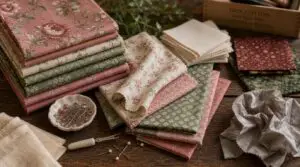
The fabric you choose can make or break your foundation piecing results. Not every material behaves as needed when sewing through paper and pressing tight seams.
For a deeper look at which fabrics hold up best against paper templates, this foundation piecing guide for beginners walks you through the key differences.
Here’s what actually works — and what to skip.
Why 100% Cotton Works Best for Foundation Paper Piecing
For foundation paper piecing, 100% cotton is simply your best friend. Its fiber durability, uniform shrinkage, and heat resistance make every step more predictable — and more enjoyable.
Here’s why using 100% cotton in foundation paper piecing works so well:
- Moisture absorption helps seams press flat and crisp
- Thread tension stays consistent through multiple fabric layers
- Fabric stiffness stays manageable — never too limp, never too rigid
- Uniform shrinkage keeps your blocks true after prewashing
Remember that pre‑washing prevents color bleed for consistent results.
Choosing Lightweight to Medium-weight Quilting Cotton
For foundation piecing, aim for lightweight to medium-weight quilting cotton — roughly 4 to 5.5 oz/yd². This weight range ensures the right drape and bulk balance, allowing seams to stay flat without stiffness.
Hand feel consistency also matters: Fabric that feels smooth and even cuts cleanly every time. A mercerized finish enhances color vibrancy and reduces snagging, further improving durability.
When selecting fabric, prioritize fiber lot matching to maintain consistent colors across blocks. Always store fabric flat to prevent distorted grain lines before cutting, preserving the material’s structural integrity.
Why Stable, Even-weave Fabric Improves Accuracy
Fabric weight gets you close — but fabric stability seals the deal. Even-weave cotton, where warp/weft balance is tight and uniform, ensures stitch alignment remains true from the first seam to the last.
Tension uniformity prevents stretch from pulling pieces off-mark, maintaining a locked-in sync between paper and fabric. This consistency preserves edge straightness across every numbered section, eliminating deviations during assembly.
Selecting appropriate fabric for foundation paper piecing hinges on prioritizing stability. This foundational choice guarantees precision throughout the process.
Fabrics to Avoid, Including Stretch, Bulky, or Slippery Materials
Not every fabric belongs on your foundation paper. Some will fight you the whole way.
Avoid these problem fabrics:
- Stretch and knits cause elastic fiber shifting and stretch distortion across numbered seams
- Bouclé and heavy pile create bulky seam bulk that hides your points
- Silk charmeuse and satin introduce slippery fabric slip under the presser foot
- Lightweight sheers lack the body needed for foundation paper piecing
Stick to stable, lightweight to medium-weight fabrics only.
How Fabric Weight Affects Seams, Points, and Block Thickness
Weight matters more than most beginners expect. Heavy fabrics increase seam bulk, leading to heavy fabric puckering and compressed points that won’t lie flat. Thin fabric points, on the other hand, stay crisp because there’s simply less material crowding the intersection.
| Fabric Weight | Effect on Seams | Effect on Points |
|---|---|---|
| Lightweight | Minimal bulk, flat seams | Crisp, clean points |
| Medium-weight | Balanced seam thickness consistency | Accurate, well-defined points |
| Heavy fabric | Bulk vs. weight tension, puckering risk | Compressed, harder to align |
| Varied weights | Uneven block thickness | Waviness at intersections |
| Starched light fabric | Improved stability | Sharper point definition |
Lightweight to medium-weight fabrics are the sweet spot. Starching and ironing for fabric stiffness helps lighter cuts behave during sewing. Weight-driven tension issues disappear when your fabrics are consistent — and the importance of fabric weight and flexibility really shows in your finished block.
Choosing Colors, Values, and Prints
Getting your fabric selection right goes far beyond just picking colors you love. Value contrast and print scale play a surprisingly big role in how sharp and clear your finished blocks will look.
Before you cut a single piece, planning your fabric choices with care can save you from blocks that look muddy or visually flat once sewn together.
Here’s what to keep in mind before you start placing fabric on those numbered sections.
Focus on these critical elements to ensure your design achieves the desired visual impact.
Using Strong Value Contrast for Sharp Foundation Piecing Designs
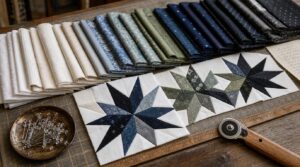
Value contrast is the backbone of every sharp foundation piecing design. Without it, your points blur and your shapes lose definition. Think of it like a value ladder — light at one end, dark at the other.
Value contrast is the backbone of sharp foundation piecing — without it, points blur and shapes lose definition
Contrast testing before you sew saves real headaches later. Place true lights directly against true darks, and your focal point emphasis will practically pop off the fabric.
Choosing True Lights, Mediums, and Darks
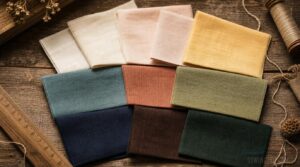
Think of your palette in three clear layers: true lights, mediums, and darks. Each plays a distinct role in your contrast strategy. True lights should feel genuinely bright — not just pale. True darks anchor the design without muddying it. Mediums bridge the two, supporting value harmony and hue balance across your quilt.
Choosing color schemes for FPP projects gets easier when palette cohesion and color temperature guide every decision.
Why Small-scale Prints Are Easier to Place Accurately
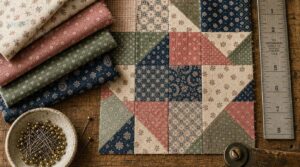
Small-scale prints are your secret weapon for accurate placement. Their repeating micro-pattern cues act as alignment ladders, helping you lock fabric position before pressing the presser foot down.
Grid-like motifs support contrast anchoring across seams, while reduced distortion keeps edges true when pinned.
For fabric selection guidelines and precise layout planning, small-scale prints deliver better pattern accuracy than larger, busier designs.
When to Use Solids for Clean Points and Crisp Shapes
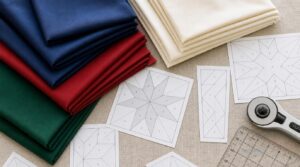
Solids are your best friend when sharp points matter most. They provide uniform color blocks that make seam lines obvious, ensuring alignment remains consistent across every numbered section. Without directional prints or subtle shading, stable point definition becomes significantly easier to achieve.
Follow basic fabric selection guidelines—choose solids with minimal nap influence and consistent scale control for cleaner, crisper results every time.
Avoiding Large Directional Prints in Small Paper-pieced Sections
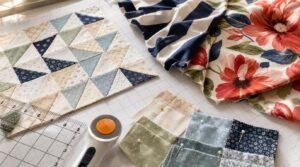
Large directional prints in small sections are a recipe for chaos. When a section measures under 2 inches, those bold stripes or oversized florals drift and warp, breaking your color harmony fast.
Keep these guidelines in mind:
- Apply print size limits: choose miniature print selection or solids under 6 inches
- Use motif rotation strategy to prevent pattern drift
- Prioritize grain direction alignment along seam lines
Planning Fabric Placement Before Sewing Numbered Sections
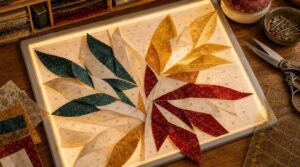
Before you sew a single stitch, lay your cut pieces against the foundation papers and numbered sections in order. Use a light box for fabric positioning to confirm each piece covers its section with enough overhang tolerance. This fabric layout planning step—your placement checklist—catches problems fast.
A quick dryfit verification with orientation mapping and sequencing sections ensures proper alignment and order. This critical step prevents errors early, saving you from ripping seams later.
Preparing Fabric Before Piecing
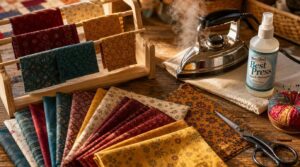
Good fabric prep is one of those steps that’s easy to skip—and almost always regrettable when you do. Taking a little time before you cut saves you from warped blocks, color surprises, and fabric that won’t behave under the iron.
Here’s what you need to do to get your fabric ready before a single stitch hits the machine.
Why Pre-washing Fabric Can Prevent Shrinkage and Bleeding
Before you cut a single piece, prewashing fabric is one of the smartest steps you can take. Skipping it risks fabric shrinkage, color bleeding, and sizing removal headaches later.
Pre-wash testing protects your finished quilt:
- Shrinkage control locks in stable dimensions before cutting
- Dye bleed prevention saves lighter fabrics from staining
- Sizing removal lets fibers press and sew cleanly
- Fabric stabilization keeps blocks accurate after washing
Pressing Fabric Flat Before Cutting
Once your fabric is prewashed, press it completely flat before cutting. Wrinkles hide in the weave and throw off your grain lines.
Set up your Wool Pressing Mat and Oliso Mini Iron with Trivet on a stable Flat Surface Setup. Use Iron Temperature Control with a cotton setting and choose a Pressing Cloth Choice to protect prints.
Mind your Steam Heat Balance—moderate steam relaxes fibers without watermarks. Let the cooling fabric rest before cutting.
Using Light Starch for Small or Oddly Shaped Pieces
Once your fabric is pressed flat, lightly starching small or oddly shaped pieces makes a real difference. A quick mist—your application technique—adds just enough body to hold edges during cutting without brittleness.
Drying time is under ten minutes. Avoid spraying directly over heavy ink areas for ink safety.
Reapply only to high-tension spots as needed. Tool compatibility with your iron remains smooth when fabric is fully dry.
Keeping Fabric Stable Without Making It Stiff or Brittle
Balancing stability with softness is where many quilters trip up. Starch helps, but too much leaves fabric brittle and hard to needle through. Instead, layer your approach:
- Try lightweight interfacing for tiny sections that keep shifting
- Use a spray stabilizer for temporary grip without stiffness
- Practice gentle edge pressing to maintain that soft hand-feel
Breathable storage and light hand-feel conditioning keep everything quilt-ready.
Sorting Prepared Fabrics by Color, Value, or Block Section
Once your fabrics are prepped, sorting them smartly saves real time at the machine. Group by color family bins first, then layer in a value ladder layout (light, medium, and dark) to ensure clarity at a glance.
| Sort Method | Best For |
|---|---|
| Section-based trays | Block assembly speed |
| Labeling system | Inventory tagging accuracy |
Inventory tagging, with color coordination notes, maintains smooth fabric handling from prep to final stitch.
Cutting Fabric for Full Coverage
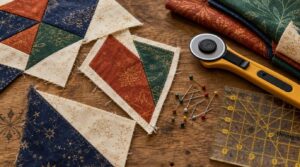
Cutting fabric for foundation piecing isn’t just about getting close — it’s about giving every piece enough room to do its job. A little extra fabric at each stage keeps your points sharp and your seams clean.
Here’s what to keep in mind when you’re cutting.
Cutting Pieces Larger Than The Paper Pattern Section
Every piece you cut for foundation paper piecing needs to be bigger than the section it covers — no exceptions.
- Practice Overhang Edge Folding to preview coverage before pinning
- Maintain Extension Length Uniformity around curves and sharp corners
- Use Aligning Corner Overhangs to avoid gaps at tricky points
- Apply Bulk Reduction Techniques by trimming only after stitching
- Use Extension Documentation to track measurements per numbered section
Adding at Least 1/2 Inch Extra Fabric for Safe Coverage
Think of that extra half inch as your safety net. A ½-inch margin beyond each section’s edge gives you room for small shifts during stitching, keeps edges stable, and makes easier bulk reduction when trimming seams.
Before cutting many pieces, test a swatch first — this quick check confirms your seam allowance calculation is working and helps minimize fabric waste across your whole project.
Including a 1/4 Inch Seam Allowance When Precutting
A quarter-inch seam allowance is your precut baseline — it keeps fabric edges aligned with the paper grid once sewn. Use a clear acrylic ruler for solid ruler alignment, maintaining consistent spacing across every piece.
A quick precut test seam on scrap fabric confirms your seam allowance calculation before committing. This ensures the fabric edge overhang fully covers printed lines, securing the quarter-inch margin completely.
Using a Light Box to Check Fabric Placement
A daylight wafer lightbox changes everything about fabric placement. When you slide your fabric over the lit surface, printed lines glow right through — no guesswork needed.
Here’s how to use it well:
- Light Box Calibration – Match color temperature to ~5000K for neutral, accurate readings.
- LED Brightness Control – Increase brightness for heavier or darker fabrics.
- Diffuser Cleaning Routine – Wipe the panel regularly to prevent hotspots.
- Grain Alignment Check – Line up fabric grain with the paper grid beneath.
- Color Overlay Testing – Lay translucent paper over the box to preview contrast before cutting.
Using a light box for fabric positioning confirms full coverage before you ever thread your needle.
Preventing Short Edges and Uncovered Printed Lines
Even with a light box, short edges still sneak up on you—when fabric sits just a hair too close to the printed line, and your stitch length or paper grain alignment is slightly off.
| Problem | Fix |
|---|---|
| Exposed printed lines | Extend fabric past the edge |
| Edge curl | Adjust pressing sequence |
| Ink density gaps | Check fabric alignment before pinning |
| Pin placement shifts | Pin parallel to seam |
| Uneven coverage | Revisit edge trimming techniques |
Reducing Fabric Waste With Templates and Rough Cutting
Once your edges are secure, smart cutting keeps waste in check. Template Nesting Strategies let you batch rough-cutting of multiple pieces from a single fabric pull—clear outlines guide your blade along efficient paths, practicing Cutting Path Minimization naturally.
Leave a generous Margin Allowance Planning buffer of ¼ to ½ inch, and your trim-sew-press workflow stays smooth without costly re-cuts.
Organizing Cut Pieces for Numbered Foundation Sections
Once your cuts are done, keeping them sorted saves real headaches later. Since foundation papers are numbered in sewing sequence, match your fabric pieces to each section right away.
Try this system:
- Store pieces in labeled Section Bins by number
- Use a Labeling System with erasable marker on each patch
- Log swaps in a Digital Tracking spreadsheet
- Set up Workflow Stations with Checklist Templates nearby
Everything stays where it belongs.
Fabric Placement and Seam Accuracy
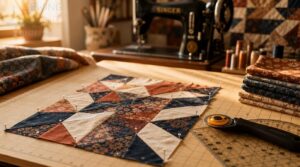
Getting your fabric in the right place—right from the start—makes all the difference between a block that lines up beautifully and one that fights you every step of the way.
Placement and seam accuracy aren’t complicated, but they do follow a specific order that’s worth knowing before you sit down at your machine. Here’s what to keep in mind as you work through each section.
Placing The First Fabric Right-side Up
Start Piece 1 right-side up—it’s the anchor for your entire block’s stepwise construction. This orientation verification step allows you to perform a quick visible color check, confirm motif positioning, and ensure your fabric pieces align with the paper guides before anything is sewn.
Employ pinning strategies for fabric placement to guarantee minimal shift during pinning, and always confirm paper edge coverage before stitching.
Positioning Later Pieces Right-side Down Before Stitching
Flipping your fabric pieces right-side down for sections 2 and beyond is the move that makes everything click. Seam line visibility depends on it—you’re sewing through both layers with the paper guides facing up, so the stitched seam lands exactly right.
- Confirm upper layer stability by smoothing from center outward
- Check seam line visibility through the fabric stack before stitching
- Apply temporary adhesive aid or spray starch to reduce shifting
- Use pinning strategies for fabric placement with pinheads pointing outward
After positioning, do a quick dry-fit verification: fold along the paper line to confirm full coverage before you hit your stitch initiation point.
Folding Paper Lines to Preview Fabric Coverage
Folding foundation paper along printed lines before you sew gives you a live preview of exactly where fabric pieces will land. Think of it as a dress rehearsal — no surprises once stitching starts.
| Fold Preview Check | What to Look For | Fold Preview Adjustments |
|---|---|---|
| Fold Line Alignment | Seam matches block grid | Shift fabric, re-fold to confirm |
| Coverage Gap Detection | Exposed paper beyond fabric edge | Extend piece, recheck margin |
| Visual Bulk Check | Multiple layers bunching at points | Trim or reposition before sewing |
| Paper Line Density | Complex areas need closer folds | Add folds in tight sections |
| Fabric Placement Test | Full section covered evenly | Re-align using folding techniques for paper alignment |
Use paper guides for quilting to test each numbered section before committing. A light touch keeps the paper flat while you preview.
Pinning Fabric Without Shifting The Paper Foundation
Pinning well is what keeps your fabric exactly where you placed it. Fine pin selection matters here — short, fine-point pins cause minimal pin perforations through the foundation. Place them perpendicular to the seam line, spacing them near corners and midpoints. For lightweight to medium-weight fabrics, this pin spacing strategy holds everything snug.
Remove pins just before your needle reaches each one. This ensures smooth stitching without disrupting the fabric’s position.
Trimming Seams With an Add-A-Quarter Ruler
The Add-A-Quarter ruler is your secret weapon here. Its built-in lip seats securely against the fold line, giving you a perfect quarter-inch seam allowance every single time — no measuring, no guessing.
Use your rotary cutter along the edge with short, steady strokes. For curved seam trimming on spirals or intricate shapes, the Add-A-Quarter 12 Plus manages longer sections cleanly.
Check your blade compatibility regularly and replace dull blades immediately. Ragged cuts on lightweight to medium-weight fabrics cause fraying that throws off your trim-sew-press rhythm entirely.
Pressing Each Seam Flat to Reduce Bulk
Back pressing first is the rule — always flip your block over and press seams from the fabric side before touching the front. Use light pressure control and a pressing cloth on delicate cottons to avoid shine or distortion.
The trim-sew-press workflow only works when you add a cool-down pause between steps.
Try a seam roller technique for flattening stubborn intersections along the seam line without stretching your fabric.
Checking Contrast and Alignment Before Joining Blocks
Before you sew two blocks together, do a quick dry-fit assessment—lay them side by side on a flat surface and inspect closely.
- Run alignment ruler checks along each seam line to catch gaps before they become problems.
- Hold contrast test swatches against each other for a pre-join visual inspection under your actual sewing light.
- Verify small-scale and subtle prints don’t visually merge, as maintaining accurate points in quilt blocks depends on true color contrast being clearly visible during seam-line verification.
Frequently Asked Questions (FAQs)
Can I mix fabric collections from different designers?
Absolutely. Think of it like assembling a playlist — different artists, one cohesive vibe. Start with Palette Coordination: pick three to five shared hues.
Then focus on Pattern Scale Balance, pairing bold prints with quieter ones.
How do I handle directional prints across block sections?
Keep directional prints running the same way across every sub-block. Before sewing, mark print direction arrows on your layout.
A quick rotational adjustment before cutting saves you from visual jogs later.
Should I audition fabrics under natural or artificial light?
Both, honestly. Natural light shows true color, but TL84 reveals how fabrics read indoors.
Metamerism awareness matters—some pairs look perfect in daylight, then clash under store lighting. Test both before committing.
How many fabric options should I pull before choosing?
Pull five to seven options minimum. That sweet spot gives you enough variety to judge contrast and value without decision fatigue.
Less than five, and you’re guessing. More than seven, and you’re just spinning your wheels.
Conclusion
Like a well-pressed seam, good foundation piecing fabric selection holds everything together invisibly—you only notice when it’s missing. Start with stable, woven cotton. Cut generously. Press before you sew. When fabrics are prepped, placed, and chosen with intention, the pattern stops fighting you and starts working with you.
That’s when foundation piecing clicks into place—not just technically, but creatively. Now go enjoy the satisfying snap of a perfectly matched point. Happy piecing!
- https://babylock.com/11-quilting-tips-for-flawless-foundation-paper-piecing?srsltid=AfmBOorNO_Z8Q7godspqriP1fMQCMomZUb5-wqchRP3emRbN6Yz88xYi
- https://nancysnotions.com/what-thread-works-best-for-piecing-quilts/
- https://quietplaydesigns.com/blogs/blog/foundation-paper-piecing-tips-part-one?srsltid=AfmBOopOmfK4eRLqzzWFpH2Y-bxAZ7u69J4N8Co3etalYz-_OPwaYW9q
- https://www.stitchedincolor.com/blog/2020/12/11/how-to-choose-fabrics-for-english-paper-piecing
- https://thebluebeeboutique.com/blogs/news/selecting-the-perfect-fabric-for-foundation-paper-piecing-a-comprehensive-guide?srsltid=AfmBOoqMDkLb3Y66_ZL8zxs00KfK7xPoDS624zNukt8DJak-Zd7kn_Nw