This site is supported by our readers. We may earn a commission, at no cost to you, if you purchase through links.
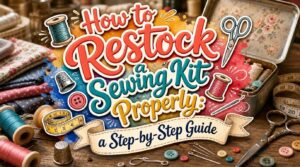
A sewing kit sitting half-empty on the counter is one of those small frustrations that snowballs fast—you need a button replaced, grab your kit, and discover three broken needles, a spool of beige thread when the shirt is navy, and scissors that couldn’t cut warm butter.
It happens to everyone, and it happens quietly, supply by supply, project by project. The fix isn’t complicated, but restocking a sewing kit properly means more than tossing in a few spools and hoping for the best.
Done right, you end up with a kit that actually solves problems instead of creating new ones.
Table Of Contents
- Key Takeaways
- Audit Your Current Sewing Kit
- Restock Essential Needles and Pins
- Choose The Right Threads
- Refill Tools and Fasteners
- Keep Fabric Scissors Sharp and Reserved for Fabric Only
- Add Embroidery Scissors for Trimming Small Threads
- Replace Worn Seam Rippers With Ergonomic Options
- Include a Flexible Tape Measure and Check It for Warping
- Organize Buttons by Size, Color, Garment Type, or Owner
- Add Hooks, Snaps, Elastic, and Basic Mending Notions
- Organize Supplies for Easy Restocking
- Use a Divided Sewing Box or Clear Storage Container
- Label Compartments for Needles, Thread, Pins, Buttons, and Tools
- Keep Frequently Used Supplies in The Main Kit
- Store Needles in Packets, Tubes, or Resealable Containers
- Keep Pins in a Secure Container With a Detachable Lid
- Review The Kit After Each Major Project
- Create a Monthly or Seasonal Restocking Routine
- Frequently Asked Questions (FAQs)
- Conclusion
Key Takeaways
- Before buying anything new, audit your current kit by emptying it completely, grouping items by type, and tossing anything bent, dull, rusted, or weak — you will save money and shop smarter.
- Stock a core set of needles (universal 80/12, heavy-duty 100/16, and hand-sewing sizes 3–9) plus matching pins, because the right needle for the job makes every repair faster and cleaner.
- All-purpose polyester thread handles most repairs, but keep heavyweight thread for denim and canvas, and always match thread color to the dominant fabric shade — going one shade darker beats going lighter every time.
- After each major project, spend ten minutes reviewing what you used and what ran low, then set a monthly restocking routine so your kit is always ready when you need it.
Audit Your Current Sewing Kit
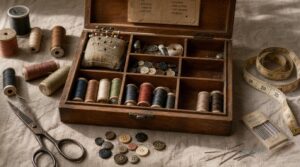
Before you buy a single thing, take stock of what you already have. A quick audit saves you money and tells you exactly where the gaps are.
If you’re eyeing a new machine, checking out Brother sewing machines with hand-drawn pattern capabilities first helps you figure out whether your current setup is actually missing something worth upgrading for.
Here’s how to work through it.
Empty The Kit and Group Items by Category
Before anything else, tip your whole kit out onto a clean, flat surface — this is your Surface Layout moment. Spread everything out so nothing hides. Adopting a one room at a time approach helps keep the process manageable.
Then sort your sewing supplies into clear Consolidation Zones: needles and pins, threads, scissors, measuring tools, and fasteners. Grouping identical items together creates a natural Sorting Workflow and instantly shows you what you’re actually working with.
Check for Missing or Duplicate Supplies
Now that everything’s grouped, compare what you see against a simple Missing Item List — needles, thread colors, pins, tools. You don’t need Barcode Scanning or a fancy Inventory Spreadsheet; even a notepad works.
Look for Duplicate Detection opportunities too, like three identical scissors but no seam ripper.
Threshold Alerts are basically just asking: "Do I have enough of this to actually finish a project?
Discard Bent Pins, Dull Needles, Rusted Tools, and Weak Thread
Once you know what’s missing or doubled up, it’s time to cut the dead weight. Toss bent metal-head pins — they snag fabric instead of holding it. Swap out dull hand sewing needles, since blunt points wreck stitch quality fast.
Rusted tools and weak cotton or polyester thread both belong in the bin too. These compromised items undermine precision and durability in your work.
Good tool hygiene practices keep your kit safe and your seams clean.
Identify Items Used Most Often for Repairs and Projects
Now that your kit is trimmed down, take a quick mental inventory of what you actually reach for. Seam rippers, safety pins, universal needles, and all-purpose thread cover most common fabric repairs. These are your workhorses — keep them front and center.
Frequent mending projects like hem fixes and seam splits also call for small scissors and a flexible tape measure.
Make a Simple Restocking Checklist Before Buying
Before you spend a single euro, write it down. A quick inventory spreadsheet — even a notes-app list — keeps your restocking focused.
Group supplies by category, then use priority ranking to separate must-haves from nice-to-haves. This ensures a structured approach to your sewing essentials.
Factor in seasonal needs, like heavier thread for winter projects, to adapt your kit throughout the year.
Budget planning and a brief supplier comparison help you build a complete sewing kit without overspending on duplicate sewing accessories.
Restock Essential Needles and Pins
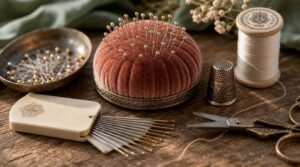
Needles and pins are the backbone of any sewing kit, and getting the right ones makes every repair feel easier. Stocking up doesn’t have to be complicated — you just need to know what to grab.
Here’s what belongs in your kit.
Add Universal Needles for Everyday Sewing
Universal needles are the Swiss Army knife of sewing accessories — one type accomplishes most jobs.
For everyday repairs, start with size 80/12. It hits the sweet spot for needle compatibility across cotton, polyester blends, and medium-weight fabrics. Thread interaction is smooth, fabric suitability is broad, and the cost efficiency is hard to beat.
Honestly, one pack covers nearly everything in your kit.
Keep Heavy-duty Needles for Denim and Canvas
Denim demands heavy-duty needles to avoid damage. For thick fabrics, use size 100/16 needles—their reinforced shafts resist bending under pressure, while chrome plating withstands abrasive fibers.
The wedge point design ensures clean cuts through dense weaves, minimizing skipped stitches.
Always verify machine clamp compatibility before sewing. One pack offers long-lasting performance.
Include Hand-sewing Needles in Multiple Sizes
Hand-sewing needles aren’t one-size-fits-all — your kit needs variety. Think of it like a toolbox: a needle size chart helps you match shaft length variety and point shape matching to the job.
Sizes 3–9 cover most repairs, from heavy upholstery to fine hand stitching. Check eye size selection and material coating options too.
These essential sewing tools make selecting the right sewing needles easy.
Replace Blunt or Damaged Needles Regularly
A dull needle is one of the sneakiest saboteurs in your kit. Here’s a simple replacement routine to keep your stitches clean:
- Project-based replacement — swap the needle after each completed project
- Thread breakage correlation — frequent snapping means it’s time for a fresh one
- Sharpness testing — drag the tip lightly across your fingernail; it should catch slightly
- Sharps disposal safety — drop used needles into a puncture-resistant container, never loosely in the bin
Add Glass-head, Metal-head, and Silk Pins as Needed
Not all pins are created equal — and the right choice depends on your fabric.
Metal head pins handle everyday fabrics reliably, offering Metal Pin Durability at a low cost.
Glass head pins resist melting under an iron, providing a real Glass Pin Benefit for pressing work.
For silk or satin, Silk Pin Precision matters — their slim shafts leave almost no trace.
Coloured head pins improve visibility across projects.
Keep Safety Pins in Several Sizes for Quick Fixes
Safety pins are just as important as straight pins — and size actually matters here. Small pins (¾ to 1 inch) handle delicate hems without stress. Medium ones cover everyday clothing repairs, while large and extra-large pins manage layered fabric handling like quilt basting or denim fixes.
Label each group for easy size-specific applications. A magnetic pin tray keeps them organized, and a small travel pin kit manages on-the-go repairs.
Choose The Right Threads
Thread is one of those things that looks simple but can quietly sabotage a repair if you get it wrong.
Thread looks simple, but the wrong choice can quietly sabotage an entire repair
The good news is that stocking the right types doesn’t take much effort — just a few smart choices upfront. Here’s what your kit actually needs.
Use All-purpose Polyester Thread for Most Repairs
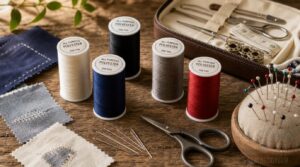
If there’s one thread worth keeping stocked at all times, it’s all-purpose polyester. It’s the backbone of any complete sewing kit — and for good reason:
- Thread Strength — retains 90–95% tensile strength after repeated washing
- Machine Compatibility — runs smoothly with sizes 10–16 needles
- Colorfastness Benefits — resists fading and bleeding through laundering
- Cost Efficiency — affordable, widely available, and reliable
Store spools upright, away from sunlight, for lasting fabric repair results.
Add Heavy-weight Thread for Denim, Canvas, and Topstitching
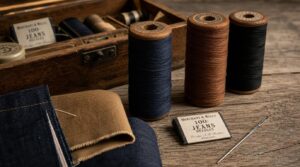
All-purpose thread handles most sewing tasks, but denim and canvas demand a tougher option. Heavy-weight threads—typically 30 to 40 wt—provide the tensile strength to secure thick seams without breaking under pressure. They are essential for any complete sewing kit.
| Feature | Heavy-weight Thread |
|---|---|
| Weight Range | 30–40 wt |
| Needle Size Pairing | Size 90–110 jeans needle |
| Topstitch Design | Bold, visible stitch lines |
| Bulk Spool Storage | 180–3,000 yards per spool |
| Thread Longevity | Colorfast through repeated washing |
Avoid using cotton thread here; it breaks too easily on dense fabrics.
Match Thread to The Dominant Fabric Color
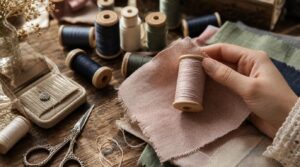
Getting the thread color right matters more than most beginners expect. Dominant hue identification is your starting point — scan the fabric to identify the most dominant color. Then test it: a quick sample seam trial under natural light reveals what artificial bulbs hide. The impact of lighting is significant; soft white bulbs skew warm and mislead your eye.
- Hold your thread against the fabric near a window for accurate color reading
- For pattern-based blending, match the background, not the print’s accent colors
- Check fabric-thread compatibility — cotton thread blends naturally with linen, while polyester suits synthetics
Choose a Slightly Darker Shade When an Exact Match is Unavailable
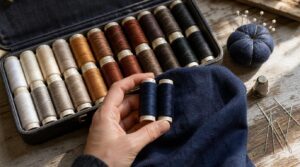
When an exact match isn’t in your sewing kit, go one shade darker — never lighter. Undertone Coordination matters here: pick a darker thread with the same warm, cool, or neutral undertone as your fabric.
Fabric shade impact varies by material, so conduct a Lighting Test near a window. For Blending Application, feather thread along seam edges to ensure seamless integration.
Track Fade Management after washing, as colorfastness may shift over time.
Store Specialty Threads Separately From Everyday Thread
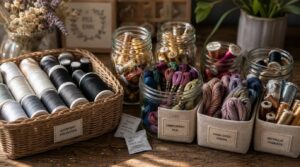
Mixing specialty threads with everyday spools is a fast track to tangled chaos. Keep them in separate, clearly labeled zones so you’re never hunting for the right fiber mid-project.
- Use color-coded bins with fiber-specific containers for polyester, metallic, and embroidery threads
- Add silica gel packs for humidity control to protect delicate fibers
- Maintain simple thread inventory logs with fiber type, weight, and purchase date
Refill Tools and Fasteners
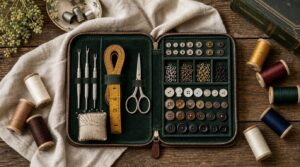
Threads and needles are only part of the picture — your tools and fasteners matter just as much.
A dull seam ripper or warped tape measure can quietly derail a simple repair.
Here’s what to check, replace, and add to keep your kit ready for anything.
Keep Fabric Scissors Sharp and Reserved for Fabric Only
Your fabric scissors are only as good as their last cut. Treat them like the essential sewing tools for beginners and experienced sewists alike that they are — reserved strictly for fabric cutting, nothing else. Cutting paper or cardboard dulls blades fast. Label them clearly with Fabric Only Labeling so no one grabs them for craft projects. A simple sticker works.
Follow this care plan:
| Habit | What to Do | Why It Matters |
|---|---|---|
| Blade Cleaning Routine | Wipe with a dry lint-free cloth after each use | Removes fibers and oils that cause friction |
| Scissor Sharpening Schedule | Schedule professional sharpening when cuts feel ragged | Preserves the precise bevel for clean fabric cuts |
| Dedicated Scissor Storage | Keep in a sheath or upright organizer | Prevents nicks and dulling from contact with other tools |
| Proper Cutting Technique | Use long, smooth strokes on a flat surface | Reduces blade stress and misalignment |
| Moisture Control | Store away from humidity and corrosive cleaners | Prevents rust and slowed blade performance |
Building a complete sewing kit means protecting your dressmaking scissors like the investment they are. Good sewing basics start with sharp, reliable tools.
Add Embroidery Scissors for Trimming Small Threads
Your big dressmaking scissors can’t reach everywhere — that’s where embroidery scissors earn their place. With 4-inch stainless steel blades, sharp micro serrations, and ergonomic grips, they snip tiny thread tails cleanly without nicking surrounding fabric.
Blade geometry matters here: pointed tips navigate dense stitches with ease.
A simple maintenance routine — wipe, dry, store covered — keeps them sharp.
Essential for building a complete sewing kit.
Replace Worn Seam Rippers With Ergonomic Options
A dull seam ripper drags instead of glides — and that’s when fabric tears. Upgrade to an ergonomic model with a cushioned grip and weighted balance, and the difference is immediate.
Look for features like a safety ball tip to protect your fabric, a replaceable blade module for long-term use, and an adjustable angle handle if your hands fatigue quickly.
It’s a small swap that makes a real difference.
Include a Flexible Tape Measure and Check It for Warping
Your tape measure is a quiet workhorse — until it isn’t. To ensure longevity, prioritize fiberglass blades over cheaper plastic alternatives. Regularly inspect for warping by laying the blade flat against a straight edge; watch for gaps that indicate bending. Verify the hook sits flush at the zero point to maintain accuracy.
Protect your tool by storing it away from heat, which can degrade materials. Implement a quick calibration routine every few months to catch inconsistencies early. These steps safeguard precision and extend the tape measure’s functional lifespan.
Organize Buttons by Size, Color, Garment Type, or Owner
Buttons are their own little chaos — and size grouping is the fastest fix. Sort small 5–8 mm buttons for lightweight garments, mid-size 9–11 mm for blouses, and larger buttons for coats.
Color coding by neutral tones first keeps things visual.
For shared kits, owner labeling prevents mix-ups.
Toss mismatched pieces into a mixed button lot so your sewing kit stays clean.
Add Hooks, Snaps, Elastic, and Basic Mending Notions
Beyond buttons, your kit needs a few quiet heroes: hooks and eyes, snap fasteners, and elastic. Match hook sizing to fabric weight — heavier materials need sturdier metal hooks.
For snap selection, plastic snaps suit lightweight fabrics, while metal secures denim easily.
Stock elastic in common widths like ¼ and 1 inch.
Tuck mending stitches, needle threaders, and fastener storage in one small labeled container.
Organize Supplies for Easy Restocking
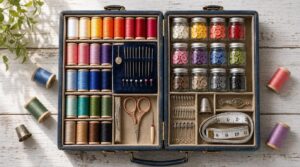
Once your kit is restocked, how you store everything matters just as much as what you have. A little organization now saves you from digging through a tangled mess mid-project.
Here’s how to set it up so restocking stays quick and painless every time.
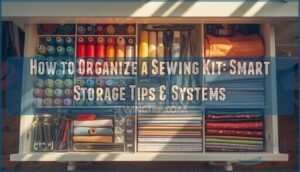
Use a Divided Sewing Box or Clear Storage Container
A good divided box is the backbone of any well-run sewing kit. Look for one with adjustable compartments, clear visibility, and sturdy construction that won’t crack after daily use.
A portable design with a built-in handle makes it easy to bring to class or a friend’s place.
Clear containers mean you spot your safety pins, pinking shears, and needle threaders instantly.
Label Compartments for Needles, Thread, Pins, Buttons, and Tools
Once your box is divided, labeling each section is what makes it truly yours. Color-coded tags, icon symbols, and size indicators turn guesswork into glancing.
Add material notes — "polyester, 50wt" or "denim only" — to grab the right thread fast.
Reusable stickers work perfectly here, letting you update labels as supplies shift without any fuss.
Keep Frequently Used Supplies in The Main Kit
Think of your main kit as a first-response zone — only the essentials live here. A compact storage pouch works perfectly for fabric marking tools, miniature measuring aids, and a magnetic pin cushion.
Toss in silk pins, safety pins, and a portable screwdriver set for snaps and hooks.
Organizing sewing supplies efficiently means elastic and thread clippers stay front and center, never buried.
Store Needles in Packets, Tubes, or Resealable Containers
Needles deserve better than a jumbled pile at the bottom of your sewing kit. Organizing sewing supplies efficiently starts with smart needle storage. Here’s how to do it right:
- Use sterile packaging for hand-sewing needles — sealed packets block dust and moisture.
- Stand machine needles in upright tube storage so points never rub together.
- Apply color-coded labels to distinguish sizes instantly.
- Choose puncture-proof containers for safe transport.
- Track quantities with a digital inventory log to simplify restocking.
Keep Pins in a Secure Container With a Detachable Lid
Storing pins loosely is a recipe for scattered messes and pricked fingers. A compact container — around 1.5 inches wide — with a snap-lock mechanism keeps your sewing kit tidy and safe.
Clear visibility through the sides lets you check your supply at a glance. Internal dividers separate pin types, ensuring organization.
The container’s material durability prevents rust, extending the lifespan of your pins. This makes it a smart essential for fabric mending, repair, and DIY fashion projects.
Review The Kit After Each Major Project
After finishing a big project, take ten minutes to go through your sewing kit before putting it away.
Note your Repair Frequency Analysis — which fixes came up most? Track your Project Time Tracking observations to identify time-consuming tasks.
Flag any Safety Observation Log concerns and sketch a quick Depletion Rate Chart for items like elastic, tape measure, pinking shears, and iron-on mending tape.
Then update your Restocking Priorities Update list while it’s still fresh.
Create a Monthly or Seasonal Restocking Routine
Set a recurring date each month to run through your Inventory Audit Checklist — same day, every month, no exceptions.
Use your Usage Data Review to spot seasonal spikes, then apply Seasonal Demand Forecasting to order ahead.
Build your Restock Calendar Planning around Supplier Lead Coordination so supplies arrive before you run out.
A steady routine keeps your sewing kit ready for any fabric mending and repair techniques without scrambling.
Frequently Asked Questions (FAQs)
What are the big 4 in sewing?
The Big Four are Simplicity, McCall’s, Butterick, and Vogue Patterns.
These brands cover everything from beginner-friendly pattern styles to expert-level fit options, with fabric recommendations and even digital patterns available today.
How do you keep your sewing tools and equipment last longer?
Clean tools after every use, oil metal parts regularly, and store everything in a dry spot away from sunlight.
Simple habits like these keep your scissors, needles, and machine running smoothly for years.
How to get motivated to sew again?
Start small — a 10-minute sprint on a zipper pouch or wallet can reignite your spark. Mini project sprints, scheduled sewing sessions, and sewing social groups all help rebuild momentum naturally.
Does sewing release dopamine?
Yes — sewing genuinely triggers a dopamine boost. Focused, goal-driven stitching activates your brain’s reward circuitry, and hitting flow state while working reduces stress and fuels creative motivation to keep going.
Can I use the same thread for hand and machine sewing?
In most cases, you can. All-purpose polyester thread works for both. Just test on scrap fabric first.
Thread weight compatibility and tension adjustments matter, especially if fiber content differences affect how your machine feeds.
How do I sew a button back on correctly?
Thread the needle doubled, knot the end, and bring it up through the fabric from the back.
Use a shank spacer for non-flat buttons, maintain even thread tension, and secure with a knot.
What is the best way to thread a needle?
Wet the thread tip, pinch it flat between your fingers, and guide it straight through the eye. If the eye is too small, use a needle threader.
Match thread weight to needle eye size for smooth tension.
How do I fix a broken zipper at home?
A stuck zipper is frustrating. Rub the teeth with a pencil for quick lubrication, then work the slider gently.
Slider adjustment with pliers fixes most separations.
Still stuck? Replacement or a full swap solves it.
When should I use a thimble while hand-sewing?
Use a thimble when pushing through thick fabrics, multiple layers, or prolonged seams. It’s especially helpful for heavy-duty projects and decorative stitching, where needle pressure builds up quickly and finger fatigue soon follows.
Conclusion
A well-stocked toolbox doesn’t just sit in a garage—it’s ready the moment something breaks. Your sewing kit works the same way. When you know how to restock a sewing kit properly, you stop scrambling and start solving.
The right needle, the right thread, the right tool—each one waiting exactly where you left it. That’s not luck. That’s a kit you’ve actually built with intention, and it’ll hold together everything else.