This site is supported by our readers. We may earn a commission, at no cost to you, if you purchase through links.
Pull out a sewing pattern envelope and count the sizes printed on those tissue sheets. Eight, ten, sometimes twelve nested cutting lines stacked on top of each other. That’s not a printing accident—it’s an acknowledgment of a basic truth most garment makers learn the hard way.
Bodies don’t conform to one measurement across the board. A 38-inch bust, a 33-inch waist, and 43-inch hips can all live on the same body, and no single size number was ever going to cover that. Sewing patterns carry multiple sizes because of this diversity, offering a practical solution to real-world proportions.
Knowing how to read those sizes, blend between them, and choose the right starting point transforms confusion into control. This skill—interpreting nested lines and adapting patterns—is where a good fit actually begins.
Table Of Contents
- Key Takeaways
- Multiple Sizes Help Patterns Fit Better
- Pattern Sizes Come From Grading
- Bodies Rarely Match One Size
- Patterns Differ From Store Sizes
- Measurements Choose Your Starting Size
- Multiple Sizes Allow Blending
- Ease Changes How Sizes Fit
- Test Fits Prevent Fabric Mistakes
- Frequently Asked Questions (FAQs)
- Conclusion
Key Takeaways
- Sewing patterns carry multiple sizes because real bodies span diverse measurements — a size 12 bust and size 16 hips on the same person are the rule, not the exception.
- Pattern sizing is built on actual body measurements, not retail labels, so always match the envelope’s size chart to your tape measure — never your clothing tag.
- Blending between size lines at the bust, waist, and hips gives you a custom fit without redrafting the whole pattern from scratch.
- Sewing a muslin test garment before cutting your real fabric separates a good fit from an expensive mistake.
Multiple Sizes Help Patterns Fit Better

Most sewing patterns come in a range of sizes for one straightforward reason — bodies don’t follow a single template. Having multiple sizes built into one pattern gives you a real starting point that actually matches your measurements.
That’s why knowing how to adjust sewing patterns for different sizes is the skill that turns a close-enough fit into the right one.
Here’s why that matters for getting a better fit from the very first cut.
Different Bust, Waist, Hip Measurements
Your bust, waist, and hips rarely follow a single size line — and that’s completely normal. For instance, if your full bust measures 38 inches, waist 33 inches, and hips 43 inches, you already have three different sizes.
Differences in the high bust affect bust point placement and bodice shaping, while hip curve mapping and waistband ease rely on proportional ratio charts.
A body measurements chart makes these differences visible — and workable.
One Design, Many Bodies
That measurement spread you just mapped? It tells a story about your unique body shape — and a multi-size pattern is built to fit it.
The size grading system behind every pattern envelope uses body shape mapping to stretch one design across dozens of body types.
Think of it as modular pattern design: the same silhouette, adapted for real human variety through fit customization and an inclusive sizing philosophy.
Better Starting Fit
Picking the right starting size is where custom fit begins. Think of it as body shape profiling — match your largest key area (bust, waist, or hips) to the pattern chart first. That single choice shapes everything: seam allowance planning, ease allowance, and fit adjustments down the line.
Solid size selection upfront means less guesswork later.
Fit assessment tools like a flexible tape measure and the envelope chart do the heavy lifting.
Less Redrafting for Beginners
Solid size selection cuts redrafting in half — especially for beginners. Multi-size patterns with traceable templates and preplanned alterations let you skip the guesswork.
Simplified blocks with bold notation show exactly where fit adjustments happen. Classic silhouettes need fewer tweaks than trendy cuts, streamlining the process further.
Work the size chart, trust pattern grading basics, and pattern resizing becomes straightforward. Better sewing fit starts with less rework, not more.
Pattern Sizes Come From Grading
Every pattern size you see on that envelope started as one carefully drafted design.
From there, grading takes over — scaling measurements up and down in a precise, repeatable way. Here’s how that process actually works.
Base Size to Size Range
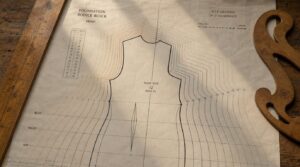
Every graded pattern starts from one anchor point: the base size. Designers pick this midpoint demographic size — usually where bust, waist, and hip proportions are most common for their target customer.
From there, pattern grading fans outward, two to five sizes in each direction. This expansion builds on the foundational measurements to accommodate a broader spectrum of body types through incremental adjustments.
Digital range extension now pushes that spread further through automated increment scaling, making multisized patterns genuinely useful for a wider range of bodies. This technology enhances inclusivity by streamlining the adaptation process beyond traditional manual grading limits.
Proportional Measurement Changes

Grading isn’t guesswork — it’s math applied consistently. Each size step uses a Uniform Scaling Ratio, so bust, waist, and hip widths grow through Balanced Width Increments together. This ensures proportional growth across key measurements.
Consistent Dart Placement shifts proportionally, maintaining precise shaping where the body requires it. Proportional Sleeve Adjustment ties cap height to bust changes, ensuring harmonious adaptation across garment elements.
This disciplined size interpolation guarantees that incremental size transitions remain smooth and seamless, eliminating abrupt shifts in fit.
Preserving Seams and Design Lines
Size grading only works if the design survives the scaling.
Here’s what keeps everything intact during pattern adaptation:
- Seam Allowance Width stays consistent — usually 1.25–1.5 cm — so seam line blending stays accurate across sizes
- Staystitching Curves at necklines and armholes prevents stretch before assembly
- Grainline Alignment keeps vertical design lines true after sewing pattern size changes
- Edge Overlock Finish stops fraying from misaligning seams over time
- Dart Pressing Method sets shaping permanently after pattern adjustments
Why Grading Matters

Without proper size grading, that beautifully designed bodice becomes a gamble. Industry standardization ensures one master pattern can grade between sizes consistently — same seam locations, same dart placement, every time.
Digital grading tools make incremental size changes precise and repeatable. Fewer alterations build customer confidence and reduce returns.
Customizing the grading for your shape? That’s where sustainable production meets personal fit.
Bodies Rarely Match One Size

Here’s the thing — most bodies just don’t fit neatly into a single pattern size, and that’s completely normal.
Your measurements might line up with a size 12 in the bust but a 16 through the hips, and that gap shows up in more places than you’d expect. These are the main areas where the mismatch commonly happens.
Mixed Bust and Hip Sizes
Most bodies split between two sizes — say, a full bust in a size 10 and size 14 hips. That gap is real, and patterns actually account for it. Hip grade lines diverge from bust lines specifically for silhouette shaping.
Dart repositioning follows naturally from your body measurements. With element customization and the right fabric drape impact, you’ll achieve a custom fit — not a compromise.
Torso and Leg Differences
Two people with identical full bust and high bust measurements can still have wildly different torso length variance. Your ribcage depth variation shifts dart placement entirely.
Leg inseam proportion changes affect where pants fitting problems start — thigh circumference variance alone can throw off body measurements charts by two sizes.
Pelvic tilt effect and size scaling both depend on reading your actual proportions, not just a number.
Shoulder and Sleeve Placement
Shoulder slope is where pattern alteration gets personal fast. Your shoulder slope directly affects sleeve cap height — a steeper angle raises the cap, tightening armhole ease.
Bodice fitting for home sewing means checking your neckline intersection first, then tracing accurate armhole curves.
Size grading rules shift these points proportionally, but your actual slope rarely follows the pattern instructions exactly.
Curves, Height, and Posture
Spinal curvature, ribcage depth, and pelvic tilt all quietly shift where your pattern lands on your body. A deeper ribcage pushes your waistline higher. Hip tilt changes how back darts track your spine. Torso length affects hem and bust highest point placement.
Cross-reference every measurement on the body measurements chart — size variance among makers is real, and body shapes rarely follow one pattern sizing line cleanly.
Patterns Differ From Store Sizes

That size 12 dress you bought last month? It almost certainly doesn’t match a size 12 sewing pattern — and that gap trips up a lot of beginners.
Here’s what’s actually going on behind the numbers.
Body Measurements Over Labels
Here’s the real secret: pattern sizes aren’t guesses — they’re math. Your bust, waist, and hip measurements tell the whole story. Skip the labels on retail racks.
Pattern sizes aren’t guesses — they’re math built on your actual measurements, not retail labels
Instead, conduct a Personal Size Audit using the Flexible Tape Technique to obtain numbers that accurately match a body measurements chart.
- Measure in Inches versus Centimeters — your choice, just stay consistent
- Use Body Chart Mapping to find your correct row
- Apply Measurement Margin Planning for ease allowances
- Cross-reference a size conversion chart when switching brands
- Build a fit guide from your own recorded measurements
Retail Vanity Sizing
Vanity Size Inflation is the quiet culprit in retail—brands deliberately grade larger while keeping numeric labels small. This practice stems from Consumer Size Perception: shoppers feel better purchasing a size 10 than a size 14.
The result is Brand Grading Variance, where a size 8 at one store may fit like a size 10 elsewhere. This inconsistency renders size conversion charts useless fast, as sizing standards lack uniformity across retailers.
Pattern Envelope Size Charts
Unlike retail tags, the pattern envelope’s back chart layout tells you exactly what you’re getting — real body measurements, not a feel‑good label. Find your bust, waist, and hips in the standard size charts, then match them.
Color‑coded ranges and combination size labels make navigation faster. Fabric requirement notations shift by pattern size also, so always cross‑check before buying.
The envelope’s finished measurements chart shows the exact garment dimensions for each size.
UK and US Size Confusion
Cross-border size chart conversion trips up even experienced sewers. A US size 8 often lands closer to a UK 12 in ready-to-wear — that’s a two-size jump. Pattern sizing adds another wrinkle: US-UK labeling follows different legacy pattern scales, with regional ease standards and metric-imperial disparity built-in.
Always compare actual body measurements against whichever size chart your pattern uses.
Why Labels Can Mislead
Label Inflation is the quiet culprit here. Vanity sizing, inconsistent Regional Size Standards, and consumer psychology all push brands to shrink numbers on tags — not garments.
Adding to the confusion are Fabric Shrinkage, Production Tolerances of one to two sizes per batch, and Metric Confusion between markets, making size labeling nearly meaningless.
Historically, a US size 8 grew six inches between 1958 and 2008, illustrating the shift. However, Pattern charts don’t play that game, maintaining consistency despite label changes.
Measurements Choose Your Starting Size

Getting your starting size right is the single most important step before you touch a pattern.
It all begins with three measurements — and how you take them matters just as much as the numbers themselves.
Here’s exactly what to do.
Measure Bust, Waist, Hips
Take your measurements before you do anything else — this is your foundation. Wrap a flexible tape snugly (not tight) across your full bust, natural waist, and widest hips. Maintain consistent posture: stand tall, shoulders relaxed. Exhale softly before measuring the waist.
Ensure layer-free measurement with thin underwear only. Practice breathing control and record each number twice. If your measurements are within half an inch when repeated, you’re good.
Wear Fitted Undergarments
What you wear during measurement matters more than most sewers realize. Fitted undergarments with supportive cups and flat seams provide an accurate body baseline — avoiding a lumpy, layered silhouette.
Moisture-wicking fabric and hypoallergenic materials ensure comfort during fit testing. These choices prevent irritation and maintain focus on achieving precise measurements.
Adjustable straps should be snug, not digging in. Proper fit eliminates distractions and ensures consistent support throughout the process.
Negative ease and ease calculations only work when your measurements reflect your actual body, not extra fabric. Accurate undergarment choices are foundational to reliable results.
Use The Pattern Chart
The pattern chart is your actual sewing pattern size guide — not decoration. Find it on the back of the envelope or instruction sheet. This chart is essential for accurate measurements.
Match your measurements directly to the chart’s columns, checking both inches and centimeters to ensure precise unit conversion. Pay attention to the ease range interpretation notes, as they explain the breathing room built into each size.
That’s measurement matching done right.
Choose by Largest Key Area
Now that you’ve matched your numbers to the chart, determine the key area — the measurement that sits furthest outside a single size.
- Bust-dominant fitting: select by total chest circumference or high bust
- Waist-focused selection: choose when your midsection drives the size conversion
- Hip-centric adjustment: size up when hips lead
- Proportion blending: mix sizes across zones
- Pattern sizes: never compromise your largest measurement
Check Finished Garment Measurements
Sizing by your largest area gets you close — but finished garment measurements confirm you’re actually there. Lay the pattern flat and check bust ease verification (you want roughly 2 inches at the bust), sleeve cap allowance, and hem alignment check.
Factor in length shrinkage allowance for washable fabrics.
Seam allowance consistency matters too — uneven seams silently steal the fit.
Multiple Sizes Allow Blending
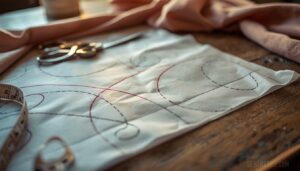
Having multiple sizes printed on one pattern means you’re not locked into a single cut — you can move between size lines to match what your body actually does.
There are a few specific ways to make that work.
Grade Between Size Lines
Grading between size lines is where real pattern customization begins. Instead of committing to one standard size, you trace a path — Seam Shift Mapping — that moves fluidly between printed lines.
Here’s how to approach it:
- Mark your midpoint measurements across bust, waist, and hip.
- Connect interpolation lines smoothly between size grades.
- Apply graduated curve adjustment at side seams.
- Confirm hybrid size drafting across all pattern pieces.
Bust-to-waist Blending
Once you’ve mapped your size path, bust-to-waist blending is where fit gets personal. This technique ensures a custom pattern fit by combining curved dart relocation and blend line placement, which follow the natural torso curve for gradual tapering from the fullest bust downward.
Curved dart relocation eliminates harsh angles and fabric stress at seams, while blend line placement enables smooth peak shaping and controlled fabric drape at the waist. These methods prioritize gradual tapering in the mid-torso, reducing seam tension and ensuring ease remains consistent without bulk.
| Blend Zone | Technique | Result |
|---|---|---|
| Upper bust | Curved dart relocation | Smooth peak shaping |
| Mid-torso | Gradual tapering | Seam stress reduction |
| Waist | Blend line placement | Fabric drape control |
| All zones | Blending between sizes | Custom pattern fit |
Ease stays consistent—no waist bulk, just clean lines.
Waist-to-hip Blending
Below the waist is where things get tricky. Your size 16 waist often doesn’t match your hip pattern size—and that gap needs a smooth Seam Curve Movement, not a sharp corner. Use a Proportional Increment Ratio to add width gradually.
Extending darts with a Dart Extension through the hip curve ensures seamless blending. Fabric Stretch Management is critical to prevent wovens from pulling under tension.
Mastering Good Pattern Trace Techniques locks in blending between sizes before cutting, ensuring precision in the final garment.
Keep Seamlines Smooth
When you blend across sizes, the seam lines need to flow — not zigzag. Three things will save your seam:
- Press seams flat immediately after stitching
- Use a walking foot for even fabric feed
- Understitch edges to stop rolling at necklines
Maintain a stitch length of 2.0–2.5 mm, grade seam allowances at curves, and interface tricky spots. Smooth pattern adjustments ensure a better fit every time.
Trace Before Cutting Fabric
Before tracing your pattern pieces onto paper, protect the original and freely test adjustments. Transfer every Grainline Marking, Notch Transfer Point, and Dart Placement exactly—these details are non-negotiable. Temporary Tracing Marks vanish post-cutting without staining, ensuring a clean process.
Then cut a Muslin Mock-Up first. This critical step refines your pattern layout, fabric cutting, and final fit—your future sewing workflow will thank you.
Ease Changes How Sizes Fit

Getting your size right is only half the equation. The other half is ease — that intentional extra room built into every pattern that determines whether a garment moves with you or fights you.
Here’s what shapes how ease works in practice.
Wearing Ease for Movement
Wearing ease is the breathing room built into every pattern — and it’s not optional. Without it, your garment binds the moment you raise your arm.
Bust room usually adds 2–4 inches; shoulder mobility and sleeve cap clearance prevent tugging overhead.
Fabric thickness allowance matters too — heavier wovens need more ease than voile.
Think of it as your fitting guide’s built-in forgiveness.
Design Ease for Style
Design ease is a different beast entirely — it’s the extra room built in on purpose to create a look. Bust fullness, waist shaping, sleeve caps, gathered details, hem flare — none of those happen by accident.
Pattern designers bake specific amounts into each design specification so that multisize patterns hold their intended silhouette across standard sizes.
More ease, more drama. Less ease, more structure.
Woven Versus Stretch Fabrics
Fabric stretch changes everything about ease. Woven fabrics rely on Weave, Drape, and Characteristics and Fabric Grain Alignment for structure — Seam Allowance Precision matters here, so adjustments on the pattern pieces stay tight.
Stretch fabrics introduce the Elastane Recovery Rate into play; even 2–5% elastane means a multi-size pattern needs less built-in ease.
Always check Fabric Care Guidelines before finalizing pattern sizes.
Fitted Versus Loose Garments
How fitted or loose your garment is directly shapes how much ease you need. A custom-fitted blazer uses Seam Sculpting and Drape Control to hug the torso — Silhouette Definition depends on tight seams and precise tailoring techniques.
A flowy blouse prioritizes Fabric Weight and Stretch Influence over rigid pattern fit. These factors dictate drape and movement, overriding strict structural constraints.
Match your ease to your intended silhouette before cutting anything.
Check Finished Measurements
Once you’ve matched ease to silhouette, take your measurements one more step — compare them against the finished garment measurements, not just the pattern size. Fabric relaxation and post-wash shrinkage can steal 1–2 inches from bust and hip areas.
Run a finished size verification before cutting:
- Pull the finished bust from the pattern envelope
- Subtract your body measurement
- Confirm ease falls within your target range
- Run a garment drape test on your muslin
- Complete a measurement tolerance check at waist and hip
Test Fits Prevent Fabric Mistakes
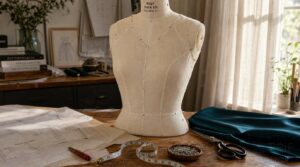
Cutting into your good fabric before testing the fit is like signing a blank check — brave, but often regrettable.
A quick muslin run-through catches problems while they’re still cheap to fix.
Here’s how to work through a test fit from start to finish.
Make a Muslin First
Sewing a muslin first is the smartest move you can make before cutting your real fabric. Think of it as garment fit testing on a budget — cost‑effective prototyping that saves expensive material from becoming an expensive mistake. Muslin’s loose weave makes drape assessment easy: you can instantly see how the garment hangs, where the bodice fitting for home sewing goes wrong, and whether ease verification is correct at the bust and hip.
| Fit Check | What to Look For | Why It Matters |
|---|---|---|
| Body Alignment Check | Shoulder seams sitting centered | Prevents twisting across the back |
| Ease Verification | Pinch room at bust and hip | Confirms movement ease is correct |
| Seamline Adjustment | Side seams hanging plumb | Signals accurate fit analysis |
| Dart Placement | Dart tip pointing to bust point | Corrects bodice shaping issues |
| Measurement Taking Techniques | Compare to pattern or finished garment measurements | Catches sizing gaps early |
Pin and Mark Adjustments
Once your muslin is on the dress form, the real work begins. Pin every adjustment in place — perpendicular to the seam, never along it. That’s your Seamline Marking baseline. Use chalk for Pleat Chalk Lines and Notch Transfer points. Fabric Test Pinning keeps layers honest while you finalize each Dart Pinning position.
Your pattern making workflow, step by step:
- Pin seamline changes before touching chalk
- Transfer notches with a tracing wheel for precision
- Mark dart tip points with tailor tacks
- Chalk pleat fold lines flat, then measure twice
Adjust Darts and Seams
Dart intake adjustment — usually 1.5 to 4 cm depending on your sewing pattern size — is the starting point for personalization. A pivoted dart tip realigns with your actual bust point, ensuring precise fit.
To refine further, employ seam grading methods to minimize bulk at cross-seams. Always balance side seams equally on both halves of the garment for symmetry and comfort.
For heavier fabrics, prioritize multiple small darts over a single large dart; this distributes tension more effectively and enhances durability.
Recheck Pattern Pieces
Before cutting anything, lay all your pattern pieces out and run a quick checklist.
Confirm Notch Alignment — every notch should have a match.
Do a Seam Allowance Check across pieces; even 1/8-inch drift adds up.
Verify Dart Consistency so each dart tip lands at the same peak.
Watch for Piece Interference near armholes.
Ensure Grading Integrity to keep your pattern size consistent throughout.
Cut Final Fabric Confidently
Once your pattern pieces are correct, you’re ready for the real thing — and confident cutting begins with several essential steps:
- Grain Alignment — Pin every piece parallel to the selvage, checking twice.
- Notch Verification — Clip clearly so assembly stays accurate.
- Fabric Flaw Inspection — Shift pieces around defects before committing.
Run a final Seam Allowance Check, perform a quick Dry Fit Pinning, then cut cleanly.
Frequently Asked Questions (FAQs)
How did Butterick first invent graded pattern sizing?
In the 1860s, Ebenezer Butterick — inspired by Ellen Butterick’s frustration with single-size drafting — pioneered graded tissue paper patterns in multiple sizes.
These lightweight patterns were designed to ship nationwide during the Civil War era, addressing practical distribution challenges while revolutionizing home sewing accessibility.
Why do pattern sizes differ between major publishers?
Each publisher writes their own grading rules. Butterick relies on legacy size charts from the 1960s, while McCall’s uses proprietary grading methods. These differences stem from brand fit philosophy, regional sizing conventions, and historical sizing trends.
As a result, a size 14 rarely matches across publishers.
Why havent pattern size standards updated since the 1960s?
Industry inertia keeps the Big Four anchored to 1960s charts. Regarding cost, vendor risk, and legacy compatibility concerns make updating impractical.
Without regulatory pressure, participants see little reason to change what already works.
Conclusion
Those nested cutting lines aren’t clutter—they’re a quiet promise that your body belongs in the pattern. Understanding why sewing patterns have multiple sizes hands you real control over fit, not just a starting guess.
You measure, blend, toile, and suddenly the tissue paper stops being a puzzle. The garment follows your shape instead of fighting it.
That’s the shift from hoping something fits to knowing it will.
- https://www.soulmatte.com/historysewingpatterns?srsltid=AfmBOor8Q6LTV7OX-MqCnX_Sc3-eTqBlgvlbWFDcsGTyTfwPkkYdu2t3
- https://thweekendproject.substack.com/p/a-brief-history-of-the-sewing-paper
- http://midvalevintagepost.blogspot.com/2012/06/history-of-sewing-vintage-pattern-sizes.html
- https://www.threadsmagazine.com/project-guides/learn-to-sew/map-your-body-and-compare-it-to-a-standard-pattern
- https://www.famcut.com/blogs/updates/how-to-size-up-a-sewing-pattern?srsltid=AfmBOoqJwUcj3M6PMqOaaUSB9pnaI1LEvo6PCGyqyj7IJhxTqc3WcVzO