This site is supported by our readers. We may earn a commission, at no cost to you, if you purchase through links.
Ease is the gap between your body measurements and the finished garment, and getting it wrong is one of the most common reasons sewn clothes don’t fit properly. Failing to account for ease results in garments that cling uncomfortably—fits like a second skin—but restrict movement, making it impossible to sit, lift your arms, or breathe comfortably.
The difference between sewing pattern ease types isn’t trivial; it’s why a fitted jacket moves with you instead of constricting. Understanding wearing ease, design ease, positive, zero, and negative ease grants real control over fit, fabric choice, and silhouette from the first pattern piece. This knowledge transforms how garments function and feel, ensuring comfort without sacrificing structure.
Mastering these concepts—wearing ease for comfort, design ease for style, and positive/negative ease for intentional drape or compression—eliminates guesswork. It bridges the gap between body and fabric, turning technical details into tools for creating clothes that move, breathe, and fit flawlessly.
Table Of Contents
Key Takeaways
- Ease is the gap between your body measurements and the finished garment, and it splits into two jobs: wearing ease keeps you moving, design ease shapes how the garment looks.
- Positive ease adds room for wovens that don’t stretch, zero ease matches your body exactly for stable knits, and negative ease is cut smaller so stretch fabrics hug without sagging.
- Getting ease wrong in either direction breaks the garment — too little and fabric pulls at every joint, too much and the silhouette loses its shape entirely.
- Every garment type needs a different ease range, so a fitted bodice, a blouse, and a winter coat each plays by its own rules — and your fabric’s stretch percentage changes the math every time.
What is Sewing Pattern Ease?

Ease is the extra room built into a pattern beyond your actual body measurements. It’s what separates a garment that fits from one that just covers you.
Think of it as the difference between wearing your measurements and actually living in them—understanding sewing pattern ease helps you choose the right amount for how a garment should look and move.
Here’s what you need to understand to get it right.
Body Vs Finished Measurements
Before you cut a single piece of fabric, you need to understand two numbers: your body measurements and the pattern’s finished garment measurements. Your body measurements—taken as bust, waist, hips—reflect your actual size. Finished garment measurements indicate the sewn piece’s dimensions. The gap between these two is your ease.
Always match sizing charts to body measurements, not finished ones. This ensures proper fit and accommodates the intended ease in the design.
Positive, Zero, Negative Ease
That gap between your body and the finished garment breaks down into three types: positive ease, zero ease, and negative ease.
Positive ease adds room for comfort and movement — usually 1 to 4 inches in wovens.
Zero ease matches your measurements exactly, ideal for stable knits like ponte.
Negative ease goes smaller, relying on stretch tolerance limits to keep the garment hugging your body.
Total Ease Formula
Finished measurement = body measurement + wearing ease + design ease.
This ease calculation drives the fit prediction across every size. It serves as your movement buffer, built in before cutting a single piece. Size scaling and fabric stretch both impact this equation:
- Wearing ease manages function
- Design ease shapes silhouette
- Together, they define fit versus ease
The interplay of these elements ensures garments are both functional and stylistically aligned.
Why Ease Affects Fit
Ease directly controls how a garment behaves on your body. Too little wearing ease restricts movement, causing fabric to pull tightly during breathing, bending, or reaching. Conversely, excessive design ease results in a distorted silhouette, losing the intended shape. Critical aspects like fit stability, shape retention, and comfort perception all depend on precise ease calculations.
Understanding standard ease values helps you select appropriate allowances for each garment type. The table below outlines key ease factors and their consequences when misjudged:
| Ease Factor | Too Little | Too Much |
|---|---|---|
| Movement tolerance | Fabric binds at joints | Excess pooling, poor drape |
| Fabric shrinkage | Garment becomes unwearable | Fit remains acceptable |
| Shape retention | Seams distort under tension | Silhouette loses definition |
| Wearing ease | Restricts breathing, bending | Looks oversized, boxy |
| Design ease | Fit looks too tight | Intended style is lost |
Wearing Ease Vs Design Ease
Ease isn’t one thing — it’s two, and mixing them up is one of the most common fitting mistakes beginners make. Wearing ease and design ease each serve different purposes, and understanding their distinct roles transforms how you interpret patterns.
Ease is two things, not one, and confusing them is where most fitting mistakes begin
Wearing ease and design ease function differently: one relates to comfort and fit, while the other defines the garment’s silhouette. Recognizing their interplay ensures accurate pattern execution.
This breakdown clarifies their collaboration, helping you avoid confusion and achieve better results.
Functional Movement Ease
Wearing ease is your garment’s built-in breathing room — the 1 to 3 inches added so you can actually move. It accommodates Armhole Mobility, Sleeve Rotation Allowance, Back Panel Relief, Side Seam Curvature, and Cuff Flexibility.
| Zone | Function | Ease Added |
|---|---|---|
| Armhole | Arm rotation | 1–2 in |
| Back Panel | Spinal flex | 0.5–1 in |
| Cuff | Wrist bend | 0.5 in |
Style and Silhouette Ease
Design ease is pure intention—it shapes the silhouette you want, not just what you need. Add A-line flare for gentle volume, or use Princess seam shaping to sculpt curves. A side seam tilt narrows the torso, while layer length contrast dramatically shifts visual balance.
| Design Tool | Silhouette Effect |
|---|---|
| Sleeve volume ease | Adds dramatic shoulder width |
| Oversized silhouette | Creates relaxed, column-like shape |
| Negative ease panels | Tighten curves selectively |
How Both Work Together
Think of wearing ease and design ease as partners—one ensures comfort, while the other shapes the look. Wearing ease manages movement simulation: reaching, bending, and sitting. Design ease controls the silhouette. Layering synergy happens when both values are intentionally set, allowing a coat to move freely without losing its structure. Fit stability analysis means checking flat measurements against the garment in motion.
| Ease Type | Primary Role |
|---|---|
| Wearing ease | Comfort-tension interplay during movement |
| Design ease | Silhouette and style shaping |
| Ease balance testing | Confirms fit vs ease harmony |
| Comfort allowance | Prevents pulling at the seams |
Common Beginner Confusion
Most beginners mix up wearing ease and design ease — treating them as one number. That’s where ease calculation errors start.
Sizing chart misreading adds to it: you pick your body measurement, ignore the finished measurement column, and wonder why the blouse billows. Pattern scale confusion and ease unit conversion (inches vs. centimeters) compound the problem fast.
| Mistake | Cause | Fix |
|---|---|---|
| Fit vs ease mismatch | Ignoring finished measurements | Compare both columns |
| Fabric stretch misinterpretation | Applying woven ease to knits | Check stretch percentage first |
| Ease calculation errors | Skipping design ease entirely | Add wearing + design ease |
Quick Comparison Chart
Side by side, wearing ease and design ease finally make sense. Use this Ease Metric Table as your go-to Fabric Impact Grid across garment types.
| Feature | Wearing Ease | Design Ease |
|---|---|---|
| Purpose | Movement and comfort | Silhouette and style |
| Typical Range | 1–3 inches | 3–10+ inches |
| Fabric Impact | Higher for wovens | Designer’s choice |
Your ease calculator starts here.
Positive, Zero, and Negative Ease
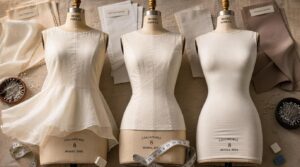
Once you understand wearing and design ease, the next step is knowing which direction that ease goes.
Positive, zero, and negative ease each serves a different purpose depending on your fabric and the fit you’re after.
Here’s how each type works and when to use it.
Positive Ease for Wovens
Woven fabrics don’t stretch — so positive ease isn’t optional, it’s structural. Without it, you can’t lift your arms or sit down comfortably. Here’s what positive ease actually does for your wovens:
- Shoulder Expansion — adds 3–5 cm so your back doesn’t pull when you reach
- Bust Drape Ratio — distributes 6–12% of bust measurement for smooth, unforced silhouette fluidity
- Weight Adjusted Ease — heavier fabrics need more ease to hang correctly and support fabric drape
- Design Ease layering — extra room lets jackets sit cleanly over shirts
- Muslin Test Protocol — always mock up first to confirm your fit before cutting into fashion fabric
Zero Ease for Stable Knits
Unlike wovens, stable knits like ponte offer a distinct advantage: zero ease. This means the finished garment precisely matches your body measurements without additional room, relying instead on fiber blend stability and knit tension control.
| Zero Ease Factor | Why It Matters |
|---|---|
| Stable knit fabric | Holds shape without added room |
| Precise dart placement | Follows body contours cleanly |
| Smooth surface selection | Prevents visual pulling or distortion |
| Edge finish techniques | Stops seams from shifting during wear |
| Exact body measurements | Ensures design ease stays intentional |
Negative Ease for Stretch Fabrics
Negative ease means cutting the pattern smaller than your body — and it only works because stretch fabrics recover. Horizontal negative ease usually runs at 8–12% for swimwear and activewear, keeping panels snug without sagging during movement.
Anisotropic stretch adaptation matters here: match your negative ease to the fabric’s stretch direction. Seam puckering control and movement symmetry testing during fitting confirm the ease is balanced across bust, waist, and hips.
When Each Type Works
Each ease type has its place.
Use positive ease for structured outerwear, stiff fabric drape, and casual layering — wovens need room to move. Zero ease suits stable knits where fit tolerance is tight and clean lines matter. Reach for negative ease when working with high‑stretch fit applications like knit compression garments.
- Positive ease: wovens, outerwear, layering
- Zero ease: stable knits, waistbands
- Negative ease: stretch fabrics, compression
Fit Risks to Avoid
Even the right ease type can go wrong. Uneven ease distribution causes pulling at side seams, while too little wearing ease triggers shoulder impingement during overhead movements. Excess negative ease strains the lower back during motion.
Poor knee alignment in slim pants stresses joints, and tight sleeves risk wrist tendinopathy during grip-intensive tasks.
| Fit Risk | Ease Problem | Fix |
|---|---|---|
| Shoulder impingement | Insufficient wearing ease | Add 2–5 cm at armhole |
| Lower back strain | Negative ease too aggressive | Reduce by 2–3 cm |
| Uneven ease distribution | Skipped fit tolerance check | Rebalance side seams |
Ease by Garment Type
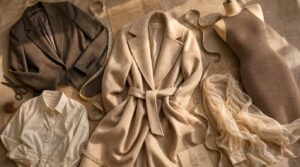
Not every garment needs the same amount of ease — a winter coat and a fitted blouse are playing completely different games.
The right ease range depends on what you’re making and how it’s meant to fit the body. Here’s how ease breaks down across the most common garment types.
Fitted Bodices and Tops
Fitted bodices demand precision—there’s little room for error when the fit is that close to the body. Aim for 2.5–5 cm of bust ease and 1.5–2.5 cm of waist ease.
Dart construction and neckline shaping control how the fabric follows your curves. Careful armhole sizing prevents gaping.
Use boning placement and a clean seam finish to lock everything in place.
Blouses and Casual Shirts
Blouses live in a comfort zone most garments don’t: 7.5–12.5 cm of bust ease, 4–7.5 cm at the waist. That range covers everything from a boxy silhouette to a relaxed peasant sleeve comfort fit.
Five key style choices that shift your ease needs:
- Ruffle detailing adds visual volume — keep wearing ease moderate so the front doesn’t balloon
- Sheer layering with chiffon needs 3–6% extra design ease for smooth drape over a lining
- Tie-neck closures sit best with semi-fitted bust ease around 11–13 cm
- Peasant sleeve comfort calls for generous armhole ease — don’t cut it tight
- Boxy silhouette styles push design ease past 15 cm, so waist ease matters less
Pants and Trouser Ease
Pants demand precision across five zones: hip seam balance, thigh seam ease, back rise comfort, waistband stretch, and leg opening allowance.
Start from your basic sloper and add 2–4 inches of wearing ease at the seat and thighs. Design ease widens this for fitted trousers.
Knit fabrics allow slight negative ease; wovens require every centimeter of ease allowance to ensure free movement.
Skirts and Hip Ease
Skirts live or die by what happens at the hip. Hip ease grading is your map from waist to thigh — get it wrong and you’ll see horizontal drag lines every time you sit.
- Apply wearing ease of 2.5–5 cm at the hip via side seam adjustment
- Use design ease and A-line circle skirt flare for freedom of movement
- Control pleat volume to add fullness without bulk
- Factor fabric drape impact — fluid crepe needs less ease than denim
- For wrap styles, build in wrap hip allowance at the overlap
Jackets, Coats, Layering
Jackets and coats carry the heaviest ease allowance of any garment. A fitted jacket requires roughly 5 cm more bust ease than a comparable top—enough room to layer without pulling. A coat worn over a jacket adds another 12.5–18 cm of wearing ease and design ease combined.
Pocket placement, collar construction, vent design, lining strategies, and seasonal weightings all influence how that ease gets distributed across pattern pieces.
Fabric Type and Ease Choices
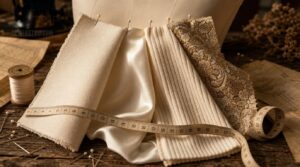
The fabric you choose changes everything about how much ease you need. A stiff canvas and a silky jersey don’t play by the same rules — and treating them like they do is how garments end up unwearable.
Matching your ease choices to your fabric is essential. Here’s what you need to know to ensure your garments fit and function as intended.
Woven Fabric Ease Needs
Woven fabrics do not stretch like knits — grain direction and weave tightness lock them in place. Tight weaves with high thread counts require 2.5–10 cm of positive wearing ease to enable movement.
Surface finish matters too: stiff canvas demands more room than fluid crepe. If your woven includes elastic yarn, ease can be slightly reduced but never eliminated entirely.
Knit Stretch Percentage
Knit fabrics work differently. Their stretch percentage—how far the fabric extends before snapping back—determines the required negative ease for a pattern. Fiber influence significantly affects this: elastane-heavy blends stretch more than cotton jerseys. Structure impact and gauge density also shape this measurement, while heat-setting can substantially reduce stretch.
Always test a 4-inch sample before drafting to account for these variables.
Fabric Weight and Drape
Stretch percentage tells you how much to reduce a pattern, but fabric weight shapes how the finished garment actually moves. Weight-Based Stiffness and Weave Density Influence work together: lightweight fabrics under 150 gsm need 2–4 cm extra wearing ease or design ease because they shift and pull more.
Heavier fabrics hold their position, so Fiber Drape Characteristics and Layered Weight Interaction can reduce that allowance slightly.
Stiff Versus Fluid Fabrics
Stiff fabrics — think canvas or dense twill — rely on structural weave to hold sharp seams and pleats, so minimal wearing ease stays minimal.
Fluid fabrics need more design ease to prevent pulling.
Drape contrast between these two categories also affects layering dynamics: stiff outer layers over fluid linings work beautifully, but care requirements differ completely between them.
Stretch Recovery Considerations
Recovery matters as much as stretch. A fabric’s elastane content — usually 2 to 5 percent in everyday knits — controls how fast it bounces back. Stitch density, fabric temperature, and care cycles all affect recovery over time.
Cutting negative ease too deep risks permanent distortion, as fabrics with poor recovery won’t spring back — it’ll bag out permanently.
Applying Ease to Pattern Pieces
Knowing your ease amounts is only half the job — the real work happens when you apply them to actual pattern pieces.
Each part of a garment has its own rules for where ease gets added and how it’s distributed. Here’s how to handle the most common ones.
Adding Bodice Ease
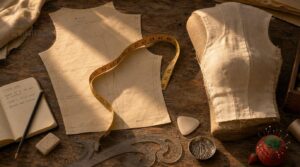
Bust ease starts with one simple rule: divide your total ease by four, then add that amount to each side seam on the front and back pieces. Keep your ease markings clear on every pattern piece before cutting.
After adjusting, always do an armhole check — adding ease shifts things. A center-front adjustment may help balance the silhouette. Sew a muslin test to confirm seam distribution feels right.
Adjusting Pants and Crotch
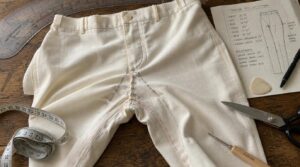
Pants fitting is where most sewists hit a wall — and crotch depth measurement is usually the culprit. Before cutting your final fabric, prioritize these critical checks to ensure a precise fit.
To address this challenge, follow these essential steps:
- Pin your pattern against well-fitting pants at waist and inseam.
- Record front/back balance differences in millimeters.
- Apply a pivot-slash adjustment to fix draglines without touching side seams.
- Sew a muslin fit test, then adjust seat ease and hip ease in 2–3 mm steps.
Distributing Skirt Ease
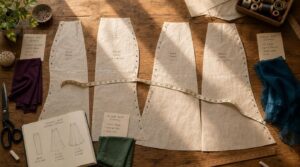
Skirts are simpler than pants — but side seam balance still matters. Divide your total hip ease by four, then add that amount to each side seam edge on both front and back pieces.
| Skirt Style | Ease Strategy |
|---|---|
| Pencil | Side seams only |
| A‑line flare | Reduce hip ease; hem fullness compensates |
| Circle | Hem carries all wearing ease |
| Fitted straight | Even front/back design ease split |
| High waist | Adjust waist before hip ease |
Baste testing confirms fabric drape effect before committing. With negative-ease knits, skip extra hip ease entirely — the stretch manages it.
Managing Sleeve Cap Ease
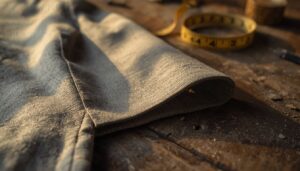
The sleeve cap is where fit problems hide in plain sight. Cap Height Adjustment — raising it tightens Shoulder Mobility Ease; lowering it adds room for arm movement. Then use Cap Width Tuning to smooth the armhole seam.
Walk the cap along the armhole using the Walking Cap Technique to catch puckering early. This step ensures smoother integration and prevents fabric distortion during movement.
Ease Versus Seam Allowance
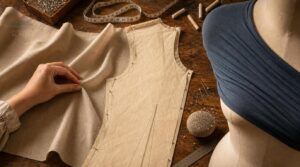
Ease and seam allowance solve two completely different problems — never mix them up. Ease governs fit and comfort: wearing ease for movement, design ease for silhouette, and negative ease for stretch fabrics. Seam allowance, however, is purely structural — it’s what holds your seams together.
In pattern drafting, always calculate ease first, then add seam allowance. This sequence protects your intended fit, ensuring design integrity isn’t compromised by construction requirements.
Frequently Asked Questions (FAQs)
How does ease change across different pattern sizes?
As size grading scales up, bust ease and hip allowance scaling grow proportionally. Grading proportion rules keep wearing ease consistent.
Digital grading’s impact means sleeve cap adjustments stay balanced, preventing fit distortion across sizes.
Does ease differ for maternity or plus-size patterns?
Yes — maternity patterns adjust ease differently using trimester ease scaling with adjustable panel inserts.
Plus-size patterns refine wearing ease and design ease through body mapping and careful size grading against updated body measurements.
How do I ease-adjust a vintage pattern for modern fit?
Vintage patterns speak a different language. Measure the finished garment, subtract modern wearing ease standards, then muslin test before cutting.
Historical sizing runs small — adjust bust, waist, and hips using today’s body ratios.
Should ease change for lined versus unlined garments?
Yes — lined garments need slightly more wearing ease, especially at the bust and shoulders. The lining adds inner friction and thickness, so add 1–2 cm to prevent binding during movement.
Conclusion
A tailor once said every misfit garment tells a story of ignored numbers. The difference between sewing pattern ease types is exactly that—numbers with a purpose.
Wearing ease keeps you moving. Design ease shapes your silhouette. Positive, zero, and negative ease match fabric to function.
Once you treat ease as a deliberate decision rather than a mystery, your patterns stop being guesswork. They become a blueprint your body can actually live in.
- https://talk.dallasmakerspace.org/t/ease-and-what-it-may-mean-in-a-sewing-pattern/103110
- https://atempopatterns.com/understanding-ease/
- https://www.professorpincushion.com/professorpincushion/functional-and-design-ease/
- https://dresspatternmaking.com/blog/ease-in-patterns-and-blocks
- https://charlottekan.com/blogs/sewingblog/what-is-ease-in-sewing-wearing-ease-design-ease-negative-ease-explained