This site is supported by our readers. We may earn a commission, at no cost to you, if you purchase through links.
A crooked cut doesn’t announce itself until you’re halfway through assembling a garment—then suddenly nothing lines up, seams pucker, and you’re left wondering what went wrong. Most beginners blame the pattern or the fabric, but the culprit is almost always how the cutting started. Fabric is unforgiving that way: one small drift of the scissors and the error multiplies across every piece you cut from it.
Knowing how to cut fabric straight and even is the skill that separates a garment that hangs beautifully from one that bunches in all the wrong places. The right preparation, tools, and technique make the difference—and none of it is as complicated as a botched hem makes it feel.
Table Of Contents
Key Takeaways
- Prep your fabric before you ever pick up scissors—prewash, press it flat, and square the edge, because skipping these steps is where most crooked cuts actually begin.
- A rotary cutter paired with a clear acrylic ruler and a self-healing mat gives you far more control and accuracy than scissors alone, especially on long, straight cuts.
- Your marking line is everything—use the right chalk or marker for your fabric type, keep the line thin and sharp, and always draw the full cut before your blade moves an inch.
- Look straight down over your blade, keep the fabric fully supported on the table, and use long smooth strokes, because short choppy cuts create jagged edges that throw off every seam downstream.
Why Straight Fabric Cuts Matter
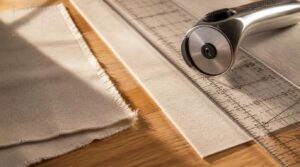
That crooked cut you’re tempted to ignore? It causes more problems down the line than you’d think. Here’s why getting it straight matters so much.
A straight cut actually starts long before the blade moves — mastering the right tools and prep for cutting stretchy fabric saves you from a cascade of fitting headaches later.
Cleaner Seams and Hems
Straight cuts mean every seam lines up the way it should. Off-grain edges throw seam allowances out of whack, making seam allowance clipping messy and hem bulk control nearly impossible. You can square up your fabric to guarantee everything is aligned correctly.
When fabric is cut along the fabric grain line, pressing seams open lies flatter, blind hem stitches stay invisible, and thread tension behaves predictably. That’s seam precision—cut straight with a rotary cutter and acrylic ruler, and everything downstream gets easier.
Better Garment Fit
Clean seams set the stage, but fit is where it really shows. When you cut fabric straight along the fabric grain line, garment balance stays even, side seams hang straight, and waist alterations go smoother. Good fabric alignment affects:
- Body measurements translating accurately
- Drape and ease behaving predictably
- Neckline fit lying flat
- Overall silhouette looking balanced
Accurate Pattern Pieces
Fit comes from fabric, but pattern pieces carry the blueprint. Cutting straight preserves seam alignment, grainline arrows, and notch matching points—so pieces sew together correctly.
| Element | Purpose | Cutting Impact |
|---|---|---|
| Notches | Match seams | Lost if uneven |
| Grainline | Garment hang | Twists off-grain |
| Seam allowance | Stitching room | Shrinks if crooked |
Using a rotary cutter and acrylic ruler keeps these markings accurate, supporting pattern balance throughout.
Less Fabric Waste
Crooked cuts don’t just ruin pieces—they eat fabric. Skewed lines force re-cuts, wasting yardage that proper pattern nesting could’ve used.
When you cut fabric straight with a rotary cutter on a self-healing cutting mat, you boost marker efficiency and support zero waste design. Better fabric layout planning means less fabric waste, and any offcuts can still serve smaller projects. Precision pays off, literally!
Prepare Fabric Before Cutting
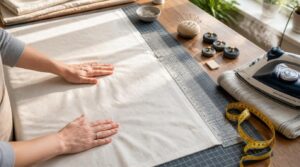
Before you ever pick up scissors, your fabric needs a little prep work. Skipping this stage is where most crooked cuts actually start. Here’s what to handle first, step by step.
Prewash and Dry Fabric
Ever cut a "perfect" rectangle, then washed it, and watched it turn into a trapezoid? That’s fabric shrinkage at work.
Always prewash and dry fabric using the same method you’ll use later—different fiber prewash routines matter, since cotton shrinks differently than rayon. Check for color bleeding, watch your drying temperature, and finish edges first to prevent edge fray. A quick shrinkage testing swatch saves headaches.
Press Wrinkles Completely Flat
Grab your iron, because wrinkled fabric throws off every measurement. Use medium heat for sensitive fabrics, add light steam, and press with an up-and-down motion—never drag. Try these:
Once your fabric is perfectly smooth, a pair of sharp dressmaking shears with a bent-handle design will glide through it cleanly without shifting a single layer.
- Test heat on a scrap first
- Use a pressing cloth for delicate fibers
- Press both sides for flatness
- Repeat short presses on stubborn creases
This fabric stabilization step keeps your cutting line accurate. Happy pressing!
Identify Grain and Selvage
Finding the grain before you cut is like reading a map before a road trip—skip it, and you’ll end up lost. Check the selvage edges; they run parallel to the lengthwise grain, your most stable direction. The bias stretches more, so save it for flowy hems. Use the thread pull method to confirm alignment.
| Direction | Stretch | Best For |
|---|---|---|
| Lengthwise | Low | Main seams |
| Crosswise | Medium | Width pieces |
| Bias | High | Bindings |
Square The Fabric Edge
Think of squaring as giving your fabric a fresh, honest starting line.
Fold selvage to selvage, align it on your grid ruler, and check that corner—it should sit at a clean right angle. To confirm: 1) check selvage alignment, 2) verify the corner, 3) trim with a rotary cutter.
A squared edge makes cutting fabric straight so much easier.
Support The Entire Fabric
A wobbly table makes a wobbly cut—simple as that. Lay your fabric on a flat work surface, fully supported, with no edges hanging off. If it’s too big, fold the extra onto the table instead of letting it drape.
Use a self-healing cutting mat for stability and edge stabilization. Add fabric weights for even weight distribution, keeping everything flat for squaring up the fabric.
Essential Tools for Straight Cutting
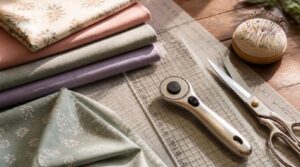
Good cutting starts with the right gear in your hands. You don’t need a huge collection, just a few key pieces that actually earn their spot on your table. Here’s what every sewist should have within reach before making that first cut.
Sharp Dressmaker Shears
A good pair of dressmaker shears is the backbone of cutting precision. Look for bent grips, which keep fabric flat on your table, plus knife-edge blades for smooth, long strokes. Choose 8–9 inch fabric scissors for control.
Keep them oiled, sharpened, and reserved only for fabric—mixing materials dulls edges fast and ruins your cuts straight away.
Rotary Cutter and Mat
Shears are great, but for long straight cuts, a rotary cutter and self-healing mat combo saves time. Pick blade size by fabric weight—28mm for curves, 45mm for general use, 60mm for denim.
- Check safety guard before storing
- Use grid markings for accurate measuring
- Choose mat size matching your table
- Replace dull blades often
Clear Acrylic Ruler
A rotary cutter gets the cut started, but a clear acrylic ruler is what keeps every line honest. The Transparent Measurement Grid—usually marked in 1/8-inch increments—lets you measure seam allowances and strip widths without shifting your fabric. Angle Guide Lines at 30, 45, and 60 degrees help you find true bias quickly.
| Feature | Why It Matters | Best Use |
|---|---|---|
| Clear body | See fabric print underneath | Matching stripes or plaids |
| Grid markings | Measure without moving fabric | Seam allowances, hems |
| Angle lines | Find bias and square corners | Quilting, binding strips |
Surface Grip Features—like etched patches or grip dots—stop the ruler from sliding mid-cut. For Size and Shape Options, a 6×24-inch rectangle accommodates long strips, while a 12.5-inch square checks right angles perfectly. Clear Ruler Benefits come down to one thing: you see exactly where you’re cutting fabric straight, every single time.
Pattern Weights or Clips
Once your ruler is locked in place, you still need something to stop the fabric itself from shifting. That’s where pattern weights and sewing clips earn their spot on your table.
- Use cast iron or steel weights on corners and curves first — those edges lift fastest
- Place weights inside the pattern outline, never in the cutting path
- Grab small clips for narrow areas like straps or necklines where weights are too bulky
Tailor’s Chalk or Marker
Weights hold your fabric down — but they can’t show you exactly where to cut. That’s where tailor’s chalk or a fabric marker steps in.
Think of your chalk or marker as the blueprint drawn before your shears ever touch the fabric. A clear line means a confident cut. A vague smudge means guesswork — and guesswork costs you fabric.
Your marking line is the blueprint — blur it, and guesswork cuts the fabric for you
Chalk material choices matter more than most beginners expect. Clay-based chalk leaves a dry, matte line that brushes off easily after sewing — great for cotton and linen. Wax-based chalk grips better on textured fabrics like wool coating or tweed, where loose powder often skips across the surface. Most tailor’s chalk comes shaped as a flat triangle, so you always have a sharp edge ready without stopping to sharpen anything.
| Marking Tool | Best Fabric Types | Removal Method |
|---|---|---|
| Clay tailor’s chalk | Cotton, linen, canvas | Brush off with soft cloth |
| Wax tailor’s chalk | Wool, tweed, felt | Brush or light wash |
| Chalk pencil | Silk, satin, fine shirting | Brush or damp cloth |
| Water-erasable marker | Most woven fabrics | Damp cloth or rinse |
| Air-erasable marker | Light to medium fabrics | Fades on its own |
Marker ink types split into a few reliable camps. Water-erasable markers lift with a damp cloth — just don’t wait too long, because some brands recommend rinsing within 24 to 72 hours for clean removal. Air-erasable markers, usually purple or blue, fade on their own over time. Heat-erasable pens are trickier — ironing can erase the line, but cold temperatures can bring it back on some fabrics, which isn’t ideal near a pressing cloth.
Fabric compatibility is worth pausing on. White chalk reads cleanly on navy or black fabric where pale lines show up under cutting-room light. On white or cream cloth, switch to blue or yellow chalk so your line doesn’t disappear before you cut. For delicate fabrics like silk or satin, always test on an offcut first — some inks bleed and some chalks leave a pressure shine that won’t come out.
For line accuracy tips, the thinner the line, the better your cut. A wide, worn chalk edge forces you to guess which side to follow, and that small uncertainty adds up across multiple pattern pieces. Rotate flat chalk often, or trim the edge to keep it sharp. For tight seam allowances — say, 6 mm or 10 mm — a chalk pencil or fine-tip fabric marker gives you the precision a broad chalk block simply can’t.
Always draw the full cutting line before picking up your shears or rotary cutter. Cutting freehand from one notch introduces drift, especially on long fabric edges. One steady, pre-drawn line keeps you on track from start to finish.
Mark removal methods are just as important as how you apply the mark. Most dry chalk brushes off with a soft garment brush once you’re done cutting and sewing. Water-erasable lines rinse out easily, but check your fabric type — heat from an iron can permanently set certain markers, so test before you press. The safest habit is simple: always test every chalk or marker on a scrap from the same fabric, because fiber content and dye can change how cleanly the mark lifts.
A good line is the quiet foundation of cutting fabric straight. When your marking is sharp, thin, and visible, everything that follows — the cut, the seam, the finished hem — lines up the way it should.
Cut Fabric Straight Step-by-Step
Good preparation only gets you so far — at some point, you have to actually make the cut. How you handle those moments determines whether your pieces come out crisp or crooked. Here are the five steps that make the difference.
Mark The Cutting Line
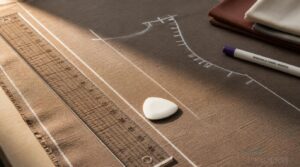
A clear cutting line is your blueprint — skip it and even the sharpest shears can’t save you.
Start by choosing the right marking tool. Tailor’s chalk works beautifully on cotton, linen, and wool, brushing away cleanly after cutting. For projects that take longer, a washable fabric marker keeps lines visible through multiple sessions. On dark fabric, reach for white or yellow chalk; on light fabric, blue or purple markers show up best.
Here’s how to mark accurately every time:
- Align your acrylic ruler parallel to the selvage to keep pieces on-grain.
- Trace pattern notches as small chalk marks along curved areas like armholes.
- For bias line marking, angle your ruler at 45 degrees to the selvage.
Before you cut, do a quick visibility check — scan the line end to end. A faint or broken section can shift your cut by several millimeters, and that adds up fast. Use good task lighting so every mark is easy to follow.
Look Straight Down
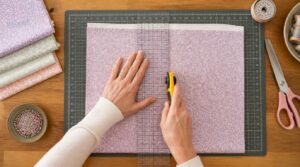
Your eyes are your most powerful cutting tool — but only when they’re in the right position. Look straight down over the blade, not from the side. Viewing from an angle creates parallax, making your rotary cutter or shears appear aligned with the marked line when they’ve actually drifted off it. That small error compounds across a long cut.
Keep Fabric Flat
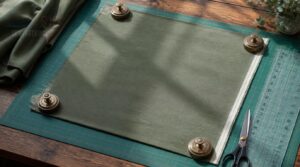
Fabric that shifts mid-cut is the enemy of a straight line. Before you start, press wrinkles completely flat using steam on natural fibers like cotton or linen, then let the fabric cool on a flat surface before moving it. Make sure every inch of fabric rests on the table — unsupported edges pull downward and throw your grainline off.
Align your selvages so the lengthwise grain runs straight, and square one raw edge to give yourself a clean reference line. Then place pattern weights near corners and curves, staying just outside your marked cutting line so the fabric stays flat without blocking your view. A self-healing cutting mat underneath keeps everything on one stable plane.
Use Long Smooth Cuts
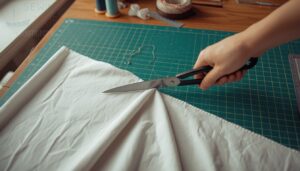
Think of your shears like a saw — short, choppy strokes create jagged edges, while long smooth cuts leave a clean, even line. Let your shoulder lead the motion forward, keeping your wrist steady.
Full blade strokes use the strongest part of the blades, covering more fabric with fewer interruptions. Keep the lower blade flat against your cutting mat throughout each pass.
Double-check Before Cutting
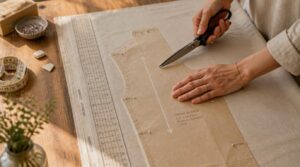
One last pause before that first cut can save an entire project.
Check the grain direction by aligning your pattern’s grainline arrow parallel to the selvage edges — even a slight angle causes twisting later. Confirm pattern alignment and edge overlap, then verify your marked line hasn’t shifted.
Sixty seconds of final inspection prevents mistakes no seam ripper can fix.
Top 3 Fabric Cutting Tools
The right cutting tool can make or break your project before a single seam is sewn. Not every tool suits every hand or every fabric, so knowing what’s out there helps you choose wisely. Here are three worth having in your sewing kit.
1. SnapFresh Cordless Rotary Electric Scissors
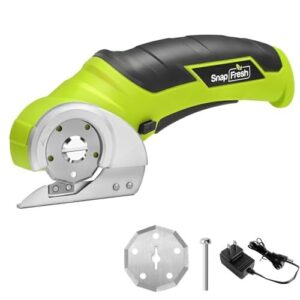
The SnapFresh Cordless Electric Scissors are a solid pick if you’re tired of hand cramps halfway through a project.
Weighing just 0.87 lbs with a 4V rechargeable battery, they’re light enough to guide with one hand and powerful enough to cut through fabric, canvas, leather, and even carpet up to 1/4 inch thick. The self-sharpening blades stay clean longer, and the built-in safety lock means you won’t have any accidental slips.
| Best For | Anyone who does a lot of cutting — cardboard, fabric, leather, or rope — especially if hand fatigue or arthritis makes traditional scissors a pain. |
|---|---|
| Power Source | Cordless rechargeable |
| Blade Material | Tungsten steel alloy |
| Ergonomic Design | Lightweight construction |
| Fabric Cutting | Yes |
| Reduces Hand Fatigue | Yes |
| Multi-Material Use | Cardboard, leather, plastic |
| Additional Features |
|
- Self-sharpening tungsten blades mean less maintenance and cleaner cuts over time
- Super lightweight at under a pound, so your hand won’t give out mid-project
- Cordless and rechargeable — grab it and go without hunting for an outlet
- Double-walled cardboard can give it trouble, so don’t expect it to power through thick boxes
- Blades heat up with extended use, so you’ll want to take breaks on big jobs
- Awkward shapes are tricky since you need one hand free to hold the material steady
2. Pink Power Cordless Electric Scissors
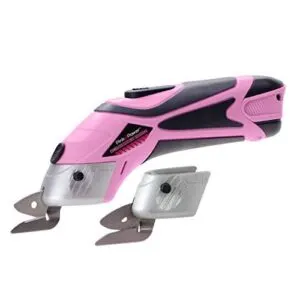
If the SnapFresh felt like a great starting point, the Pink Power HG2043 takes things a step further for crafters who work across materials.
It weighs under a pound, runs on a 4V lithium-ion battery, and charges fully in under 90 minutes — giving you up to two hours of continuous use. What makes it stand out is the dual-blade system: the O blade processes fabric and paper, while the D blade cuts through cardboard and heavier materials.
| Best For | Quilters, sewers, and crafters who regularly cut through a variety of materials and want to reduce hand fatigue over long sessions. |
|---|---|
| Power Source | Cordless rechargeable |
| Blade Material | Stainless steel |
| Ergonomic Design | Dual-handed handle |
| Fabric Cutting | Yes |
| Reduces Hand Fatigue | Yes |
| Multi-Material Use | Cardboard, leather, plastic |
| Additional Features |
|
- Handles a wide range of materials — fabric, leather, cardboard, carpet, and plastic — with two dedicated blades for each job
- Lightweight at under a pound, with an ergonomic handle that works for both left and right-handed users
- Up to two hours of cordless use on a single charge, so you’re not tethered to an outlet mid-project
- It’s on the louder side, so expect some noise during use
- Takes a little time to get used to if you’ve never used electric scissors before
3. Professional Titanium Coated Sewing Scissors
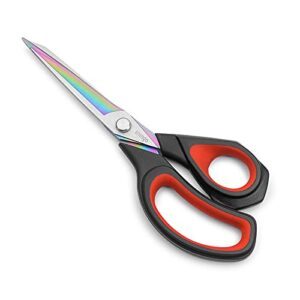
If you’re ready to step away from battery-powered tools and invest in something built to last, the Professional Titanium Coated Sewing Scissors deserve a close look.
Forged from high-density stainless steel with a titanium-coated blade, they cut through up to 16 layers of fabric cleanly — leather, denim, and canvas included. The curved blade keeps your fabric flat on the table, and the ergonomic handle reduces hand strain during longer sessions.
Available in 21 cm, 23 cm, and 26 cm lengths.
| Best For | Tailors, quilters, and serious crafters who regularly work with heavy materials like leather, denim, or canvas and need scissors that can handle the load session after session. |
|---|---|
| Power Source | Manual (handheld) |
| Blade Material | Stainless steel/titanium |
| Ergonomic Design | Comfort grip handles |
| Fabric Cutting | Yes |
| Reduces Hand Fatigue | No |
| Multi-Material Use | Denim, paper, mats |
| Additional Features |
|
- Titanium-coated blades resist rust and adhesive buildup, so they stay sharp and clean over time
- Cuts through up to 16 layers of fabric in one go — great for pattern cutting and bulk work
- High-density steel construction is three times harder than standard stainless, meaning these will last
- The handle runs on the larger side, which can feel clunky if you have smaller hands
- Extended cutting sessions may cause some hand fatigue due to the grip design
- If you’re used to Japanese shears, the cutting action here may feel a little less fluid by comparison
Frequently Asked Questions (FAQs)
How do I cut curves and rounded fabric edges?
To cut curves, mark the line first, then use sharp scissors with slow, steady snips—keeping the lower blade on the table. For tight curves like armholes, small scissors give you the most control.
Can I cut multiple fabric layers at once safely?
Yes, you can — but keep it to 4 to 6 layers max. More than that and the stack shifts, your blade wanders, and you lose control fast.
Whats the best way to cut slippery fabrics?
Slippery fabrics are like water — the moment you think you have them, they’re gone. Stabilize with tissue paper beneath and above the cloth, then cut one single layer at a time.
How often should fabric cutting tools be sharpened?
Most sewists sharpen fabric shears every 6–12 months. Heavy daily use? Every 3–6 months. Replace rotary blades every 3–4 projects. If fabric snags or tears instead of cutting cleanly, that’s your sign.
How do I cut fabric without a cutting mat?
You don’t need a cutting mat. Lay fabric flat on a firm table, use dressmaker shears, mark your line with tailor’s chalk, and cut slowly with long, smooth strokes.
Conclusion
Here’s the theory worth testing: precision at the cutting table determines everything that follows. Learning how to cut fabric straight and even isn’t just technique—it’s the foundation your finished garment stands on.
Sharp tools, a flat surface, and a deliberate hand don’t guarantee flawless execution, but they eliminate the hidden errors that compound into real frustration.
Cut well once, and the whole project moves with quiet confidence. That’s the difference you’ll feel every single time.
- https://www.freshlypieced.com/blog/piecing-101-accurate-cutting
- https://inthefolds.com/q-a-series/2024/how-to-cut-fabric-straight
- https://mellysews.com/how-to-cut-fabric
- https://madamsew.com/blogs/sewing-blog/rotary-cutter-tips-for-safe-accurate-fabric-cutting
- https://sarahgoerquilts.com/2017/07/14/my-favorite-tips-and-tools-for-accurate-fabric-cutting