This site is supported by our readers. We may earn a commission, at no cost to you, if you purchase through links.
The wrong thread can unravel a perfectly cut suit—sometimes literally. A tailor in Milan once told me he spent three hours fixing a seam that failed not because of poor technique, but because someone grabbed a Tex 18 thread for a heavy wool jacket. One wrong choice on the spool rack, and the whole job collapses.
Thread weight, fiber content, and tensile strength aren’t details you revisit after the fact. The nine threads reviewed here cover every professional tailoring scenario, from fine bridal silk to bonded nylon rated for upholstery loads.
Table Of Contents
- Key Takeaways
- Top 9 Professional Tailor Threads
- 1. Professional Sewing Kit with Thread and Scissors
- 2. Dual Duty XP Polyester Sewing Thread
- 3. Singer Polyester Sewing Thread Assorted Color Set
- 4. Polyester Sewing Thread and Bobbin Kit
- 5. Assorted Color Sewing Thread Bobbin Kit
- 6. Polyester Sewing and Embroidery Thread Kit
- 7. Connecting Threads White Cotton Sewing Thread
- 8. Polyester Sewing Thread and Bobbins
- 9. UV Resistant High Strength Polyester Thread
- Thread Materials for Tailoring
- Thread Weight and Sizing
- Best Threads by Project
- Storage and Maintenance Tips
- Frequently Asked Questions (FAQs)
- Conclusion
Key Takeaways
- Thread weight and fiber type aren’t optional details — matching Tex rating to fabric weight is what keeps seams from failing under load.
- Polyester handles 95% of garment work, but silk, cotton, nylon, and Kevlar each own a specific job that polyester can’t cover.
- Your needle size, stitch length, and machine tension must align with your thread choice, or even the best spool won’t save the seam.
- Store thread at 15–25°C, away from UV and humidity — cotton degrades in 3–5 years, and a weakened spool shows up exactly when you can’t afford it.
Top 9 Professional Tailor Threads
The right thread can make or break a finished garment — and not every spool earns a place in a professional kit. These nine options cover the range from everyday polyester to UV-resistant outdoor thread, each chosen for real performance. Here’s what’s worth keeping on your rack.
If you’re still building your kit, this beginner’s guide to sewing threads breaks down what each type actually does before you spend money on the wrong spools.
1. Professional Sewing Kit with Thread and Scissors
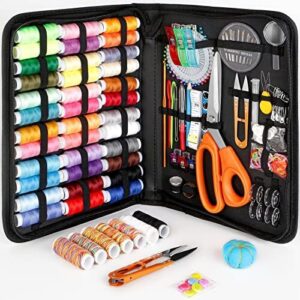
A 201-piece sewing kit sounds like overkill — until you’re mid-alteration and missing a seam ripper. This kit covers the essentials: dual scissors (8-inch fabric and 4-inch precision), 150-yard polyester thread spools in black, white, and rainbow colors, needles, pins, and button assortments.
Everything packs into an 11 x 7.8-inch Oxford cloth bag, making it travel-ready. It’s beginner-friendly but practical enough for quick professional repairs.
| Best For | Anyone who sews regularly — from beginners tackling basic repairs to crafters who need a portable, all-in-one kit for travel or emergencies. |
|---|---|
| Material | Polyester |
| Thread Length | 150 yards/spool |
| Colors Available | Multi-color assortment |
| Bobbins Included | No |
| Primary Use | Mending and repairs |
| Skill Level | Beginner |
| Additional Features |
|
- 201 pieces covers nearly every basic sewing need, from needles and pins to buttons and seam rippers
- Dual scissors (8-inch and 4-inch) handle both heavy cutting and fine detail work
- Compact Oxford cloth bag makes it easy to toss in a bag, glove compartment, or suitcase
- Dark thread colors are limited, which can be frustrating for repairs on darker fabrics
- Needle selection skews small — not great for heavier materials like denim or canvas
- A few buyers noted the actual contents didn’t quite match what was advertised
2. Dual Duty XP Polyester Sewing Thread
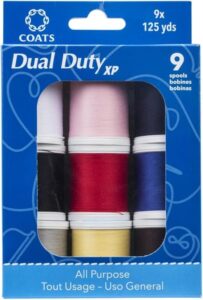
When the kit manages quick repairs, you need a thread that won’t quit mid-project. Dual Duty XP earns its spot here. It’s 100% polyester with a corespun construction — smooth feed, minimal fraying, and consistent tension across knits and wovens alike.
At around Tex 30, it suits most standard home machines with size 11–14 needles. Colorfastness holds through repeated washing. It’s the reliable daily driver your workroom deserves.
| Best For | Home sewers, quilters, and anyone who needs a dependable everyday thread for garment construction, repairs, and alterations. |
|---|---|
| Material | Polyester |
| Thread Length | 125 yards/spool |
| Colors Available | 9 basic shades |
| Bobbins Included | No |
| Primary Use | Garment construction |
| Skill Level | All levels |
| Additional Features |
|
- Corespun polyester means smooth feeding and minimal fraying, even at high speeds
- Holds tension consistently across both knits and wovens
- Colorfastness stands up to repeated washing without fading
- Spools are smaller than standard options, so you’ll restock more often on bigger projects
- Color range sticks to basics — specialty or unique shades aren’t in the mix
- Not ideal if you need heavy-duty thread for thick fabrics or upholstery work
3. Singer Polyester Sewing Thread Assorted Color Set
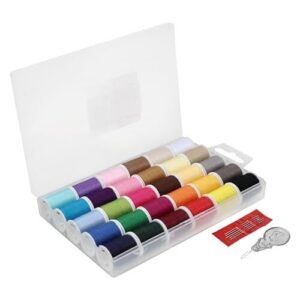
Dual Duty takes care of your everyday workload well — but what about when you need color fast? That’s where the Singer Assorted Color Set earns its place.
Thirty spools, 50 yards each, all 100% polyester — shrink-resistant, colorfast, and consistent in diameter. The palette covers light, medium, and dark tones, so shade-matching on quick repairs takes seconds, not minutes. It won’t replace your professional-grade thread for large projects, but as a mending and repair kit, it’s hard to beat.
| Best For | Home sewers, beginners, and anyone who needs a reliable color-matching kit for quick mending and everyday repairs. |
|---|---|
| Material | Polyester |
| Thread Length | 50 yards/spool |
| Colors Available | Assorted colors |
| Bobbins Included | No |
| Primary Use | Apparel mending |
| Skill Level | Beginner |
| Additional Features |
|
- 30 spools in a wide range of shades — light, medium, and dark — so you’re rarely hunting for the right color
- 100% polyester thread holds up well: shrink-resistant and colorfast through regular washing
- Comes with a storage case, needles, and a threader, so it’s ready to use right out of the box
- 50 yards per spool runs out fast on bigger projects — not ideal if you’re sewing something from scratch
- The storage case latch isn’t the most secure, so it can pop open if tossed in a bag
- Needles and threader are basic — fine for casual use, but you may want to swap them out for better quality tools
4. Polyester Sewing Thread and Bobbin Kit
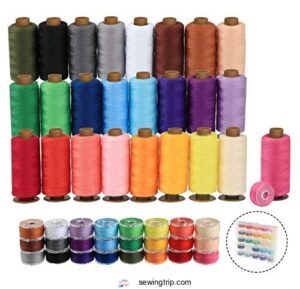
When color-matching matters but setup time doesn’t, this Polyester Thread and Bobbin Kit pulls its weight. You get 25 colors, 400 yards per spool, and pre-wound Size A bobbins — ready to drop in and go. The anti-fade polyester construction holds up through repeated washing without losing stitch integrity.
It works cleanly on Brother, Singer, and Janome machines. One note: skip it for Futura Embroidery models. For quilting, patching, and everyday repairs, it delivers.
| Best For | Home sewers and DIY enthusiasts who work with Brother, Singer, or Janome machines and need a reliable, color-ready thread kit for quilting, patching, and everyday repairs. |
|---|---|
| Material | Polyester |
| Thread Length | 400 yards/spool |
| Colors Available | 25 colors |
| Bobbins Included | Yes |
| Primary Use | Quilting and embroidery |
| Skill Level | All levels |
| Additional Features |
|
- 25 color-matched spools and pre-wound bobbins mean you’re ready to sew right out of the box
- Anti-fade polyester holds its color wash after wash, so your stitches stay sharp
- Works across a wide range of popular home machines without any fuss
- Not compatible with Futura Embroidery machines, so it’s a hard pass if that’s what you’re running
- Thread can fray or break under heavy use, which gets frustrating mid-project
- Leaves lint buildup in the machine over time, so expect more frequent cleaning
5. Assorted Color Sewing Thread Bobbin Kit
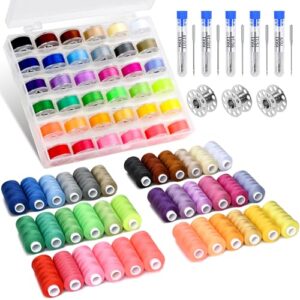
Thirty-six colors, all with matching prewound bobbins — that’s the headline here. You drop them in, align your thread, and sew. No hunting for a close-enough bobbin color mid-project.
It’s the kind of kit that makes sense for anyone building out a versatile sewing thread collection for mixed fabric projects — everything’s already paired and ready to go.
The 100% polyester construction resists linting and fraying, keeping your seams clean through repeated washing. Needle sizes run from 70/9 up to 100/16, covering soft cotton to heavy denim. Just don’t push it on industrial machines or thick quilting layers — it won’t hold.
| Best For | Beginners and hobbyists who want a complete, ready-to-go thread kit without piecing things together separately. |
|---|---|
| Material | Polyester |
| Thread Length | 400 yards total |
| Colors Available | 36 colors |
| Bobbins Included | Yes |
| Primary Use | Clothing repairs and DIY |
| Skill Level | Beginner |
| Additional Features |
|
- 36 colors with matching prewound bobbins — no color-matching headaches mid-project
- 100% polyester thread holds up through washing without linting or fraying
- Wide needle range (70/9 to 110/18) handles everything from lightweight cotton to denim
- Not compatible with industrial sewing machines
- Can break under the stress of thick quilting fabrics
- Only 11 yards per spool, so heavy projects may burn through spools quickly
6. Polyester Sewing and Embroidery Thread Kit
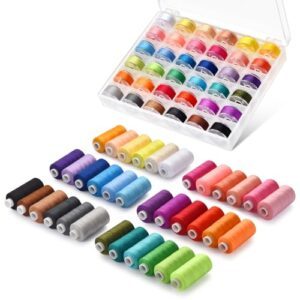
When both sewing and embroidery land on your table, this kit earns its place. You get 36 color-coordinated spools at roughly 40-weight, each running around 500 meters — enough for long seams without mid-project restocking. The polyester filament core keeps tension consistent and lint minimal inside your bobbin case.
One honest caveat: gathering tasks can stress the thread to breaking. For embroidery on cotton or synthetics, though, it feeds smoothly and delivers clean luster on detailed work.
| Best For | Sewers, quilters, and embroidery enthusiasts who want a wide color range and the convenience of prewound bobbins ready to go. |
|---|---|
| Material | Polyester |
| Thread Length | 400 yards/spool |
| Colors Available | 36 colors |
| Bobbins Included | Yes |
| Primary Use | Sewing and quilting |
| Skill Level | All levels |
| Additional Features |
|
- 36 colors gives you solid coverage for most projects without hunting down individual spools
- Prewound bobbins mean you can jump straight into a project without the setup hassle
- Polyester construction holds up well for both hand and machine work across fabrics
- Thread can snap under the stress of gathering or ruffling, so it’s not ideal for those techniques
- Some spools have a linty, fuzzy texture that can affect the finish on detailed work
- Missing a few staple colors like gold for jean hems or a reliable beige, which might frustrate certain projects
7. Connecting Threads White Cotton Sewing Thread
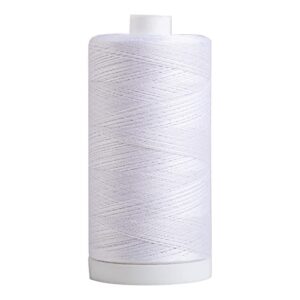
Pure cotton work belongs with pure cotton thread. The Connecting Threads 50-weight is triple-ply, long-staple construction — tight enough to resist fraying, smooth enough to glide through a fine needle without friction. You get 1,200 yards per spool, which accommodates medium to large projects without interruption.
Its low-lint satin finish keeps your bobbin race clean and your stitch flow steady. For quilting, piecing, or topstitching on natural fabrics, this thread simply fits.
| Best For | Quilters and sewists of all skill levels who work primarily with natural fabrics and want a clean, reliable cotton thread for quilting, piecing, or topstitching. |
|---|---|
| Material | Cotton |
| Thread Length | 1,200 yards |
| Colors Available | White only |
| Bobbins Included | No |
| Primary Use | Quilting and topstitching |
| Skill Level | All levels |
| Additional Features |
|
- Triple-ply, long-staple construction holds tight and glides smoothly through fine needles without fraying or friction.
- Low-lint satin finish keeps your bobbin race clean and your machine running smoothly over long sessions.
- 1,200 yards per spool gives you plenty of thread to get through medium to large projects without stopping to rewind.
- Lower tensile strength than polyester options, so it can snap if you’re pulling thread to gather fabric.
- Occasional thread nodules can pop up and disrupt your machine’s performance mid-project.
- Not the best pick if you need a heavy-duty thread for high-stress seams or stretch fabrics.
8. Polyester Sewing Thread and Bobbins
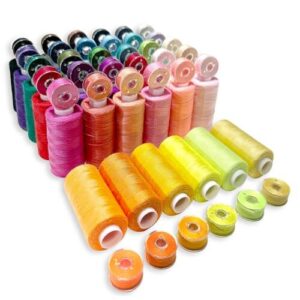
Match your thread to your bobbin — it sounds simple, but most tension problems start right here. This kit gives you 36 pre-wound bobbins, each paired with a matching 400-yard spool of durable polyester. That’s full color continuity without hunting for a compatible wind.
The transparent storage box keeps all 72 pieces visible and sorted at a glance. Works across most standard machines and supports hand sewing, embroidery, and quilting with equal ease.
| Best For | Home sewers and crafters who work across multiple projects and need reliable color variety without the hassle of mismatched bobbins. |
|---|---|
| Material | Polyester |
| Thread Length | 400 yards/spool |
| Colors Available | 36 colors |
| Bobbins Included | Yes |
| Primary Use | DIY crafts and sewing |
| Skill Level | All levels |
| Additional Features |
|
- Each spool comes with a pre-wound matching bobbin, so you’re never scrambling to find the right thread pairing mid-project.
- 400 yards per spool gives you plenty of thread to finish most jobs without running out at a bad time.
- The clear storage box keeps all 72 pieces visible and within reach — no digging around in a tangled mess.
- Not built for heavy-duty work like upholstery or thick home decor fabrics, so it’ll fall short if that’s your main use.
- Some machines may run into tension or nesting issues, which can slow things down until you dial in the settings.
- With 36 colors to manage, the storage box helps — but it can still feel like a lot to sort through if you only need a handful of shades.
9. UV Resistant High Strength Polyester Thread
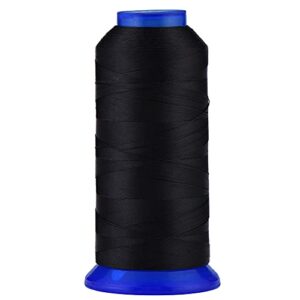
When outdoor conditions push your seams to the limit, this thread holds the line. UV absorbers are integrated directly into the polymer — delivering less than 5% fade after 500 hours of direct sunlight. At Tex 70, it sews canvas, leather, and awnings without skipping a beat.
Tensile strength exceeds 8.0 kgf, so heavy seams stay intact under load. Use a 16/100 or 18/110 needle and set a slightly longer stitch. Your outdoor work deserves thread built for it.
| Best For | Sewers and makers who work with heavy outdoor materials like canvas, leather, awnings, or convertible tops and need a thread that can take sun and stress without giving out. |
|---|---|
| Material | Polyester |
| Thread Length | 1,500 yards |
| Colors Available | Black only |
| Bobbins Included | No |
| Primary Use | Heavy-duty outdoor use |
| Skill Level | Intermediate to advanced |
| Additional Features |
|
- Holds up in direct sunlight — less than 5% fade after 500 hours, so your outdoor projects stay looking sharp
- Tensile strength over 8.0 kgf means heavy seams won’t give out under real load
- Works with both home and commercial machines, and plays nicely with canvas, denim, leather, and upholstery
- Non-bonded construction means it can fray or unravel if you’re not careful with handling or finishing
- Needs the right needle (16/100 or 18/110) and some machine adjustment — not totally plug-and-play
- Higher friction can cause tension issues, so you may need to fiddle with your machine settings before it runs smooth
Thread Materials for Tailoring
The thread you pick does more work than most tailors give it credit for. Each material has its own personality — how it behaves under tension, how it ages, how it plays with different fabrics. Here’s what you need to know about the five core options.
Polyester for Daily Sewing
Polyester is the workhorse of any serious tailor’s thread cabinet. All-purpose polyester threads handle roughly 95% of apparel projects without complaint. They deliver genuine tensile strength and colorfastness, resisting fading through dozens of washes. Add in wrinkle resistance, quick drying, and low cost — you’ve got a thread built for daily volume without sacrificing quality.
For intensive use, high-tenacity filament thread provides peerless durability.
Cotton for Natural Fabrics
When natural fabrics are on the table, cotton thread is the right match. Mercerized cotton grips natural fibers cleanly, producing tight, nearly invisible seams. Egyptian cotton thread — spun from long-staple fibers — delivers extra strength with a fine hand. It absorbs dye evenly, so color stays true.
Use 60-weight for lightweight cottons, and always prewash your fabric first.
Silk for Formalwear
Silk thread is the go-to for formalwear. Mulberry silk thread delivers fine, strong seams in suits, tuxedos, and gowns. Its natural dye depth produces rich, fade-resistant color under indoor lighting. Silk also regulates moisture — staying breathable through long events.
Always dry clean or hand wash cold to preserve fiber integrity and colorfastness.
Nylon for Heavy Seams
Where silk accommodates the delicate, nylon accommodates the demanding. When you’re sewing canvas, leather, or heavy denim, nylon thread is your first call.
Here’s why professional tailors reach for it on heavy seams:
- High load capacity — tensile strength ranges from 2.5 to 8.5 pounds depending on denier size.
- Flexing seam integrity — elongation of 15–30% before failure keeps seams intact under stress.
- Abrasion resistance — holds up on upholstery edges and leather where friction is constant.
- Chemical resistance — withstands oils and solvents common in workwear and automotive textiles.
For serious seam strength, use bonded nylon at Tex 90. The bonding reduces fraying and extends thread durability on thick layers. Adjust your machine tension carefully — nylon’s slippery surface can cause skipped stitches if you don’t. Larger needles, slower speeds, and proper tension settings make the difference between a seam that holds and one that fails at the worst moment.
Kevlar for Extreme Durability
Nylon accommodates heavy seams well — but Kevlar is in a different league entirely.
Kevlar thread delivers tensile strength around 3.6 GPa and five times steel’s strength by weight. It resists abrasion, heat up to 260°C, and most chemicals. Tailors use it for ballistic protection gear and extreme-duty composites where standard threads simply won’t last.
Thread Weight and Sizing
Thread weight isn’t just a number — it determines whether your seam holds or fails. Getting the sizing right means knowing exactly which system applies to your thread and your machine. Here’s what every professional tailor should understand before threading a single needle.
Tex System Basics
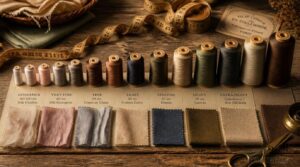
The Tex system measures thread weight in grams per 1,000 meters. Lower numbers mean finer thread; higher numbers mean heavier. A Tex 30 suits lightweight fabrics, while Tex 90 is suited for upholstery.
You can also reverse-calculate: Tex equals 1,000 divided by thread weight. So a 60-weight thread works out to roughly Tex 17.
Denier Size Comparison
Denier measures grams per 9,000 meters of fiber — a different scale than Tex, but equally essential for professional tailors selecting thread by tensile strength and fiber composition.
- 10–20 denier: ultra-fine, for sheer fabrics
- 40–80 denier: activewear and light outerwear
- 100–200 denier: upholstery and outdoor garments
- 300–600 denier: rugged luggage and heavy-duty gear
Thread Weight Ranges
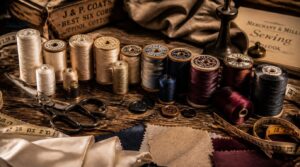
Thread weight tells you how thick or fine a thread is — and picking the wrong range ruins a seam. Weight runs inverse to thickness: a 60-weight thread is finer than a 20-weight.
Lightweight fabrics like silk need 60-weight or finer. Medium fabrics suit 40–50 weight. Upholstery demands 20–28 weight for strong, visible stitches.
Needle Size Matching
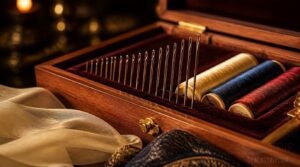
The needle isn’t just a delivery tool — it’s your thread’s first gatekeeper. Eye diameter should be roughly 1.4 times your thread’s diameter. Too narrow and you’ll fight fraying; too wide and tension slips.
Match needle size to fabric weight: fine fabrics need sizes 70/10–80/12, while heavy upholstery demands 100/16 or above.
Heavy-duty Thread Ratings
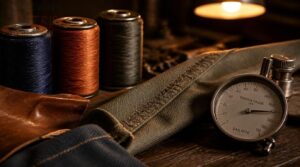
When a seam fails under load, you don’t get a second chance. Heavy-duty ratings tell you exactly where your thread stands before that moment arrives. Look for Tex 70 to 135 for upholstery, bonded nylon at Tex 90 for reinforced strength, and UV-treated polyester where outdoor exposure matters. Ratings aren’t suggestions — they’re load limits.
Heavy-duty thread ratings aren’t suggestions — they’re the load limits standing between a seam that holds and one that fails
- Tensile strength above 15 lbs for canvas seams
- Elongation under 5% for rigid upholstery applications
- Abrasion resistance rating suited for leather and marine fabrics
Best Threads by Project
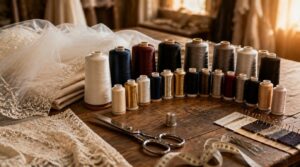
The right thread doesn’t just depend on the material — it depends on what you’re building. A bridal gown and a boat cover have nothing in common, and neither should the thread holding them together. Here’s how to match your thread to the job.
Suit and Wool Tailoring
Wool doesn’t forgive weak thread. For suit tailoring, reach for fine-gauge mercerized cotton or Egyptian cotton — both preserve invisible seams in worsted and merino wool.
These threads match the fabric’s natural give without distorting the weave. Pair them with proper needle sizing, and your seams stay clean through every press and alteration.
Bridal Garment Construction
Bridal construction leaves zero room for error. For 60 to 80 weight polyester or silk thread, the margin between invisible and obvious is razor-thin. Corset base design demands fine thread that moves through boning channels cleanly, supporting seam grading without visible bulk.
Embellishment security depends on your thread holding under real stress.
Alterations and Repairs
Alterations demand precision that bridal work trains you for. All-purpose polyester thread covers roughly 95% of garment alterations cleanly.
For hemming trousers or sleeves, blind hem techniques keep stitching invisible. Zipper replacement requires matching coil weight exactly. Patch reinforcement and buttonhole repair both need thread durability that holds under daily stress.
Quick repairs done right stay right.
Upholstery and Heavy Fabrics
Garment alterations keep things moving. But upholstery is a different animal entirely.
Bonded nylon (Tex 90) withstands the brutal demands of heavy seams. Upholstery work requires Tex 70 to 135 rated thread for genuine durability. Double rub counts exceeding 50,000 cycles mean your thread tensile strength must match fabric compatibility — or the seam fails first.
- Choose bonded nylon for high-traffic seating
- Match thread weight to fabric backing layer stability
- Verify weave pattern selection before cutting
- Check fabric durability ratings against project use
Outdoor and Marine Sewing
Upholstery pushes thread hard — but marine environments are even less forgiving.
UV-treated polyester retains up to 80% tensile strength after 1,000 sun hours. Bonded nylon accommodates stretch and cold saltwater flex. For extreme load points, Kevlar holds without compromise.
| Thread Type | Key Benefit | Best Use |
|---|---|---|
| UV Polyester | Marine UV protection | Boat covers |
| Bonded Nylon | Saltwater resistance | Dodger seams |
| Kevlar | Maximum tensile strength | Rigging patches |
Waxed finishes add thread lubrication benefits — repelling moisture, reducing wicking. Match your thread to your outdoor fabric, and seams won’t fail when conditions get brutal.
Storage and Maintenance Tips
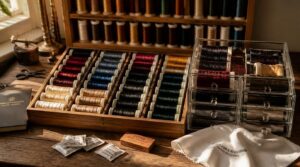
Good thread is an investment — treat it like one. How you store and maintain your supplies directly affects stitch quality, thread lifespan, and how smoothly your next project runs. Here’s what every serious tailor should have in place.
Spool Rack Organization
A cluttered rack wastes more time than a dull needle. Wall-mounted racks hold 30 to 120 spools — space pegs 1 to 1.5 inches apart so nothing tangles. Use a tiered carousel for rotation access without removing spools. Mount racks at chest to shoulder height for ergonomic reach. Add desiccant pockets to control moisture.
- Space pegs evenly to prevent tangling
- Use tapered pegs for secure spool grip
- Mount carousels with smooth, lockable bearings
- Place desiccant pockets near ventilation gaps
Color Family Sorting
Sorting by color family saves real time. Group warm reds, oranges, and yellows on one side; cool blues, greens, and violets on the other.
Keep neutral threads — black, white, gray, tan — in a dedicated center row. Within each family, arrange light to dark.
A simple thread color chart pinned nearby makes matching easy.
Portable Thread Cases
A good portable thread case is one of the most practical tools a working tailor can own.
- Case size: 8–12 inches wide, 4–6 inches tall
- Capacity: double-sided designs hold 50–100 spools
- Material: heavy-duty canvas or nylon for durability
- Carrying options: built-in handle plus detachable shoulder strap
- Access: clear vinyl windows for instant color ID
Preventing Thread Degradation
Thread doesn’t last forever — but neglect shortens its life dramatically.
Store spools at 15 to 25°C with 40 to 60 percent relative humidity. Use moisture barrier containers to block dust and humidity. Keep spools away from windows; UV exposure weakens fibers and fades color fast.
| Factor | Risk | Solution |
|---|---|---|
| UV exposure | Color fade, fiber breakdown | UV protection coatings, dark storage |
| High humidity | Mold, fiber swelling | Airtight, sealed containers |
| Heat fluctuation | Embrittlement | Temperature control storage |
| Aging stock | Brittleness | Stock rotation practices |
| Coating wear | Weak points, fraying | Uniform coating thickness maintenance |
Rotate older spools first. Cotton degrades in 3 to 5 years; polyester holds strong past 10.
Reducing Lint Buildup
Lint is a silent enemy in any tailor’s workspace. Choose fabrics with high twist yarn and tight weave construction — they shed far less during wear and washing.
For polyester thread and bonded nylon, use the vinegar wash method: add half a cup per load to loosen stray fibers before rinsing. Toss in dryer balls to separate fabrics and improve airflow.
Static neutralization — via anti-static sprays or ionizers — cuts lint cling at the source.
Frequently Asked Questions (FAQs)
How do corespun threads compare to standard polyester?
Corespun thread is a two-part system: filament core carries load, cotton wrap controls heat. You get stronger seams, less fraying, and better needle penetration than standard polyester — without sacrificing that clean, matte finish.
What thread types work best for stretch fabrics?
Stretch fabrics need thread that moves with them. Polyester thread accommodates most knits well. For high-stretch pieces, wooly nylon gives high elasticity. Bonded nylon adds durability where seams take repeated motion stress.
How does thread color affect fabric appearance after washing?
Color bleeds like ink on wet parchment. Dye migration from dark thread halos light fabric at seams. Test colorfastness first. Wash cool. Match thread closely using Thread Color Charts for lasting results.
When should tailors switch from sewing silk to alternatives?
Switch from silk to synthetics when durability thresholds rise. High-stress seams, frequent laundering, or humid climates demand polyester or nylon. When cost pressures spike or colorfastness matters, reliable polyester thread wins every time.
Conclusion
Funny how the smallest spool in your entire kit carries the most responsibility. Every cut, every seam, every finished hem depends on a choice most skip without thinking twice.
The right sewing threads for professional tailors don’t announce themselves—they just hold, quietly and completely. Store them properly, match them to your fabric, and never treat thread as an afterthought.
Your hard-earned reputation is stitched into every garment you finish. Make sure it always holds.
- https://www.threadsmagazine.com/project-guides/learn-to-sew/sewing-thread-fibers-and-special-types
- https://www.bsewinn.com/blogs/inspiration/types-of-sewing-thread
- https://www.mh-chine.com/blog/products/wooly-nylon-thread
- https://www.sewingpartsonline.com/blogs/education/ultimate-thread-reference-guide-2
- https://wunderlabel.com/blog/p/choose-right-sewing-thread