This site is supported by our readers. We may earn a commission, at no cost to you, if you purchase through links.
Somewhere between a strict grid and a blank canvas lives the most exciting territory in modern quilting. Traditional blocks taught you structure; contemporary quilt piecing methods hand you permission to break it—deliberately, precisely, beautifully.
A focal block shifted one-third across the quilt face. Negative space that does real compositional work. High-contrast pairings that read clearly from across a room.
None of this happens by accident. It happens when you understand the tools, the geometry, and the logic underneath the freedom. What follows gives you exactly that foundation.
Table Of Contents
- Key Takeaways
- Contemporary Quilt Piecing Basics
- Essential Tools for Accurate Piecing
- Fabric Choices for Modern Quilts
- Pattern Preparation and Templates
- Foundation Paper Piecing Methods
- Freezer Paper Piecing Techniques
- Improv Piecing for Modern Designs
- Curved and Geometric Piecing
- Stitching and Seam Accuracy
- Common Piecing Mistakes to Avoid
- Frequently Asked Questions (FAQs)
- Conclusion
Key Takeaways
- Modern quilting is built on intentional asymmetry, high-contrast color placement, and negative space — not happy accidents, but deliberate choices made at every step.
- Your tools set the ceiling on your accuracy: a sharp rotary blade, a scant quarter-inch seam, and a properly set-up machine aren’t optional extras; they’re the foundation everything else rests on.
- Fabric selection goes beyond color — value contrast, weight matching, and surface finish (matte vs. shiny) directly shape whether your seams lie flat and your geometric lines stay sharp.
- Techniques like foundation paper piecing, freezer paper templates, and improv strip sets each solve a specific problem, so picking the right method for your block type beats trying to master them all at once.
Contemporary Quilt Piecing Basics
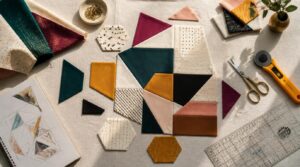
Contemporary quilting isn’t just a craft — it’s a whole different way of thinking about fabric and space. Before you cut a single piece, it helps to understand what sets modern piecing apart from the traditional approach. Here are the core ideas that shape everything you’ll do.
If you want to dig deeper into what makes this style tick, modern quilting techniques and core design principles lay out the building blocks in a way that actually makes sense.
Modern Piecing Versus Traditional Piecing
Modern piecing isn’t just a trend — it’s a different philosophy. Where traditional piecing repeats fixed blocks like nine patch or log cabin across a regular grid, modern piecing deliberately mixes block sizes, shifts symmetry, and limits the palette to a few high-contrast colors.
You’re not following a rigid formula. You’re making intentional choices at every step.
Clean Lines and Negative Space
Once you’ve committed to intentional choices over formulas, clean lines and negative space become your most powerful tools. Large unpieced background panels let geometric patterns breathe, while high contrast — think dark navy on white — keeps every seam sharp and readable from across a room.
- Use a rotary cutter for precise, grain-true cuts
- Keep backgrounds solid for visual balance
- Aim for open space that frames each motif clearly
Asymmetry in Quilt Layouts
Asymmetry isn’t about randomness — it’s about deliberate imbalance.
Place your focal block off-center, near one-third of the quilt width rather than dead center. Mix 6-inch, 12-inch, and 18-inch blocks in one layout, vary spacing between units, and let rows stop short of the edge.
Visual weight — not mirror symmetry — keeps the whole quilt top feeling grounded.
Bold Color Placement
Once you’ve found your layout’s balance through asymmetry, color becomes your next lever.
Value contrast does the heavy lifting here. Place a pale sky blue beside navy, and the seam reads clearly from across a room. A single saturated accent — citron, hot pink — captures the eye fastest when surrounded by neutrals. Keep warm tones advancing, cool tones receding, and let one temperature family lead.
Scale and Block Variation
Shifting scale is one of the fastest ways to give your quilt visual energy. A 12-inch finished block draws the eye, while four 6-inch blocks fill the same space with rhythm and detail. Mix both in the same row — they align perfectly when your design shares a common 3-inch grid, no trimming required.
Additionally, incorporating significant negative space can help these varying scales breathe within the design.
Essential Tools for Accurate Piecing
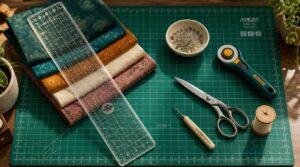
The right tools don’t just make quilting easier — they make precision actually achievable. Before you cut a single piece of fabric, it’s worth knowing what belongs on your workspace. Here’s what you need to piece accurately and confidently.
Rotary Cutter and Mat
Your rotary cutter and cutting mat are the foundation of every clean, precise cut. Choose the right blade for the job — the three most common sizes each serve a different purpose:
- 45 mm blade — manages most cotton strips and patchwork cuts
- 28 mm blade — navigates tight curves and small trimming work
- 60 mm blade — powers through thick stacks or batting layers
An ergonomic grip handle reduces hand strain during long cutting sessions, letting you stay accurate without fatigue. Keep your blade sharp and clean — a dull edge leaves fuzzy, skipped threads instead of one clean pass. Always cut on a self-healing mat, rotating it regularly to spread wear evenly and extend its life.
Quilting Rulers and Templates
Good rulers do more than measure — they’re what turn a rotary cutter and cutting mat into a precision system. Clear acrylic construction lets you see fabric grain and printed motifs underneath, so every cut lands exactly where you intend. The standard ⅛-inch thickness gives your blade a firm edge to follow without slipping.
Use 45-degree alignment lines when trimming half-square triangles, and reach for curved template sets — sold in matched pairs — for smooth Drunkards Path seams. Flying Geese trimming rulers keep that goose point perfectly centered. Add non-slip grip dots on the underside, and your ruler stays put through every pass, protecting your seam accuracy and keeping each quilt block true.
Precision Sewing Machine Setup
Your sewing machine is either your most reliable partner or your biggest obstacle — the difference comes down to setup.
Start with a 75/11 or 80/12 quilting needle for standard cotton. Set your stitch length to 1.8–2.0 mm.
Balance thread tension near 4, then test on folded project scraps. Use a scant quarter-inch seam and verify with a 6½-inch strip test.
Walking Foot Uses
A walking foot might be the single biggest upgrade you can make to your machine piecing workflow. It has its own upper feed dogs, pulling the top layer while your machine’s built-in feed dogs handle the bottom — so both layers advance together.
This even feed control keeps strip sets flat, stabilizes bias edges on triangles and diamonds, and helps you glide over bulky seam intersections without losing your quarter-inch allowance.
Steam Pressing Tools
Pressing is where good piecing becomes great piecing.
A wool pressing mat lets fabric sink slightly into the surface, so your seams lie flat without distorting the edges around them. Pair it with a mini steam iron for tight corners, and use a full-size steam iron set between 250°F and 360°F for cotton to maintain fabric stability throughout.
Fabric Choices for Modern Quilts
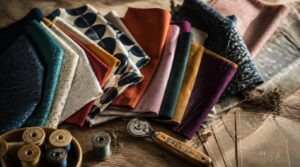
Fabric is where your quilt’s personality really shows up. The choices you make — contrast, texture, weight, sustainability — shape everything from how the finished piece looks to how it holds together over time. Here’s what to keep in mind as you build your fabric palette.
High-contrast Fabric Pairings
Choosing the right fabric pairings can make or break your quilt’s visual impact. Value contrast matters more than color alone — a black fabric next to white creates the strongest separation available, keeping your pieced lines crisp from across a room.
Always do a grayscale check before committing; two fabrics can differ in hue but still muddy your design if their values match.
Matte Versus Shiny Fabrics
Once you’ve sorted contrast, think about surface. Matte quilting cotton diffuses light evenly, keeping your eye on the shapes — exactly what modern quilting rewards.
Shiny fabrics like sateen shift their value with every light change, reading lighter on raised areas and darker in folds. That unpredictability can quietly undermine a clean geometric layout.
Balancing Fabric Weights
Surface finish matters, but fabric weight shapes how your quilt behaves from the inside out. Standard quilting cotton runs 4 to 5 ounces per square yard — mix beyond that range and your seams start fighting you.
- Rippling seams where light meets heavy fabric
- Blocks that refuse to square up cleanly
- Intersections too stiff to press flat
- Sections that hang unevenly in the finished quilt
Keep weight matching strategies simple: use heavier fabrics in smaller accent pieces and lighter fabrics in larger expanses. That fabric ratio planning reduces drag and keeps your blocks cooperative.
Sustainable Textile Options
Weight-conscious fabric choices open the door to something bigger — building a quilt that’s kind to the planet.
Organic cotton, certified to GOTS standards, grows without synthetic pesticides and stays stable under a rotary cutter. Hemp-cotton blends (55% hemp, 45% cotton) offer serious tensile strength while using far fewer farming inputs. Upcycled textiles round out a responsible, modern fabric stash beautifully.
Prints, Solids, and Texture
Mixing prints, solids, and textures is where your quilt truly comes alive.
- Small-scale prints stay readable in 2½-inch patches; large-scale prints lose their motif in narrow strips
- Solid fabrics expose every seam, so they reward clean piecing
- Tone-on-tone prints add subtle texture without disrupting your color palette
Shot cotton and linen blends shift beautifully under light, deepening monochrome layouts.
Pattern Preparation and Templates
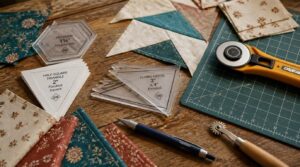
Getting your patterns right before you touch a single piece of fabric saves you from a lot of frustrating do-overs later. Think of this stage as laying the groundwork — every accurate cut starts with a solid template. Here’s what you need to know to get it right from the start.
Printing Patterns at Scale
Always set your print dialog to Actual Size or 100% — never "Fit" or "Shrink." One wrong click and your 2-inch shape prints smaller, throwing every cut off.
| Print Method | Best Use | Key Setting |
|---|---|---|
| Home tiled pages | Small blocks | 100%, Poster mode |
| Tile overlap | Multi-page assembly | 0.25–0.5 inch overlap |
| A0 copy shop | Full-size foundations | 100%, single sheet |
| Color-coded PDF | Multi-size patterns | Match line styles |
| Black and white | Templates and cutting | Bold outer cut lines |
Use Adobe Acrobat Reader for tiled output — it processes PDF scaling more reliably than browser windows.
Checking Measurements Before Cutting
Before a single blade meets fabric, hold your printed template against a ruler. That 1-inch test square on your pattern isn’t decorative — it tells you whether your printout matches reality. Measure it. If it’s off, reprint.
Check ruler zero alignment at both ends of every strip. A 2.5-inch strip can drift narrower mid-length if your fabric isn’t squared first.
Labeling Fabric Pieces
Think of your labels as a map key — without them, identical pieces scatter into chaos.
Use letter-number codes like A1 or B2 on each cut piece. Write them on the wrong side with a washable fabric marker or friction pen. Place every label in the same upper corner so sorting stays fast and nothing gets sewn in blind.
Paper Template Selection
The paper you choose for your templates quietly shapes every cut and seam that follows.
- 20 lb copy paper works well for standard foundation paper piecing — it tears away cleanly without distorting seams.
- 24 lb printer paper offers more stability but requires slightly more force to remove after stitching.
- Printable vellum lets you see fabric placement through the sheet, making it ideal for sharp angles.
- Newsprint releases fastest thanks to its soft fiber structure and thin profile.
- Freezer paper bonds temporarily to fabric and peels away cleanly, making it fully reusable for repeated pattern templates.
Marking With Removable Pens
The right pen can make or break your fabric alignment precision.
| Pen Type | Best Use |
|---|---|
| White heat-erasable | Dark fabrics |
| Dark Frixion pen | Light fabrics |
| Chalk alternative | Curved lines |
Iron at minimum 180°F to erase marks fully. Test on scrap first — some pens leave ghost lines on medium-dark fabrics.
Foundation Paper Piecing Methods
Foundation paper piecing gives you a level of accuracy that’s hard to match with any other method. It’s especially useful when you’re working with small, intricate shapes that need to line up perfectly. Here’s what you need to know to get it right.
Choosing Small Template Sizes
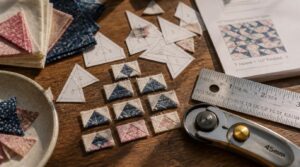
Scaling down opens up a whole new level of detail in your quilts. For foundation paper piecing, templates range from tiny 0.5 x 1-inch Flying Geese blocks up to 6-inch foundations.
Before cutting any fabric, print your chosen size at 100% and measure the included 1-inch test square to confirm accuracy. Small templates demand precision from the start.
Sewing Through Paper Layers
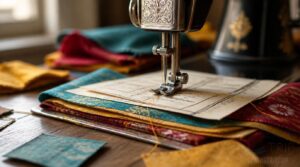
Once your template is printed and confirmed, place the printed side facing up on your machine. Your fabric sits underneath, against the unprinted side.
Set your stitch length to 1.5 mm — those tight, frequent holes let the paper tear away cleanly later. Use a fresh 80/12 needle; paper dulls tips fast, and a dull needle skips stitches on quilting cotton.
Trimming Seam Allowances
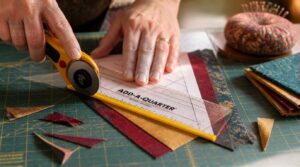
After each stitch line, fold the paper back along the printed seam line and use an Add A Quarter ruler against that fold.
Its raised lip locks the ruler in place so your rotary cutter trims a precise quarter-inch seam allowance every time. That consistent width keeps bulk manageable and your seam uniformity intact across every repeated block.
Removing Paper Cleanly
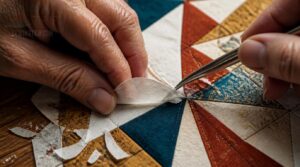
Once your seams are trimmed, timing your paper removal matters. Wait until the unit is fully pieced and pressed — the surrounding seams hold everything stable.
Pull the paper back over the stitch line, not straight up. Support the seam with a fingertip while tearing. Use tweezers for tight corners.
Specialty foundation paper tears cleanest at a 1.3–1.8 mm stitch length.
Avoiding Reversed Fabric Placement
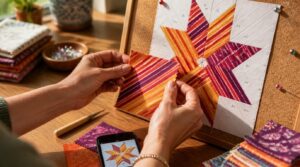
Foundation paper piecing works on the unprinted side, so the finished block mirrors what you see while sewing. Before adding any piece, flip the paper over for a fabric orientation preview. Directional prints — stripes, words, novelty motifs — read backward if you skip this check.
A quick phone photo of the front confirms placement before you commit to a single seam.
Freezer Paper Piecing Techniques
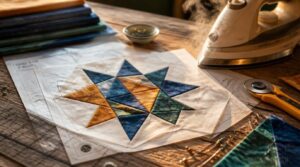
Freezer paper piecing gives you a level of control that’s hard to beat — templates that stick, hold firm, and peel away cleanly without leaving a trace.
It’s one of those methods that feels almost too simple until you see how precise your finished blocks turn out. Here’s what you need to know to make it work.
Reusable Peelable Templates
Freezer paper templates are the unsung heroes of paper piecing — reusable, peelable, and precise. Unlike foundation paper piecing, where paper tears away in fragments, freezer paper lifts off cleanly in one intact piece.
- Trace shapes on the matte side
- Cut to exact pattern shape
- Label with block name and piece letter
- Store flat in labeled envelopes
- Replace when edges nick or curl
Pressing Paper to Fabric
Getting the bond right starts before your iron ever touches the paper. Make sure your fabric is fully dry and lint-free — moisture and loose fibers both weaken adhesion. Place the plastic-coated side down against the fabric’s wrong side.
| Step | Key Detail |
|---|---|
| Heat Settings | Cotton or medium-high, no steam |
| Iron Pressure | Press straight down, don’t slide |
| Bond Duration | 2–5 seconds per area |
Peel slowly from one edge when done.
Folding Along Seam Lines
The fold is everything in freezer paper piecing. Crease exactly on the printed seam line — not the cutting line — using a postcard or index card for a sharp edge.
- A crisp fold separates the seam allowance from the stitched area
- Even 1/16 inch off makes your quarter-inch allowance too narrow or wide
- Repeated folds soften the paper, so replace worn templates promptly
Accurate Fabric Positioning
Place each patch so its longest edge aligns with straight grain — not bias. Bias edges stretch during handling, which throws off your seam allowance fast.
Hold the unit up to a light source to confirm the template edge is fully covered by at least 1/4 inch. Flip the patch into finished position first, then press.
When to Reuse Templates
A reusable freezer paper template earns its keep when the same shape repeats across an entire quilt. Press, peel, and repress it for each duplicate piece — but retire it the moment corners lift, edges nick from your rotary cutter, or finished units start measuring off.
One bad template multiplies every error. Sew a test block first.
Improv Piecing for Modern Designs
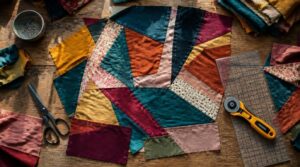
Improv piecing throws out the rulebook — and that’s exactly the point. It gives you real creative freedom while still producing a quilt that holds together beautifully. Here’s what you need to work with to make it happen.
Unstructured Strip Sets
Breaking the rules is exactly the point with unstructured strip sets. Instead of cutting every strip to the same width, you mix measurements — say 1 inch, 1½ inches, 2 inches, and 3 inches — in one panel. Wider strips read bolder; narrow strips add density.
Use a ¼-inch seam consistently, since even a small deviation shifts your finished panel size across multiple joins.
Intuitive Fabric Placement
Once your strip widths feel right, the next question is which fabric goes where. With improv piecing, that decision is instinctive, not random. Start by sorting your fabrics by value — light, medium, dark — before touching the machine. A grayscale photo of your pull instantly reveals whether contrast is spread evenly or clustering in one spot.
- Warm colors advance — reds, oranges, and yellows draw the eye first, so scatter them rather than grouping them.
- Mix print scales — pair one dominant large print with quieter small prints to create clear visual hierarchy.
- Rotate directional prints — turning a stripe from vertical to horizontal changes line movement without adding a new fabric.
Keep a design wall or flat surface nearby. Move one piece at a time, step back, and photograph it. That small pause prevents overpowering one area and keeps the whole composition breathing.
Asymmetrical Block Building
Once you know where each fabric wants to live, the next challenge is building a block that doesn’t mirror itself — and that’s exactly the point.
Asymmetrical blocks combine unequal units: a 2½-inch strip beside a 6½-inch rectangle, both sitting inside one 12½-inch unfinished block. The totals balance; the visual weight doesn’t. That imbalance is what makes modern quilts feel alive.
Trimming for Clean Edges
Once your asymmetrical block is sewn, trimming brings it into shape without killing its character. Use a square acrylic ruler and rotary cutter to clean all four sides evenly.
Always leave ¼ inch beyond seam lines to protect your allowance. Apply spray starch before cutting any bias edges — they stretch fast. Press flat after trimming.
Balancing Spontaneity and Precision
Holding your creative instincts and your ruler in the same hand is the real skill here. Use improv size anchors — fixed finished units like 12 inches — so spontaneous inserts land where they belong. A freemotion foot guides curves freely, while stitch precision at 2.0 mm keeps every seam secure.
| Element | Spontaneous Approach | Precision Check |
|---|---|---|
| Block size | Cut intuitively | Confirm against anchor |
| Seam allowance | Sew freely | Measure ¼ inch consistently |
| Layout | Audition on design wall | Photograph in grayscale |
Curved and Geometric Piecing
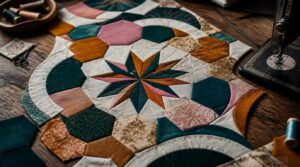
Curved and geometric piecing is where modern quilting really starts to flex its muscles. Shapes like hexagons, curves, and intricate star blocks demand a bit more patience, but they’re what take a quilt from flat to visually stunning. Here’s what you need to know to piece them with confidence.
Sewing Smooth Curved Seams
Curved piecing is where quilting gets interesting — and a little unforgiving. The secret is matching centers first, then ends, breaking each arc into manageable sections.
- Draft opposing templates so seam lines meet at ¼ inch
- Finger-press midpoints before pinning
- Place the concave piece on top while sewing
- Clip concave allowances; notch convex ones
- Press with an up-and-down motion on a tailor ham
Hexagons, Diamonds, Triangles
Hexagons, diamonds, and triangles are the backbone of geometric quilting — and each one brings its own challenges. A regular hexagon breaks into six equilateral triangles, which means bias edges are everywhere. Handle them with up-and-down pressing only.
Use an acrylic 60-degree ruler for precise diamond and triangle cuts, and always mark your seam intersections before joining units at Y seams.
Half-square Rectangle Blocks
Half-square rectangle blocks split a rectangle diagonally, giving you two triangle-filled units that enable layouts like chevrons and arrows. A 3 by 6 inch finished unit trims to 3.5 by 6.5 inches unfinished.
Because that long seam joins two bias edges, press straight up and down — never slide the iron. High-contrast fabrics make the diagonal read sharp from across the room.
Modern Log Cabin Variations
The log cabin block is a shape-shifter.
Courthouse Steps adds strips to opposite sides in pairs, creating a grid-like, four-quadrant look. Half log cabin strips two adjacent sides, making it ideal for asymmetrical modern layouts. Quarter log cabin anchors the square near one corner. Wonky log cabin embraces uneven strip widths for bold, irregular results.
Directional color placement ties every variation together.
Complex Star Block Construction
The Texas star block is where geometry gets personal. Start with 45-degree diamond patches cut precisely using your rotary cutter. Join diamonds into pairs, then use Y seam joining — stopping exactly at your marked quarter-inch intersection, never sewing into the corner. Finally:
- Trim dog ears flat.
- Press with a lifting iron motion.
- Square the block using diagonal ruler markings.
Stitching and Seam Accuracy
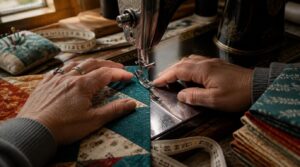
Every gorgeous quilt eventually comes down to one thing: how well your seams hold up. Stitching accuracy isn’t about exactness for its own sake — it’s what keeps your blocks flat, your lines sharp, and your finished quilt looking intentional. Here’s what to focus on when it counts.
Stitching accuracy isn’t about perfectionism — it’s what keeps every seam flat, every line sharp, and every choice intentional
Short Stitch Length Settings
Getting your stitch length right changes everything in quilt construction. For standard piecing, set your machine between 1.8 and 2.0 mm — roughly 12 to 14 stitches per inch. That range locks seams securely without making unpicking a nightmare.
Drop to 1.5 mm for paper piecing, where dense perforations help the paper tear away cleanly afterward.
Maintaining Consistent Seam Allowance
Stitch length gets you in the door — seam allowance keeps you in the room. Most quilt patterns rely on a 1/4 inch seam allowance. Even being 1/16 inch off adds up fast across dozens of joins.
Run a quick test block calibration: sew three 1.5-inch strips together. The center strip must measure exactly 1 inch.
Pressing Seams Flat
Once your seam allowance is locked in, pressing seams flat seals that accuracy in place. Press seams closed first, wrong side up — this sinks the thread before you open the allowances. Use an up-and-down iron motion to avoid skewing your pieces.
Let each unit cool completely on the mat before handling, so the fibers hold their shape.
Reducing Bulky Intersections
Flat seams set the stage — but where they cross, bulk becomes your next challenge.
- Use seam allowance grading to trim one layer to ⅛ inch, the other to ¼ inch
- Spin center seams open a few stitches so allowances rotate into a flat pinwheel
- Nested seam joins butt allowances in opposite directions, keeping intersections to four layers
- Trim dog ears immediately after diagonal piecing to prevent trapped layers
- Plan subunit construction to spread seams across joins, not one center point
Backstitching Only When Needed
Knowing when to backstitch — and when to skip it — is one of those small decisions that quietly shapes your quilting accuracy. Most interior seams don’t need it. A short stitch length of 1.5 to 2.0 mm creates enough thread anchors that later crossing seams lock everything in place naturally.
Save backstitching for exposed raw edges, broken threads, or precise stop points in curved and Y-seams.
Common Piecing Mistakes to Avoid
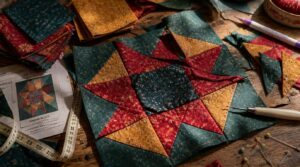
Even experienced quilters hit the same stumbling blocks — and most of them are completely avoidable once you know what to watch for. A few small habits can quietly derail an otherwise beautiful project before you even reach the quilting stage. Here are the most common piecing mistakes and how to sidestep them.
Cutting Inaccurate Fabric Pieces
One misaligned ruler can quietly unravel hours of careful work. Ruler alignment errors are often the first culprit — if your measurement line isn’t sitting exactly on the fabric edge before the rotary cutter moves, every piece comes out slightly off. Even a 1/16-inch slip compounds fast across a full block.
A dull rotary blade makes things worse. Instead of slicing cleanly, it drags threads and leaves fuzzy, uneven edges. You’ll notice yourself pressing harder — and that extra pressure pushes the cutter away from the ruler. Swap the blade before it gets there.
Unprepared fabric cutting adds another layer of error. Press your fabric completely flat before touching the mat. Wrinkles and ripples make strips measure inconsistently from one end to the other. Square one crosswise edge first, and always print templates at 100% — verify against the pattern’s control box with a ruler before cutting a single piece.
Stretching Bias Edges
Stretching a bias edge is one of those mistakes that sneaks up on you. Any diagonal cut — think half-square triangles or curved piecing shapes — sits on the bias and will shift under even light handling.
Use leader and ender scraps to anchor units at the machine, apply heavy starch before cutting, and always support finished blocks flat on a design board rather than letting them hang.
Skipping Test Blocks
Skipping a test block is like skipping a dress rehearsal — everything looks fine until it isn’t. Here’s what one sample block actually confirms before you commit your full yardage:
- Seam allowance accuracy — a 1/16-inch drift multiplies fast across eight blocks
- Fabric behavior — how your chosen bundle cuts, feeds, and presses
- Color contrast — whether shapes actually read at real scale
Sew one block first. Always.
Ignoring Seam Direction
Seam direction isn’t optional — it’s a built-in alignment system. When you press opposing seams toward each other, they nest and lock at intersections, reducing side-to-side shifting before the needle even touches fabric.
Ignore that, and you’re stacking up to eight fabric layers in one spot, creating ridges that throw off your block flatness, point accuracy, and row consistency.
Overcomplicating Modern Layouts
Modern quilts breathe through simplicity — the moment you pile in too many block families, competing focal points fracture your composition.
Stick to one or two repeated forms. Keep negative space intact, let bold geometry lead, and resist adding pieced units where a single cut works cleanly. Less complexity means more impact.
Frequently Asked Questions (FAQs)
What are the quilters in jail for?
Prison quilters aren’t jailed for one reason. Convictions vary widely — drug offenses, property crimes, assault. Quilting programs admit based on conduct and eligibility, not offense type. Public records rarely list participants’ charges.
How do I quilt with metallic or 3D threads?
Use a size 90/14 metallic needle and slow your machine to around 400–600 SPM. Reduce upper tension slightly. For 3D threads, try couching with a zigzag stitch instead.
Can raw edge appliqué work on modern quilts?
Yes, raw edge appliqué works beautifully on modern quilts. It delivers bold shapes, pairs with negative space, and accommodates high contrast edges cleanly. Fuse pieces, stitch the perimeter, and you’re done.
What is trapunto and how is it used?
Trapunto is a raised surface technique that stuffs extra padding beneath stitched motifs, lifting them above the quilt’s surface. It creates a three-dimensional effect using either hand stuffing or a machine layer method with high-loft batting.
How do I combine improv and foundation piecing?
Let the foundation control the geometry while improv fills the rest. Draft one key angle or focal shape, then piece surrounding strips freely. Trim all units to matching sizes before joining.
Which organic fabrics hold up best over time?
Regarding the long game, hemp and linen win.
Both resist tearing and abrasion far better than silk.
Organic cottons and wool hold up well too, especially in tighter weaves.
Conclusion
Congratulations—you’ve now mastered the radical art of measuring twice and cutting once. Truly novel stuff.
But here’s what the rulebooks won’t tell you: contemporary quilt piecing methods only open when you actually run fabric through the machine. No amount of careful reading ever squared a seam. Every block you build sharpens your eye for negative space, contrast, and scale.
So put the guide down. Pick up your rotary cutter. The quilt doesn’t make itself.
- https://www.countrysidequilts.com/blogs/countryside-stitches/top-quilting-trends-for-2025-new-techniques-and-projects-every-crafter-should-try
- https://likesew.com/blog/quilting-trends
- https://blog.sewingboutique.com/quilting-trends-2025-walking-foot-vs.-free-motion-the-colors-inspiring-todays-stitchers
- https://www.seasonedhomemaker.com/the-best-steam-iron-for-sewing-and-quilting
- https://sherriquiltsalot.com/2024/03/20/a-pressing-matter