This site is supported by our readers. We may earn a commission, at no cost to you, if you purchase through links.
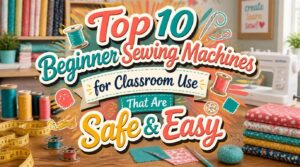
Picture twenty-five seventh graders, twenty-five sewing machines, and one bobbin thread already tangled beyond recognition. Sound familiar? If you teach Family and Consumer Sciences, you know that chaos can turn into confidence with the right equipment in the room.
Not every machine belongs in a classroom. Home sewists want fancy stitches; you need durability, safety, and simplicity that survive back-to-back class periods without a meltdown (yours or the machine’s).
That’s where picking the right beginner sewing machines for classroom use makes all the difference. Grab your coffee, because you’re about to find ten machines that’ll have even your most nervous student threading a needle like a pro.
Table Of Contents
- Key Takeaways
- Top 10 Classroom Sewing Machines
- 1. Brother XM2701 Sewing Machine
- 2. Brother XR9550 Sewing and Quilting Machine
- 3. KPCB Tech Beginner Sewing Machine Kit
- 4. LEETAT Portable Handheld Sewing Machine
- 5. Portable Cordless Handheld Sewing Machine
- 6. FNV Complete Travel Sewing Kit
- 7. Singer M3330 Sewing Machine
- 8. Singer Heavy Duty 4432 Sewing Machine
- 9. Brother CP60X Computerized Sewing Machine
- 10. Brother HC1850 Sewing and Quilting Machine
- Classroom Buying Considerations
- Beginner-Friendly Features
- Safety and Classroom Management
- Maintenance for School Use
- Frequently Asked Questions (FAQs)
- Conclusion
Key Takeaways
- Classroom sewing machines should prioritize durability, safety, and simplicity over fancy features, with Brother and Singer models like the XM2701, XR9550, and Singer M3330 being top picks for beginners.
- Key beginner-friendly features to look for include automatic needle threaders, drop-in bobbin systems, adjustable speed control, simple stitch selection, and easy presser foot changes.
- Safety measures such as finger guards, cordless power options, start-stop button controls, proper seating layout, and active teacher supervision are essential for a safe classroom sewing environment.
- Budget around $150-$300 per machine, and maintain equipment through regular cleaning, needle replacement every 8-12 hours, organized bobbin systems, and protective carrying cases to ensure machines last 5-10 years.
Top 10 Classroom Sewing Machines
Picking the right machine for your classroom can feel overwhelming with so many options out there. Good news: you don’t need to guess, because we’ve done the homework for you! Here are ten beginner-friendly machines that check every box for safety, ease, and durability.
If you’re curious how much of a learning curve to expect, this guide on whether machine embroidery is hard to learn breaks down what beginners really face.
1. Brother XM2701 Sewing Machine
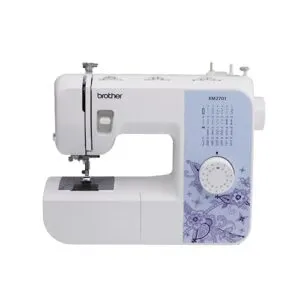
Think of this one as the reliable minivan of classroom machines: nothing fancy, but it gets everyone where they need to go. With 27 built-in stitches, an automatic needle threader, and a jam-resistant drop-in bobbin, your students can focus on learning instead of wrestling with setup.
At under 13 pounds with a carrying case, it’s easy to store between classes. Backed by a 25-year warranty, it’s built to survive a whole lot of first projects!
| Best For | classrooms and beginner sewists who want a simple, no-fuss machine for everyday projects like hemming and basic garment work. |
|---|---|
| Built-in Stitches | 27 stitches |
| Needle Threader | Automatic |
| Buttonhole Function | One-step |
| Beginner Friendly | Yes |
| Portability | Free arm, portable |
| Power Source | 120V electric |
| Additional Features |
|
- Automatic needle threader and jam-resistant drop-in bobbin make setup easy for beginners
- 27 built-in stitches plus a one-step buttonhole function cover most everyday sewing needs
- 25-year limited warranty and lifetime access to Brother technical support offer great long-term peace of mind
- At 12.6 pounds, it’s not the lightest option for frequent transport between classes
- Only compatible with 120V power, limiting use to the US
- No mention of a carrying case included, so extra storage solutions may be needed
2. Brother XR9550 Sewing and Quilting Machine
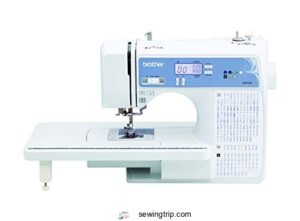
Ready to level up? The XR9550 is your quilting-and-more upgrade, packing 165 built-in stitches and an LCD screen that makes selection a breeze.
Eight one-step buttonholes, a wide table for bigger projects, and automatic threading mean students spend less time fumbling and more time creating. A built-in handle makes hauling it between rooms simple.
At 10.1 pounds, it’s still classroom-friendly. Just remember: it’s a 120V, US-only machine, so keep that in mind for travel programs!
| Best For | The XR9550 is best for beginner-to-intermediate sewists and quilters, including students and classroom settings, who want an easy-to-use machine with room to grow. |
|---|---|
| Built-in Stitches | 165 stitches |
| Needle Threader | Automatic |
| Buttonhole Function | 8-style one-step |
| Beginner Friendly | Yes |
| Portability | Portable, wide table |
| Power Source | 120V electric |
| Additional Features |
|
- 165 built-in stitches plus an intuitive LCD display make stitch selection quick and beginner-friendly
- Automatic needle threading and a wide table make quilting and everyday sewing more convenient
- Lightweight and portable at 10.1 pounds, so it’s easy to move between classrooms or take to sewing groups
- Limited to 120V power, so it’s only suitable for use in the US and isn’t ideal for travel programs abroad
- May struggle when sewing through very thick or heavy fabrics
- Some users find the automatic needle threader feels flimsy over time
3. KPCB Tech Beginner Sewing Machine Kit
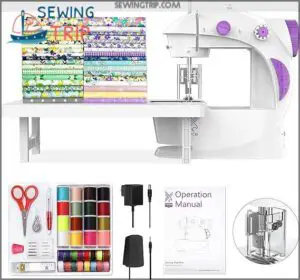
Not every classroom needs the biggest machine on the shelf—sometimes a starter kit does the trick. The KPCB Tech kit comes with a 42-piece accessory set, a built-in LED light, and a finger guard for extra safety.
Its foot pedal and extension table give students a stable surface, while adjustable speeds let beginners ease in slowly. Best part? Setup is quick, so kids spend more time stitching than untangling instructions.
| Best For | This kit is best for beginners and kids just learning to sew who want a simple, safe machine to practice on. |
|---|---|
| Built-in Stitches | N/A (manual) |
| Needle Threader | Manual threader tool |
| Buttonhole Function | None |
| Beginner Friendly | Yes |
| Portability | Compact, lightweight |
| Power Source | US adapter |
| Additional Features |
|
- Comprehensive starter kit with bobbins, scissors, measuring tape, thimble, and needle threader, plus 20 pieces of cotton fabric to start practicing right away
- Dual stitching speeds with a slow mode make it easy for beginners to build confidence
- Built-in thread cutter and finger guard add convenience and safety during use
- Plastic construction may feel less durable than professional metal machines
- Lacks a reverse stitch function
- Fixed tension settings can lead to occasional thread breakage
4. LEETAT Portable Handheld Sewing Machine
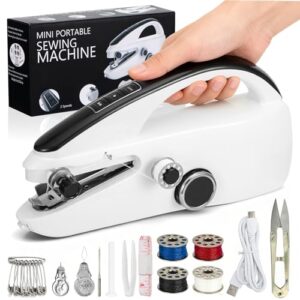
Sometimes a quick fix beats a full setup. LEETAT weighs under a pound and fits right in a backpack, making it perfect for fast hemming or patch jobs between projects.
It runs on AA batteries or USB power, so cords aren’t tripping anyone. A guarded needle keeps little fingers safer, and pre-threading means less fumbling. It won’t replace a tabletop machine, but for teaching quick repairs, it’s a handy little helper worth keeping in your supply closet.
| Best For | Beginners and on-the-go menders who need a lightweight, portable option for quick clothing repairs and hems. |
|---|---|
| Built-in Stitches | N/A (one-button) |
| Needle Threader | None |
| Buttonhole Function | None |
| Beginner Friendly | Yes |
| Portability | Ultra compact |
| Power Source | AA batteries/USB |
| Additional Features |
|
- One-button operation makes it easy for beginners to pick up
- Flexible power options with 4 AA batteries or USB, plus dual-speed stitching up to 378 stitches per minute
- Compact and lightweight, perfect for travel or storing in a supply closet
- Some users report inconsistent quality, with occasional battery or USB power issues
- Only handles fabrics up to 1.5 mm thick, so heavier materials like thick denim may not sew well
- No built-in guides or detailed instructions, requiring manual fabric handling
5. Portable Cordless Handheld Sewing Machine
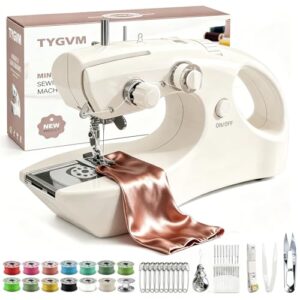
When outlets are scarce, this little machine saves the day. It runs on two AA batteries with a built-in presser foot and preset thread tension, so students won’t wrestle with snags.
With 32 stitches, a sturdy stainless steel bed plate, and an automatic needle threader, it’s a solid pick from this roundup of beginner sewing machines for clothing repairs.
Weighing under a pound, it works with cotton, nylon, and thin denim, with reverse stitching to lock seams. A single-button start-stop keeps things simple, and automatic shutoff prevents overheating. Perfect for teaching quick, confidence-building repairs without complicated setup.
| Best For | Students, beginners, and DIY enthusiasts who need a simple, no-fuss way to make quick clothing repairs at home, in the dorm, or on the go. |
|---|---|
| Built-in Stitches | N/A (lock stitch) |
| Needle Threader | None |
| Buttonhole Function | None |
| Beginner Friendly | Yes |
| Portability | Compact, wireless |
| Power Source | AA batteries/AC |
| Additional Features |
|
- Cordless and lightweight, so it’s easy to carry in a bag or drawer for repairs anywhere
- Simple single-button operation with automatic shutoff makes it beginner-friendly and safe to use
- Handles everyday fabrics like cotton, nylon, and thin denim with reliable reverse stitching to lock seams
- Runs on AA batteries only, which may need frequent replacing and aren’t included
- Limited to a single lock stitch, so no decorative or multi-pattern options
- Not suited for thick materials like heavy denim layers or upholstery leather
6. FNV Complete Travel Sewing Kit
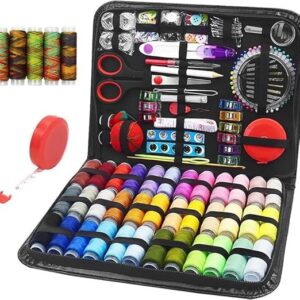
Sometimes hand sewing beats machine work, and that’s where this kit shines. Packed with needles, thread, and precision scissors, it fits easily in a desk drawer or backpack.
You’ll love how the organized case keeps everything from spilling mid-lesson. It’s great for button repairs, seam fixes, and teaching basic hand-stitching before students touch a machine.
Fair warning: with so many pieces, younger learners might feel a little overwhelmed at first, so introduce sections gradually!
| Best For | This kit is best for beginners, hobbyists, and travelers who want a compact, all-in-one solution for hand sewing and quick garment repairs. |
|---|---|
| Built-in Stitches | N/A (kit) |
| Needle Threader | Manual threader tool |
| Buttonhole Function | None |
| Beginner Friendly | Yes |
| Portability | Pocket-sized case |
| Power Source | N/A (manual tools) |
| Additional Features |
|
- Comes with 229 pieces, including needles, scissors, tape measures, and other handy accessories, so you’re ready for almost any repair
- Portable case makes it easy to toss in a bag, pocket, or trunk for on-the-go fixes
- Great for teaching basic hand-stitching skills before moving on to a sewing machine
- Small items like pins and needles can be easy to misplace if not stored carefully
- Scissors are best for light to medium tasks, not heavy-duty cutting jobs
- Included thread spools may not match every fabric type or machine requirement
7. Singer M3330 Sewing Machine
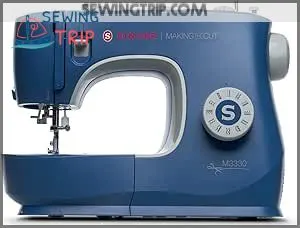
Once your students master hand stitches, this navy blue workhorse is a natural next step. With 23 built-in stitches and 97 applications, there’s room to grow without overwhelming beginners.
The integrated needle threader and one-step buttonhole keep frustration low. A free arm controls sleeves and cuffs like a champ, while snap-on feet make switching techniques quick.
Heads up: bobbin installation trips up some users, so demonstrate it slowly before letting students fly solo!
| Best For | Beginner sewers and students transitioning from hand stitching who want an easy-to-use machine that grows with their skills. |
|---|---|
| Built-in Stitches | 23 stitches (97 apps) |
| Needle Threader | Automatic |
| Buttonhole Function | One-step |
| Beginner Friendly | Yes |
| Portability | Portable design |
| Power Source | 120V electric |
| Additional Features |
|
- 23 built-in stitches offering 97 applications, giving beginners plenty of room to grow
- Integrated needle threader and one-step buttonhole function reduce frustration and eye strain
- Free arm design makes sewing sleeves and cuffs simple, with snap-on feet for quick technique changes
- Bobbin installation can be tricky and may cause frequent jamming for new users
- The automatic needle threader, while helpful in theory, can be difficult to operate
- Requires a voltage transformer for use in regions with 220V power
8. Singer Heavy Duty 4432 Sewing Machine
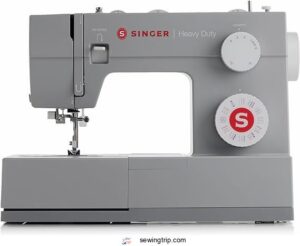
Ready for older students who mean business, this grey beast grips denim and canvas like it’s nothing. With a 1,100 stitches per minute top speed and heavy-duty metal frame, it powers through thick fabrics without bogging down.
You get 32 stitches, a one-step buttonhole, and a stainless steel bed plate for smooth feeding. The built-in needle threader and adjustable presser foot pressure round it out nicely.
Just know the power cord runs short, so plan your table setup accordingly!
| Best For | Older students, hobbyists, and upcyclers who need a durable machine that can handle everything from heavy denim and canvas to delicate, lightweight fabrics. |
|---|---|
| Built-in Stitches | 32 stitches (110 apps) |
| Needle Threader | Automatic |
| Buttonhole Function | One-step |
| Beginner Friendly | Yes |
| Portability | Table-mountable |
| Power Source | 120V electric |
| Additional Features |
|
- Powerful 1,100 stitches-per-minute motor with a heavy-duty metal frame tackles thick materials like denim, canvas, and leather with ease
- 32 built-in stitches plus a one-step buttonhole function offer plenty of versatility for garment design and home decor projects
- Adjustable presser foot pressure, integrated needle threader, and a top drop-in bobbin make it easy to switch between heavy-duty and delicate work
- The integrated power and foot pedal cord may be too short for some table setups
- On/Off and feed dog switches can be hard to reach once the machine is mounted in a table
- Some users report no physical instruction manual included, and bobbin winding can be tricky while the machine is threaded
9. Brother CP60X Computerized Sewing Machine
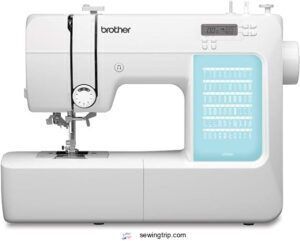
Want tech smarts without the intimidation factor? The CP60X brings 60 built-in stitches to your table, all displayed on a bright LCD screen so students pick with confidence, not guesswork.
Seven auto-size buttonholes, a 2-step needle threader, and a quick-set drop-in bobbin keep setup fast. The drop feed aids free-motion quilting, too.
Best part? Brother backs it with a 25-year limited warranty — huge peace of mind for busy classrooms.
| Best For | Beginners and students who want an easy, tech-friendly sewing machine for everything from garments to free-motion quilting. |
|---|---|
| Built-in Stitches | 60 stitches |
| Needle Threader | 2-step automatic |
| Buttonhole Function | 7-style one-step |
| Beginner Friendly | Yes |
| Portability | Lightweight portable |
| Power Source | 120V electric |
| Additional Features |
|
- 60 built-in stitches with an LCD screen make stitch selection simple and beginner-friendly
- Auto-size buttonholes and a 2-step needle threader speed up setup and reduce fuss
- Lightweight, portable design with free-arm capability handles a wide range of fabrics and projects
- Limited to 120V, so it’s only usable in the US without a converter
- Extremely thick materials may be tricky to sew through
- Adjusting stitch width and length can take a bit of practice for new users
10. Brother HC1850 Sewing and Quilting Machine
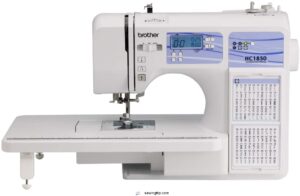
Rounding out our list is a machine that grows with your students: the HC1850. With 185 built-in stitches and a detachable wide table, it takes care of everything from quilting projects to garment construction without blinking.
The auto needle threader and jam-resistant bobbin keep setup painless, while push-button stitch selection on the backlit LCD makes choosing patterns a breeze. Eight presser feet cover nearly any classroom assignment. Best part? Brother’s At Your Side support means help is always one call away.
| Best For | Sewing students and hobbyists who want one machine that can handle quilting, garment sewing, and light monogramming without a steep learning curve. |
|---|---|
| Built-in Stitches | 185 stitches |
| Needle Threader | Advanced automatic |
| Buttonhole Function | One-step auto-size |
| Beginner Friendly | Yes |
| Portability | Portable, wide table |
| Power Source | 120V AC |
| Additional Features |
|
- 185 built-in stitches plus a detachable wide table make it versatile enough for quilting, clothing construction, and heirloom projects
- Auto needle threader, jam-resistant drop-in bobbin, and a backlit LCD with push-button selection keep everyday setup and stitch choice simple
- Lifetime access to Brother’s At Your Side technical support means help is easy to find whenever it’s needed
- Only intended for sale and use in the US, and it requires 120V power, so it’s not a good fit outside that market
- Using it with non-120V power, even with an adapter, voids the warranty
- Comes with an instructional DVD, which isn’t useful without a compatible player
Classroom Buying Considerations
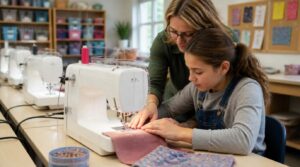
Now that you’ve seen the top 10 machines, how do you pick the right one for your classroom? A great machine on paper won’t help much if it doesn’t fit your students, your space, or your budget. Let’s break down the five things every teacher should check before buying.
Student Skill Level
Before buying anything, picture your students’ hands: are they total beginners or have they touched a machine before?
Match the machine to skill progression stages—simple straight stitching for newbies, more stitch variety for developing sewers.
This keeps cognitive load manageable, builds motor skills steadily, and lets you assess proficiency accurately as everyone grows more confident, one seam at a time!
Machine Weight and Size
Once skill level’s sorted, think about the machine itself. A 25-pound quilting beast doesn’t belong in a middle schooler’s hands—that’s a student lifting safety issue waiting to happen.
Look for:
- Lightweight models under 20 lbs
- Compact size (12-14 in. width)
- Sturdy, non-tippy footprints
- Ergonomic carrying grips
Balance portability vs stability—too light wobbles, too heavy strains backs!
Classroom Storage Needs
Now that you’ve picked a lightweight machine, where’s it going to live when class ends? That’s where vertical wall shelving and mobile carts earn their keep.
Tall shelves store bins up to ceiling height; carts wheel supplies to stations. Under-desk bins hold rulers and scissors within arm’s reach. Add color-coded labels and modular wall panels, and cleanup becomes second nature!
Budget Per Workstation
Let’s talk dollars, because budget-friendly classroom supplies matter as much as bells and whistles.
- Basic models: $150–200, bulk-friendly
- Mid-range: $250–300 with LED lighting, auto-threaders
- Heavy-duty: up to $350
Budget accessories ($25–60) and consumables ($10–20/year) too. Bulk purchasing stretches limited funds while delivering beginner-friendly machines built for long-term classroom value!
Warranty and Support
Because twenty machines running daily will eventually hiccup, don’t skip the fine print on sewing machine warranty coverage. Review the parts and labor warranty details to know what repairs are covered.
Register within 30 days, expect a 1–3 day claim turnaround, and ask about loaner machine availability during repairs. Watch for repair exclusions like misuse damage.
Keep maintenance manuals handy and consider extended coverage—good technical support saves your budget and your sanity!
Beginner-Friendly Features
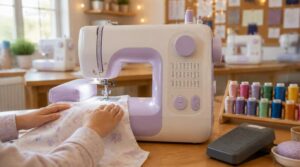
Now that you’ve thought through the buying basics, let’s talk about what actually makes a machine easy to learn on. Not every feature is created equal when you’re teaching beginners! Here are the five must-haves that’ll save you tears, tangled thread, and a whole lot of "wait, how do I do this again?" moments.
Automatic Needle Threader
Squinting at a tiny needle eye while twenty students wait their turn? No thanks. Automatic needle threading uses a lever for one-handed operation, pulling thread through in under a second.
Look for threading slot versatility (fits small and large eyes) and integrated cutter safety for clean snips. Check needle size compatibility and stay on top of mechanism durability maintenance for reliably easy threading.
Drop-in Bobbin System
Since fumbling with a bobbin case eats up class time, go with a drop-in bobbin system for easy threading. The transparent housing lets students monitor thread visually, spotting tangles early.
- No case to detach
- Rapid bobbin swapping
- Simplified tension management
- Reduced thread tangling
- Clear supply checks
These beginner-friendly machines keep classroom-friendly safety features front and center!
Adjustable Speed Control
Ever hit the gas too hard and lurched forward? That’s exactly what happens when beginners sew without a speed control slider.
Look for machines with dual speeds and smooth acceleration ramp benefits—they prevent fabric bunching and protect motor torque management. Real-time speed feedback keeps stitches even, while speed override locks stop curious hands from cranking things up. These features make classroom-friendly machines truly beginner-friendly, building confidence one careful stitch at a time!
Simple Stitch Selection
Fewer buttons, less panic. Beginner-friendly machines keep stitch menus short and clearly labeled, so students pick a straight stitch, zigzag, or buttonhole without hunting through 165 options.
- Zigzag stitches finish raw edges like a pro
- Buttonhole settings build confidence fast
- Simple dials mean less "what does this button do?"
Matching stitch to fabric—straight for wovens, zigzag for stretch—makes classroom-friendly machines feel foolproof!
Easy Presser Foot Changes
Swapping feet shouldn’t feel like a pop quiz! Most beginner-friendly machines use snap-on presser feet—press the release lever, click on a zipper or buttonhole foot, done in seconds.
Screw-on alternatives exist too; just loosen, swap, tighten snug.
Check foot compatibility before class starts. If fabric jams, reseat the foot—it boosts ease of use and student safety in every classroom-friendly machine.
Safety and Classroom Management
Safety isn’t just a nice bonus in your classroom, it’s the whole foundation. Once you’ve picked a machine with beginner-friendly features, the next question is how you keep little fingers and busy rooms safe while everyone sews. Let’s break down what to look for.
Finger Guard Options
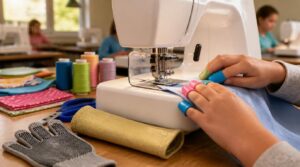
Finger guards are your best friend when little fingers meet fast needles. Silicone fingertip caps offer flexible, washable protection for everyday stitching.
Need tougher coverage? Kevlar shield sleeves or rigid plastic guards handle abrasive fabrics like champs. Protective sewing gloves work great for group projects.
These safety features build real student safety in crafting—no scary surprises, just confident, beginner-friendly machines doing their thing!
Cordless Power Choices
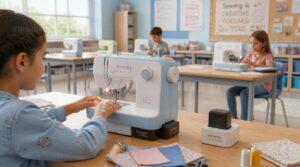
Cords turn a busy classroom into a tripping-hazard obstacle course, so battery and USB power options keep things safer.
Lithium batteries pack more punch with less weight, and charging docks refill them fast between classes. Look for 18V or 20V voltage platform compatibility across your portable sewing machines. Watch battery runtime and weight distribution too—balanced, beginner-friendly machines with these safety features feel steadier in young hands!
Start-stop Button Controls
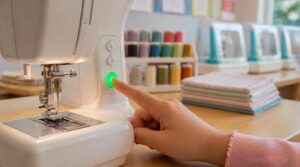
Start-stop button controls put you in charge with just one press. Many beginner-friendly machines light up the button so you know it’s ready to go, and tactile feedback gives that satisfying click.
Safety interlocks stop the machine if something’s off—like a jam. If a button sticks, check for dust before assuming it’s broken!
Safe Seating Layout
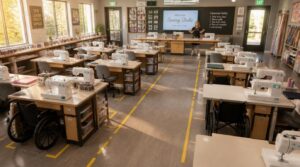
Good buttons mean nothing if your room’s a maze! Keep aisle width at 900mm minimum so nobody trips carrying fabric.
Stagger rows for clear student sight lines to you and the demo table. Leave 1200mm leg room per station, plus gaps near tables for quick emergency egress.
Don’t forget accessible seating — two wheelchair-friendly stations, minimum, keep everyone included and safe.
Teacher Supervision Tips
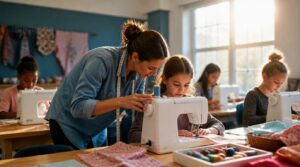
Once your seating’s set, supervision makes or breaks safety compliance. Walk the room like you’re on patrol, not parked at your desk!
- Rotate check-ins using a supervision schedule
- Run quick coaching moments during practice
- Keep an observation log for continuity
- Use praise-first feedback models
- Watch student engagement, not just machines
Your eyes catch problems before they become accidents.
An attentive teacher’s watchful eyes catch problems before they ever become accidents
Maintenance for School Use
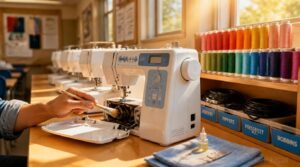
Now that your machines are safe to use, let’s keep them running strong all year long. A little upkeep goes a long way toward avoiding classroom meltdowns mid-project! Here’s exactly what you need to stay on top of.
Cleaning After Lessons
Sweep fabric scraps and threads into a covered bin, wipe down surfaces with disinfectant, and gather pins with a magnet. Empty waste bins, brush lint from machine exteriors, and store tools properly.
Quick habits like these keep classrooms safe, sanitary, and ready for tomorrow’s stitching adventures—no cross-contamination, no surprises.
Needle Replacement Schedule
A few dull needles can wreck an entire class period’s worth of projects! Swap needles every 8-12 hours of sewing—sooner for denim, later for lightweight cotton. Watch for:
- Skipped stitches
- Fabric snags
- Needle wobble
- Faint stitch lines
- Visible burrs
Toss old needles into a sharps container immediately. Schedule swaps between classes to dodge downtime!
Bobbin Organization System
Color coding saves your sanity here—sort bobbins by thread brand and weight so nobody’s hunting through a junk drawer mid-project.
Use transparent containers for quick visual checks, and a rolling cart with labeled drawers for easy access. Keep a simple inventory sheet to track what’s running low.
Whether your machines use drop-in bobbin systems or front-load styles, consistent tension and tucked tails keep bobbins ready to grab and go!
Transport Case Protection
Think of the case as a shock absorber for your machine’s whole life. A sturdy carrying case with pick-and-pluck foam keeps every model snug, while a rubber-gasket seal blocks dust and spills.
Look for a protective case with reinforced corners and a stainless steel hasp—that’s real durability against daily drops between classrooms.
Repair Parts Availability
A machine’s only as good as its next repair. Brother and Singer keep parts flowing for 10-15 years, with needles shipping in 24-48 hours from regional supplier networks.
- Choosing OEM vs Aftermarket parts
- Asking about modular component swaps
- Stocking bulk inventory for common fixes
That planning keeps your classroom’s sewing machine maintenance running smoothly, stretching equipment lifespan without surprise downtime.
Frequently Asked Questions (FAQs)
What is the easiest sewing machine to use for a beginner?
For pure beginner setup ease, the Singer Start 1304 wins hands-down! One dial picks stitches, an automatic needle threader saves your eyes, and it’s electronic (not manual), so the learning curve stays gentle for first-timers.
What sewing machine do schools use?
Schools lean on Brother and Singer most, thanks to reliable service and educational kits. Districts often standardize one model per classroom, weighing budget-friendly pricing, warranty support, and easy-to-use features like automatic threaders over pricier computerized options.
What is a good beginner sewing machine for kids?
A good kid’s machine is training wheels for creativity: the Brother XM2701 fits the bill, with easy threading, simple controls, and kid-friendly ergonomics that keep frustration low while young sewers tackle age-appropriate projects safely and confidently.
How much should I spend on a sewing machine as a beginner?
Aim for the $150–$300 sweet spot—it’s the budget-friendly zone where mechanical machines feel durable, not flimsy. You’ll get essential stitches without overpaying, plus room to upgrade later as skills (and projects) grow!
How long do classroom sewing machines typically last?
Think of your machine like a trusty pair of scissors: dull with neglect, sharp with care. With proper maintenance and light use, most classroom machines run 5 to 10 years—sometimes longer, especially sturdy mechanical models over fussier electronic ones!
Can students practice sewing skills at home too?
With home practice kits, affordable starter machines, and safe home setups, students can strengthen classroom lessons, tackling garment repairs and simple hems—building real sewing education confidence between school sessions, one stitch at a time.
What curriculum activities pair well with machine lessons?
Two birds, one stone: pair machine time with fabric sorting exercises, bead stitch simulation, project planning outlines, sewing log tracking, and post-lesson reflections.
This project-based learning combo builds beginner sewing skills through hands-on learning students actually remember.
How should group sewing projects divide student responsibilities?
Give each teammate a skill-based role—project manager, sewing specialist, quality control lead—with rotating leadership every cycle.
This builds real ownership through hands-on, collaborative projects while spreading skills evenly across your whole sewing curriculum!
Conclusion
A sturdy sewing machine is like a good pair of scissors: reliable, sharp when needed, and built to keep working through every wobbly hand that grabs it. You don’t need bells and whistles, just beginner sewing machines for classroom use that survive twenty-five first attempts a day.
Pick one from this list, set it up right, and watch nervous fingers turn into confident hands. That’s the real win—stitch by stitch, student by student.
- https://meissnersewing.com/blogs/inspiration/best-sewing-machine-to-buy-for-kids
- https://littlestitchstudio.com/blog/2016/4/27/the-best-sewing-machine-for-beginning-sewers
- https://mypacklove.com/blogs/label/top-7-best-sewing-machines-for-beginners-in-2025-expert-picks
- https://www.applegreencottage.com/best-sewing-machine-for-beginners
- https://www.lindazs.com/post/best-sewing-machine-for-beginners-2026