This site is supported by our readers. We may earn a commission, at no cost to you, if you purchase through links.
Most sewists never think about what happens inside their machine during a stitch—and that’s fine, until something goes wrong. A skipped stitch, a thread jam, or a machine that sounds like it’s chewing gravel usually traces back to one small, spinning (or swinging) component: the hook.
Rotary, oscillating, horizontal, vertical—these aren’t just spec sheet details. They determine how fast your machine runs, how much maintenance it demands, and whether it can handle the work you’re throwing at it. Knowing the difference puts you in control of your equipment instead of at its mercy.
Table Of Contents
Key Takeaways
- Rotary hooks spin a full 360° continuously, making them faster and more jam-resistant, while oscillating hooks swing back and forth—which means more vibration but more forgiveness with heavy threads.
- Hook timing is everything: even a fraction of a millisecond off during loop capture causes skipped stitches, so it’s the first thing to check when your machine starts misbehaving.
- Horizontal drop-in bobbins make thread changes faster and easier to see, but vertical systems handle heavier materials better and keep tension more stable through a straighter thread path.
- Your hook type doesn’t determine seam strength—thread quality, stitch density, and fabric choice do that—but it does directly affect speed, noise, consistency, and how much maintenance you’ll need.
What Sewing Machine Hooks Do
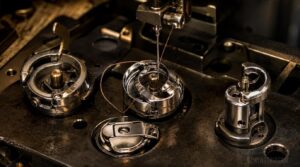
Before you can compare hook types, you need to understand what a hook actually does inside your machine.
Knowing how the hook moves thread through each stitch cycle makes sewing machine hook replacement and compatibility a much less intimidating process.
It’s a small part, but the entire stitch depends on it getting one job exactly right.
Here’s what’s happening every time your needle moves.
How The Hook Catches The Upper-thread Loop
The hook’s entry path is everything here. The spinning steel hook captures the needle thread loop with precise timing. Right as the needle withdraws, the upper thread loop forms — small, brief, and perfectly exposed. This is the capture timing window.
Missing it by even a fraction causes a skipped stitch. Loop size control through thread tension keeps that loop accessible. The hook slips in, seizes it cleanly, and stitch formation begins.
How The Hook Works With The Needle and Bobbin
Once the loop is seized, three components take over in rapid sequence. The needle rises, the hook carries the upper thread around the bobbin case, and the take-up lever pulls everything taut. Here’s what that teamwork looks like in practice:
- Needle Rise Synchronization triggers Loop Release Mechanics at peak loop size
- Hook Clearance Tolerances keep the tip from snagging the bobbin case
- Bobbin Thread Feed stays passive — the hook threads around it, not through it
- Take-up Lever Interaction cinches the interlock into the fabric layers
- Lockstitch Formation completes whether you’re running an oscillating hook, rotary hook, horizontal rotary hook, or vertical rotary hook
How Lockstitches Form Around The Bobbin Case
That teamwork between needle and hook pays off in a surprisingly elegant knot. As the hook tip radius sweeps the upper thread around the bobbin case, the take-up lever tightening cinches everything into place — that’s lockstitch knot geometry in action.
Thread path alignment and bobbin case clearance keep the whole exchange clean, whether running an oscillating hook, rotary hook, or horizontal rotary hook.
Why Hook Timing Affects Skipped Stitches
Timing is everything in stitch formation — a missed capture window, even by a fraction, results in a skipped stitch. Precise synchronization ensures the hook tip radius intercepts the ascending thread loop at the exact moment.
Needle-hook phase alignment dictates this critical interception. If the timing is off—too early or too late—the loop escapes, causing flaws.
Timing backlash effects compound the problem, accelerating issues. Thus, diagnostics are the first thing to check on both oscillating hook and rotary hook machines to resolve skipped stitches.
Why Hook Type Does Not Change Seam Strength
Whether you’re running a rotary or oscillating hooks, seam strength comes down to thread tensile properties, stitch density, and fabric weave — not hook geometry. Needle and bobbin thread interaction do the real work, with the bobbin thread’s contribution being particularly vital.
The hook’s primary function in stitch formation is loop capture, not load bearing. While hook design influences stitch quality, it does not directly determine seam strength.
Ultimately, thread and fabric choices drive seam strength, as these factors govern the structural integrity of the seam under stress.
Rotary Vs Oscillating Hooks
The hook type your machine uses shapes everything from how fast you can sew to how often you’re stopping to fix jams.
Rotary and oscillating hooks look similar on the surface, but they behave very differently under load. Here’s what sets them apart.
Rotary Hook 360-degree Continuous Motion
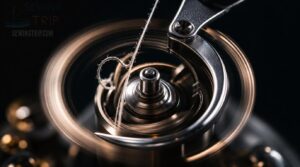
The rotary hook never stops — it spins a full 360° around the bobbin case on every single stitch.
That constant rotation benefits everything downstream: rapid loop capture, smooth stitch flow, and almost zero thread jams.
| Feature | Rotary Hook Behavior |
|---|---|
| Motion type | Continuous rotary motion |
| Bearing precision | Critical for minimal wobble |
| Rotational inertia | Bolsters high-speed consistency |
| Hook style | Full rotary machine |
| Orientation options | Horizontal rotary hook or vertical rotary hook |
Oscillating Hook Back-and-forth Swing Motion

Unlike the rotary hook’s smooth spin, the oscillating hook swings back and forth — roughly 200° per stitch — then reverses to start again. Swing amplitude control depends entirely on linkage geometry effect and cam profile design. Get those wrong, and your stitches pay the price.
| Oscillating Hook Feature | What It Means for You |
|---|---|
| Hook motion type | Back-and-forth arc swing |
| Pivot wear impact | Alters swing amplitude over time |
| Vibration damping methods | Limited; reversal creates more noise |
| Cam profile design | Controls timing and loop capture |
| Oscillating hook mechanisms in Bernina machines | Known for refined linkage precision |
Oscillating hook mechanisms in Bernina machines are known for refined linkage precision.
Speed Differences Between Rotary and Oscillating Hooks
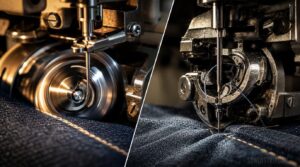
Speed is where rotary hooks pull ahead — and the gap matters. Rotary hook systems achieve a peak stitch rate of 900 to 2,000 stitches per minute because continuous rotation eliminates inertia loss at each cycle. Oscillating hook systems, however, top out at 600 to 1,200 spm due to acceleration lag from direction reversals, which becomes more pronounced with heavier fabric weights.
| Hook Type | Peak Stitch Rate |
|---|---|
| Rotary | 900–2,000 spm |
| Oscillating | 600–1,200 spm |
Speed stability remains stronger with rotary systems across varying fabric weights.
Noise and Vibration Comparison

The oscillating hook system stops and reverses twice per stitch — this mechanical back-and-forth manifests as impact spikes in noise readings. In contrast, rotary hook systems maintain smoother operation through continuous rotation, resulting in tighter frequency spectra and enhanced operator comfort during extended use.
| Factor | Rotary vs Oscillating |
|---|---|
| Typical noise range | 40–70 dB both types |
| Peak industrial noise | Up to 90 dB oscillating |
| Machine vibration | 0.5–2.5 m/s² oscillating higher |
| Isolation mounts benefit | 20–40% reduction |
| Acoustic enclosures benefit | Up to 8 dB reduction |
Decibel thresholds matter, especially when exceeding 85 dB over sustained periods. The horizontal rotary hook generally operates more quietly. While both systems benefit from isolation mounts and acoustic enclosures, the choice of hook type demonstrably influences sewing speed and noise levels.
Stitch Consistency and Thread-jam Tendencies
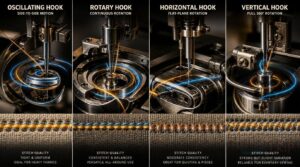
Thread jams don’t lie — they tell you exactly where your hook system is struggling. Rotary hooks, with their continuous 360° rotation, produce a smoother machine vibration signature and far fewer jams. Oscillating hooks, stopping and reversing twice per stitch, create stitch density variance under speed and are more sensitive to thread coating friction, needle-eye burrs, and bobbin spring wear.
| Factor | Rotary Hook | Oscillating Hook |
|---|---|---|
| Thread-jam frequency | Low | Higher |
| Stitch density variance | Minimal | Noticeable at speed |
| Thread tolerance considerations | Narrow range | Wider range |
The horizontal rotary hook especially shines here — its impact on hook design and stitch quality is measurable. Comparison of rotary and oscillating hooks consistently shows that rotary systems handle consistent thread tension better across fabric types.
Cost and Manufacturing Differences
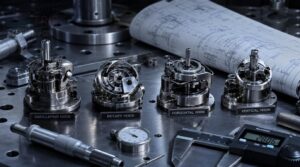
Cost follows complexity. Rotary hooks demand tighter tolerances, precision tooling, and higher labor intensity during calibration — which is reflected in the price.
Manufacturing simplicity of oscillating hook designs keeps material costs and tooling amortization lower in smaller production runs.
| Factor | Rotary Hook | Oscillating Hook |
|---|---|---|
| Tooling precision | High | Moderate |
| Labor intensity | Higher | Lower |
| Production scaling | Efficient at volume | Flexible at small batch |
Best Uses for Each Hook Type
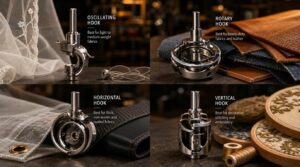
Cost tells part of the story — but best use seals the decision.
Rotary hooks excel in high-demand work, such as denim construction, automotive upholstery, sailcloth stitching, and leather crafting. Their smooth continuous rotation and speed make them ideal for these applications.
Oscillating hooks are better suited for home use, curtain panels, and decorative stitching, where slower speeds and thread flexibility are prioritized.
| Application | Rotary Hook | Oscillating Hook |
|---|---|---|
| Leather crafting | Excellent | Moderate |
| Curtain panels | Good | Excellent |
| Automotive upholstery | Excellent | Limited |
Horizontal Vs Vertical Hook Orientation
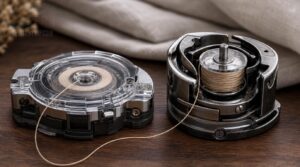
Hook orientation is another layer that changes how you use your machine daily. Whether the bobbin sits flat or stands upright affects everything from bobbin changes to thread tension.
Here’s what you need to know about each setup.
Horizontal Drop-in Bobbin Systems
With a horizontal rotary hook, the bobbin sits flat in a shallow cradle design — enabling drop-in placement by being inserted directly from the top. This design ensures full top-down view, allowing users to verify threading without guesswork, while a rapid bobbin change takes only seconds.
| Feature | Horizontal Drop-In |
|---|---|
| Loading method | Top drop-in |
| Bobbin position | Flat/horizontal |
| Visibility | Full top-down view |
| Bobbin case spring | Side-tension clip |
| Change speed | Very fast |
The bobbin case spring employs a side-tension clip to automatically regulate thread tension, ensuring consistent stitches across diverse fabric types through automatic tension regulation.
Vertical Front-loading and Side-loading Bobbins
Vertical systems flip the script on drop-in convenience. With front loading, you pop open a front panel and slide the bobbin case straight in — the bobbin tension spring is right there, easy to adjust.
Side loading offers side-access visibility without disturbing your fabric.
| Feature | Vertical Systems |
|---|---|
| Bobbin case | Removable, metal or plastic |
| Quick change mechanism | Front or side panel |
| Lint removal zones | Accessible via door |
| Hook type | Vertical rotary hook |
Fabric Handling During Bobbin Changes
Before you swap a bobbin, the setup matters more than you’d think. Always start with presser foot release — that small step relieves tension and opens the bobbin housing clearance for clean access.
| Step | Horizontal Drop-in | Vertical Side-loading |
|---|---|---|
| Lint removal routine | Open top, brush race | Open side door, wipe case |
| Bobbin winding direction | Match lid arrow | Match case indicator |
| Bobbin case removal | No case needed | Lift and pull case out |
| Top thread draw-up | Pull through needle plate | Same — gently tug upper thread |
| Restart check | Confirm thread seats flat | Confirm case clicks in |
Both oscillating hook vs rotary hook systems demand this same discipline. Whether comparing bobbin loading methods (drop-in vs side-loading), skipping lint removal invites jams every time.
Thread-path Differences and Tension Effects
Thread path orientation becomes a personal consideration, as horizontal machines introduce a 90° turn in the upper thread route. This bend increases friction and requires precise top tension balance to maintain consistent loop height control.
| Feature | Horizontal | Vertical |
|---|---|---|
| Path alignment | 90° turn present | Straight feed |
| Friction mitigation | Higher | Lower |
| Top tension balance | Needs fine-tuning | More forgiving |
| Bobbin tension impact | Amplified by bend | Stays stable |
Vertical paths, characterized by a straight feed, result in better thread tolerance and smoother loop formation overall.
Horizontal Rotary Hook Advantages
Drop-in bobbins aren’t just convenient — they’re backed by serious mechanical advantages. The horizontal rotary hook system delivers low friction rotation and reduced thread buildup through continuous 360° movement, giving you uniform stitch pitch across dense fabrics.
| Advantage | Rotary Hook Operation | Impact |
|---|---|---|
| Precise timing tolerance | ±0.02mm tip radius | Fewer skipped stitches |
| Extended bearing life | Continuous smooth rotation | Less wear over time |
| Stitch consistency | Stable loop formation | High-speed reliability |
Advantages of rotary hook machines compound at speed — this rotary hook system genuinely earns its place in high-output environments.
Vertical Rotary Hook Advantages
When heavy material handling is your daily reality, the vertical rotary hook earns its keep fast.
| Feature | Vertical Rotary Hook | Real-World Impact |
|---|---|---|
| Drive strength | Built for high resistance | Pushes through leather, canvas reliably |
| Large thread capacity | Larger bobbin setup | Fewer mid-seam interruptions |
| Durability focus | Precision-machined assembly | Holds timing under sustained load |
| Precision under load | Tight needle-hook timing | Clean lockstitches in dense layers |
| Heavy material handling | Heavy-duty hook structure | Stable on upholstery, bags, and automotive work |
Advantages of rotary hook machines shine here — performance characteristics of rotary hook machines built around drive strength, not just speed.
Why Orientation and Hook Motion Are Separate Features
Think of it like a car’s engine and its transmission — they work together, but they’re engineered independently. Your machine’s hook motion (rotary or oscillating) and its orientation (horizontal or vertical) are separate design parameters. Manufacturers combine them freely based on varying load distribution and user interface flexibility.
Hook motion and orientation are engineered independently, giving manufacturers freedom to combine them any way load and usability demand
| Feature | What It Controls |
|---|---|
| Hook motion | Stitch formation speed |
| Orientation | Bobbin access and thread path |
Maintenance, Timing, and Thread Compatibility
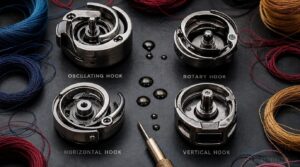
Keeping your hook system in good shape is not complicated, but it does require knowing what to watch for. The type of hook you have — rotary or oscillating — changes what needs attention and how often.
Here’s what matters most regarding maintenance, timing, and thread compatibility.
Cleaning Lint From The Hook Race
Lint is the silent saboteur of hook performance. It accumulates in the hook race groove, gradually leading to skipped stitches or jams. A solid hook cleaning procedure is essential to prevent these issues:
- Power off and unplug before touching anything.
- Remove the needle plate for full access.
- Use tools like a fiber brush or lint-free swab.
- Brush outward — never inward — to avoid pushing lint deeper.
- Wipe clean, then apply post-clean lubrication lightly along the race edge.
Cleaning frequency matters: Light use requires attention every 6–8 sewing hours, while heavy daily sessions demand cleaning every 2–4 hours. Effective lint diagnosis involves noticing skipped stitches or sluggish hook motion before problems escalate. Consistent maintenance is key to distinguishing machines that last decades from those needing constant repair.
Lubrication Needs by Hook System
Once lint is cleared, lubrication is next. Rotary hooks require light oil—continuous 360° motion demands it.
Oscillating hooks do better with grease on pivot points to prevent stiction.
Horizontal systems can suffer gravity-affected lubrication pooling, so a thin film wins every time.
Sealed hook systems skip routine oiling entirely.
For fabric work, food-grade oil keeps your lubricated hook residue-free.
Aim for an 8–12 hour lubrication interval.
Hook-tip Damage and Skipped Stitches
Tip Wear Detection starts with a fingernail test — drag it lightly across the tip. Any snag means trouble.
Hook wear and tear leads directly to Thread Snagging Symptoms:
- Nicks deflect the loop instead of catching it
- Dings from needle strikes shred thread on contact
- Tip misalignment collapses the loop before the hook arrives
Nick Impact Analysis confirms even a 0.02mm burr disrupts the function of the hook in stitch formation, tanking the impact of hook design on stitch quality. Hook Edge Restoration through light honing or full replacement is your cleanest fix. Ding Prevention Techniques start with correct needle sizing — most strikes are avoidable.
Rotary Hook Timing Sensitivity
Rotary hook timing sensitivity is where precision meets consequence. The hook timing synchronization window is razor-thin—micro-gap calibration keeps the hook tip nearly touching the needle at the exact timing point.
Timing drift causes issues to stack up fast: worn timing belt linkage, temperature impact from prolonged high-speed runs, or minor shaft play all shift that gap enough to start dropping stitches consistently.
Oscillating Hook Tolerance for Heavier Threads
Where rotary hooks demand razor-thin timing windows, oscillating hooks provide greater flexibility with heavier threads. This design allows for more forgiving operation when working with thicker materials, reducing the precision required for timing.
The swing dwell adjustment is critical for optimizing loop capture, particularly when using thick threads that slow engagement. Fine-tuning this parameter ensures the hook lingers appropriately, maintaining stitch quality despite material challenges.
However, tip wear monitoring becomes essential with heavier threads, as they accelerate clearance tolerance degradation. Equally vital are lubrication regime and heat dissipation strategy, which directly impact component longevity and performance under demanding conditions.
When Specialty Threads Cause Tension Problems
Core stiffness in heavy polyester or monofilament raises upper thread tension unpredictably, while spool wobble starves the feed mid-seam.
Needle eye diameter must match your thread size — too tight and you’ll shred it.
Bobbin tension sync matters too: fabric stretch tension demands a lighter bobbin setting, or loops creep to the underside every time.
Signs Your Hook Needs Adjustment or Repair
Your hook is telling you something — listen to it. Watch for these warning signs:
- Bird‑nest loops tangling under fabric
- Loud clicking or grinding mid-seam
- Needle heat increase near the hook race
- Irregular stitch length across a seam
Excess hook play and machine timing drift accelerate these symptoms.
Maintenance differences between rotary and oscillating hooks matter here — rotary systems need tighter, faster intervention.
Choosing The Right Hook System
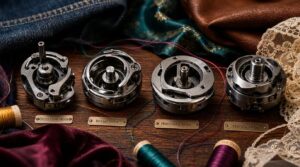
Picking the right hook system comes down to what you actually sew — not what sounds most impressive on a spec sheet. A few key factors will point you in the right direction faster than any chart ever could.
Here’s how each hook type stacks up for the most common sewing needs.
Best Hook Type for Beginners
If you’re just starting out, the mechanical simplicity of oscillating hooks offers a gentle learning curve without overwhelming complexity. These machines tend to be more affordable, offer quiet operation and low vibration, and handle thread changes without fussing over tight tolerances.
When comparing rotary and oscillating hook mechanisms, beginners benefit most from oscillating systems. Beginner-friendly controls, forgiving timing, and an affordable price make hook type selection simple.
Best Hook Type for Quilting
Rotary hook operation in sewing machines is your best bet for quilting. Its 360-degree continuous motion ensures precise stitch length control and maintains quilt-layer stability, even when sewing through thick fabric sandwiches without hesitation.
A horizontal rotary hook offers drop-in bobbin convenience, eliminating the need to shift your project mid-seam. This design simplifies threading and reduces interruptions during quilting.
The sharp tip of the rotary hook prevents thread snag resistance and manages batting-heat buildup, ensuring polyester threads remain cool and stitches stay consistent from edge to edge.
Best Hook Type for Embroidery Machines
Embroidery machines demand a rotary hook — full stop. High-density fills and satin stitch consistency require that smooth, continuous 360-degree motion. Large-diameter rotary hooks manage steep thread angles without fray, making thread fray reduction easy at speed.
Horizontal and vertical rotary hooks both work well here, though drop-in horizontal designs win on bobbin changes.
The Bernina B9 hook system takes this further with modular hook systems that adapt to specialty threads — something no oscillating hook can match at embroidery speeds.
Best Hook Type for Heavy Fabrics
Heavy fabrics punish weak systems fast. You need heavy-duty clearance, a hardened hook tip, and a high-torque design that won’t buckle under canvas or leather. Rotary hooks handle sustained loads better than oscillating alternatives, and thick-thread tolerance matters more than speed here.
Look for hardened steel races with a solid heat-dissipation rating — your hook assembly takes the real punishment.
Best Hook Type for High-speed Sewing
Speed changes everything. When you push past 1,200 stitches per minute, the rotary hook’s continuous 360° motion becomes the clear winner — with no start-stop reversal or burning torque transfer, and no rattling your frame. The impact of hook type on sewing speed and noise is real.
- High-performance hook alloys resist tip wear under sustained load
- Thread slip prevention stays consistent where oscillating hooks lose rhythm
High-speed machines demand rotary.
Home Sewing Versus Semi-industrial Machines
Not every machine is built for the same life. Home machines run light duty cycles on lower power requirements, with smaller hooks and drop-in bobbins. Semi-industrial setups carry a heavier weight footprint, higher ownership cost, and rotary hooks engineered for continuous runs.
Where the differences between rotary and oscillating hook mechanisms, and the impact of hook type on sewing speed and noise, actually matter at scale.
| Feature | Home Machine | Semi-Industrial |
|---|---|---|
| Duty Cycle Rating | Light/occasional | Continuous production |
| Hook System | Oscillating or rotary | Rotary preferred |
| Software Integration | Basic or none | Embroidery/production modules |
How to Identify Your Machine’s Hook Type
Once you’ve weighed home versus semi-industrial options, knowing exactly what’s inside your machine seals the deal. Start by checking your manual diagram reference—it’s the fastest route.
From there, follow these steps:
- Trace the thread path to spot the bobbin case shape.
- Compare your hook tip silhouette against rotary and oscillating hook system diagrams.
- Run a model number lookup on the manufacturer’s site for confirmed specs.
Frequently Asked Questions (FAQs)
What is the difference between vertical and horizontal hooks on a sewing machine?
The bobbin’s position tells the whole story. Horizontal hooks load from the top; vertical hooks load from the front or side —
Affecting operator ergonomics, bobbin change frequency, and how your thread path behaves.
What does horizontal rotary hook mean?
A horizontal rotary hook mounts flatly beneath the needle plate, rotating around a horizontal axis. This orientation enables drop-in bobbin integration, smooth thread path geometry, and quiet operation.
The design prioritizes durable material construction, ensuring reliability for everyday home sewing.
What are the different types of sewing machine hooks?
There are three main types: the rotary hook, the oscillating hook, and variations by orientation — horizontal or vertical. Each manages the loop-capture cycle differently, affecting speed, noise, and thread compatibility.
What is the difference between rotary and oscillating sewing machines?
One spins without stopping. The other swings back and forth.
Rotary hooks run faster with less vibration, while oscillating hooks handle heavier threads more forgivingly and stay easier to time and repair.
How do hook types affect stitch quality?
Hook type shapes stitch quality through loop uniformity and thread tension control. Rotary hooks deliver seam smoothness at speed; oscillating hooks handle thread tension tolerance better.
Microscopic hook wear causes fabric pull distortion over time.
Can hook types impact fabric compatibility?
Hook geometry directly shapes how your machine manages everything from slippery silk to stiff denim.
It governs thread tension variation, fabric drape, and the interaction of weave density with every single stitch.
What maintenance do sewing machine hooks need?
Skip maintenance, and even one burr turns a perfect stitch into a tangled mess. Clean lint, do a race alignment check, control your oil drip, and verify screw tightness regularly.
Do hook systems change sewing speed options?
Rotary hooks handle higher sewing speeds with less vibration than oscillating hooks.
Continuous rotation eliminates start-stop reversal, so thread tension limits and fabric type constraints matter less when pushing your machine’s motor power to its peak.
Are specific hook types better for beginners?
For beginners, a drop-in horizontal rotary system excels in Bobbin Visibility and Thread Tension Simplicity. These features ensure ease of use from the start.
The Learning Curve stays gentle, Error Forgiveness is built in, and Timing Simplicity reduces frustration, making it an ideal choice for newcomers.
How do I adjust hook timing myself?
Start with the needle at its lowest point, then raise it slightly. Use gauge calibration to confirm hook-tip alignment within 2–5 mm.
Micro-screw tweaks let you shift the hook without losing position.
Conclusion
Rotary or oscillating, horizontal or vertical—each hook system rewards the sewist who understands it. Knowing how your machine moves thread changes how you troubleshoot, maintain, and push it further. Whether you’re chasing speed, handling heavy fabric, or tired of skipped stitches, that knowledge puts the right answers within reach.
Your machine hasn’t changed—but how you see it has. Understanding its hook system transforms frustration into control, allowing you to optimize performance and resolve issues efficiently.
This insight empowers you to maximize your machine’s potential, ensuring smoother operation and better results, no matter the project.
- https://sewingmachineman.substack.com/p/the-4-different-hook-systems-found
- https://primeproductpicks.com/how-does-a-sewing-machine-work/
- https://knowledgebase.gammill.com/knowledge/rotary-hook
- http://www.ashleyandthenoisemakers.com/blog/2015/5/16/what-to-look-for-in-a-vintage-sewing-machine-part-2
- https://quiltingroomwithmel.com/sewing-machine-hook/