This site is supported by our readers. We may earn a commission, at no cost to you, if you purchase through links.
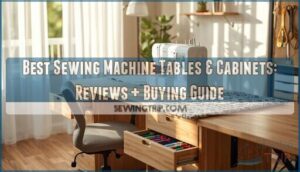
Your sewing machine deserves better than a wobbly card table or a corner of the dining room. The right sewing machine table or cabinet transforms your workspace from makeshift to masterful, turning neck strain and cluttered fabric piles into smooth workflows and organized efficiency.
A proper setup places your machine at the exact height that keeps your shoulders relaxed, provides dedicated storage that puts thread and scissors within arm’s reach, and creates a stable surface that won’t vibrate when your needle hits denim. Whether you’re hemming curtains twice a year or quilting queen-sized blankets every month, your table choice impacts everything from your stitching precision to how long you can work before fatigue sets in.
Table Of Contents
Key Takeaways
- A proper sewing table transforms your workspace by placing your machine at the exact height that keeps shoulders relaxed (28-38 inches adjustable range), provides dedicated storage for thread and tools within arm’s reach, and creates a stable surface that won’t vibrate during heavy stitching projects.
- Key features that separate quality tables from mediocre furniture include hydraulic mechanisms, solid hardwood or 16-18 gauge steel frames that resist warping, full-extension drawers with organized compartments, and heavy-duty locking casters rated for 200+ pounds each.
- Your table choice depends on three critical factors: available floor space (need 30-36 inches of clearance in front plus 12-18 inches on sides), machine compatibility (verify shank type, mounting holes, and weight capacity match your equipment), and whether you need permanent workspace or portable folding options that collapse for storage.
- Proper workspace setup requires positioning your table to face natural traffic flow with 36-inch aisles, setting work surfaces at elbow height (34-36 inches), keeping cutting stations within 6 feet of your machine, and using wall-mounted pegboards plus drawer dividers to organize notions and accessories for efficient workflow.
Key Features of Sewing Machine Tables & Cabinets
The right sewing table or cabinet transforms your workspace from cramped and chaotic into a command center that actually works with you, not against you.
If you’re working with limited space, a small sewing machine table project can give you a custom setup without eating up your entire room.
The right sewing table transforms your workspace from cramped chaos into a command center that actually works with you
Your investment hinges on features that deliver comfort, efficiency, and longevity, which means you can’t afford to overlook the details that separate mediocre furniture from game-changing equipment. Here’s what you need to evaluate before you commit your space and budget.
Adjustable Heights and Ergonomics
You’ll find adjustable heights ranging from 28 to 38 inches on most sewing tables, letting you switch between seated and standing postures to protect your posture during long projects.
Electric lifts with memory presets make workspace optimization easy, while contoured edges reduce forearm pressure and wrist deviation.
Ergonomic design isn’t optional when comfort features directly impact your stitching precision and stamina at the machine.
Storage Solutions and Organization
Built in drawer organization separates thread management from fabric storage, with full extension glides pulling out completely so you can grab bobbins and rulers without digging.
Your sewing station gains efficiency when shallow top drawers handle flat patterns while deeper bottom drawers store bulky notions, and drop leaf extensions add 12 inches behind the machine to support quilts.
Shelf optimization in sewing cabinets keeps cutting mats and pressing pads close, transforming your crafting storage solutions into an ergonomic sewing furniture hub.
For additional options, you can explore a variety of thread storage solutions overview to further refine your sewing space.
Material Quality and Durability
Material strength starts with 16 to 18 gauge steel frames that resist warping under heavy machines, while solid hardwoods like birch and maple provide rigid support without sag.
You’ll find powder coated finishes and scratch resistant laminates protect your sewing cabinet surfaces from daily wear, and dado joints with metal corner brackets prevent wobble.
Environmental impact matters too—reclaimed wood and formaldehyde free adhesives deliver hardware quality with responsible manufacturing. When selecting materials, it’s useful to understand how material durability fundamentals affect the long-term performance and maintenance of your sewing furniture.
Mobility and Locking Wheels
Your mobile sewing station needs swivel mechanism casters rated for 200 pounds each, with dual wheel designs that protect hardwood floors through polyurethane treads.
Foot activated brake systems lock both rotation and swivel for a stable workspace, while quick release stems let you reposition your cabinet without tools.
Choose locking casters with corrosion resistant plates to guarantee your mobile workspace stays secure during long sessions.
Airlift and Hydraulic Lift Mechanisms
You’ll encounter two main lift system designs in premium sewing machine cabinet reviews: airlifts use air pressure control for smooth, rapid adjustments with light machines, while hydraulic fluid types deliver rock-solid stability for heavier models.
Both require minimal mechanism maintenance—check seals quarterly and verify safety features like emergency locks. Machine lift compatibility matters most: confirm your sewing machine’s weight falls within the mechanism’s range before sewing cabinet assembly begins for ideal sewing workspace organization.
Types of Sewing Tables and Cabinets
Your sewing table choice comes down to how you work and what you need from your workspace. The right table type depends on your machine, the projects you tackle, and whether you’re setting up a permanent studio or need something you can tuck away between sessions.
Here’s a breakdown of the main table and cabinet styles, so you can match the design to your actual sewing life.
Standard Sewing Tables
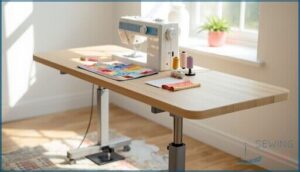
Standard sewing tables deliver the foundation you need for everyday projects, from simple alterations to quilting marathons. These workhorses usually feature a flush-mount surface where your sewing machine sits level with the tabletop, eliminating awkward height gaps that strain your shoulders. You’ll enjoy sewing comfort through adjustable heights ranging from 28 to 37 inches, a dimension that lets you:
- Align the needle position with your seated eye level for precision piecing
- Reduce back fatigue during multi-hour sessions at your sewing desk
- Accommodate standing work when tackling large quilt layouts
- Fine-tune workspace efficiency using gas lift or screw mechanisms
- Lock your preferred height with pins or hydraulic assists for consistent machine integration
Most standard models offer 48- to 60-inch surfaces made from solid core plywood or engineered wood with protective veneers, giving you room to spread full-width fabric without sagging. Locking caster wheels provide mobility when you need to shift your sewing cabinet across the room, then lock for vibration-free stitching. Rounded edge profiles prevent thread snags, while cable management keeps foot pedal cords tidy—small details that enhance user experience and table ergonomics alike.
Sewing Cabinets With Storage
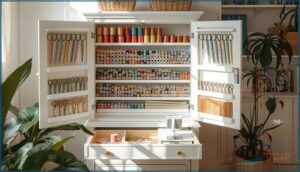
Sewing cabinets with storage transform scattered supplies into a command center where everything you need lives within arm’s reach. Built-in drawers hold threads, bobbins, and scissors, while hidden cubbies stow rulers and rolled fabrics. Door bins keep seam rippers accessible, and spool racks organize up to 32 spools in compact layouts—cabinet designs that let you master fabric management without hunting for notions mid-seam.
| Storage Feature | Capacity | Best For |
|---|---|---|
| Pull-out drawers | 3–6 compartments | Threads, bobbins, notions |
| Built-in spool racks | Up to 32 spools | Thread organization |
| Hidden cubbies | Bulk storage | Large rulers, rolled fabrics |
| Door bins & pegboards | Variable pegboard panels | Scissors, seam rippers |
| Adjustable dividers | Customizable slat systems | Tool layout flexibility |
Folding and Portable Tables
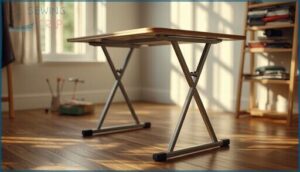
When your workspace shifts between rooms or vanishes after each project, folding tables deliver freedom without compromise.
Lightweight aluminum or steel frames with locking hinges fold inward to half their open height, while rubberized feet stabilize on any surface.
Foldable designs with quick-fold systems collapse in under 60 seconds, transforming 48-inch workspaces into compact storage that slips behind doors or under beds—portable workspaces that adapt to your rhythm.
Specialty Tables for Quilting & Embroidery
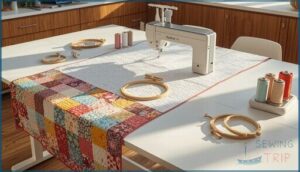
When quilting and embroidery demand precision beyond standard sewing tables, specialty surfaces meet the challenge with engineering built for scale and stability.
You’ll find these targeted designs deliver:
- Built-in extendable wings providing workspace for quilts up to 110 inches wide
- Recessed spaces that float quilt tops during basting
- Zero-sag flat surfaces maintaining hoop stability for embroidery machines
- Integrated rulers and grid markings ensuring precise block alignment
These sewing cabinet configurations transform ambitious needlework accessories into finished masterpieces.
Factors to Consider Before Buying
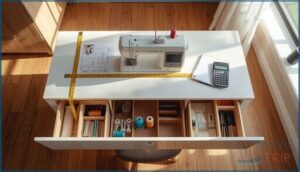
Before you commit to a sewing table or cabinet, you need to measure your reality against the product specs. The right choice depends on your available floor space, how much you’re willing to spend, and whether your machine will actually fit the table’s dimensions and cutout design.
Here’s what separates a smart purchase from a storage headache gathering dust in your corner.
Space and Size Requirements
Before you commit to a sewing cabinet, measure your room dimensions carefully—you’ll need 30 to 36 inches of clearance space in front for comfortable movement.
Table depth ranges from 18 to 30 inches, while side access requires 12 to 18 inches.
For effective sewing space optimization, maintain 48 inches of walking width in your workspace layout, ensuring your crafting furniture fits without cramping your creative flow.
Budget and Price Range
Your budget planning for sewing machine tables starts around 100 to 150 dollars for affordable folding models, while mid-range cabinets with storage run 300 to 450 dollars.
Premium hydraulic lift systems demand 700 to 1500 dollars, offering financial savings through durability. When you compare prices, remember that solid wood construction exceeds 2000 dollars but delivers decade-long performance—making cost analysis essential for smart expense management.
Machine Compatibility
Your sewing machine integration starts with shank types—low shank or short shank machines need compatible presser feet and mounting systems. Check that the cabinet’s arm height and throat depth accommodate your machine model, ensuring the needle position remains unobstructed.
Verify mounting holes align with your machine’s bed system, while power requirements match the cabinet’s outlet setup. Bed flatness and size directly impact fabric feed and stitch consistency, making sewing machine compatibility non-negotiable.
Assembly and Installation
Once your sewing cabinet arrives, you’ll face hardware installation that requires a clear 6-by-4-foot workspace and basic tools like Allen keys and a soft mallet.
Most product assembly and delivery includes euro screws and cam locks, making table setup straightforward if you inventory parts first.
If electrical wiring or a lift mechanism is involved, follow color-coded terminals and test connections before mounting your sewing machine table.
Warranty and Support
After you’ve assembled your table, pay attention to warranty coverage, which usually runs one to five years depending on brand and model.
Product registration activates your protection and streamlines warranty claims if defects appear, so keep purchase receipts and serial numbers accessible. Check whether customer service offers repair options through authorized centers, what support levels are available, and if sewing machine maintenance assistance or replacement sewing machine parts are covered.
Top Sewing Machine Tables and Cabinets
You’ve narrowed down your needs, so now it’s time to look at specific sewing tables and cabinets that deliver on quality, function, and value.
These seven options represent different price points, storage configurations, and workspace sizes to match various sewing setups. Each brings its own strengths, whether you’re working with limited space, need a hydraulic lift for heavy machines, or want a portable solution that folds away when you’re done.
1. Sew Ready Hobby Sewing Table
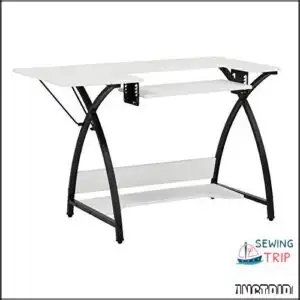
This adjustable workhorse gives you the flexibility to tackle fabric cutting and machine stitching without switching stations, thanks to its height range from 29.75 to 38.75 inches in 1.5-inch increments.
You’ll find a spacious 45.5-inch wide surface with a foldable shelf, a drop-down platform for your sewing machine, and two wire mesh drawers for thread and tools.
The heavy-gauge steel frame holds up to 50 pounds on top, while six casters—four locking—let you roll the table exactly where you need it.
| Best For | Sewers and crafters who need a versatile workspace that adjusts to different projects and want built-in storage without taking up too much room. |
|---|---|
| Material | Heavy gauge steel |
| Storage Features | Large lower shelf |
| Mobility | Four floor levelers |
| Workspace Size | 45.5″ W x 23.5″ D |
| Height | 30″ H |
| Color Options | Not specified |
| Additional Features |
|
- Adjustable sewing machine platform lets you position your machine at the perfect height while keeping the main work surface clear for cutting and prep
- Sturdy steel construction with a 50-pound weight limit on the main surface handles heavy fabric bolts and larger projects
- Rolling casters with locks make it easy to move the table around your workspace and lock it in place when you’re working
- The table doesn’t fold up for storage, so you’ll need to dedicate floor space to it even when you’re not sewing
- Assembly can take a while according to some users, so plan for extra setup time
- Each shelf has a relatively low weight limit (15-20 pounds), which means you’ll need to distribute heavier supplies carefully
2. Arrow Sewing Cabinet Chair
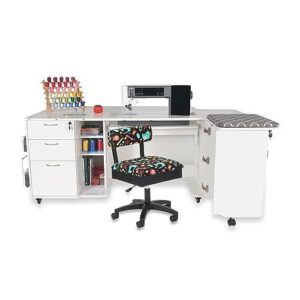
Comfort drives every quilting marathon, and this hydraulic chair adjusts from 18 to 22 inches so you can dial in the perfect height for your posture and reduce lower back fatigue during long sessions.
You’ll get targeted lumbar support, plush cushions that hold their shape, and a hidden compartment under the seat for scissors and small notions. The five-star swivel base with heavy-duty casters rolls smoothly across most floors, while the 360-degree rotation keeps fabric and tools within easy reach throughout your project.
| Best For | Sewers and quilters who spend hours at their machines and need adjustable height, lumbar support, and convenient storage without leaving their seat. |
|---|---|
| Material | Metal base / Teak top |
| Storage Features | Hidden seat compartment |
| Mobility | 360° swivel casters |
| Workspace Size | 58.5″ W x 23.5″ D |
| Height | 18-22″ adjustable |
| Color Options | Ash White |
| Additional Features |
|
- Hydraulic height adjustment (18–22 inches) lets you find the exact position that protects your back during long projects
- Hidden under-seat storage keeps scissors, seam rippers, and small notions within arm’s reach
- Heavy-duty swivel base with smooth-rolling casters gives you full mobility across your workspace
- Premium price point of nearly $2,860 puts it out of reach for casual hobbyists or those on a tight budget
- Only available in Ash White, so it won’t match every sewing room’s color scheme
- Assembly required, which can eat up time you’d rather spend sewing
3. Arrow Harriet Sewing Cabinet
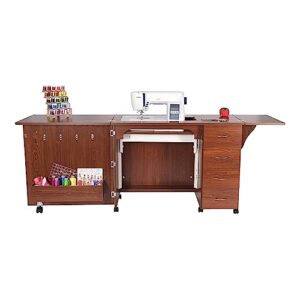
The hydraulic lift transitions your machine between free arm, flat bed, and storage modes without wrestling heavy equipment, and the lift accommodates machines up to 55 pounds for broad compatibility.
You’ll expand your workspace with foldable leaves that stretch the surface beyond 82 inches, while four drawers keep notions organized and interior embroidery hoop hooks eliminate tangled threads.
The woodgrain melamine finish resists scratches and spills, heavy-duty locking casters provide stability when you’re stitching and mobility when you need to reconfigure your studio, and Arrow backs the Harriet with a 10-year warranty.
| Best For | Sewers with dedicated studio space who regularly work on large quilting projects and need a durable cabinet that handles heavy machines while keeping supplies organized. |
|---|---|
| Material | Wood |
| Storage Features | 4 large drawers |
| Mobility | Locking wheels |
| Workspace Size | 82.68″ W x 19.87″ D |
| Height | 30.5″ H |
| Color Options | Teak |
| Additional Features |
|
- Hydraulic lift handles machines up to 55 pounds and switches between three positions so you don’t strain yourself moving equipment around
- Expandable leaves give you over 82 inches of workspace for quilts, plus four drawers and hoop hooks keep everything tidy
- 10-year warranty and scratch-resistant finish mean this cabinet handles daily use without showing wear
- Assembly takes several hours and the cabinet’s size might overwhelm smaller sewing rooms
- $1,099.99 price tag puts it out of reach for casual sewers or beginners
- Customer reports mention shipping delays and occasional missing package issues
4. Sauder Sewing Craft Storage Cart
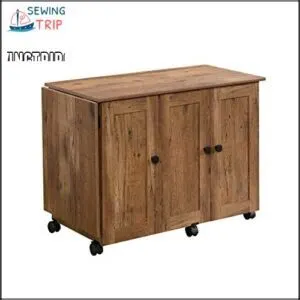
The Sauder Sewing Craft Storage Cart in Soft White with Lintel Oak accents delivers a compact footprint that fits small rooms without sacrificing workspace, thanks to a drop leaf that extends when you need extra surface area and folds away when projects wrap up.
You’ll organize spools, patterns, and fabric scraps behind roll-open doors with three adjustable shelves on the right side and a roomy left cabinet with removable dividers, while the heat-resistant melamine top withstands daily wear and locking casters keep the 79-pound cart stationary during stitching.
| Best For | Crafters and sewers who need flexible workspace in tight quarters—the drop leaf gives you room to spread out fabric and patterns when you’re working, then tucks away to free up floor space. |
|---|---|
| Material | Engineered Wood |
| Storage Features | 2 storage bins, shelves |
| Mobility | Easy-roll casters |
| Workspace Size | 44″ W x 21″ D |
| Height | 8.69″ H |
| Color Options | Vintage Oak |
| Additional Features |
|
- Drop leaf extends your work surface on demand, so you can handle larger projects without dedicating an entire room to your craft station
- Roll-open door with adjustable shelves and removable bins keeps thread, scissors, and your sewing machine tucked away but easy to grab
- Casters let you roll the cart wherever you need it, then lock it down so it stays put while you’re cutting or stitching
- The top can sag a bit under heavier machines, so you might need extra support for industrial-weight equipment
- Fingerprints show up easily on the finish, which means you’ll be wiping it down more often than you’d like
- Assembly instructions can be confusing—some people found the process trickier than expected
5. Arrow Sewing Cabinet With Hydraulic Lift
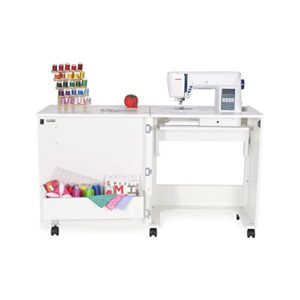
Arrow’s hydraulic lift cabinet gives you three settings—free arm, flat bed, and storage—with a piston-driven system that raises your machine up to 55 pounds through a single lever pull, eliminating the awkward bending and lifting that derails your workflow.
You’ll create a flush sewing surface with custom acrylic inserts that align with the cabinet top, while the door cubby corrals notions within arm’s reach and heavy-duty locking casters anchor the 55-pound MDF frame during intensive stitching sessions, all backed by a 10-year warranty.
| Best For | Sewers in small spaces who need a compact, mobile workstation that lifts machines up to 55 pounds and creates a flush sewing surface without permanent installation. |
|---|---|
| Material | MDF |
| Storage Features | Door cubby |
| Mobility | Heavy-duty locking casters |
| Workspace Size | 25.5″ W x 17.25″ D |
| Height | 29.5″ H |
| Color Options | White |
| Additional Features |
|
- Three-position hydraulic lift lets you switch between free arm, flat bed, and storage with one lever pull
- Heavy-duty locking casters keep the cabinet stable during use but let you roll it out of the way when you’re done
- 10-year warranty backs the hydraulic mechanism and MDF construction
- Assembly instructions are confusing and the lift mechanism can be tricky to install correctly
- Operating the lift takes significant upper body strength, which might be tough if you’re adjusting it frequently
- Limited storage space with just one small door cubby for your notions and accessories
6. Best Choice Folding Sewing Table
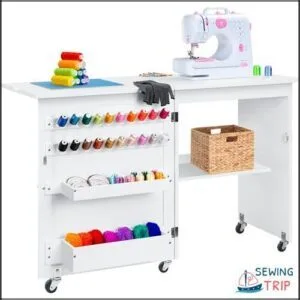
Best Choice’s folding design delivers a multipurpose craft station with two work modes—46 inches deep when open, 23 inches when closed—using magnetic doors, metal doorknobs, and a convertible side table mounted on locking casters that roll into closets or under beds between projects.
You’ll organize threads and notions across two peg rows, two attached trays, and one large interior shelf, while the white MDF surface resists crafting stains and wipes clean with standard cleaners, though you’ll want to verify assembly tightness for stability during heavy machine use.
| Best For | Crafters and sewers with limited space who need a mobile workstation that folds away when not in use. |
|---|---|
| Material | MDF |
| Storage Features | 2 trays, shelf, pegs |
| Mobility | Wheels |
| Workspace Size | 46″ D x 14.75″ W |
| Height | 30.5″ H |
| Color Options | White |
| Additional Features |
|
- Folds from 46 inches to 23 inches and rolls on casters, making it easy to tuck into closets or slide under beds
- Offers multiple storage options including peg rows, attached trays, and a large interior shelf to keep supplies organized
- White MDF surface resists stains and cleans up easily after messy craft projects
- MDF construction may not hold up as well as solid wood under heavy sewing machine use
- Can feel wobbly if not assembled carefully, which might affect stability during operation
- Limited weight capacity when extended, so it’s not ideal for heavy-duty equipment or materials
7. Arrow Sewing Cabinet with Lift
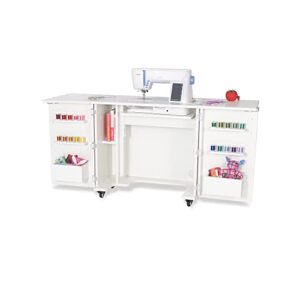
Where folding models compromise lift power, this Ash White K8211 uses a three-position hydraulic mechanism to place your machine flush with the 60-inch workspace, store it below deck, or switch to free-arm mode for sleeve hems and cuffs—handling standard machines up to 55 pounds through engineered wood construction and heavy-duty casters that lock your 103-pound station in place while you work.
Across door cubbies, thread pegs, and dual shelves that organize notions within arm’s reach.
| Best For | Beginner to intermediate sewers who want a dedicated workspace with hydraulic lift convenience and plenty of built-in storage for their machine and supplies. |
|---|---|
| Material | Engineered Wood |
| Storage Features | 2 shelves, door cubbies |
| Mobility | Heavy-duty locking casters |
| Workspace Size | 60.25″ D x 17.75″ W |
| Height | 29.75″ H |
| Color Options | Ash White |
| Additional Features |
|
- Three-position hydraulic lift handles machines up to 55 pounds and switches between flat bed, free arm, and storage modes without manual lifting
- Generous storage with thread pegs, door cubbies, and two shelves keeps all your notions and accessories organized in one spot
- Heavy-duty locking casters let you roll the 60-inch cabinet wherever you need it, then lock it down for stable stitching
- Assembly takes serious time and patience—multiple reviewers found the instructions confusing and the process tedious
- Build quality feels inconsistent for the price point, with some users reporting wobbly doors and alignment issues
- Shipping damage is common enough that you might need to improvise fixes or wait for replacement parts
Maximizing Your Sewing Workspace
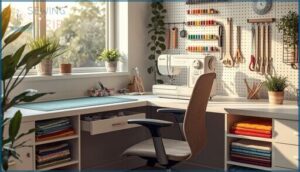
A well-chosen table won’t do much if your workspace feels cramped, chaotic, or uncomfortable. The way you position your sewing station, organize your supplies, and set up your workflow can transform an ordinary corner into a productive creative hub.
Let’s look at practical strategies that help you make the most of every square inch, whether you’re working with a dedicated sewing room or a compact multipurpose space.
Optimizing Table Placement
Position your sewing tables to face natural traffic flow and maintain 36-inch wide aisles around primary work zones. Ergonomic layout demands you place cutting stations within 6 feet of your machine for quick material transfer, while spatial planning requires at least 48 inches of clearance around your sewing cabinet for chair movement.
Smart workspace flow means:
- Align table frontage to face entry points
- Set work surfaces at elbow height, 34 to 36 inches
- Keep pressing areas 2 feet from sewing stations
- Install corner shelving for bulk storage
- Group similar tasks together to minimize cross-traffic
This traffic optimization transforms your crafting space into a command center where every motion counts.
Organizing Tools and Accessories
Wall-mounted pegboards with 1-inch holes hold hooks and bins for hand tools, while sewing bins with clear labels sort threads, needles, and bobbins by color and size.
Drawer dividers separate presser feet and spool caps, keeping accessory kits organized within your sewing cabinet. Use shallow top trays for daily notions and magnetic strips on cabinet doors for small metal tools, transforming your sewing tables into command centers for supply management and crafting storage.
Enhancing Comfort and Workflow
Set your sewing cabinet at 28 to 32 inches so your elbows bend at 90 degrees, reducing shoulder tension and wrist strain during extended projects.
Add a retractable footrest adjustable from 2 to 5 inches to support proper sewing posture, and position your pattern light at eye level to prevent neck fatigue while you work through complex designs and long seams.
Tips for Small Sewing Spaces
Choose a foldable table measuring 24 by 36 inches that collapses to half its size, freeing your sewing space between projects.
Mount vertical storage racks along one wall to hold 60 thread spools and rulers, while a compact rolling cart tucks into corners when you finish. These space-saving solutions transform tight sewing stations into efficient workspaces without sacrificing the functionality of traditional sewing cabinets.
Frequently Asked Questions (FAQs)
How do I adjust the height of my sewing cabinet?
Most cabinets use a hydraulic lift mechanism you’ll adjust with a foot pedal or lever, loosening hex screws to reposition the platform until your elbows rest at a comfortable right angle while seated.
Can I use a sewing cabinet with multiple machine brands?
Yes, most sewing cabinets accommodate multiple machine brands if the opening dimensions match your machine footprints, usually up to 20-24 inches wide, and the airlift mechanism accommodates each machine’s weight range.
Whats the difference between airlift and electric lift mechanisms?
Here’s the thing: airlift mechanisms use compressed air to raise your sewing machine lift smoothly, while electric lifts rely on motors for precise control, each bringing different maintenance needs, power source requirements, and cost comparison points to your sewing cabinet.
Are there sewing cabinets designed for small spaces?
You’ll find folding designs and slim profile models built specifically for tight quarters, with drop-down leaves that extend your workspace by 12 to 24 inches and fold away to maintain clear floor space.
How much weight can a typical sewing cabinet support?
When the rubber meets the road, most sewing machine cabinets handle 40 to 60 pounds depending on frame materials and lift mechanisms, though hydraulic models with reinforced construction distribute load more effectively for heavier equipment.
How do I measure for a perfect-fit cabinet?
Measure your sewing workspace width, depth, and height at multiple points, noting the smallest dimensions for precision fitting.
Check for electrical outlets, wall studs, and floor-level variations to guarantee your sewing cabinet fits perfectly without gaps or binding.
Can sewing tables accommodate serger machines?
Most sewing tables accommodate sergers with compatible depth and clearance, though you’ll need 28 to 36 inches of depth for serger compatibility—standard 18 to 24 inch sewing desks won’t fit bulkier sewing equipment and machine clearance requirements.
Are assembly services available for complex cabinets?
Yes, specialized service providers offer assembly for complex sewing furniture within 75 miles of major metros.
Expect quotes covering labor, travel, and onsite preparation, with lead times from 3 to 14 days depending on custom modifications needed.
What maintenance extends sewing table lifespan?
You’ll extend your table’s life through regular surface cleaning, hardware checks, finish protection, alignment verification, and humidity control—each step guards your investment and keeps your workspace ready for every project ahead.
How important are locking wheels/casters?
Locking mechanisms transform your sewing cabinet from a rolling cart into a rock-solid workstation, preventing mid-stitch shifts that throw off precision.
They deliver caster safety, floor protection, and instant table mobility when you need workspace flexibility with legs on wheels.
Conclusion
Picture a quilter who spent years hunched over a dining table, finishing each project with shoulder pain and scattered supplies.
After upgrading to one of the best sewing machine tables cabinet options with proper height adjustment and organized storage, she completed her first queen-sized quilt without discomfort.
Your workspace investment directly impacts your results, comfort, and creative endurance. Choose the table that matches your projects, your space, and your commitment to the craft you’ve already mastered.