This site is supported by our readers. We may earn a commission, at no cost to you, if you purchase through links.
Your sewing machine’s decorative stitch menu holds more creative power than most sewers ever tap into. Those dozens of built-in patterns—florals, scallops, geometric designs—aren’t just there to fill up the display; they’re practical tools that can transform plain fabric into customized pieces without requiring embroidery software or digitizing skills.
The challenge isn’t access to these stitches—it’s knowing which patterns work best for different fabrics, when to choose dense versus open designs, and how to prevent the frustrating puckering that makes beginners abandon decorative stitching altogether.
Master the fundamentals of stitch selection, stabilizer pairing, and tension adjustment, and you’ll discover professional-looking embellishments that enhance everything from heirloom quilts to everyday garments.
Table Of Contents
- Key Takeaways
- What Are Decorative Stitches?
- Types of Decorative Stitch Patterns
- Dense Vs. Open Decorative Stitches
- Choosing The Right Stitch for Fabric
- Thread and Needle Selection Tips
- Common Decorative Stitch Applications
- Troubleshooting Decorative Stitch Problems
- Top 4 Decorative Stitch Tools and Products
- Frequently Asked Questions (FAQs)
- Conclusion
Key Takeaways
- Your sewing machine’s built-in decorative stitches deliver professional embellishments without embroidery software—master stitch selection, stabilizer pairing, and tension adjustments to prevent puckering and achieve polished results on any fabric weight.
- Dense stitches create bold, sculptural designs best suited for heavier fabrics, while open patterns preserve drape on lightweight materials—combine both strategically by stitching open designs first, then layering dense sections with adjusted tension.
- Match your decorative stitch density to fabric weight using proper stabilizers for lightweight materials, position stitches at least 3/8 inch from raw edges, and always test needle size and thread tension on scraps before committing to your final piece.
- Thread breakage, skipped stitches, and fabric bunching signal tension imbalances or wrong needle-fabric pairings—fix these by adjusting upper tension, selecting fresh needles matched to your thread weight, and securing quality stabilizers that prevent distortion.
What Are Decorative Stitches?
Decorative stitches are fancy stitch patterns built into your sewing machine that add personality and flair to fabric—they’re not meant for construction, but for making your projects visually interesting. Unlike the straight or zigzag stitches you use to build seams, these patterns range from geometric designs to florals, transforming plain fabric into something special.
Understanding what decorative stitches are, how they differ from everyday utility stitches, and what benefits they bring will help you use them with confidence.
Definition and Purpose
Decorative stitches transform ordinary fabric into remarkable pieces through ornamental stitches that prioritize aesthetic value over structural bonding. Your sewing machine offers embroidery-inspired stitch patterns designed for visual interest and texture improvement—not for seaming or construction.
These embellishment techniques serve one primary purpose: personalization. Consider decorative stitching your creative signature:
- Add dimension with raised textures and layered motifs
- Inject color through contrasting thread combinations
- Create focal points on garments, accessories, and home decor
- Express individuality with custom pattern selections
- Improve surface appeal while maintaining fabric integrity
Most patterns require stabilizers for professional results.
Differences From Utility Stitches
While decorative stitches captivate with ornamental stitch patterns, utility stitches prioritize seam strength and construction durability. Your sewing machine distinguishes these categories clearly:
| Utility Stitches | Decorative Stitches |
|---|---|
| Short stitch length for durability | Longer, specialized stitch length for texture |
| Build structural seams under stress | Add visual interest without reinforcement |
| Minimal fabric support needed | Require stabilizers to prevent distortion |
| Focus on construction strength | Prioritize appearance and stitch density |
Thread tension and fabric support requirements differ substantially between categories.
Benefits for Sewing Projects
Beyond their ornamental charm, decorative stitches deliver practical advantages that transform routine projects. Your sewing machine becomes a design studio with these capabilities:
- Texture addition and visual interest replace costly trims—no beading or appliqué required
- Tailored designs distinguish your work with individual embellishments that reflect personal style
- Aesthetic value increases through fabric embellishment while reinforcing edges
Strategic thread choice and stitch patterns create professional results efficiently.
Types of Decorative Stitch Patterns
Your machine’s decorative stitch library is packed with options—each pattern fulfills a different purpose and creates distinct visual effects. Understanding the main categories helps you choose stitches that complement your fabric and project goals.
Let’s break down the three primary pattern families you’ll work with most often.
Geometric and Motif Stitches
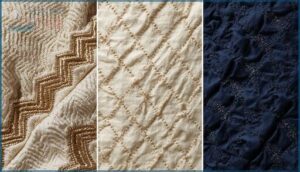
When you need structure without softness, geometric patterns and motif designs deliver precision through repeating shapes—diamonds, chevrons, lattice—that turn fabric into architectural statements. Stitch density determines boldness: tight repeats create dimension, while open spacing adds subtlety. Match your thread choice to fabric stability, using polyester or rayon on stabilized material to prevent distortion.
Border embellishments frame edges with symmetrical motifs that transform plain seams into focal points on your sewing machine.
| Stitch Type | Best Application |
|---|---|
| Chevron motifs | Garment borders, quilt edges |
| Diamond repeats | Allover texture, seam reinforcement |
| Lattice patterns | Home decor accents, decorative panels |
Florals and Nature-Inspired Designs
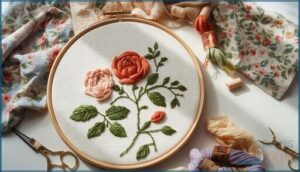
Floral patterns bring organic elegance through petal designs, leaf motifs, and botanical stitches that layer satin and fill techniques—40% to 60% of your sewing machine’s decorative stitch library features these nature embroidery options.
Use interlace patterns for delicate petals, stem stitches for vines, and separate outline from fill in embroidery files to control thread coverage precisely.
Master decorative stitching with these nature-inspired stitch patterns.
Border, Scallop, and Heirloom Stitches
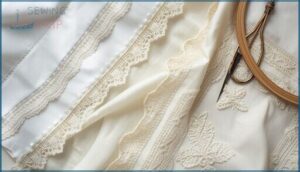
Edge designs frame your fabric with architectural precision—border designs create crisp lines along seams, scallops add curved elegance to hems, and heirloom stitching delivers delicate vintage charm through wing needle techniques.
- Match stitch density to fabric weight: dense satin stitch requires stabilizer on lightweight materials
- Adjust stitch tension before starting: loose tension causes loops, tight tension creates puckering
- Use blanket stitches for edge finishing that combines decoration with seam reinforcement
- Control fabric selection carefully: natural fibers showcase weaving patterns in heirloom work better than synthetics
Dense Vs. Open Decorative Stitches
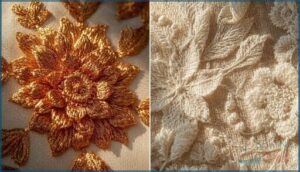
Dense stitches pack thread tightly together for bold, sculptural designs, while open patterns leave breathing room between each pass of the needle. Your choice between these two styles determines how your fabric feels, how much thread you’ll use, and whether your design reads as subtle or striking.
Let’s break down what makes each approach distinct—and how to combine them for maximum impact.
Characteristics of Dense Stitches
Dense patterns pack impressive stitch count into small areas—think tightly woven tapestries that transform plain fabric. Higher thread coverage means better fabric stability, reducing fraying along seams while adding heft. You’ll notice knit fabrics lose stretch as thread interlock increases. Proper needle selection and controlled thread tension prevent puckering, especially when stabilizers support heavyweight decorative stitches.
| Aspect | Dense Stitches | Impact |
|---|---|---|
| Stitch Density | High count per inch | Reduced fabric mobility |
| Thread Coverage | Complete surface fill | Enhanced edge stability |
| Machine Requirements | Stronger stabilizers needed | Prevents distortion |
When to Use Open Stitch Patterns
Lightweight fabrics demand open stitch patterns because lower thread visibility preserves natural fabric drape. You’ll want open stitches when showcasing fabric texture beneath decorative patterns—think airy feather stitches on voile or delicate cross-stitch effects on linen. Lower stitch density prevents weight buildup while maintaining breathability. These patterns shine on sheer materials where dense coverage would overwhelm delicate fibers.
| Fabric Type | Best Open Stitch | Reason |
|---|---|---|
| Lightweight cotton | Feather stitch | Preserves drape |
| Sheer voile | Cross-stitch pattern | Maintains transparency |
| Linen blends | Blanket stitch | Highlights weave texture |
| Summer knits | Chain stitch | Allows stretch retention |
Mixing Dense and Open Stitches
Think of combining stitch patterns as orchestrating texture—dense satin fills paired with open feather borders create striking contrast. Start with open stitches first to establish your layout, then layer dense sections. This stitch order management prevents fabric distortion at boundary points. Adjust thread tension between pattern types to maintain motif integrity and prevent puckering where coverage shifts from airy to solid.
Mix dense and open stitches like orchestrating texture—start open, layer dense, and adjust tension to prevent puckering where coverage shifts
| Stitch Combination | Stitch Order | Key Adjustment |
|---|---|---|
| Satin + Feather | Open first, dense second | Lower tension for dense fills |
| Blanket + Motif | Border first, fill last | Add stabilizer at boundaries |
| Chain + Scallop | Outline first, detail second | Match stitch density control settings |
Choosing The Right Stitch for Fabric
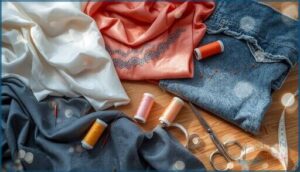
Your fabric choice determines whether your decorative stitches look sharp or fall flat. Pairing the wrong stitch with the wrong material creates puckering, skipped stitches, and frustration that wastes thread and time.
Master these three fabric-matching strategies to transform any project from amateur to polished.
Matching Stitch Density to Fabric Weight
Your fabric weight guidelines determine stitch density control. Heavier fabrics handle dense patterns without puckering, while lightweight materials need open stitches to preserve drape.
Match cotton twill with 2–3 mm spacing for visible effects. Silk demands tighter spacing to prevent snagging. Denim accommodates high-density embroidery, but linen blends require moderate patterns.
Test on scraps first, adjusting thread tension and needle selection to prevent fabric distortion.
Using Stabilizers for Lightweight Fabrics
Proper fabric stabilization prevents distortion when decorative stitching demands precision. Choose stabilizer materials that match your fabric weight—water-soluble options like Solvy Water Soluble Stabilizer dissolve cleanly, while tear-away types remove without residue.
- Use cut-away stabilizers for permanent support on delicate weaves
- Hoop stabilizer with fabric to minimize shifting during stitching
- Adjust tension settings slightly when layering stabilizer materials
- Select size 70/10 needles for smooth penetration through stabilized layers
Test fabric hooping techniques on scraps before committing to your project.
Stitch Placement for Best Results
Once stabilization is set, mark your stitch placement with water-soluble pens or temporary tacking stitches. Position decorative stitches at least 3/8 inch from raw edges to prevent fraying during edge finishing.
Maintain consistent stitch spacing by using your presser foot edge as a guide—this controls stitch density and fabric tension. Test needle placement and thread tension on scraps first to verify stitch alignment before working your final piece.
Thread and Needle Selection Tips
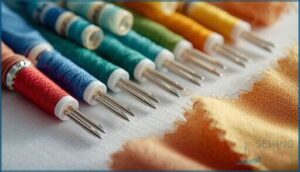
Your thread and needle choices can make or break a decorative stitch—literally. The wrong combination leads to snapped threads, skipped stitches, and designs that look nothing like what you envisioned.
Here’s how to match your materials to your machine and fabric for perfect results every time.
Thread Types: Rayon, Polyester, Cotton
Thread comparison starts with fiber analysis: rayon delivers high-gloss embroidery perfect for decorative stitches, polyester offers durability across fabric types, and cotton provides a classic matte finish. Each affects stitch visibility and color consistency differently.
Here’s your thread breakdown:
- Rayon: Lustrous sheen for embellishment, best on lightweight fabrics
- Polyester: All-purpose strength, resists fading and stretching
- Cotton: Soft texture for heirloom work and natural fibers
- Metallic threads: Add sparkle but require tension adjustments
- Yarn weight: Match thread thickness to your stitch density
Needle Types and Sizes for Decorative Stitches
Your thread choice means little if your needle can’t deliver. Match needle types to your decorative stitches: embroidery needles (60/8–90/14) handle rayon and polyester beautifully, while wing needles create heirloom openwork.
Stitch formation depends on thread compatibility—larger eyes prevent shredding metallic threads.
Fabric interaction requires ballpoint needles for knits, sharp points for wovens. Replace needles every 8–12 hours to maintain consistent needle material performance.
Adjusting Tension for Smooth Stitching
Occasionally, even perfect needle alignment won’t save decorative stitches if tension balance is off. Start with your sewing machine’s mid-range setting, then test on scrap fabric—upper thread tension affects stitch quality directly.
Lightweight materials need lower tension; heavyweight fabrics require more. Adjust gradually while monitoring fabric stability.
Proper tension prevents loops, puckering, and thread breakage, ensuring your decorative stitches lie flat with consistent stitch density across complex sewing techniques.
Common Decorative Stitch Applications
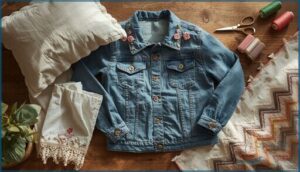
You’ve mastered the technical setup—now it’s time to put those decorative stitches to work.
These patterns transform everyday projects into customized pieces that reflect your unique style. From clothing embellishments to functional edge finishes, you’ll discover exactly where decorative stitches deliver the biggest impact.
Embellishing Garments and Home Decor
You can transform ordinary apparel and linens into standout pieces with the right decorative stitches. Apply small, dense motifs along hems and cuffs for garment personalization without adding bulk—especially on lightweight fabrics.
For home decor accents like pillows and curtains, use motif repeats to create cohesive designs. Border and scallop stitches give towels decorative trims, while florals add stitch texture that elevates fabric embellishment into true textile art.
Quilting With Decorative Stitches
You release artistry in Quilt Block Design when you pair geometric fills with floral motifs across layers. Control how much Fabric Loft Management your batting needs by adjusting Stitch Density Control—denser embroidery compresses loft, while open patterns preserve drape. Test these combinations on scrap squares:
- Stipple quilting for even texture across large areas
- Border decorative stitches to frame each block
- Machine Tension Adjustment and Quilting Thread Selection for consistent sewing machine results
Edge Finishing and Seam Reinforcement
Overlock Techniques secure edges against fraying on both woven and stretch fabrics—decorative stitches like blanket stitches add polish while delivering Seam Security.
Topstitching along seams distributes load and reduces stress concentration. Twin needle work and satin stitch create durable Edge Binding on knits, while zigzag patterns stabilize lighter materials.
Pair Reinforcement Methods with Fabric Stabilizers at stress points for professional edge finishing.
Troubleshooting Decorative Stitch Problems
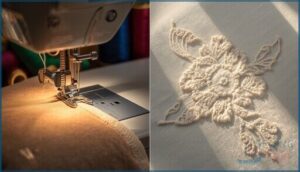
Even experienced sewists hit roadblocks when decorative stitches don’t cooperate—thread snaps mid-pattern, fabric bunches like an accordion, or designs skip and warp unpredictably.
These frustrations aren’t random; they’re signals that your machine, stabilizer, or tension settings need adjustment.
Here’s how to diagnose and fix the three most common decorative stitch problems so you can get back to creating impeccable embellishments.
Fixing Thread Breakage and Bunching
Thread breakage often signals your thread tension needs adjustment—loosen the upper tension dial first and test on scrap fabric. Check that your needle selection matches thread weight and fabric thickness.
For fabric stability issues causing bunching, pair a quality stabilizer with proper stitch density settings.
Clean your sewing machine’s tension discs and verify the thread path runs smoothly through all guides.
Preventing Skipped and Distorted Stitches
Skipped stitches vanish when you master needle selection—use fresh, sharp needles sized for your fabric weight and thread type. Balance thread tension to stitch density, then test on scrap material.
Machine calibration matters: clean your bobbin area weekly and guarantee proper fabric stabilization with quality backing. Align fabric grain parallel to feed dogs, adjusting presser foot pressure to prevent distortion and maintain consistent stitch formation.
Stabilizer and Machine Adjustment Tips
Perfect stitches demand strategic stabilizer selection and precise machine calibration. Match stabilizer weight to your fabric—tear-away for wovens, water-soluble for delicates—and secure it with temporary spray adhesive to prevent shifting.
Fine-tune your setup with these essentials:
- Adjust thread tension on scrap fabric before starting your project
- Reduce presser foot pressure on lightweight materials to avoid stretching
- Clean your bobbin area weekly for consistent stitch density
Document your settings for repeatability across future projects.
Top 4 Decorative Stitch Tools and Products
Your decorative stitching results depend on the tools you choose—the right machine, threads, stabilizers, and feet make all the difference. Quality equipment prevents frustration and gives you clean, professional stitches every time.
Here are four essential products that’ll transform your decorative stitching from adequate to outstanding.
1. Brother Sewing And Embroidery Machine
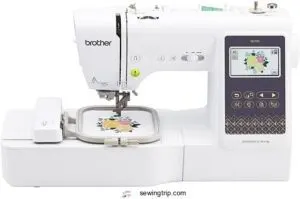
You’ll gain complete control over decorative stitches with the Brother SE700—a combination sewing and embroidery machine that puts 103 built-in patterns at your fingertips. Machine setup takes minutes thanks to the automatic needle threader and color-coded threading paths.
The 4×4-inch embroidery hoops handle most decorative projects, while the 3.7-inch touchscreen lets you preview designs before stitching. Adjust thread tension through straightforward controls, and the jam-resistant drop-in bobbin management system keeps your workflow smooth.
Set sewing speed up to 710 stitches per minute for efficient embroidery, and sewing machine maintenance stays simple with accessible feed dogs.
| Best For | Beginners and experienced sewers looking for a versatile machine that handles both everyday sewing projects and custom embroidery work without breaking the bank. |
|---|---|
| Primary Use | Sewing & Embroidery |
| Material | Metal and Plastic |
| Brand | Brother |
| Color | White |
| Weight | 15.6 pounds |
| Skill Level | Beginner to Advanced |
| Additional Features |
|
- Wireless connectivity and Artspira app compatibility make it easy to transfer custom designs from your phone or computer straight to the machine.
- The automatic needle threader and drop-in bobbin save time on setup, so you spend more time creating and less time threading.
- 135 embroidery designs and 103 sewing stitches give you plenty of built-in options for quilting, apparel, and home decor projects.
- The 4×4-inch embroidery area limits you to smaller designs, which won’t work for large-scale embroidery projects.
- Limited throat space makes it tough to maneuver bulky quilts or thick layered fabrics through the machine.
- You’ll need to budget extra for threads, needles, and design software since those aren’t included in the package.
2. Brothread Polyester Embroidery Thread Kit
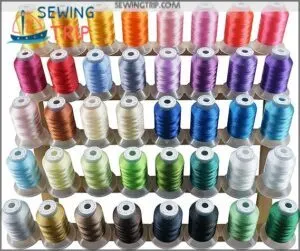
Your decorative stitches deserve thread quality that keeps pace with your vision—the Brothread 40-color polyester embroidery thread kit delivers exactly that. Each 550-yard spool offers high tensile strength to handle dense satin stitches and delicate florals without breaking mid-pattern.
The color variety accommodates everything from monochromatic geometric designs to vibrant nature-inspired motifs, while polyester’s colorfastness ensures stitch durability through repeated washing.
Compatible with Brother, Janome, and Singer sewing machines, this kit manages fabric compatibility across lightweight cottons to heavier canvas, though you’ll need proper stabilizers for best embroidery techniques.
| Best For | Home embroiderers and small business owners who need a reliable, colorfast thread collection for decorative stitching on workwear, uniforms, and home décor projects. |
|---|---|
| Primary Use | Embroidery Thread |
| Material | Polyester |
| Brand | New brothread |
| Color | 40 Colors |
| Weight | 66000 feet total |
| Skill Level | All Levels |
| Additional Features |
|
- 40 vibrant colors with 550 yards per spool give you plenty of thread for multiple projects without frequent restocking
- High tensile strength and polyester construction prevent breakage during dense stitching and resist fading through commercial laundering
- Wide machine compatibility with Brother, Janome, Singer, and other major brands makes setup straightforward
- No storage rack included, so you’ll need to buy or build your own organization system
- May require machine servicing and stabilizer use for optimal performance on complex patterns
- Warranty support requires contacting the manufacturer directly rather than through the retailer
3. Water Soluble Embroidery Stabilizer
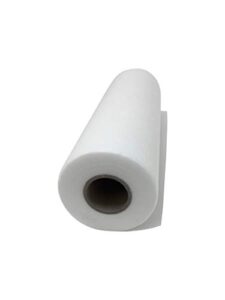
Dense decorative stitching demands support that vanishes without a trace—water soluble stabilizer manages the job perfectly. This 1.5 oz fibrous material prevents fabric puckering during intricate embroidery techniques, then dissolves completely in warm water within 5 to 15 minutes.
You’ll need proper stabilizer storage in airtight containers to prevent moisture absorption. The Solvy water soluble stabilizer works across lightweight cottons to delicate sheers, though high-stitch-count projects require doubling up.
Match your stabilizer materials to fabric compatibility requirements, and always rinse thoroughly to eliminate residue on darker fabrics.
| Best For | Embroiderers working on delicate fabrics, free-standing lace projects, or intricate designs where no stabilizer residue can remain visible. |
|---|---|
| Primary Use | Embroidery Stabilizer |
| Material | Water-Soluble Film |
| Brand | SULKY |
| Color | Clear |
| Weight | 13.4 ounces |
| Skill Level | All Levels |
| Additional Features |
|
- Dissolves completely in warm water within 5 to 15 minutes, leaving no trace on fabric
- Prevents puckering and fabric show-through during embroidery while maintaining support for detailed stitching
- Cost-effective 25-yard bulk roll works across multiple fabric types from lightweight cottons to sheer materials
- Thinner 1.5 oz weight may require doubling up for high-stitch-count or dense embroidery projects
- Can leave residue or clumping on darker fabrics if not rinsed thoroughly enough
- Requires airtight storage to prevent moisture absorption and maintain usability over time
4. VANICE Monogramming Presser Foot
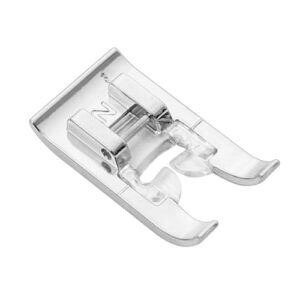
Precision monogramming demands consistent needle placement. Install the VANICE open-toe presser foot for reliable stitch alignment on your low-shank sewing machine. This alloy steel accessory weighs just 0.634 ounces yet transforms decorative stitching accuracy through its clear view window and integrated guide channel.
Follow standard foot installation procedures: position it onto the holder, secure with your machine’s screw, then engage straight or decorative embroidery patterns.
Proper presser foot care maintains performance across cotton poplin and linen blends. Apply monogramming tips like pairing with stabilizer to prevent puckering while executing intricate monogram design work and complex stitching patterns.
| Best For | Sewers who want to add clean, professional monograms and decorative lettering to garments and home decor projects using low-shank snap-on machines. |
|---|---|
| Primary Use | Embroidery Presser Foot |
| Material | Alloy Steel and Plastic |
| Brand | YEQIN |
| Color | Silver |
| Weight | 0.634 ounces |
| Skill Level | All Levels |
| Additional Features |
|
- Open-toe design with a clear view window lets you see exactly where the needle lands, making it easier to align letters and keep stitching consistent.
- Durable alloy steel and plastic construction holds up through repeated embroidery sessions without wearing down quickly.
- Built-in guide channel helps maintain uniform stitch width and reduces fabric shifting, which cuts down on puckering and uneven lettering.
- Only works with low-shank snap-on sewing machines, so you’ll need to verify compatibility before ordering.
- Performance varies depending on fabric type—delicate materials often require a stabilizer to get clean results.
- Doesn’t include a sewing machine or additional accessories, just the presser foot itself.
Frequently Asked Questions (FAQs)
Can decorative stitches be used on stretch fabrics?
Wondering if your stretchy knit can handle those fancy patterns? Yes—decorative stitches work on stretch fabrics when you pair elastomeric thread with ballpoint needles, proper stabilizer types, and test your sewing machine settings first to prevent fabric distortion.
How do you resize decorative stitch patterns?
Adjust your machine’s stitch width and length settings to resize decorative stitch patterns—start between 50% and 200% scale.
Test on scrap fabric first, then fine-tune thread tension and add stabilizer to maintain pattern density and fabric stability.
Whats the best way to practice new stitches?
Like warming up before a workout, stitch practice begins with scrap fabric matching your project’s weight. Test tension control and thread management, calibrating your sewing machine’s decorative stitches until stitching patterns flow smoothly—then graduate to real material.
Can you create custom decorative stitch combinations?
Yes—you can layer or alternate decorative stitch patterns to create one-of-a-kind fabric manipulation effects.
Modern machines let you program custom embroidery sequences, blending thread colors and stitch density for truly unique decorative stitching results.
How do you remove decorative stitches without damage?
Use a seam ripper to lift individual threads carefully—work slowly on a flat surface under good light.
Cut one thread at a time to prevent fabric damage, ensuring clean stitch removal without distortion.
Conclusion
The moment you press that foot pedal with the right decorative stitch options explained, stabilizer layered beneath, and tension dialed in—that’s when plain fabric stops being ordinary. Your machine transforms into a precision tool that rivals commercial embroidery, delivering professional results without digitizing headaches or specialty equipment.
Start with one pattern, master the fundamentals, then watch your creative possibilities multiply. Every stitch you’ve overlooked until now becomes an opportunity waiting to be stitched into reality.