This site is supported by our readers. We may earn a commission, at no cost to you, if you purchase through links.
If you’ve ever tried to hem your pants with a flimsy needle that bends like a paperclip, you know the difference between basic and professional sewing kit isn’t just about price—it’s about sanity.
The gap between a starter kit and the kind a tailor swears by can mean fewer pricked fingers, straighter seams, and less muttered cursing at midnight.
Whether you’re patching a pocket or planning your own wardrobe, the right tools don’t just make things easier—they open up what’s possible.
Let’s break down what separates the “good enough” from the “built to last”, so you can choose a kit that matches your ambitions.
Table Of Contents
- Key Takeaways
- Key Components of a Basic Sewing Kit
- What Sets a Professional Sewing Kit Apart
- Comparing Basic Vs. Professional Sewing Kits
- Top 10 Sewing Kits and Accessories to Consider
- 1. Vellostar Portable Sewing Kit
- 2. Yuanhang Sewing Kit for Adults
- 3. WILLBOND Nylon Coil Zippers
- 4. Singer Sewing Scissors Bundle
- 5. Singer Comfort Grip Seam Ripper
- 6. ICNOW Sewing Kit Essentials
- 7. Simthread All Purpose Polyester Sewing Thread
- 8. Mr Pen Large Eye Sewing Needles
- 9. Fiskars Sewing Needle Set
- 10. Headley Tools Rotary Cutter Set
- Choosing The Right Sewing Kit for Your Needs
- Frequently Asked Questions (FAQs)
- Conclusion
Key Takeaways
- Basic sewing kits ($5-$15) cover everyday mending with general-purpose needles, thread, and scissors, while professional kits ($60-$150+) include specialty tools like rotary cutters, precision shears, and presser feet designed for garment construction and complex techniques.
- The real difference isn’t just price—it’s durability and precision, with professional tools using carbon steel blades that hold edges 60% longer and maintain cutting accuracy within 0.2mm tolerance compared to basic kits that bend or dull quickly.
- Your skill level and project frequency should guide your purchase: beginners need portability and simplicity, while intermediate sewers benefit from upgrading 2-3 core tools as they tackle more ambitious projects like custom garments or upholstery work.
- Smart upgrading beats buying everything at once—start with high-quality scissors and specialty needles as your frustrations reveal what’s actually holding you back, rather than investing in features you won’t use yet.
Key Components of a Basic Sewing Kit
A basic sewing kit won’t win any awards for fancy tools, but it’ll get you through most mending jobs and simple projects without breaking the bank.
Most kits include a general-purpose presser foot, though you can explore different types of presser feet once you’re ready to tackle zippers or hems.
Think of it as your safety net—compact, practical, and ready when a button pops off or a hem comes loose. Here’s what you’ll actually find inside a solid starter kit.
Essential Hand Sewing Needles
Your hand sewing needles are the workhorses of any sewing kit—they handle quick repairs, fine detail work, and everything between. Most basic kits include assorted sharps in several needle sizes, covering light to medium fabrics with ease.
Here’s what you’ll usually find:
- Sharps for general hand stitching on woven materials
- Embroidery needles with larger eyes for decorative thread types
- Quilting needles that help you pull small, even stitches through layers
You can also find a wide range of designed for various sewing and embroidery tasks.
Standard Thread Selection
Thread choices in your sewing kit matter more than you’d think. Most basic kits stock all-purpose polyester thread in core colors like black, white, and beige—suitable enough for everyday repairs and light projects. Thread weight usually falls around Tex 27 to Tex 40, balancing strength with smooth stitching. Spool sizes range from compact 100-yard spools for portability to generous 500-yard rolls for bigger jobs.
For those seeking more options, you can explore to cover a wide range of sewing needs.
| Fiber Choices | Thread Weight | Typical Spool Sizes |
|---|---|---|
| All-purpose polyester | Tex 27–40 (medium) | 100–500 yards |
| Cotton-wrapped polyester | Tex 30–40 | 200–500 yards |
| 100% cotton | Tex 40+ | 250–600 yards |
| Nylon (heavy-duty) | Tex 70–80+ | 200–1000 yards |
Fabric and Embroidery Scissors
You won’t get far without sharp cutting tools. Most basic kits provide one pair of general fabric scissors—usually stainless steel with blades around 8 inches for straight cuts.
Embroidery scissors run shorter, around 3 to 4 inches with pointed tips, perfect for snipping threads close to your work. Blade design and handle ergonomics matter: softer grips reduce fatigue, and micro-serrated edges grip slippery fabrics without sliding.
Pins, Safety Pins, and Pin Cushions
Once you’ve cut your fabric, you’ll need Pins to hold everything in place. Basic kits usually include straight sewing pins around 1 1/4 inches with ball or glass heads, plus a few Safety Pins for quick fixes.
A simple stuffed pincushion keeps them organized—though some sewists swear by Magnetic Cushions that catch dropped pins instantly. Pin Materials vary: nickel-plated steel resists rust, while different Sewing Pinheads (glass, plastic, flat T-shapes) suit different tasks.
Pin Sizes range from tiny half-inch appliqué pins to 2-inch quilting giants, so grab what matches your project weight.
Thimbles and Needle Threaders
Your fingers will thank you for adding a Thimble to your Sewing Kit—metal, silicone, or leather Thimble Materials each offer solid Finger Protection when you’re hand-stitching thick fabric.
A simple wire-loop Needle Threader saves eyestrain and frustration, especially with fine threads. Together, these Sewing Essentials boost Sewing Ergonomics and Thread Management, turning tedious tasks into smooth sailing—even if you’re wrestling denim at midnight.
Seam Rippers and Tape Measures
Mistakes happen—that’s where a Seam Ripper slides under stitches with its forked blade, freeing you to start fresh without tearing fabric.
Pair it with a flexible Tape Measure (cloth or retractable metal) for Sewing Accuracy in seam allowances and body measurements. Together, these Measurement Tools and Sewing Essentials keep your Fabric Cutting precise and your fixes painless.
Basic Marking Tools
You’ll need to transfer pattern lines onto fabric—that’s where Marking Tools like Tailor’s Chalk, Chalk Pencils, and Fabric Markers come in. Chalk Types (blue, white, pink) show clearly on different Thread Colors and wash out easily.
Marking Pens offer vivid, water-soluble lines for seam allowances and darts. Pair these Sewing Notions with your Tape Measure and Seam Gauge for precision every time.
What Sets a Professional Sewing Kit Apart
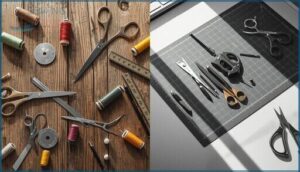
Once you’ve mastered the basics, you’ll notice professional kits operate on a completely different level. They’re packed with specialized tools designed for precision, durability, and serious garment construction—not just quick repairs.
Let’s break down what actually earns a sewing kit the “professional” label.
Specialty and High-Quality Scissors
You’ll notice professional scissors right away—they’re built with high carbon or titanium-coated blades that hold an edge through hundreds of cuts.
The blade materials make all the difference in edge retention, while ergonomic handle designs reduce hand fatigue during long sessions. These premium sewing tools transform cutting techniques, giving you the precision and control that basic sewing kit scissors simply can’t match.
Rotary Cutters and Multiple Shears
Professional kits give you rotary cutters with blades from 18mm to 60mm—perfect for fabric layering and slicing multiple pieces at once. You’ll get pinking shears, multiple fabric shears, and specialty cutting tools that basic sewing kit essentials don’t include.
Rotary cutter safety features like retractable guards protect you, while self-healing cutting mats preserve blade edges. Regular shear maintenance and blade sharpening keep these sewing tools and supplies performing like new.
Advanced Measuring and Marking Tools
Accuracy becomes second nature when you’ve got marking tools that actually do what you need them to. Professional kits include chalk pencils, fabric marking tools, and multiple measuring tape options—think quilting rulers with angle guides and measuring techniques you’ll rely on daily.
You’ll find precision gauges that support sewing accuracy for darts and seam allowances, plus caliper usage for buttonhole spacing and zipper placement.
Specialty Needles and Threads
Once you’ve nailed down your measurements, you’ll want the right needles and threads to match your fabric types.
Professional kits stock ballpoint needles for knits, microtex for silk, and leather needles with wedge points—plus embroidery thread, polyester for strength, cotton for heirloom work, and wax threads for upholstery.
Different needle sizes and yarn weights mean you’re ready for any sewing technique.
Presser Feet and Sewing Machine Accessories
Beyond those specialty needles and threads, your machine sewing depends on the right presser foot types and sewing machine accessories. Professional kits swap standard feet for zipper, walking, rolled hem, and bias feet—each one improving stitch quality on tricky fabrics. Foot compatibility matters, so check your shank before you buy.
Regular accessory maintenance keeps attachments sharp and your sewing machine feet performing like new.
- A zipper foot hugs the coil so you can stitch right alongside the teeth without wobbling
- Walking feet prevent slippery polyester or thick quilts from shifting mid-seam
- Rolled hem feet create those clean, narrow edges on chiffon that look store-bought
- Bias binding feet guide fabric strips into perfect folds for polished edge finishes
Tools for Garment Construction and Finishing
Once you nail the feet, you’ll want specialized notions that refine garment construction from functional to exceptional. Pattern making and textile handling tools—point turners, bias tape makers, pressing hams—transform raw seams into professional finishes.
These sewing supplies support complex sewing techniques across fabric cutting, dart marking, and zipper work.
| Tool | Primary Use | Finish Impact |
|---|---|---|
| Point turner | Sharp corner shaping | Clean collar tips |
| Pressing ham | Curved seam pressing | Structured darts |
| Bias tape maker | Edging preparation | Polished hems |
| Tracing wheel | Pattern transfer | Accurate placement |
Storage and Organization Solutions
Great finishes need great Sewing Box Designs—clutter kills precision work. Professional sewing storage solutions shift from basic pouches to integrated systems that protect your investment and speed up projects.
Smart storage case options include:
- Modular multi-layer Craft Organizers with removable trays and dividers for needles, bobbins, and presser feet
- Wall-mounted Thread Management racks holding 100+ spools visible by color near your Sewing Station
- Portable sewing solutions with padded compartments and elastic loops that secure tools during transport
Comparing Basic Vs. Professional Sewing Kits
Now that you know what separates a basic kit from a professional one, let’s put them side by side and see how they actually stack up.
The differences go beyond just what’s included—they affect how you work, what you can create, and how much you’ll spend. Here’s what really sets these two kit types apart.
Range and Quality of Included Tools
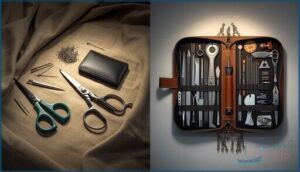
When you open a basic sewing kit, you’ll find maybe five to ten tools—enough for quick repairs. Professional kits triple that range, offering specialty shears, rotary cutters, and presser feet you won’t see in beginner sewing supplies.
Here’s how tool variety and precision cutting differ:
| Feature | Basic Kit | Professional Kit |
|---|---|---|
| Needle Selection | Single hand needle set for light fabrics | Specialty needles for denim, leather, stretch |
| Fabric Handling | Entry-level steel scissors, basic pins | Hardened shears, rotary cutters, micro-serrated blades |
| Sewing Tools | 5–10 essential items | 30+ tools including marking wheels, presser feet |
| Durability | Light plastics, intermittent use | Reinforced materials, corrosion-resistant coatings |
| Kit Customization | Fixed contents in zip pouch | Modular cases with labeled compartments |
Professional sewing tools and equipment maintain sharpness longer and resist rust after repeated washes—vital when you’re working daily.
Suitability for Different Projects
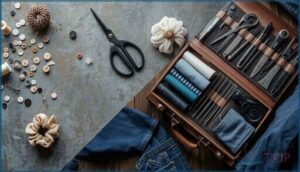
Your project complexity dictates which sewing kit wins. Basic kits handle scrunchies, quick hems, and button replacements—hobby-friendly craft applications that don’t demand specialty embroidery tools or complex sewing techniques.
Professional kits tackle garment construction from scratch, managing thick denim and custom jackets with the right fabric types and sewing tools for each step.
| Kit Type | Suitable Projects |
|---|---|
| Basic | Mending, label sewing, simple alterations |
| Professional | Dresses, custom trousers, upholstery work |
Durability and Precision
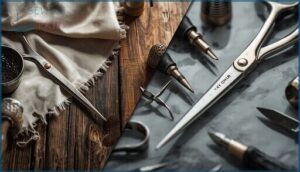
Professional kits outlast basic versions because material selection matters—carbon steel blades stay sharp for 20 hours of cutting, while stainless steel grips resist rust through five years of use. You’ll notice cutting accuracy improvements of 60 percent less fraying with micro-serrated sewing scissors.
Tool longevity and wear resistance justify the investment when precision engineering meets your sewing techniques and tips.
| Feature | Basic Kit | Professional Kit |
|---|---|---|
| Blade Material | Standard steel | Carbon steel (HRC 57) |
| Cutting Precision | Moderate | 0.2mm tolerance |
| Expected Lifespan | 1-2 years | 5+ years |
| Thimble/Seam Ripper Quality | Lightweight plastic | Heat-treated alloys |
Kit Price Points and Value
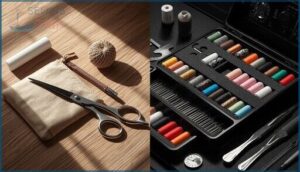
When you’re weighing sewing kits and accessories, budget planning starts with understanding what you’re really paying for. Basic kits usually cost $5 to $15 for beginner sewing tools—think needles, thread, and small scissors.
Midrange sewing supplies run $15 to $40, while investment returns on professional sewing tools jump to $60–$150+, delivering high precision and durability that justify the price comparison.
| Kit Type | Price Range | Best For |
|---|---|---|
| Basic | $5-$15 | Quick repairs, portability |
| Midrange | $15-$40 | Hobby projects, occasional use |
| Professional | $60-$150+ | Frequent sewing, garment construction |
Scalability for Skill Levels
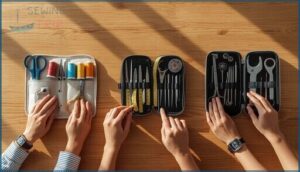
Your sewing journey maps directly to the tools you need—beginners face frustration with too many features, while intermediate projects demand upgrades basic kits can’t handle. Skill level assessment shows most sewists upgrade 2 to 3 tools as they grow, balancing beginner challenges with expanding capability.
Your sewing journey maps directly to the tools you need—most sewists upgrade two to three tools as their skills expand from beginner to intermediate projects
| Skill Level | Recommended Kit Type |
|---|---|
| Beginner Sewing | Basic (1-2 specialty tools) |
| Intermediate Projects | Midrange (3-5 core tools) |
| Expert Techniques | Professional (5-8 specialty tools) |
| Full Garment Work | Professional with expansions. |
Sewing kit upgrades follow your sewing experience—start simple, then add precision tools as sophisticated techniques become second nature.
Top 10 Sewing Kits and Accessories to Consider
Now that you understand the gap between basic and professional kits, let’s talk about what’s actually worth buying.
I’ve pulled together ten solid tools and kits that won’t let you down—whether you’re mending a hem or building a full garment from scratch.
Here’s what made the cut.
1. Vellostar Portable Sewing Kit
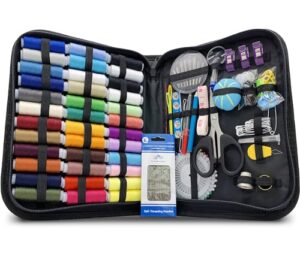
Think of the Vellostar kit as your trusty travel companion—small enough for a tote bag but packed with 36 color threads and 30 needles. You’ll get stainless-steel scissors, threaders, and a durable case that holds everything in one spot.
It’s built for quick fixes and beginner-friendly projects, though some users mention the needle container can be stubborn to open. At around $15, it won’t handle heavy-duty work, but it’s perfect for mending hems and replacing buttons on the go.
| Best For | Beginners, travelers, and anyone who needs a compact kit for quick repairs and basic sewing projects at home or on the go. |
|---|---|
| Primary Material | Polyester, Stainless Steel |
| Use Case | Home mending, crafting |
| Skill Level | Beginners, adults |
| Portability | Portable, compact |
| Piece Count | 100+ pieces |
| Brand | VelloStar |
| Additional Features |
|
- Includes 36 color threads and 30 needles plus stainless-steel tools in one organized, portable case
- Great value at around $15 for everyday mending and simple crafting needs
- Compact size makes it easy to toss in a bag for travel or emergency fixes
- Needle storage container can be frustrating to open
- Some users report the needles and pins feel flimsy or low-quality
- Not built for professional or heavy-duty sewing work
2. Yuanhang Sewing Kit for Adults
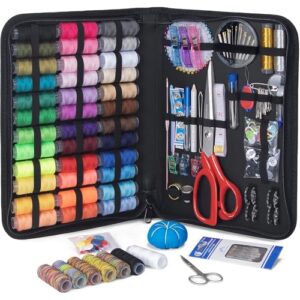
If you need more supplies without the hefty price tag, the Yuanhang kit offers 251 pieces for around $15. You’ll find 41 XL thread spools (upgraded to 150 yards each), 55 spare buttons, and 30 hand-sewing needles plus 12 self-threading ones.
The heavy-duty 600D Oxford case keeps everything organized with elastic holders, and at 11 x 9.25 inches, it’s still portable. Some users note the scissors aren’t outstanding and the measuring tape feels flimsy, but it’s hard to beat this range for beginners tackling household repairs.
| Best For | Beginners and budget-conscious sewers who want a comprehensive starter kit for basic repairs and DIY projects without spending much. |
|---|---|
| Primary Material | Plastic, Stainless Steel |
| Use Case | Travel, basic sewing |
| Skill Level | Beginners, professionals |
| Portability | Portable design |
| Piece Count | 251 pieces |
| Brand | YUANHANG |
| Additional Features |
|
- Includes 251 pieces with 41 upgraded thread spools (150 yards each) and multiple needle types for around $15
- Durable 600D Oxford case with elastic organizers keeps supplies neatly arranged and portable
- Great variety of accessories like 55 spare buttons makes it versatile for different sewing tasks
- Scissors quality isn’t great and the measuring tape feels flimsy
- The sheer number of items (251 pieces) can be overwhelming for some users
- Higher price point compared to more basic kits may not justify the extras for simple repairs
3. WILLBOND Nylon Coil Zippers
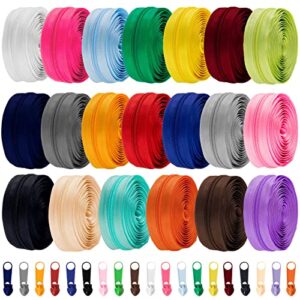
When you’re ready to add zippers to your projects, the WILLBOND Nylon Coil Zipper set gives you 60 yards across 20 colors plus 200 sliders—plenty for bags, pouches, and garments. Each roll runs 3 yards by 1.2 inches, and you can cut them to any length you need.
The nylon coil resists rust and bends smoothly around curves, though some folks find the sliders tricky to attach at first. At around $15, it’s a solid bulk option for experimenting without breaking the bank.
| Best For | Crafters and sewers who need bulk zipper yardage in multiple colors for bags, pouches, garments, and DIY projects. |
|---|---|
| Primary Material | Nylon |
| Use Case | DIY sewing crafts |
| Skill Level | DIY crafters |
| Portability | Not portable |
| Piece Count | 60 yards + 200 sliders |
| Brand | WILLBOND |
| Additional Features |
|
- 60 total yards across 20 colors with 200 sliders gives you tons of flexibility for different projects
- Nylon coil design resists rust and bends smoothly around curves
- Budget-friendly at around $15 for the whole set
- Sliders can be tricky to attach, especially when you’re first learning
- Fabric quality is thinner than premium sewing-store zippers and may wave if not handled carefully
- Some batches arrive tangled or with grease on the tape
4. Singer Sewing Scissors Bundle
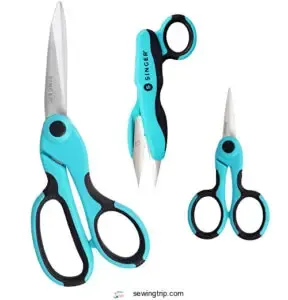
Sharp scissors make every cut count, and the Singer ProSeries Bundle delivers three tools in one go: 8.5-inch bent fabric shears, 4.5-inch detail scissors, and 5-inch thread snips. The tempered stainless steel blades stay sharp through multiple layers, while the teal and black comfort grips work for lefties and righties alike.
Some users mention the scissors feel stiff out of the box—a drop of oil helps—and there’s no storage case included. At around $15 to $20, it’s a multifaceted starter set.
| Best For | Beginner sewers and crafters who need a versatile set of scissors for fabric, embroidery, and detail work without breaking the bank. |
|---|---|
| Primary Material | Stainless Steel |
| Use Case | Sewing projects, crafts |
| Skill Level | All levels |
| Portability | Not specified |
| Piece Count | 3 pieces |
| Brand | ProSeries |
| Additional Features |
|
- Three different sizes handle everything from heavy fabric layers to precise thread snips
- Tempered stainless steel blades stay sharp and resist rust
- Ambidextrous design with comfortable grips works for both left and right-handed users
- Scissors arrive stiff and may need lubrication before they cut smoothly
- No storage case included despite the multi-piece set
- Teal color may look different in person than in product photos
5. Singer Comfort Grip Seam Ripper
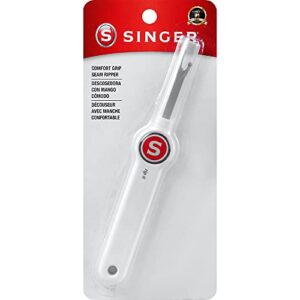
Mistakes happen—wrong seam, crooked topstitching, a buttonhole that wandered off course—and the Singer Comfort Grip Seam Ripper gets you out of those tangles without tearing your fabric. The oversized rubber handle sits comfortably in your hand, even during marathon unpicking sessions, while the forked metal blade slips under individual stitches with surgical precision.
You’ll find a two-pack (large and small blade) for around $5 to $8, complete with safety caps. That little red ball on one prong keeps the sharp edge from scratching delicate fabrics.
| Best For | Sewers who need to remove stitches, open buttonholes, or take off buttons and snaps without damaging their fabric. |
|---|---|
| Primary Material | Rubber, Metal |
| Use Case | Thread picking, seam removal |
| Skill Level | All seamstresses |
| Portability | Handheld |
| Piece Count | 1 piece |
| Brand | S07320 |
| Additional Features |
|
- Comfortable rubber grip handle makes it easy to hold during long seam-ripping sessions
- Protective cap and red safety ball prevent fabric scratches and keep you safe when not in use
- Affordable at $5-$8 for a two-pack with both large and small blade options
- Some users find the rubber handle texture slightly unpleasant to grip
- At under an ounce, the lightweight design might feel too flimsy for some sewers
- No extended warranty or durability guarantees mentioned for the blade tips
6. ICNOW Sewing Kit Essentials
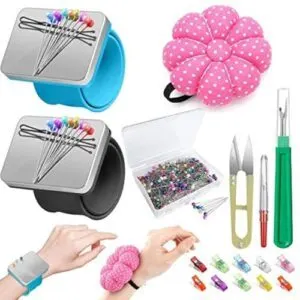
If you pin a lot—quilts, garment seams, thick binding—the ICNOW Sewing Kit bundles 200 straight pins, two magnetic wrist cushions, 10 clips, two seam rippers, and a pair of thread scissors into one grab-and-go package for around $16.
Those wrist magnets hold over 100 pins each, so you won’t spend half your evening fishing dropped pins from carpet (or worse, stepping on them barefoot). Clips replace pins on vinyl or layered fabrics that resist piercing, and having backup seam rippers means you’re never stuck mid-project.
| Best For | Quilters, sewers, and crafters who work on multi-step projects and want their pins, clips, and cutting tools organized in one portable kit. |
|---|---|
| Primary Material | Cotton, Fabric, Metal |
| Use Case | Sewing, quilting, embroidery |
| Skill Level | Beginners, DIY lovers |
| Portability | Portable, compact |
| Piece Count | 213 pieces |
| Brand | ICNOW |
| Additional Features |
|
- Magnetic wrist cushions hold 100 pins each, keeping them within reach and off your floor
- Bundled tools—200 pins, clips, seam rippers, scissors—give you everything for piecing, binding, and quick fixes
- Clips work on thick or delicate fabrics like vinyl and leather where pins would leave marks or snap
- Wrist magnets don’t grip as strongly as some users expect, occasionally dropping pins
- Pins bend on heavy-weight fabric, so you may need sturdier ones for denim or canvas
- Quality varies—some kits arrive with chipped magnet paint or dull scissor blades
7. Simthread All Purpose Polyester Sewing Thread
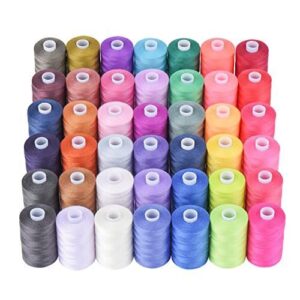
Color matters when you’re blending seams into fabric—and the Simthread 42-spool polyester set gives you 1,000 yards per color for roughly $20, so you’re stocked for everything from invisible hems to topstitching denim. Each spool accommodates domestic machine tension without constant snapping, and polyester holds strength through washing better than cotton.
You’ll get slight sheen that looks polished on most garments, plus enough yardage to tackle multiple projects before reordering. A few users report occasional breakage, but most find it reliable for everyday sewing.
| Best For | Sewers and quilters who need a wide color range for everyday projects like garment repairs, topstitching, and creative work without breaking the bank. |
|---|---|
| Primary Material | Polyester |
| Use Case | Quilting, sewing projects |
| Skill Level | All levels |
| Portability | Not portable |
| Piece Count | 42 spools |
| Brand | Simthread |
| Additional Features |
|
- 42 colors with 1,000 yards each gives you plenty of thread for multiple projects at around $20
- Polyester holds up well through washing and works smoothly with most domestic sewing machines
- Versatile enough for hand sewing, machine sewing, topstitching, and embroidery
- Some users experience thread breakage and fraying during use
- Limited to 42 colors, so you might not find the exact shade for invisible repairs on specific fabrics
- May not work well with older sewing machines or certain tension settings
8. Mr Pen Large Eye Sewing Needles
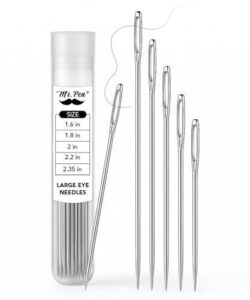
Threading a needle when your eyes aren’t what they used to be—or you’re juggling embroidery floss—can turn simple mending into a test of patience.
The Mr Pen 50-piece set solves that with oversized eyes that accept thicker threads or multiple strands without fraying. You get five lengths (1.6″ to 2.35″) in a compact wooden tube, all made from polished iron alloy that glides smoothly through fabric. Around $8 for 50 needles means you’re covered for basting, visible mending, and hand quilting without wrestling with a tiny eye.
| Best For | Anyone with poor eyesight, arthritis, or dexterity challenges who needs to thread needles quickly for hand sewing, embroidery, or quilting projects. |
|---|---|
| Primary Material | Iron |
| Use Case | Hand sewing, embroidery |
| Skill Level | All levels |
| Portability | Compact storage |
| Piece Count | 50 needles |
| Brand | Mr. Pen |
| Additional Features |
|
- Large eyes make threading with thick embroidery floss or multiple strands effortless—no squinting required
- Five different lengths (1.6″ to 2.35″) handle everything from delicate stitching to heavy-duty mending
- Transparent storage tubes keep each size organized and the whole set costs around $8 for 50 needles
- The large eye can let thread slip out mid-stitch, which gets annoying on longer seams
- Some users report the eye isn’t quite as wide as expected despite being marketed as “big eye”
- Quality control varies—a few needles in the pack may arrive bent or with rough spots
9. Fiskars Sewing Needle Set
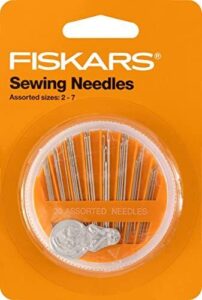
When you need different needle types without buying five separate packs, Fiskars’ 30-needle assortment covers the essentials. You’ll find betweeners for quilting, darners for sock repairs, embroidery needles, and sharps—all in sizes 2 through 7.
They arrive in a compact orange-and-clear case that rotates to dispense one needle at a time (no spills). A threader’s included, though some users note it’s flimsy. Around $5 to $7 makes this a solid starter set for mending, crafts, and basic hand-sewing without cluttering your workspace.
| Best For | Anyone who wants a variety of hand-sewing needles for mending, crafts, or starting out without buying multiple packs. |
|---|---|
| Primary Material | Plastic |
| Use Case | Sewing projects, crafts |
| Skill Level | All levels |
| Portability | Compact storage |
| Piece Count | 30 needles + threader |
| Brand | Fiskars |
| Additional Features |
|
- Wide assortment of needle types and sizes for different projects
- Compact spinning case keeps needles organized and safe
- Includes a needle threader for easier threading
- Packaging and spinning top can be tricky to open or turn
- Needle threader feels flimsy and may break
- Plastic case isn’t the most durable and can come apart
10. Headley Tools Rotary Cutter Set
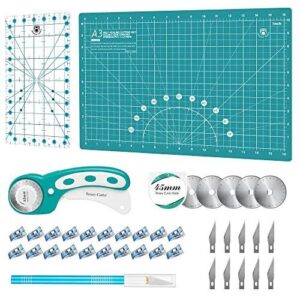
Ever wished you could slice through fabric stacks as smoothly as a sharp knife? The Headley Tools Rotary Cutter Set gives you that power—think 45mm SKS-7 steel blade, ergonomic handle, and a safety lock so you keep all your fingers.
It’s bundled with an A3 self-healing mat, acrylic quilting ruler, and extra blades—plus sewing clips for wrangling slippery layers. Great for quilting, garment cutting, or even leather, it’s a solid upgrade for anyone tired of hand cramps and ragged edges.
| Best For | Anyone who loves quilting, sewing, or DIY crafts and wants a reliable, all-in-one cutting set. |
|---|---|
| Primary Material | Plastic |
| Use Case | Quilting, sewing, patchwork |
| Skill Level | Beginners, experienced crafters |
| Portability | Not portable |
| Piece Count | Multiple pieces |
| Brand | Headley Tools |
| Additional Features |
|
- Includes everything you need: rotary cutter, self-healing mat, ruler, extra blades, and sewing clips.
- Ergonomic handle and safety button make cutting comfortable and safe.
- Cuts through fabric, paper, vinyl, and more with ease.
- Cutting mat may feel small for bigger projects.
- Price varies depending on color choice.
- Limited info on how well it holds up over time.
Choosing The Right Sewing Kit for Your Needs
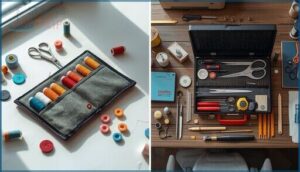
Choosing a sewing kit isn’t one-size-fits-all—it depends on what you want to make and how often you sew.
Your skill level, workspace, and budget all play a part.
Let’s look at how these factors shape which kit will actually work best for you.
Beginners Vs. Experienced Sewists
Isn’t it wild how your sewing kit grows with your confidence? Beginner sewing often means sticking to basic sewing tools—just enough to tackle mending or simple projects.
As your skill level rises, so does your arsenal: premium sewing supplies, specialty scissors, and sophisticated marking tools. Sewing communities, learning resources, and sewing motivation make every challenge feel less intimidating—and far more rewarding.
Project Type and Frequency
Once your sewing schedule starts filling up—whether it’s weekly mending or tackling complex garments—project planning becomes your best friend.
The frequency and type of sewing projects you tackle shape the sewing kit you’ll need. High production volume? You’ll want durable sewing tools and supplies. For occasional beginner sewing, a basic kit covers most tasks without overkill.
Portability and Storage
If you’re always on the move, portable sewing kit design matters just as much as the tools inside. From soft fabric pouches to reinforced portable cases, smart sewing kit organization keeps your gear sorted.
Consider these features for travel sewing kit storage:
- Case Materials
- Storage Solutions
- Kit Organization
- Portable Designs
- Travel Accessories
Budget and Long-Term Use
Now, once you’ve sorted your sewing kit for travel, it’s time to think about Cost Analysis and Budget Planning.
Tool Durability matters—high-quality scissors and stainless needles last longer, saving you hassle and money.
Maintenance Tips like annual kit checks and rotating supplies help stretch Longevity Factors.
Smart sewing kit contents mean fewer replacements and more reliable sewing essentials for years.
Frequently Asked Questions (FAQs)
What are the 4 categories of sewing tools?
You’ll find your Sewing Tools sorted into four main categories: Cutting Tools (scissors, rotary cutters), Measuring Devices (tape measures, rulers), Sewing Notions (pins, needles, Thread Management supplies), and Fabric Markers for pattern transfer.
What are the levels of sewing?
Your sewing journey unfolds across five stages: beginner sewing builds fabric handling and stitch techniques, intermediate addresses garment construction, expert perfects polished finishes, expert achieves couture-level sewing mastery, and specialty masters focus their sewing experience.
Your sewing journey can be seen as progressing through these distinct levels of skill and specialization.
Can basic kits handle leather or upholstery?
Not really. Basic kits lack heavy-duty needles, waxed thread, and sharp cutting tools needed for leather stitching and upholstery work—you’ll want a specialized leather sewing kit with proper leathercraft prongs and reinforced sewing tools instead.
Do professional kits include serger or overlock tools?
Think of a serger as the finishing maestro—professional kits often include compatible accessories like specialty presser feet, rolled hem attachments, and gathering tools that transform raw edges into polished, boutique-quality garment finishing.
What maintenance do professional scissors require?
Professional sewing scissors need regular blade cleaning, pivot lubrication with thin oil, and periodic sharpening to maintain sharp edges.
Proper rust prevention through thorough drying and protective storage keeps these essential sewing tools performing flawlessly.
Are travel kits suitable for garment alterations?
Travel sewing kits handle quick fabric fixes like hems and loose seams, but they fall short for complex garment alterations—zippers, heavy fabrics, or major construction need professional sewing repair tools beyond portable sewing essentials.
How do I upgrade from basic to professional?
You don’t need to buy everything at once—upgrading happens one frustration at a time.
Start with high-carbon scissors, then add a rotary cutter and specialty needles as your projects demand more precision.
Conclusion
Think of your sewing kit like choosing between a pocket knife and a full toolbox—both cut, but only one shapes what you can build. Understanding the difference between basic and professional sewing kit means knowing where you’re headed.
A beginner’s bundle gets you started; a pro’s arsenal sets you free. Pick tools that stretch with your skills, not against them. Your next project deserves more than bent needles and crossed fingers.
- https://www.goldstartool.com/blog/10-essential-tools-for-your-first-sewing-kit.htm
- https://www.eeekit.com/blogs/articles/top-5-best-sewing-kits-2024
- https://blog.siysewityourself.com/2022/06/10/15-must-have-notionf-for-your-sewing-kit/
- https://www.quiltersreview.com/beginners-guide-tailors-chalk/
- https://growyourownclothes.com/2020/05/09/how-to-make-an-ultra-fine-point-ultra-washable-fabric-marking-pen/