This site is supported by our readers. We may earn a commission, at no cost to you, if you purchase through links.
Pick up a hand sewing needle and a machine needle side by side, and the difference hits you immediately—one has its eye at the top, the other near the tip. That single design choice reflects two completely different mechanical relationships between needle, thread, and fabric.
Hand needles guide thread pulled by your fingers; machine needles work with a hook mechanism moving at hundreds of stitches per minute, which changes everything about how they’re built. Shaft thickness, point shape, eye size—each spec exists for a reason, and using the wrong needle quietly ruins your work.
Knowing the difference between hand and machine sewing needles puts you in control of every project.
Table Of Contents
- Key Takeaways
- Key Differences: Hand Vs Machine Sewing Needles
- Hand Sewing Needle Types and Features
- Machine Sewing Needle Types and Features
- Choosing The Right Needle for Your Project
- Needle Sizes Explained for Hand and Machine
- Stitch Quality and Fabric Safety Considerations
- Maintenance and Replacement Best Practices
- Specialty Needles and Their Unique Roles
- Top 10 Sewing Needles and Accessories
- 1. SCHMETZ Universal Household Sewing Machine Needles
- 2. SCHMETZ Jersey Ball Point Sewing Machine Needles
- 3. Schmetz Microtex Machine Needles
- 4. Schmetz Quilting Sewing Machine Needles
- 5. SCHMETZ Embroidery Sewing Machine Needles
- 6. SCHMETZ Leather Sewing Needles
- 7. SCHMETZ Denim Sewing Machine Needles
- 8. Automatic Needle Threader Device
- 9. Schmetz Chrome Topstitch Sewing Needles
- 10. Schmetz Double Stretch Sewing Machine Needle
- Frequently Asked Questions (FAQs)
- Conclusion
Key Takeaways
- The eye placement tells the whole story: hand needles have it at the top for finger-pulled thread, while machine needles place it near the tip so a hook can catch the loop at speed.
- Sizing works backwards for hand needles (higher number = finer shaft) but runs direct for machine needles, where an 80/12 simply means a 0.80mm blade.
- Point shape isn’t cosmetic — a ballpoint slides between knit loops to prevent runs, a sharp slices through woven fibers, and a wedge cuts leather, so matching point to fabric is what keeps your seams clean.
- Needles wear out faster than most people expect, so swapping your machine needle every 6–8 hours of use — and watching for popping sounds or skipped stitches — protects both your fabric and your time.
Key Differences: Hand Vs Machine Sewing Needles
Hand and machine needles look similar at a glance, but they’re built differently for a reason.
The difference goes deeper than design—the materials sewing needles are made from directly shape how each type handles fabric, tension, and wear.
A few key structural details determine which one belongs in your hand and which one clicks into your machine.
Here’s what sets them apart.
Eye Placement and Size
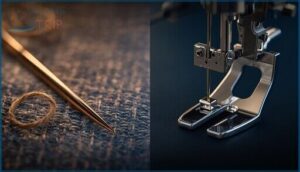
Eye placement is where hand and machine sewing needles part ways completely. On hand sewing needles, the needle eye sits at the top, away from the point. Machine needles flip that arrangement, positioning the eye just above the tip so the hook can catch the thread loop for stitch consistency.
| Feature | Hand Sewing Needles | Machine Needles |
|---|---|---|
| Eye Location | Top (opposite the point) | Near the tip |
| Eye Alignment | Flexible for hand use | Fixed by flat shank |
| Eye Polish | Smooth oval | Rounded, polished groove |
| Thread Friction | Low with correct thread | Reduced by larger eye types |
| Needle Strength | Tied to needle size | Balanced with shaft thickness |
Choosing the right needle and thread combination is vital for proper sewing, as detailed in this helpful resource on.
Needle Shaft and Length
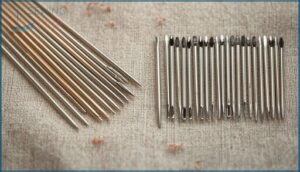
Shaft thickness and length separate hand and machine sewing needles more than most beginners expect. Hand needles use inverse sizing — lower needle size numbers mean thicker shafts — while machine needles label shaft diameter directly, so a size 80 measures 0.80 mm.
Length variations also differ: machine needles stay standardized, but hand needles range widely based on task.
| Feature | Hand Needles | Machine Needles |
|---|---|---|
| Shaft Thickness | Inverse sizing (1–12) | Direct mm sizing (60–120) |
| Length Variations | 32.5 mm to 59 mm | Standardized per system |
| Needle Flexibility | Finer sizes flex slightly | Tapered designs reduce vibration |
For more information about how to match fabric, thread, and size, check out this guide to selecting the perfect needle.
Point Styles and Uses
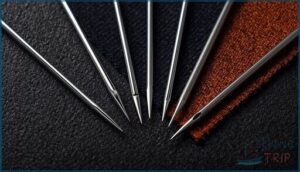
Point styles shape how Sewing Needles interact with fabric at a fundamental level. Sharp Points slice cleanly through woven materials, while Blunt Tips slide between yarns without cutting them — a key distinction in Sewing Needle Selection.
| Point Style | Best Fabric Interaction | Common Needle Types |
|---|---|---|
| Sharp Point | Wovens, microfiber, denim | Microtex, Jeans, Dressmaking Sharps |
| Ballpoint | Knits, jersey, spandex | Stretch, Ballpoint Needles |
| Blunt Tip | Evenweave, yarn | Tapestry, Weaving Needles |
| Wedge/Chisel | Leather, suede, vinyl | Leather Needles |
| Universal | Mixed everyday fabrics | Universal Needle Types. |
Stitch Formation depends heavily on matching the point to your material.
Compatibility With Sewing Techniques
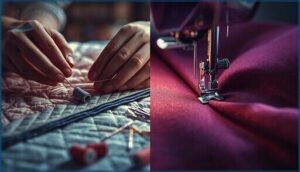
Needle type directly shapes how much Stitch Control and Technique Precision you get — and that affects everything downstream. Hand Sewing Needles favor slow, deliberate work where Fabric Handling matters stitch by stitch, while Machine Needles prioritize Sewing Speed and consistent Thread Tension across long seams.
| Technique | Hand Sewing Needles | Machine Needles |
|---|---|---|
| Quilting | Betweens for tight curves | Quilting needle for layers |
| Knit seams | Limited control | Ballpoint for clean loops |
| Embroidery | Large-eye for thick thread | Embroidery needle, polished eye |
Matching Needle Types to your Sewing Techniques is smart Sewing Needle Selection.
Hand Sewing Needle Types and Features
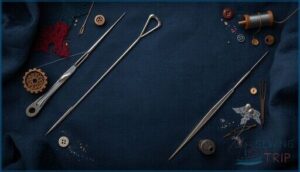
Hand sewing needles aren’t one-size-fits-all — each type is built for a specific job, and using the wrong one can make your work harder than it needs to be.
Knowing your options puts you in control before you even thread the needle. Here’s a breakdown of the main hand sewing needle types you’ll want to know.
Sharps, Betweens, and Milliners
Three hand sewing needle types do most of the heavy lifting in general hand work. Sharps handle everyday hemming and garment sewing on medium-weight fabrics, while betweens — shorter by design — give quilters the tight control needed for fine, even stitches through multiple layers.
Milliners, the longest of the three, suit basting, smocking, and bullion knots where extra shaft length makes thread-wrapping far easier.
Embroidery and Tapestry Needles
Embroidery and tapestry needles each solve a specific problem with fabric thread and stitch tension. An embroidery needle’s eye design features a longer, oval opening so multiple floss strands pass through without thread fraying.
Tapestry needles flip that logic — their blunt tip glides between canvas holes instead of piercing them, making them the go-to for embroidery and cross-stitch on counted-weave fabrics like Aida.
Beading and Specialty Hand Needles
Beading needles are a world apart from standard hand sewing needles — they’re intentionally thin and flexible so they can pass through tiny bead holes multiple times without cracking glass bead materials. Sizes run from 10 to 15, with higher numbers meaning finer diameters. Once you’ve got the right needle, pairing it with proper technique makes all the difference — this basic embellishment stitch guide covers how beads and sequins work alongside stitching for polished results.
For specialty hand stitching like doll-making or upholstery, curved and doll needles handle what sharps or tapestry needles simply can’t reach.
Length, Flexibility, and Eye Shape
Length, flexibility, and eye shape each play a direct role in how well your hand sewing needles perform across different projects.
- Length Control: Longer needles like milliners load multiple stitches faster; shorter betweens offer precision in tight spots.
- Flexibility Benefits: A slight shaft flex reduces finger fatigue when pushing through dense layers.
- Shaft Stiffness: Thicker needle types flex noticeably less than fine ones.
- Needle Eye & Eye Polish: A smooth, well-polished needle eye prevents thread fraying mid-stitch.
- Eye Groove: Unlike a machine needle, hand sewing needles don’t use a front groove — the thread pulls fully through behind the point.
Machine Sewing Needle Types and Features
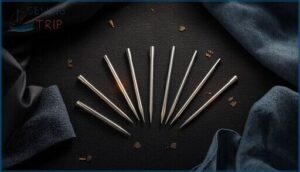
Machine needles aren’t one-size-fits-all — the right one depends on what you’re sewing and how your machine processes it.
Each needle type is built for a specific job, whether that’s gliding through stretch fabric or punching through thick denim. Here’s a breakdown of the main machine needle types and what each one actually does.
Universal, Ballpoint, and Sharp Needles
These three machine sewing needles cover most projects you’ll encounter. A Universal Needle accommodates everyday wovens and stable knits, while a Ballpoint Needle slides between loops in jersey to protect stitch formation.
Sharp needles slice cleanly through microfiber and silk.
| Needle | Best Fabric Compatibility |
|---|---|
| Universal | Wovens, stable knits |
| Ballpoint | Jersey, interlock, spandex |
| Sharp/Microtex | Silk, microfiber, dense weaves |
Jeans/Denim and Quilting Needles
Thick denim and multi-layer quilt sandwiches demand needles built for the job. A jeans/denim needle features a reinforced blade and denim needle tips that push through tightly woven fabric density without breaking threads — swap to a 90/14 for standard jeans, 100/16 for heavy workwear.
Quilting needles use a tapered point that glides through batting and quilting thread layers, keeping your sewing machine stitches consistent across all quilting methods.
Embroidery and Leather Needles
Machine embroidery needles have an extra-wide, elongated eye that lets rayon threads and polyester threads pass through without shredding — a narrow eye causes fraying and broken threads on dense designs.
Leather needles take a different approach entirely, using a cutting point that slices through hides rather than spreading fibers. Match leather needle size to hide thickness: size 90/14 for soft leather, 110/18 for medium weights.
Point Types and Fabric Compatibility
Point type determines how a sewing needle enters the fabric, which directly shapes stitch formation and thread tension across every project.
A ballpoint tip slides between knit loops to protect fabric integrity, while a sharp point slices cleanly through woven threads for precise fabric puncture. Matching needle sharpness to fabric type is what separates clean seams from skipped stitches and material damage.
Match your needle’s point to your fabric, or risk skipped stitches and material damage
Choosing The Right Needle for Your Project
Picking the right needle isn’t guesswork — it comes down to a few key factors that work together. Your fabric, your thread, and the nature of your project each pull the decision in a specific direction.
Here’s what to keep in mind before you thread up.
Matching Needle Type to Fabric
Fabric type is the first decision you make when picking a sewing needle — and getting it wrong affects everything from thread tension to sewing speed. Here’s how to match needle to fabric:
- Woven fabrics need sharp or universal needles that pierce cleanly without disturbing the grain.
- Knits and fabric stretch require ballpoint needles to slide between loops without cutting fibers.
- Fabric density in denim or canvas demands jeans needles with reinforced shafts.
- Delicate sheers need fine needles (60/8–70/10) to avoid permanent holes.
- Needle flexibility and needle sizing should match fabric weight for proper fabric and thread compatibility.
Considering Thread Weight
Thread weight shapes how your needle performs just as much as fabric type does. A standard 80/12 needle pairs with 50 wt thread for everyday garment work, while heavier 30 wt thread needs a 100/16 to pass cleanly through the needle eye without shredding.
When thread diameter and needle size don’t match, expect poor thread tension, skipped stitches, and uneven stitch visibility.
Project-Specific Needle Selection
Every project tells you what it needs — you just have to listen.
Quilting through a dense sandwich calls for size 90/14 quilting needles, while a sheer blouse demands a 70/10 sharp.
Think of needle calibration and thread matching as your project planning foundation.
Use this sewing needle guide to align sewing needle types, fabric analysis, and needle sizing for true stitch optimization.
Needle Sizes Explained for Hand and Machine
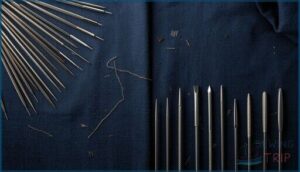
Needle sizing isn’t complicated once you know what the numbers actually mean.
Both hand needles and machine needles follow their own numbering systems, and matching the right size to your fabric thickness makes a real difference in how your stitches turn out.
Here’s what you need to know about sizing for both.
Hand Sewing Needle Size Guide
Hand sewing needles run on an inverted scale — the higher the number, the finer the needle. Here’s how it breaks down:
- Sizes 1–3: Thick and long, built for canvas and upholstery
- Sizes 4–8: Mid-range, ideal for quilting cotton and standard hand sewing
- Sizes 10–12: Fine and slim, suited for silk and delicate fabrics
Match needle sizing to your fabric thickness and thread compatibility for clean, damage-free results.
Machine Needle Numbering System
Machine needles use a dual numbering system — metric sizes paired with American sizes, like 80/12 or 90/14. The first number is the blade diameter in millimeters multiplied by 100, so a size 80 needle measures 0.80mm.
Needle codes like 130/705 H identify shank compatibility, while color markings help you match loose needles fast.
| Metric/American | Needle Type | Best Use |
|---|---|---|
| 70/10 | Sharp | Delicate fabrics |
| 80/12 | Universal | Everyday sewing |
| 90/14 | Ball Point Needle | Knits and stretch |
| 100/16 | Jeans/Denim Needle | Heavy denim, canvas |
Selecting Needle Size for Fabric Thickness
Fabric thickness is your starting point, not an afterthought. Lightweight fabric needles — sizes 60/8 to 70/10 for machine, 9 to 12 for hand — keep fine weaves intact.
Medium fabric weight calls for 80/12 to 90/14. Heavy fabric needs jump to 100/16 and above.
With loosely woven fabrics, a finer sewing needle slips between threads cleanly. Match needle size to thread size, and test first.
Stitch Quality and Fabric Safety Considerations
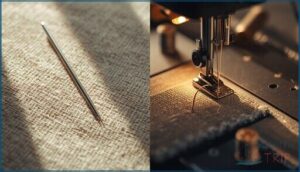
The needle you choose affects more than just how a stitch looks — it directly impacts whether your fabric comes out intact.
Getting this right means understanding a few key factors that separate clean, professional work from frustrating results.
Here’s what to keep in mind.
Preventing Skipped Stitches
Skipped stitches usually point to one of three culprits: poor needle alignment, inconsistent fabric feed, or mismatched thread tension.
Start with your sewing machine needle — a dull or incorrectly seated needle is the most common cause. Replace it every 8 hours of use, check that it’s fully inserted, and match needle size to thread weight. Proper machine calibration and correct stitch length handle the rest.
Avoiding Fabric Damage
A worn sewing needle is one of the fastest ways to ruin good fabric. Needle wear leads to tiny burrs that cause thread breakage and fabric fraying with every stitch.
For fabric protection, match your machine needles to fabric weight — using too large a needle on delicate material creates permanent holes. With hand sewing needles, improper fabric manipulation increases stitch tension and distorts weaves. Test on scraps first.
Achieving Professional Results
Getting professional results comes down to matching every variable — needle types, fabric selection, and thread tension — so nothing fights against anything else. Stitch consistency isn’t luck; it’s needle calibration in action.
- Choose the right sewing needle size for your fabric weight
- Pair thread thickness to needle eye size
- Use sharp machine sewing needle types on tightly woven fabrics
- Apply correct sewing techniques and tips for each seam
- Test sewing precision on scraps before final pieces
Maintenance and Replacement Best Practices
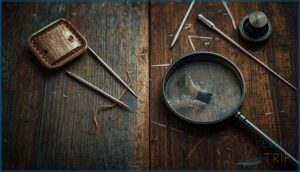
A needle that’s past its prime can quietly ruin your work before you even notice something’s wrong. Knowing when to swap it out makes a real difference in how your sewing holds up.
Here’s what you need to stay on top of it, including where to keep it, and what signs of wear to look for.
When to Change Needles
Most sewists wait too long to swap out a sewing machine needle, and that’s where problems start. For machine sewing, change your sewing machine needle every 6 to 8 hours of use — heavy fabrics like denim may demand a replacement after just one project.
Needle wear signs include popping sounds, skipped stitches, and fabric pulling. Following consistent replacement schedules is the simplest form of sewing machine maintenance you can practice.
Storing Needles Safely
Proper needle storage is just as important as knowing when to replace them. Use labeled compartment containers or magnetic holders — like Dritz magnetic tubes — to keep hand and machine needles sorted by type and size.
For moisture protection, tuck silica gel packets into airtight boxes to prevent rust. Keep everything out of reach of children as a basic sewing safety habit.
Inspecting for Wear or Damage
Once your needles are stored safely, keeping an eye on their condition is the next step in solid sewing needle care. A damaged sewing needle quietly wrecks your sewing performance before you notice.
Watch for these damage signs:
- Skipped stitches along the seam
- Thread breakage with no obvious cause
- Fabric damage like snags or puckers
- Popping sounds during stitching
- A tip that catches on nylon stocking
Visual inspection — comparing the needle against a new one — confirms needle wear fast.
Specialty Needles and Their Unique Roles
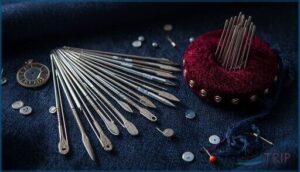
Not every sewing project fits neatly into the universal category, and that’s exactly where specialty needles earn their place.
Some fabrics, techniques, and thread types demand a tool built specifically for the job. Here are the specialty needles and accessories worth knowing.
Leather, Topstitch, and Twin Needles
Specialty machine needles each solve a specific problem. Leather stitching calls for a wedge-point leather needle that slices cleanly through hides and vinyl without tearing fibers.
Topstitch techniques rely on a topstitch needle‘s deeper groove and oversized eye for smooth decorative threading with heavy thread. Twin needle uses include parallel hems and stretch seams, with wider spacings handling heavy fabric sewing on denim and canvas.
Chenille, Bodkin, and Weaving Needles
Three hand sewing needles stand apart for specialized work: chenille, bodkin, and tapestry. Chenille tips feature a sharp point and large oval eye for ribbon embroidery and wool threads, while bodkin uses center on threading elastic or cord through casings. Weaving techniques rely on blunt tapestry needles for thread management across knit and crochet work.
- Chenille needle — sharp tip, large eye, accommodates thick wool and silk ribbon
- Flat bodkin — guides ribbon through bag drawstring channels without twisting
- Tweezer bodkin — grips elastic securely through waistband casings
- Tapestry/weaving needle — blunt tip preserves knit stitches during hand sewing finishing
- Bent-tip tapestry — reaches tight seams for cleaner weaving techniques
Needle Threaders and Accessories
Threading a needle shouldn’t slow you down. Wire loop needle threaders handle standard hand and machine needles, while desk-style threaders like the Clover Desk Needle Threader let you thread without squinting.
For needle storage, labeled cases keep your sewing notions and supplies sorted. Thimbles — leather, metal, or silicone — protect your finger, and beeswax thread conditioners reduce tangling as you sew.
Top 10 Sewing Needles and Accessories
With so many needle options out there, knowing where to start can feel overwhelming.
The list below cuts through the noise and focuses on ten needles and accessories that consistently deliver results across a wide range of projects. Whether you’re stitching denim or delicate knits, there’s something here for you.
1. SCHMETZ Universal Household Sewing Machine Needles
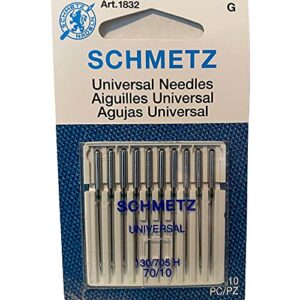
If you want one needle that tackles most of what you throw at it, the SCHMETZ Universal (130/705 H) in size 70/10 is a smart starting point. Its slightly rounded point navigates both woven and knit fabrics without tearing threads or causing runs.
It fits virtually all household machines and works with standard polyester or cotton thread. For lighter fabrics like batiste or chambray, this size hits the right balance — though heavier materials will need a larger size or a specialty needle.
| Best For | Home sewers who work with a mix of woven and knit fabrics and want a reliable, all-purpose needle that fits any household machine. |
|---|---|
| Brand | SCHMETZ |
| Pack Size | 10 |
| Weight | 0.317 oz |
| Machine Compatible | All household brands |
| Primary Use | General sewing |
| Needle Point | Slightly rounded |
| Additional Features |
|
- Works on both wovens and knits — you don’t need to swap needles as often
- Fits virtually every household sewing machine brand, including embroidery machines
- SCHMETZ is a trusted name, so you’re getting consistent quality at a fair price
- Size 70/10 only, so thicker or heavier fabrics will need a different needle
- Not cut out for heavy-duty or specialty sewing tasks
- Quality can occasionally vary from pack to pack, even with a reputable brand
2. SCHMETZ Jersey Ball Point Sewing Machine Needles
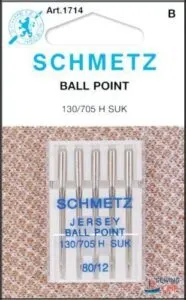
Knit fabrics are unforgiving when you use the wrong needle — a sharp point can snag loops and create runs that ruin your seam.
The SCHMETZ Jersey Ball Point (size 80/12) solves that by using a medium ball point that slides between fibers instead of piercing them. That small difference means skip-free stitches and clean seams on jersey, bouclé, sweatshirt fabric, and even faux fur.
Each pack includes five needles, and the orange shank band makes them easy to identify in your storage box.
| Best For | Anyone sewing knit fabrics like jersey, fleece, or sweatshirt material who wants clean seams without snags or skipped stitches. |
|---|---|
| Brand | SCHMETZ |
| Pack Size | 5 |
| Weight | 0.32 oz |
| Machine Compatible | All home brands |
| Primary Use | Knit fabrics |
| Needle Point | Medium ball point |
| Additional Features |
|
- The ball point tip slides between fibers instead of piercing them, so no more snags or runs on delicate knits.
- Works with all home sewing machine brands, so you don’t have to worry about compatibility.
- Five needles per pack gives you plenty of replacements before you need to restock.
- Pricier than generic brands, though most sewers agree the quality is worth it.
- Needles dull over time with heavy use, so you’ll need to swap them out regularly.
- Not ideal for industrial machines, so check your machine type before buying.
3. Schmetz Microtex Machine Needles
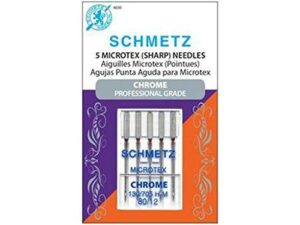
Dense fabrics and intricate designs demand a needle that doesn’t compromise. The Schmetz Microtex (size 80/12) delivers exactly that with its very slim, acute point — sharper than a standard universal needle — that pierces fibers cleanly instead of pushing them aside.
That precision matters when you’re topstitching collars, working with batiks, or sewing microfiber without puckering. Chrome plating keeps heat buildup low during long runs. Each pack includes five needles, and the purple color band makes identification simple.
| Best For | Sewers and quilters working with dense designs, batiks, microfiber, or faux suede who need clean, precise stitches without puckering. |
|---|---|
| Brand | SCHMETZ |
| Pack Size | 5 |
| Weight | 0.2 oz |
| Machine Compatible | Most machines |
| Primary Use | Straight stitching |
| Needle Point | Very sharp |
| Additional Features |
|
- Extra-sharp, slim point pierces fabric cleanly — great for intricate embroidery and topstitching
- Chrome plating reduces heat buildup during long sewing sessions
- Works across a wide range of fabrics and threads, from quilting cotton to semi-stretchy materials
- Only five needles per pack, so you’ll be reordering sooner than you might like
- Not compatible with all sewing machines — worth double-checking before you buy
- Can be hard to find in stores, so you’ll likely need to order online
4. Schmetz Quilting Sewing Machine Needles
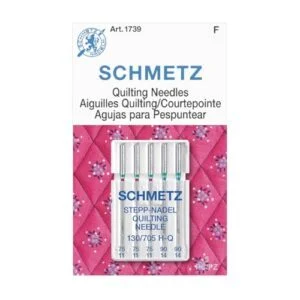
Where Microtex manages precision on fine fabrics, quilting demands something different — control through layers.
The Schmetz Quilting needle uses a slightly rounded, tapered point that glides through cotton, batting, and backing without pushing the layers out of alignment. That design reduces skipped stitches over bulky seams, which is a real problem in patchwork work.
It comes in sizes 75/11 and 90/14, fits most home machines, and the green color band keeps identification quick and reliable.
| Best For | Quilters who work with multiple layers and need clean, consistent stitches through cotton, batting, and backing without skipped stitches or alignment issues. |
|---|---|
| Brand | SCHMETZ |
| Pack Size | 25 |
| Weight | 1.6 oz |
| Machine Compatible | All major brands |
| Primary Use | Quilting |
| Needle Point | Slightly rounded |
| Additional Features |
|
- The tapered, slightly rounded point glides through thick layers and bulky seams without pushing fabric out of place
- Fits most major home machines — Singer, Brother, Janome, Pfaff — so no compatibility headaches
- Comes in two sizes (75/11 and 90/14) with a color band that makes identification quick and easy
- The product image can be misleading, showing 5 packages when you’re actually getting 3
- Only two needle sizes included, so it won’t cover every quilting scenario
- Limited to woven fabrics like cotton — not the right pick for stretch or specialty materials
5. SCHMETZ Embroidery Sewing Machine Needles
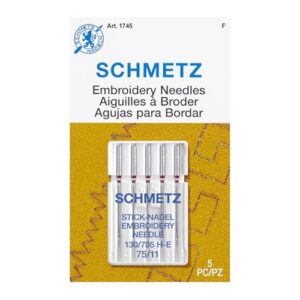
Where quilting needs control through layers, embroidery demands protection for the thread itself.
The SCHMETZ Embroidery needle tackles that with an enlarged eye and widened groove, so rayon, polyester, and specialty threads move through without shredding. That reduced friction also cuts down on skipped stitches during dense designs.
It comes in size 75/11 in this five-pack, works with most home machines, and carries a red color band so you won’t mix it up mid-project.
| Best For | Sewers and embroiderers who work with delicate threads like rayon or polyester and want clean, skip-free results on decorative or quilted projects. |
|---|---|
| Brand | SCHMETZ |
| Pack Size | 5 |
| Weight | 0.16 oz |
| Machine Compatible | All home machines |
| Primary Use | Embroidery |
| Needle Point | Standard |
| Additional Features |
|
- The enlarged eye and widened groove are genuinely kind to specialty threads — less shredding, fewer skipped stitches
- Works with most home sewing machines, so no compatibility headaches
- Comes with a storage case and a color band, which makes staying organized way easier
- A few users have had needles break sooner than expected, which is frustrating
- Only comes in size 75/11, so it won’t cover every project you throw at it
- Packaging quality has been hit or miss — some needles arrived damaged or went missing
6. SCHMETZ Leather Sewing Needles
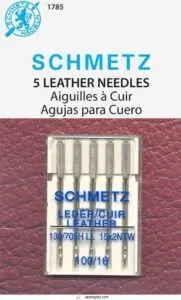
Embroidery thread needs protection from friction — leather needle needs a needle that can actually cut through the material.
The SCHMETZ Leather Needle does exactly that with its LL twist point, which slices through genuine leather, faux leather, and vinyl rather than pushing through them. That cutting action creates a slightly angled stitch hole, giving seams a clean, directional look. Size 100/16, five needles per pack.
Just don’t use it on woven or knit fabrics — the cutting point will sever the fibers instead of passing between them.
| Best For | DIY crafters and hobbyists who sew leather goods like bags, belts, wallets, or upholstery on a home sewing machine. |
|---|---|
| Brand | SCHMETZ |
| Pack Size | 5 |
| Weight | 0.2 oz |
| Machine Compatible | Home machines |
| Primary Use | Leather/heavy materials |
| Needle Point | LL cutting point |
| Additional Features |
|
- The LL cutting point slices cleanly through leather, faux leather, and vinyl without tearing or pushing
- Leaves a slightly angled stitch hole that gives seams a polished, professional look
- Precision-engineered for home machines, so no industrial setup needed
- Can’t be used on woven or knit fabrics — the cutting point will damage the fibers
- Five needles per pack gets pricey if you’re doing large-scale leather work regularly
- May need some machine setting tweaks to get the best results
7. SCHMETZ Denim Sewing Machine Needles
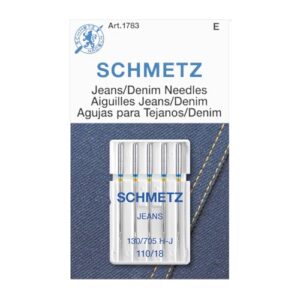
Where leather demands a cutting point, denim calls for something different — a needle built to muscle through dense, tightly woven layers without shredding them.
The SCHMETZ Denim Needle (size 110/18) uses a reinforced blade and medium ball point that slips between fabric threads rather than cutting them, which keeps your stitches clean and your seams intact.
It accommodates denim, canvas, twill, and quilts with multiple layers — and it resists bending even when you’re pushing through the thick stuff.
| Best For | Anyone sewing thick, heavy fabrics like denim, canvas, or quilts — whether you’re just starting out or you’ve been at it for years. |
|---|---|
| Brand | SCHMETZ |
| Pack Size | 5 |
| Weight | 0.2 oz |
| Machine Compatible | All home machines |
| Primary Use | Thick fabrics |
| Needle Point | Medium ball point |
| Additional Features |
|
- Reinforced blade resists bending and breaking, even through multiple layers of thick fabric
- Medium ball point glides between threads instead of cutting them, keeping stitches clean
- Works with all home sewing machines, so no compatibility headaches
- Not a great fit for thin or delicate fabrics — it’s built for the heavy stuff
- Stretchy or elastic fabrics aren’t really its thing; you’d want a different needle for those
- Go too fast on heavy material and you risk breakage, so you’ll need to pace yourself
8. Automatic Needle Threader Device
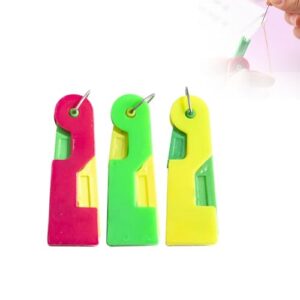
Threading a needle shouldn’t feel like a battle — and with an automatic needle threader, it doesn’t have to. This compact, 6.82cm plastic tool weighs just 5 grams, but it solves one of sewing’s most frustrating small problems in seconds.
You simply rest the needle in the slot, guide the thread, and press — done. It works across hand sewing, embroidery, cross-stitch, and machine sewing. It’s especially useful if your eyesight or hand steadiness isn’t what it used to be.
| Best For | Anyone who struggles with threading needles — especially the elderly, visually impaired, or people with shaky hands, but honestly handy for any sewer or crafter. |
|---|---|
| Brand | Unbranded |
| Pack Size | Multiple |
| Weight | 5 grams |
| Machine Compatible | Hand and machine |
| Primary Use | Thread threading aid |
| Needle Point | N/A |
| Additional Features |
|
- Works with hand sewing, embroidery, cross-stitch, and machine sewing — pretty versatile for such a tiny tool
- Super lightweight at just 5 grams and small enough to toss in any sewing kit
- Makes a thoughtful, practical gift for anyone who sews regularly
- The hooks can be too small for thicker threads or yarn, so it’s not a universal fix
- Some users found the build quality a bit lacking — feels cheaper than expected
- No instructions included, which can be frustrating if you can’t figure it out right away
9. Schmetz Chrome Topstitch Sewing Needles
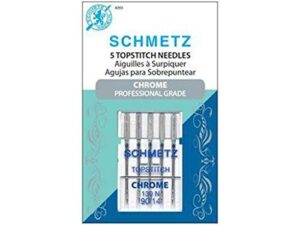
When heavy decorative thread keeps shredding or skipping stitches, the Schmetz Chrome Topstitch needle is usually the fix. Its extra-long 2mm eye accommodates thick, metallic, and multi-strand threads without the friction that causes breakage.
The chrome-plated finish resists heat buildup during long sewing runs, which keeps stitch quality consistent from start to finish. Available in sizes 70/10 through 100/16 in five-needle packs, these needles work on medium-weight fabrics like denim and quilting cotton — anywhere clean, straight topstitching lines matter.
| Best For | Sewists who regularly work with decorative, metallic, or heavy topstitch thread and want clean, straight stitches without constant thread breakage. |
|---|---|
| Brand | SCHMETZ |
| Pack Size | 5 |
| Weight | 0.2 oz |
| Machine Compatible | Most machines |
| Primary Use | Topstitching |
| Needle Point | Standard |
| Additional Features |
|
- The extra-large eye makes threading way easier and cuts down on frustrating thread breaks, even with thick or metallic thread.
- The chrome finish handles heat well during long sewing sessions, so stitch quality stays consistent throughout.
- Works across a range of sizes and fabrics, making it a versatile go-to for topstitching and decorative work.
- The price is a bit higher than standard needles, which might give budget-conscious sewists pause.
- You won’t always find these on local store shelves, so planning ahead and ordering online is usually the safer bet.
- Compatibility isn’t universal — worth double-checking that your machine plays nice with these before buying a few packs.
10. Schmetz Double Stretch Sewing Machine Needle
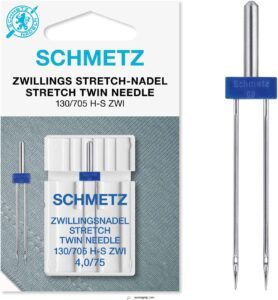
If you hem knit garments without a coverstitch machine, the Schmetz Double Stretch needle closes that gap. Two ball-point needles on a single flat shank sew parallel rows at once, mimicking that professional double-row hem on T-shirts, leggings, and swimwear.
The medium ball point pushes knit loops aside rather than piercing them, so you don’t get runs or skipped stitches. Available in 2.5 mm and 4.0 mm widths, it fits any standard 130/705H home machine that accommodates twin-needle mode.
| Best For | Home sewers who want a professional-looking double-row hem on knit garments without investing in a coverstitch machine. |
|---|---|
| Brand | SCHMETZ |
| Pack Size | 1 |
| Weight | 0.32 oz |
| Machine Compatible | Standard flat shank |
| Primary Use | Stretch fabrics |
| Needle Point | Stretch double |
| Additional Features |
|
- Mimics a coverstitch hem on T-shirts, leggings, and swimwear using any standard 130/705H machine
- Medium ball point glides through knit loops instead of piercing them, so no runs or skipped stitches
- Comes in two widths (2.5 mm and 4.0 mm) to suit different hemming and topstitching needs
- Needles can be fragile and may break under excessive stress or a snagged thread
- Some users have reported quality control issues, like cracked packaging on arrival
- Easy to accidentally order the wrong size, so double-check before you sew
Frequently Asked Questions (FAQs)
Can I hand sew with a sewing machine needle?
You can hand sew with a machine needle in a pinch, but it won’t feel right.
The flat shank limits your grip, and the eye sits too close to the tip for comfort.
What is a hand sewing needle used for?
A hand sewing needle lets you join fabric, mend tears, sew on buttons, and work decorative stitches by hand — giving you precise control in spots a machine simply can’t reach.
Can you reuse needles for different fabric types?
You can, but it’s not ideal. Reusing the wrong needle type risks skipped stitches, fabric snags, or visible holes.
Match needle to fabric first, and replace when stitching sounds or looks off.
How do needle brands compare in overall quality?
Not all needles are created equal. Bohin and Tulip lead in consistency and finish, while Schmetz dominates machine needle reliability.
Titanium-coated options from top manufacturers last noticeably longer, making them worth the extra cost for heavy projects.
What causes a needle to break during sewing?
Needles break from wrong size choices, poor installation, or pulling fabric while stitching. Using a fine needle on thick denim or hitting a pin mid-seam are the most common culprits.
Are expensive needles worth the extra cost?
For most projects, yes. Premium needles last longer, reduce skipped stitches, and protect expensive fabrics. The small price difference rarely outweighs the cost of ruined material or wasted sewing time.
How does needle coating affect sewing performance?
Think of coating like wax on a surfboard — it’s what lets everything glide.
Chrome and titanium coatings reduce friction, prevent heat buildup, and extend needle life, keeping your stitches clean and consistent.
Conclusion
A carpenter wouldn’t grab any nail from the bin without checking its gauge—the wrong one splits the wood before the job’s half done.
Needles work the same way. Understanding the difference between hand and machine sewing needles means you’re no longer guessing; you’re making deliberate choices that protect your fabric, your thread, and your time.
The right needle doesn’t just complete a stitch—it’s what separates work that holds from work that unravels.
- https://sewingforaliving.com/sewing-needles-guide/
- https://fabrellia.com/can-you-use-a-sewing-machine-needle-to-hand-sew/
- https://www.jjneedles.com/needles-guide
- https://weallsew.com/five-basic-sewing-needles-you-need-and-why/
- https://www.gauthmath.com/solution/1985490724480772/12-What-is-the-design-difference-between-hand-sewing-needles-and-machine-needles