This site is supported by our readers. We may earn a commission, at no cost to you, if you purchase through links.
Most sewing problems trace back to one overlooked culprit: the needle.
A skipped stitch, a snagged thread, a hole where there shouldn’t be one—swap the needle, and half those problems disappear.
The wrong needle doesn’t just affect stitch quality; it can shred delicate silk, skip across denim, or tear through knit fabric like it owes you money.
Matching different sewing machine needles to your fabrics isn’t a minor detail—it’s the difference between a clean seam and a frustrating rework.
Get the needle right, and everything downstream gets easier.
Table Of Contents
- Key Takeaways
- Sewing Machine Needle Basics
- Needle Size and Selection
- Needle Types and Applications
- Choosing Right Needle Size
- Needle Maintenance and Replacement
- Fabric and Thread Considerations
- Sewing Machine Compatibility
- Needle Insertion and Thread Direction
- Selecting Right Needle for Project
- Frequently Asked Questions (FAQs)
- Conclusion
Key Takeaways
- The needle is your first troubleshooting stop — skipped stitches, thread shredding, and fabric damage usually trace back to a wrong needle type or a worn-out tip.
- Needle size follows fabric weight: lightweight fabrics need 60/8 to 75/11, medium-weight fabrics land at 80/12 to 90/14, and heavy denim or canvas demand 100/16 or larger.
- Point shape is everything — ballpoint for knits, sharp for wovens, cutting-edge for leather, and stretch-specific for spandex; using the wrong point wrecks seams before you finish the first pass.
- Replace your needle every 6–8 hours of sewing, store it dry in a labeled case, and always check your machine’s manual for approved needle systems before swapping in a specialty type.
Sewing Machine Needle Basics
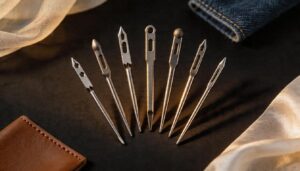
Most sewists pick up a needle, thread it, and start stitching without a second thought — until something goes wrong. The needle isn’t just a pointy stick; every part of it does a specific job.
Learning the anatomy of your needle gets a whole lot easier when you pair it with easy sewing patterns designed for beginners that let you practice each stitch with purpose.
Here’s what you need to know about how it’s built and why it matters.
Needle Structure and Function
Unlike hand-sewing needles, machine needles are precision-engineered from shank to tip. Three features drive everything:
- Shank Flatness locks the needle into the correct orientation inside the clamp.
- Groove Geometry channels thread smoothly, reducing friction through the fabric.
- Scarf Length gives the hook just enough clearance to catch the thread loop reliably.
Get these wrong, and skipped stitches follow quickly.
The needle’s [butt features a beveled edge](https://www.schmetzneedles.com/blogs/blog/sewing-machine-needle-anatomy) helps with insertion into the machine.
Needle Components and Purpose
Each part of a needle pulls its weight. The shank flat side locks orientation inside your machine’s clamp — no guessing, no slipping. Below that, the shaft controls stiffness. The thread groove channels thread straight to the eye, cutting friction before it becomes a problem. The scarf indentation behind the eye gives the hook clearance to catch the loop cleanly.
| Component | Function | Failure Without It |
|---|---|---|
| Shank Flat Side | Locks needle orientation | Skipped stitches |
| Thread Groove | Guides thread to eye | Thread shredding |
| Scarf Indentation | Clears hook rotation | Missed loops |
| Eye Diameter | Matches thread size | Breakage, fraying |
| Needle Point Geometry | Penetrates fabric cleanly | Snags, puckering |
Needle anatomy isn’t trivia — it’s your troubleshooting map.
Needle Size and Selection
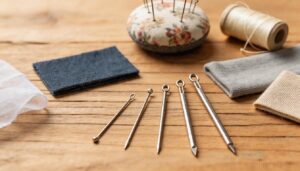
Picking the right needle size isn’t guesswork — it’s a system. Two sizing scales work together to tell you exactly what you need for any fabric or thread.
Here’s how both work.
European and American Sizes
Needle sizing trips up even experienced sewists—so here’s the short version. The European system, called NM (Number Metric), tells you the blade’s diameter directly. NM 90 means 0.90 mm thick. Simple math.
The American sizing system uses a parallel SIZE standard; the numbers don’t measure anything physical, but they track the same scale. Your needle size chart pairs them like this: 60/8, 70/10, 80/12, 90/14, 100/16.
Higher number, thicker needle—in both systems. That’s your NM vs SIZE size pairing guide in one clean row.
Fabric Weight and Thread Type
Size follows weight—that’s the rule.
Lightweight fabrics like chiffon sit in the 1–150 GSM range and need 60/8 to 75/11 needles with fine thread to avoid puckering.
Medium-weight cotton or linen: Go 80/12 to 90/14.
Heavy denim pushes past 350 GSM, so grab a 100/16 or larger.
If you’re unsure whether your needle matches the fabric weight, this sewing machine needle types and sizes guide breaks down both European and American sizing so you can pick the right one with confidence.
Thread and needle compatibility considerations matter just as much—thread fiber match and thread weight balance keep your tension settings stable and your stitches clean.
Needle Types and Applications
Not all needles are built the same, and that difference matters more than most sewists realize. The type you choose determines how cleanly your machine stitches through a given fabric — and whether you end up with skipped seams or snapped thread.
Here’s a breakdown of the main needle types and what each one actually does.
Universal and Sharp Needles
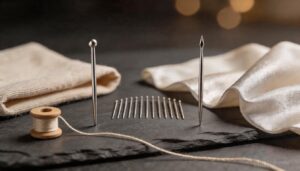
Think of universal and sharp needles as the two anchors of your sewing kit — each built for a different job.
Universal needles have a slightly rounded tip, which makes them solid for everyday wovens and light knits. They’re your go-to for cotton blends, linen, and most garment work. Sharp needles, on the other hand, have a fine, precise point. That edge matters when you’re working with densely woven fabrics like silk or microfiber, where fabric puckering and skipped stitches are real risks.
Here’s how needle size and fabric weight matching breaks down across both types:
- Sizes 60/8–70/10 — sheer and delicate fabrics
- Sizes 75/11–80/12 — lightweight to medium cottons
- Sizes 90/14 — medium-weight wovens and quilting cotton
- Sizes 100/16+ — heavier materials needing stronger shafts
Thread compatibility matters too. Universal needles pair well with polyester or cotton threads. Sharp needles shine with finer threads on dense weaves, giving you the seam precision that messy points simply can’t deliver. Swap in a fresh needle every 8 hours — needle longevity directly affects stitch quality.
Ballpoint and Leather Needles
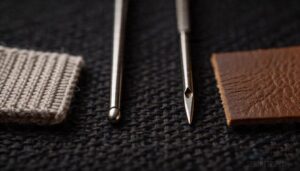
When your fabric fights back, the needle point is usually the problem.
Ballpoint needles use a rounded tip to slip through knit loop interaction zones without cutting yarn — no runs, no snagged jersey.
Leather needles flip the logic entirely: their cutting edge delivers a clean leather hole finish through hides and vinyl.
Point shape comparison between these two tells you everything about impact of needle choice on stitch quality.
Specialty Needles for Quilting and Embroidery
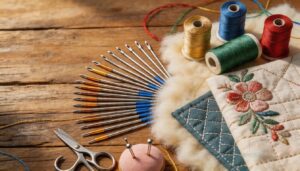
Quilting and embroidery needles each solve a specific problem.
Quilting needles have tapered shafts and finer groove depths to pierce multiple layers cleanly — batting included — without dragging.
Embroidery needles bring a larger thread eye size and polished metal plating that reduces friction on metallic or rayon threads.
Some manufacturers use color coding to identify point type at a glance.
Match the scarf design to your fabric, and stitch quality follows automatically.
Choosing Right Needle Size
Picking the right needle size isn’t guesswork — it’s a simple skill once you know what the numbers actually mean. The size printed on the package tells you exactly how thick the needle shaft is and which fabrics it can handle.
Here’s what to look at when making your choice.
Measuring Needle Diameter
The number tells you everything. Needle size uses two paired figures — European (metric) and American — where 100 equals exactly 1 mm in shaft diameter.
Measure at the midshaft using a digital caliper for Caliper Accuracy, or use a Gauge Card Usage approach for quick checks.
Avoid Parallax Error Prevention mistakes by holding the needle perpendicular.
A needle dimension chart confirms your Midshaft Diameter Check instantly.
Correlating Needle Size to Fabric Weight
Needle size and fabric weight move together like gears — get the ratio wrong and everything grinds.
Lightweight fabrics like chiffon or silk need a 60/8 to 75/11 needle for minimal Hole Visibility Effects.
Medium-weight cotton and linen land at 80/12 to 90/14.
Heavy denim or canvas demands 100/16 or larger.
This Weight-Based Sizing logic is your Thread Compatibility Guide and Metric Size Mapping rolled into one.
Match needle gauge to fabric density — that’s your Fabric Density Impact baseline.
Needle Maintenance and Replacement
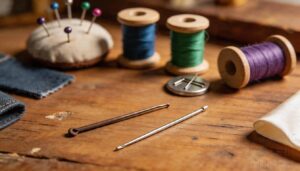
Even the best needle won’t save your stitches if it’s worn out. Knowing when to swap it and how to store it properly makes a real difference in your results.
Here’s what to watch for.
Signs of Wear and Damage
A worn needle doesn’t whisper — it shouts. Needle wear indicators show up quickly once damage sets in. Watch for these needle damage signs:
- Skipped stitch patterns appearing suddenly on otherwise consistent seams
- Thread path fraying just above the eye, shredding thread mid-seam
- Rust corrosion signs or scuff mark indicators along the shaft
A bent needle shank, dull tip, or needle tip deformation guarantees fabric damage next.
Replacement Frequency and Storage
Once you’ve spotted the damage, act fast — then build habits that prevent the next worn needle from sneaking up on you.
Replace every 6–8 hours of general sewing, or every 2–3 projects for heavy embroidery. Usage Hours Tracking keeps guessing out of it. A simple Replacement Calendar and Labeling System manages your needle inventory cleanly.
| Needle Type | Replacement Frequency | Storage Method |
|---|---|---|
| Universal | Every 8–10 hours | Labeled snap case |
| Ballpoint | Every 6–8 hours | Separate compartment |
| Leather | Every 6–8 hours | Metal tin, silica packet |
| Embroidery | Every 8–12 hours | Airtight labeled container |
| Denim/Jeans | Every 6–8 hours | Dry, cool drawer |
Moisture Control matters too — skip plastic bags. Use a Magnetic Tray nearby to catch dropped needles safely during needle maintenance.
Fabric and Thread Considerations
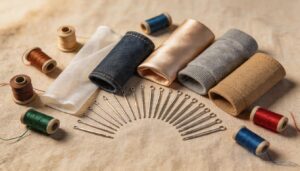
Getting your needle right is only half the equation. The fabric you’re sewing and the thread you’re using both play a direct role in which needle actually works.
Here’s what you need to know before you start.
Matching Needle to Fabric Type
Each fabric tells you exactly what it needs — you just have to listen. Here’s how fabric compatibility breaks down:
- Jersey Knit Compatibility – Ballpoint needles push fibers apart instead of piercing them, preventing runs in jersey and fleece.
- Stretch Elastic Matching – Spandex and Lycra need a stretch needle; its modified scarf stops skipped stitches, cold.
- Denim Heavyweight Selection – Use a jeans needle (100/16) — sharp point, reinforced shank, no bending.
- Silk Fine Needle – A microtex 60/8 slides through silk and chiffon cleanly, leaving no visible holes.
- Vinyl Coated Materials – Skip the leather needle here; a microtex sharp needle manages faux leather and coated fabrics without tearing.
Wrong needle types for different fabrics don’t just cause skipped stitches — they wreck your seams.
Thread Weight and Needle Selection
Thread weight drives needle selection just as much as fabric does. A 50 wt thread fits an 80/12; drop to 30 wt, and you need a 100/16 for proper needle eye clearance.
Ignore that, and thread breakage issues follow quickly. Eye size compatibility isn’t optional — it’s what keeps thread tension settings stable and stitch quality impact consistent across different needle types for various fabrics.
Sewing Machine Compatibility
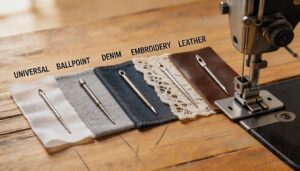
Not every needle works in every machine — compatibility matters more than most sewers realize. Before you buy a pack of specialty needles, it’s worth checking a couple of key things.
Here’s where to start.
Checking Machine Manufacturer Instructions
Your machine’s manual isn’t decoration — it’s your first defense against costly mistakes.
Before any needle swap, open it.
Most home machines run the 130/705 H or 15×1 system; using anything else risks machine timing damage or voided warranties.
Manufacturer size charts also flag maximum needle sizes your model can safely handle.
Check your manual for:
- Approved needle system (HAx1, 15×1, or 130/705 H)
- Warranty needle guidelines and size restrictions
- Safety lock procedures during installation
- Needle replacement frequency guidelines
- Brand-specific sewing machine needle compatibility notes
Using Compatibility Charts and Guides
Compatibility charts cut the guesswork out of needle selection — but only when you know how to read them. A good needle size guide uses clear Scenario Definition, Rating Systems, and Category Grouping to organize needle compatibility with thread types by fabric weight and project.
Watch for Unknown Entries marked explicitly, not left blank. Source Documentation tells you whether ratings came from testing or assumption.
Grab a free printable sewing machine needle chart or needle size guide download to keep these references within arm’s reach.
Needle Insertion and Thread Direction
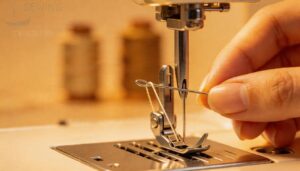
Getting the needle in correctly is one of those small things that makes a big difference. A wrong insertion or misthreaded eye throws off your tension before you sew a single stitch.
Here’s what you need to know to get it right every time.
Insertion Methods and Techniques
Getting needle insertion right is non-negotiable — a wrong move can ruin your seam before you even start. Always follow Power-Off Safety first: unplug your machine completely. Then loosen the Clamp Screw Tightening mechanism, slide the old needle out, and push the new one upward until it stops.
Key checks before you sew:
- Confirm Flat Side Orientation faces the rear
- Verify Scarf Alignment toward the hook
- Complete a Needle Height Check — no wobble allowed
- Follow needle replacement frequency guidelines: every 6–8 hours
Thread Direction and Needle Eye Orientation
Once the needle is locked in, eye orientation becomes your next checkpoint.
Thread always travels front to back — that’s Groove Forward Alignment, keeping friction low. The eye of the needle sits slightly right of center, roughly 5 degrees, for smooth Eye Angle Optimization.
Get that Thread Path Tilt wrong, and you’ll see fraying fast.
Test on scrap fabric first — your Orientation Testing Procedure, before any real project begins.
Selecting Right Needle for Project
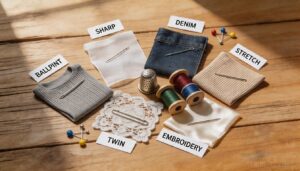
Picking the right needle comes down to two things: what your fabric is and what you’re trying to do with it. Get either one wrong, and your thread breaks, your fabric puckers, or your stitches skip — every time.
Here’s what to think through before you thread up.
Considering Fabric Weight and Type
Fabric is the boss here — your needle answers to it. Lightweight material handling starts at 60/8 for silk and satin, where fine needles leave minimal puncture marks. Medium cottons and linens land at 80/12. Heavyweight material penetration — denim, canvas, anything above 400 GSM — needs 100/16 or larger.
- Knit vs woven: ball-point for knits, sharp for wovens
- Stretch fabric needle: use stretch-specific types for spandex or Lycra
- Silk satin selection: 60/8 to 70/10 only
- Fabric compatibility: wrong size causes puckering or broken threads
Choosing Specialty Needles for Optimal Results
Specialty needles aren’t a luxury — they’re problem-solvers. Each one is engineered for a specific challenge, and picking the right one protects both your thread tension and your fabric.
Specialty needles are problem-solvers engineered for specific challenges, protecting your thread tension and fabric
- Stretch needles feature a modified scarf that prevents skipped stitches on high fabric stretch materials like spandex and Lycra
- Metallic thread needles have an elongated eye that reduces friction and shredding by up to 60%
- Specialty needles for leather, embroidery, and quilting each address unique stitch density and fabric compatibility demands
- Titanium needle coating extends lifespan considerably on dense or high-volume projects
Match the needle to the mission — stitch quality follows.
Frequently Asked Questions (FAQs)
Which sewing machine needles for which fabric?
your needle as a translator — it speaks the language of each fabric.
Match it wrong, and you’ll face thread breakage, fabric puckering, and poor stitch consistency from the first seam.
What are the 7 different types of sewing needles?
Seven types cover every project: universal, ballpoint, stretch, jeans/denim, leather, embroidery, and quilting.
Each differs in point shape, scarf design, shaft diameter impact, groove function, and eye size matching — built for specific fabrics and thread path mechanics.
Are there needles for different fabrics?
Yes — and it matters more than you’d think. The right needle protects your fabric, reduces skipped stitches, and makes thread behave.
Wrong needle, and your seams fight you the whole way.
Which sewing needle for which fabric?
Grab the wrong needle and your fabric will tell you — loudly. Use ballpoint for knits, sharp for wovens, denim needles for heavy canvas, and universal for everyday cotton.
Needle eye size and stitch tension follow your fabric’s lead.
How do I know what sewing machine needle to use?
Start with fabric weight. Light fabrics need sizes 60–70; heavy ones need 90–
Match needle type to fabric behavior — universal for wovens, ballpoint for knits.
Wrong needle wrecks thread tension and stitch quality fast.
What is the difference between 80 12 and 90 14 needles?
The 80/12 measures 80mm — finer, smaller holes, less fabric distortion on delicate materials. The 90/14 hits 90mm, delivering more stiffness and stitch strength for medium-weight fabrics like twill or denim blends.
Can sewing machine needles be recycled?
Standard sewing machine needles can’t go in your curbside bin. Collect them in a puncture-resistant metal tin and check Community Drop-off Locations or Metal Recovery Programs for small sharps disposal.
How do titanium needles compare to steel?
Titanium needles outlast steel through greater material toughness, corrosion resistance, and sharpness retention.
They handle heavy-fabric performance with less needle wear, though their higher cost means steel remains the practical everyday choice for most sewists.
Do vintage machines require special needles?
Most vintage machines from the 1950s onward accept modern 15×1 needles. Older models may need system-specific needle types — always verify butt-to-eye distance and round flat shank compatibility before stitching.
Can needle coatings affect fabric dyeing?
Needle coatings don’t alter dye chemistry, but coating residue transfer and heat-induced color shift can leave marks on treated fabrics. Anti-adhesive coating benefits include keeping your needle cleaner, longer.
Conclusion
Mastering different sewing machine needles for fabrics transforms your sewing. With the right needle, you conquer tough projects. Using the correct needle size and type ensures professional results.
By choosing the right needle for your fabric, you achieve clean seams and perfect finishes, making different sewing machine needles for fabrics an essential part of your sewing toolkit.
- https://www.schmetzneedles.com/pages/sewing-machine-needle-chart
- https://www.organneedle.com/img/pdf/Organ-Nadelindex-web-e.pdf
- http://jjneedles.com/images/about-us/how-needles-are-made.jpg
- https://www.schmetz.com/en/household-needles/knowledge/needle-anatomy/
- https://www.nationalquilterscircle.com/post/the-anatomy-of-a-sewing-machine-needle