This site is supported by our readers. We may earn a commission, at no cost to you, if you purchase through links.
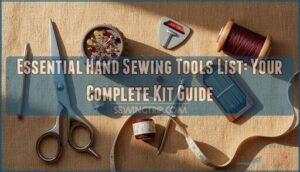
The right tools don’t just make hand sewing easier—they’re what separates a project you’re proud of from one you shove in a drawer. A dull rotary blade, a measuring tape that slips, scissors that drag instead of cut—these small frustrations compound fast.
Most beginners assume skill is the bottleneck, but seasoned sewists know the truth: your kit does half the work. Building a solid essential hand sewing tools list isn’t about buying everything at once—it’s about knowing which pieces genuinely earn their place on your worktable and why.
Table Of Contents
Key Takeaways
- Your tools do more of the work than your skill level does — a dull blade or a slipping tape measure compounds wasted time and frustration quickly.
- Three measuring tools earn a permanent spot in your kit: a flexible tape measure, a seam gauge, and a fabric marking tool you’ve tested on scrap first.
- Cutting and pinning upgrades matter more than most beginners expect — a self‑healing mat with grid lines and no‑hole sewing clips genuinely change how clean your work looks.
- Small extras like a needle threader, beeswax, and a thimble aren’t optional once you’ve tried them — they’re the difference between dreading hand sewing and actually enjoying it.
Essential Tools for Hand Sewing
Building a solid hand sewing kit doesn’t have to be complicated — you just need the right tools in your corner.
If you’re just starting out, these beginner sewing tips can help you understand exactly what to reach for first.
Whether you’re a total beginner or coming back to sewing after a long break, having the essentials organized and ready makes all the difference.
Here’s what belongs in every good hand sewing kit.
Measuring and Marking Tools
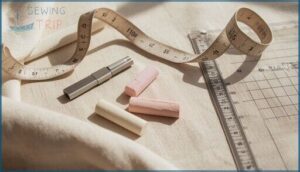
Good measuring and marking tools are the backbone of any hand sewing kit. You’ll rely on three essentials every single session:
- A measuring tape — flexible tape bends around curves for accurate body measurements, and metric‑imperial conversion is easy since most show both sides.
- A seam gauge for seam gauge precision on hems and button spacing.
- Fabric marking tools — tailors chalk, marking pens, or heat‑erasable markers for clean, removable lines.
A transparent ruler with grid lines helps too — ruler grids keep your cuts straight every time.
Accurate measurements are ensured by using a measuring tape for body dimensions.
Cutting Tools and Accessories
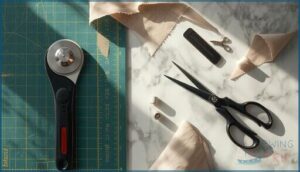
Once your measurements are marked, you need the right fabric cutting tools to bring them to life. A rotary cutter with quality blade materials slices through multiple layers cleanly — and blade replacement keeps every cut crisp. Pair it with a cutting mat featuring cutting mat grids for accuracy.
Add sewing scissors, thread snips, and ergonomic grips for comfort, plus smart safety storage to protect those blades.
For delicate materials, choose sharp lightweight fabric scissors.
Pins, Needles, and Thread
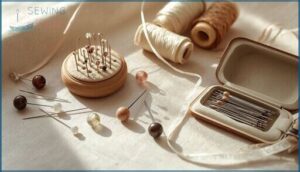
Now let’s talk about the small stuff — sewing pins, needles, and thread. These sewing notions might seem minor, but they make or break your work.
Sewing pins come in several pin materials; glass head pins handle ironing without melting.
Needle sizing systems can feel confusing at first, but generally, smaller numbers mean larger needles.
Match your thread weights to your fabric — 50 weight suits lightweight cotton beautifully.
Choosing The Right Measuring Tools
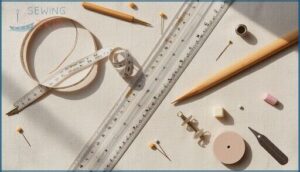
Getting your measurements right can make or break a sewing project — even a small mistake can mean a seam that doesn’t line up or a hem that’s way off. That’s why having the right measuring tools in your kit isn’t optional, it’s essential.
Here’s what you’ll want to have on hand.
Tape Measures and Sewing Gauges
Your measuring tape is the unsung hero of every sewing kit.
It works hand-in-hand with the skills you’ll pick up from beginner sewing machine projects on YouTube, where precise measurements make all the difference.
A flexible curve measuring tape manages body contours and fabric grain verification with ease, while locking mechanisms keep your reading steady mid-measure.
Sewing gauges shine for small precision work — that gauge’s slider precision nails consistent hems every time.
Whether you prefer metric vs imperial, having both measuring devices on hand just makes sense.
Rulers and Rotary Rulers
A clear acrylic quilting ruler might just be the upgrade your cutting table needs. Paired with a rotary cutter, it keeps every edge straight and your lines crisp.
Here’s what to look for in your ruler:
- Non-slip features grip fabric layers without shifting
- Edge visibility with bold, high-contrast scale options
- Quilting rulers sized for both small blocks and wide borders
- Adjustable angles for mitered corners and diagonal cuts
- Grip materials that work with any measuring tape or rotary cutter setup
Fabric Marking Pens and Chalk
Picking the right marking tools can save your project — or quietly ruin it.
Marking pens and chalk are sewing notions you’ll reach for constantly, so knowing their ink types and chalk formulations matters.
Here’s a quick comparison:
| Tool | Visibility Duration | Removal Safety |
|---|---|---|
| Water-soluble pen | Until washed | Rinses out cleanly |
| Air-erasable pen | 24–48 hours | Fades on its own |
| Tailor’s chalk | Until brushed off | Dusts away easily |
Always test on a scrap first.
Top 5 Hand Sewing Tools to Buy Now
If you’re ready to build a solid hand sewing kit, starting with the right tools makes everything easier.
I’ve rounded up five picks that are genuinely worth your money — whether you’re just getting started or filling gaps in your collection.
Here’s what made the cut.
1. OLFA Fabric Cutting Kit with Rotary Mat
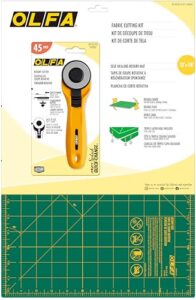
If there’s one kit that pulls double duty in my sewing room, it’s the OLFA Fabric Cutting Kit.
You get a razor-sharp 45mm tungsten steel rotary cutter plus a 12" x 18" self-healing mat — everything bundled together so you’re ready to cut from day one.
The mat’s grid lines (marked down to 1/8 inch) make measuring almost easy, and the self-healing surface keeps things smooth, cut after cut.
It works for both right- and left-handed sewers, which is a nice bonus.
| Best For | Sewers, quilters, and fabric crafters who want a reliable all-in-one cutting kit that works right out of the box. |
|---|---|
| Primary Material | Alloy Steel |
| Intended Use | Quilting & Sewing |
| Multi-Layer Capable | Yes |
| Ergonomic Design | Quick-change cutter |
| Unit Count | 1 set |
| Heavy-Duty Suitable | No |
| Additional Features |
|
- Sharp 45mm tungsten steel blade cuts through multiple fabric layers cleanly and smoothly
- Self-healing mat holds up to repeated cuts and protects your work surface over time
- Works for both right- and left-handed users, so it’s a fit for pretty much anyone
- The blade and mat may wear down faster with heavy or frequent use
- Some users have run into quality control inconsistencies
- Not the best choice if you need something built for heavy-duty, high-volume cutting
2. Premium Plastic Sewing Clips Assorted Colors
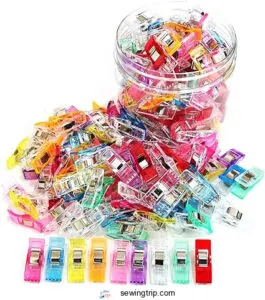
Pins are fine — until they’re not. That’s where these Premium Plastic Sewing Clips completely win me over.
Each clip opens up to 0.9 cm, so they grip multiple fabric layers without slipping, and they won’t leave holes in your silk or leather. The 3 marking lines on every clip help you keep spacing consistent, which is a quiet little breakthrough for bindings and hems.
With 100 assorted-color clips per pack, you can color‑code your projects and actually stay organized.
| Best For | Sewers, quilters, and crafters who want a no-fuss alternative to pins — especially when working with thicker fabrics or materials that can’t afford needle holes. |
|---|---|
| Primary Material | AS Plastic |
| Intended Use | Quilting & Sewing |
| Multi-Layer Capable | Yes |
| Ergonomic Design | Easy-grip clips |
| Unit Count | 100 pcs |
| Heavy-Duty Suitable | No |
| Additional Features |
|
- Grip multiple fabric layers without slipping or leaving holes — great for silk, leather, and everything in between
- Built-in measuring lines on each clip make spacing consistent, which is a game-changer for hems and bindings
- 100 assorted colors per pack so you can color-code projects and stay organized without even trying
- Clips can break or go missing over time, so you may need to restock sooner than expected
- Some buyers have run into issues with packaging and shipping, which can be hit or miss
- Not the best fit for very thin or delicate materials that need a lighter touch
3. Kai Quilting Scissors
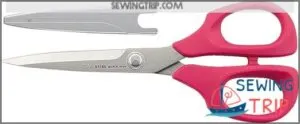
Small scissors might seem like a minor upgrade — but the Kai Quilting Scissors will change your mind fast. The 16.5 cm blade is made from NSSWR-2 steel, so it stays sharp through cotton, batting, and even light vinyl.
What I really love is how comfortable they’re — perfect if your hands get tired or achy mid‑project.
Sharp tips make trimming dog ears and clipping threads feel easy.
At just 0.08 kg, they’re light enough to use all day without a second thought.
| Best For | Quilters, sewists, and crafters who need precision cuts in tight spots — especially anyone dealing with hand fatigue, tremors, or arthritis. |
|---|---|
| Primary Material | Alloy Steel |
| Intended Use | Quilting & Sewing |
| Multi-Layer Capable | Yes |
| Ergonomic Design | Comfortable handle |
| Unit Count | 1 |
| Heavy-Duty Suitable | No |
| Additional Features |
|
- NSSWR-2 steel blade stays sharp through fabric, batting, and light vinyl
- Super lightweight at 0.08 kg, so your hand won’t wear out after a long session
- Sharp tips make detail work like trimming dog ears and clipping threads a breeze
- Too small to be your go-to for cutting large pieces of fabric
- Not built for heavy-duty or thick materials
- May feel cramped if you have larger hands
4. Kai Ergonomic Sewing Scissors
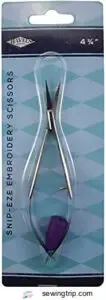
hands tire easily, these scissors might become your new best friend.
Kai Ergonomic Sewing Scissors weigh barely 0.64 ounces, so long embroidery sessions feel much less draining.
The curved tips slip right under your presser foot for clean, precise snips — no awkward repositioning needed.
They’re especially great if arthritis makes squeezing tough, since the gentle squeeze action does most of the work.
Sharp, reliable, and thoughtfully designed for real sewists who sew often.
| Best For | Sewists and embroiderers with arthritis, hand fatigue, or limited grip strength who need a lightweight, precise snipping tool for regular use. |
|---|---|
| Primary Material | Plastic |
| Intended Use | Quilting & Sewing |
| Multi-Layer Capable | No |
| Ergonomic Design | Easy squeeze action |
| Unit Count | 1 |
| Heavy-Duty Suitable | No |
| Additional Features |
|
- Feather-light at 0.64 oz, so long sewing sessions won’t wear your hands out
- Curved tips make it easy to snip threads right under the presser foot without fumbling
- Gentle squeeze action is a lifesaver for anyone with arthritis or weak hand strength
- Blades can dull over time, so they may not stay sharp forever
- Not built for heavy-duty cutting or thick materials
- The safety cap is small and easy to misplace if you’re not careful
5. Omnigrip Non Slip Quilting Ruler
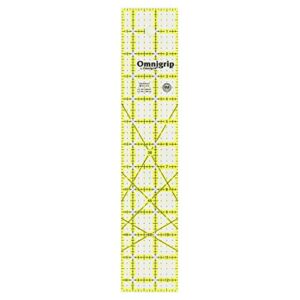
If scissors are the handshake, a good ruler is the backbone of clean quilting work. The Omnigrip Non Slip Quilting Ruler is one I keep reaching for — and for good reason.
Its patented non-slip backing grips fabric without budging, so your cuts stay straight every single time. At just 2.5" x 12.4", it’s compact enough for precise trimming and squaring up blocks. The neon green double-sight lines pop on both light and dark fabrics, making accuracy genuinely easy.
| Best For | Quilters and crafters — both lefties and righties — who need a reliable, precise ruler for cutting small fabric pieces, squaring up blocks, or working on projects like patchwork and greeting cards. |
|---|---|
| Primary Material | Acrylic |
| Intended Use | Quilting & Sewing |
| Multi-Layer Capable | Yes |
| Ergonomic Design | Non-slip bottom |
| Unit Count | 1 |
| Heavy-Duty Suitable | No |
| Additional Features |
|
- Non-slip bottom keeps the ruler firmly in place for clean, accurate cuts every time
- Clear acrylic with clearly marked inch and 1/8-inch increments makes measuring a breeze
- Works for both left- and right-handed crafters with 30-45-60 degree angle lines built right in
- May still shift during use depending on how much pressure you apply
- Only measures in inches, so metric users are out of luck
- A bit small for larger projects — you’ll want a bigger ruler if you’re making wide cuts
Helpful Extras for Your Sewing Kit
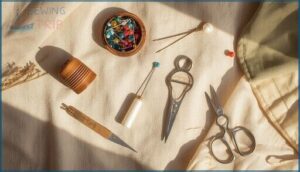
Once you’ve got the basics covered, a few small additions can make your sewing sessions a whole lot smoother.
These aren’t must-haves, but once you try them, you’ll wonder how you ever managed without them. Here are the extras worth adding to your kit.
Seam Rippers and Thread Snips
Every sewing kit needs a reliable seam ripper and thread snips — trust me, mistakes happen to everyone. Here’s what to look for:
- Blade Materials — Stainless or high-carbon steel stays sharp longer
- Ergonomic Grips — Soft-grip designs reduce hand fatigue
- Safety Tips — The ball-tipped prong protects your fabric
- Maintenance Routine — Clear lint regularly to prevent dulling
Electric options exist for long seams, making these sewing tools and equipment genuinely beginner-friendly sewing supplies.
Needle Threaders and Wax
Threading a needle shouldn’t make you want to quit sewing. A good needle threader — like the Clover Desk or Bohin Super Threader — manages sewing needles up to size 11 with almost no effort.
A quality needle threader turns the most frustrating sewing task into effortless seconds
Pair that with smart wax application using beeswax, and your sewing thread glides through fabric like butter.
Waxed thread strength is real — it resists snapping and tangles beautifully.
Thimbles and Finger Protectors
Your fingers take a beating with hand sewing needles — that’s where thimbles earn their place in your sewing tools and equipment lineup. Material types matter here:
- Metal — durable, dimpled top that grips the needle
- Leather/silicone — cushioned protective features for long sessions
- Ring-style — adjustable fit sizing for comfort
These sewing aids cover most usage scenarios, including specialty designs for quilting and leatherwork — perfect sewing notions for beginners.
Frequently Asked Questions (FAQs)
What are the basic tools needed for hand sewing?
Funny how the simplest projects still need the right tools. You’ll want hand sewing needles, sewing pins, a seam ripper, fabric scissors, and a measuring tape to get started confidently.
What are the 5 basic tools of sewing?
The 5 basic sewing tools are scissors, a measuring tape, pins, hand sewing needles, and a seam ripper. These cover cutting, measuring, securing fabric, stitching, and fixing mistakes.
Can sewing help with stress relief?
Yes, absolutely. The rhythmic motion of Mindful Stitching creates Sensory Calm and activates Creative Flow, naturally easing tension.
That steady, Rhythmic Breathing rhythm lowers stress and delivers a real Accomplishment Boost — stitch by stitch.
Which tool is essential for hand stitching?
Needle and thread are the heart of hand stitching. Your hand sewing needles carry the thread through every stitch, so matching needle types and thread weight to your fabric makes all the difference.
What are the must-have sewing tools?
Every great sewing kit starts with sewing needles, thread, pins, scissors, and a seam ripper.
These five must-haves handle most hand sewing tasks, and they’re all budget-friendly options you can grab today.
What should be in a hand sewing kit?
Your kit needs sewing needles, thread, scissors, pins, and a measuring tape at minimum.
Toss in fabric swatches, repair patches, needle storage, and a portable light, and you’re genuinely set for anything.
What 10 tools should be included in a sewing kit?
A solid sewing kit covers ten must-haves: sewing needles, scissors, measuring tape, seam ripper, pins, thread, a pincushion, tailor’s chalk, a needle threader, and beeswax for smooth thread organization.
How do you store hand sewing tools properly?
Keep your tools in clear bins so you can spot what you need fast. Use magnetic pin holders, blade safety covers, and moisture control packs to protect everything and stay organized.
Whats the best lighting for hand sewing work?
Good lighting makes a huge difference.
Look for daylight-balanced lights around 5000K–6500K with a high CRI rating above
adjustable arm, solid brightness levels, and magnification options help you stitch with zero eye strain.
How often should you replace sewing needles?
Think of your needle as a tiny workhorse — it dulls faster than you’d expect. Replace hand sewing needles every 8–10 hours of use, or sooner if fabric starts puckering or threads snag.
Conclusion
Studies show that sewists who invest in quality tools complete projects up to 30% faster—and with far fewer “why did I even start this?” moments.
Your essential hand sewing tools list isn’t just a shopping checklist; it’s the foundation every stitch you make rests on.
The right needle, a sharp blade, a ruler that stays put—these aren’t luxuries. They’re what turns a frustrating hobby into one you actually want to come back to.
- https://threadsmonthly.com/hand-sewing-needles/
- https://www.thesewingdirectory.co.uk/hand-sewing-needles-guide/
- https://naturesfabrics.com/blogs/all-things-sewing/how-to-select-sewing-thread
- https://www.mh-chine.com/blog/products/best-hand-sewing-thread
- https://theruffledpurse.com/essential-guide-for-straight-sewing-pins/