This site is supported by our readers. We may earn a commission, at no cost to you, if you purchase through links.
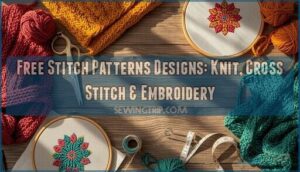
You don’t need permission to experiment with free stitch patterns designs, and you definitely don’t need to drain your wallet to build a vibrant pattern library. Thousands of knitting stitches, cross stitch charts, and embroidery motifs sit online right now, waiting for you to download them without spending a cent.
What separates a maker who sticks to the same three stitches from one who creates bold, textured pieces? Access to diverse patterns and the willingness to try them. These downloadable designs give you instant visual guides for cable twists, colorwork grids, and surface decoration techniques that transform ordinary yarn or fabric into something worth showing off.
Whether you’re chasing intricate lace panels or geometric cross stitch borders, free resources let you test new territory before committing to a full project or paid collection.
Table Of Contents
Key Takeaways
- Free stitch patterns give you instant access to thousands of knitting, cross stitch, and embroidery designs without spending money, letting you test new techniques before committing to paid collections or full projects.
- These downloadable patterns span three main categories—knitting stitches that build fabric row by row, cross stitch charts on counted fabric, and embroidery designs with surface decoration—each offering distinct textures and construction methods.
- You’ll find reliable free pattern libraries organized by skill level, yarn weight, and technique complexity, with clear filters that match designs to your current abilities while pushing you toward new territory.
- Customizing downloaded patterns through gauge adjustment, stitch replacement, and creative mixing transforms generic charts into personalized projects that reflect your style and vision.
What Are Free Stitch Patterns?
Free stitch patterns are downloadable designs that guide you through creating specific textures, motifs, or structures in knitting, cross stitch, or embroidery without spending a dime. You’ll find everything from simple beginner-friendly stitches to intricate complex techniques, all available in common file formats like PDF or pattern charts.
If you’re just starting out, beginner sewing tutorials walk you through essential techniques that pair perfectly with simple stitch patterns.
Let’s break down what they’re and why they’re worth exploring for your next project.
Definition and Types
A free stitch pattern is a design you can use without paying fees, covering knitting stitches, cross stitch patterns, and embroidery techniques. These stitch pattern basics include downloadable charts with step-by-step guidance for knit stitch variations, beading methods, and weaving.
Free design types range from simple ribbing and seed stitch to intricate lace motifs, all available as PDFs or grids you can print and follow immediately.
Benefits of Using Free Designs
Now that you know what free patterns are, let’s talk savings. Cost savings hit first—you skip licensing fees and subscriptions, freeing budget for yarn or beads.
Time efficiency follows, with instant downloads from a knitting stitch library or free cross stitch patterns. Creative freedom lets you experiment without risk, while free knitting stitch patterns and free crafting resources open accessibility options for every maker.
Popular Categories of Free Stitch Patterns
When you start exploring free stitch patterns, you’ll quickly notice they fall into three main camps, each with its own flavor and technique.
Knitting patterns work with yarn and needles to build fabric row by row, while cross stitch uses counted threads on even-weave fabric, and embroidery brings surface decoration to life with thread and beads. Let’s break down what you can expect from each category so you can jump into the one that calls to you.
Knitting Stitch Patterns
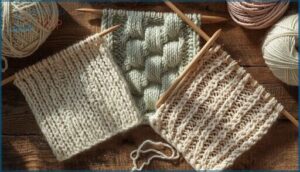
You can break free from boring rectangles with knitting stitch patterns that range from rebellious texture plays to elegant twists. Here are three game-changers worth exploring:
If you’re planning to explore these patterns on a sewing machine instead, check out key features to look for in a sewing machine to handle textured fabrics smoothly.
- Garter Stitch and Mitered Squares – flat, squishy fabric you can knit into dramatic angles
- Cable Patterns – twisted columns that add depth without fuss
- Lace Knitting – airy openwork combining knit, purl, yarn overs, and decreases for show-stopping results
To improve your skills, understanding is invaluable for reading and executing complex designs.
Cross Stitch Designs
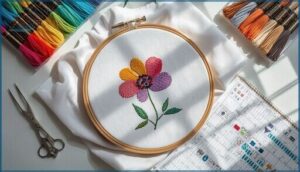
Cross stitch patterns translate images into grids where each square becomes one stitch on counted fabric like Aida.
You’ll find design software that manages pattern conversion, turning photos into charts with color theory guiding your floss choices.
Stitch density and fabric choices control the final size, while free cross stitch patterns let cross stitchers experiment boldly without breaking the bank on their next rebellious project.
For tips on decoding the chart’s layout and symbols, see this guide to understanding cross stitch charts.
Embroidery and Beading Patterns
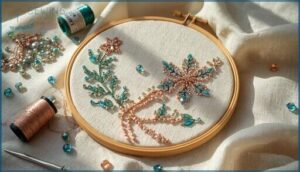
Embroidery and needlework expand beyond thread alone when you add beads to your fabric selection. Digital embroidery patterns guide you through bead weaving with clear embroidery designs that specify bead color theory and embroidery threads for shimmer.
- Seed beads in sizes 11/0 or 15/0 create fills and outlines
- Nylon thread secures beads without fraying
- Stitch density controls weight and drape
- Free cross stitch patterns adapt into mixed media pieces
Best Websites for Free Stitch Pattern Designs
You don’t have to hunt through dozens of sites to find quality free patterns anymore. I’ve gathered the best knitting and embroidery libraries that offer reliable downloads, clear instructions, and designs you can actually use.
Here’s where to start your search for patterns that won’t cost you a dime.
Knitting Pattern Libraries
You’ll find major knitting stitch libraries brimming with pattern organization systems that sort by yarn weight systems and stitch complexity. These knitting stitch resources offer downloadable knitting stitch patterns, often with clear knit stitch guides showing gauge and yardage details.
Library management tools let you filter by difficulty, so your knitting pattern guides match your skill level. Many sites mix free knitting stitch library entries with premium options, making it simple to explore diverse stitch guide for knitters collections.
Embroidery and Beading Download Sites
Specialized portals serve up hundreds of Free Crafting Patterns for embroidery, cross stitch, and beading. You can browse Stitch Libraries with filters for difficulty and project type, then grab Digital Downloads in PDF or DST formats. Most Free Cross Stitch Patterns include DMC floss lists, while Beading Techniques guides specify thread and bead sizes.
Check Pattern Licensing terms before you start:
- Personal use only restrictions
- Commercial use with attribution
- No resale of patterns as-is
- Group sharing rules
These Free Crafting Resources often bundle Embroidery Tools tutorials with Digital Patterns, making Cross Stitching as a hobby more accessible for newcomers and seasoned stitchers alike.
Stitch Patterns for Different Skill Levels
Your skill level doesn’t box you in, it just points you toward the patterns that’ll build your confidence without frustrating you to tears.
Whether you’re picking up needles for the first time or you’ve already conquered cables and lace, there’s a design out there that matches where you’re right now. Let’s break down what works best at each stage, so you can choose patterns that challenge you just enough without turning into a yarn eater.
Beginner-Friendly Patterns
Starting your stitching journey doesn’t mean you’re stuck with boring choices. Beginner knitting relies on simple repeats like garter stitch or 1×1 rib, which teach you fundamentals without overwhelming tension issues.
Easy knits use basic increases and decreases, while stitch guides help you master knit-purl combinations.
Pattern tips for beginner projects suggest Aida fabric for cross stitch or size 11 beads for weaving, and smart yarn choices make knitting tutorials far more forgiving.
Intermediate and Advanced Designs
Once you’ve mastered those basics, you’re ready to explore cable knitting techniques with multi-directional twists, colorwork mastery using stranded Fair Isle repeats, and beading techniques with size 11 seed beads on linen.
Fabric interplay with lace patterns creates gorgeous depth, while knitting stitch categorization helps you navigate complex motifs. These stitch variations demand precision with tension control and charted sequences, but the creative freedom is absolutely worth it.
Tips for Pattern Selection by Skill
Choosing the right pattern starts with honest skill level assessment, matching your comfort with stitch complexity to what each design demands.
Use pattern filtering tools on download sites to sort by technique, then check for beginner guidance like labeled diagrams and glossaries.
For project planning, select knitting stitch patterns with clear stitch variations you’ve practiced, building your knitting techniques library one motif at a time.
How to Use and Customize Free Stitch Patterns
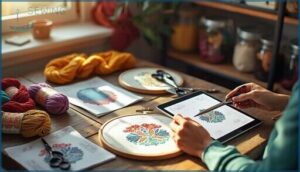
Finding a pattern you love is just the beginning—the real fun starts when you make it your own. Whether you’re printing a chart, tweaking stitch counts for a different yarn weight, or mixing two patterns into one fabric, you’ve got more freedom than you might think.
Here’s how to download, adjust, and combine free stitch patterns so they work perfectly for your project.
Downloading and Printing Instructions
Most free stitch patterns arrive as PDF file formats, ready for your printer. Before you hit print, check your print settings to match actual size—distortion ruins knitting stitch instructions.
Here are your download tips for perfect results:
- Save PDFs to your device for offline access to knitting stitch tutorials and video tutorials
- Select high-quality print mode to preserve fine details in knitting stitch patterns and techniques
- Choose heavy paper choices like cardstock for durability during your projects
Customizing Patterns for Projects
Once you’ve got your patterns printed, reshape them to suit your vision. Gauge adjustment lets you resize motifs, while stitch replacement swaps textures without losing the pattern design. Fabric selection and color palette choices transform knitting stitch patterns into something entirely yours.
| Modification Type | What You Control | Creative Impact |
|---|---|---|
| Gauge Adjustment | Stitch density, needle size | Resize without distortion |
| Stitch Replacement | Texture blocks, knitting patterns | Unique surface effects |
| Color Palette | Yarn shades, contrast ratios | Personal aesthetic stamp |
Textile design thrives when you bend the rules, so treat downloaded knitting stitch patterns as springboards for stitch combinations that reflect your style.
Combining Patterns Creatively
After reshaping individual motifs, you’re ready to push pattern design further through pattern mixing. Layer cable crossings over lace grounds, then add seed stitch borders for scale variance and visual balance.
Color harmony comes from repeating two or three yarn shades across knitting stitch combinations, while texture blending pairs smooth stockinette with raised textural elements for vibrant depth.
Frequently Asked Questions (FAQs)
What are knitting stitch patterns?
Knitting stitch patterns are specific sequences of knit and purl stitches that create different textures in your fabric, from simple garter ridges to intricate cables, transforming basic yarn choices into sculptural surfaces.
Where can I find information about a stitch pattern?
You’ll discover detailed information on hobby blogs listing materials and gauge, searchable stitch library resources, designer portfolios with charts, and craft communities sharing knitting stitch guides, pattern books, and needle tips across specialized archives.
What’s in my knitting stitch library?
Your knitting stitch library holds Cable Knitting Stitches, Knit and Purl Stitches, lace textures, and rib variations, organized for quick Yarn Selection and Pattern Storage.
With a Knit Sampler for Stitch Journaling and testing new knitting stitches.
How many different knitting stitches are there?
Think of Knit and Purl Stitches as your creative alphabet—two building blocks that weave into hundreds of Stitch Pattern Variations.
From simple garter to intricate Cable Knitting Stitches, these Knit Stitch Types expand your design possibilities endlessly.
What are the different types of knitting stitches?
You can build fabric with knit and purl basics, then explore Garter Stitch, Stockinette Stitch, Rib Stitch textures,
dramatic Cable Knitting twists, delicate Lace Patterns with yarn overs, and colorful slip-stitch weaving techniques.
How do I learn a knitting stitch?
You don’t need years to master Knit Stitch Basics. Start with Knit Stitch Basics by holding the yarn behind your needle, pulling a loop through, then practicing consistent Stitch Tension until your hands remember the rhythm.
How can I create custom stitch patterns?
Start with a motif sketch on grid paper, then translate it into stitch counts using digital stitch tools or pattern drafting software that lets you define rows, columns, and custom motif creation for reusable designs.
What tools help simplify reading knitting charts?
Chart reading gets easier when you use magnetic boards, highlighting tape, or color-coded flags to track rows.
Digital tools like knitting apps convert stitch markers and row counters into scannable grids, untangling complex knit stitch patterns.
Are there eco-friendly yarn options for patterns?
You’ll find fabulous eco yarns crafted from organic cotton, bamboo, linen, and hemp alongside recycled materials like repurposed polyester.
Look for GOTS or OEKO-TEX certifications to verify sustainable fibers and natural dyes meet green knitting standards.
How do I fix mistakes in complex stitches?
The irony? Complex stitches seem bulletproof until you spot that one rogue cable stitch.
Use tinking for single-row errors, frogging for deeper mistakes, or thread a lifeline through your stitch library before tackling intricate stitches requiring careful correction techniques.
Conclusion
A single cable twist can shift an entire sweater from forgettable to unforgettable, proof that pattern choice carries real weight in your work.
You’ve got the libraries, the skill tiers, the customization tricks—now it’s about picking a chart that makes your fingers itch to cast on. Download something unfamiliar tonight, then watch your next project break free from the usual.
- https://www.studioknitsf.com/stitch-patterns-beginner/
- https://nimble-needles.com/knitting-stitches-and-patterns/
- https://www.dmc.com/US/en/patterns/free-patterns-by-craft/cross-stitch
- https://www.lovecrafts.com/en-us/l/cross-stitch-and-embroidery/cross-stitch-and-embroidery-patterns/free-cross-stitch-and-embroidery-patterns
- https://www.badasscrossstitch.com/makestuff/free-patterns