This site is supported by our readers. We may earn a commission, at no cost to you, if you purchase through links.
Thick quilts don’t fail at the design stage—they fail at the needle.
Stack three layers of dense batting between cotton panels, and most machines stall, skip, or chew through your work before you hit the second seam.
The culprit isn’t always skill. It’s mechanical mismatch.
Quilting machines built for thick fabric layers use a specific combination of motor torque, presser foot control, and feed mechanisms that standard machines lack.
Understanding how those systems work together changes how you choose equipment, set up your project, and troubleshoot problems before they destroy hours of careful piecing.
Table Of Contents
- Key Takeaways
- Key Features for Quilting Thick Fabric Layers
- How Quilting Machines Feed Thick Layers
- Needle and Thread Considerations for Thick Quilts
- Essential Quilting Techniques for Thick Fabrics
- Maintenance Tips for Quilting Thick Layers
- Top Quilting Machines for Thick Fabrics
- Troubleshooting Common Issues With Thick Quilts
- Frequently Asked Questions (FAQs)
- Conclusion
Key Takeaways
- Mechanical mismatch — not skill — is the real reason most machines fail on thick quilts; motor torque, presser foot control, and feed systems must all work together.
- Your feed mechanism is everything: walking feet, integrated dual feed, and pin feed systems each solve layer shifting differently, so match the system to your project.
- Needle size and thread weight are load‑bearing decisions — a 90/14 or 100/16 needle with bonded polyester thread prevents the skipped stitches and breakage that wreck thick quilts.
- Speed discipline at seam intersections separates clean quilts from jammed ones — slow to half speed, bump stitch length to 3.0–3.5 mm, and let your machine catch up to the bulk.
Key Features for Quilting Thick Fabric Layers
Not every sewing machine can handle thick quilts — and the difference comes down to a handful of key mechanical features. Some machines struggle the moment you stack batting between two fabric layers, while others power through without missing a beat.
Knowing which brands consistently nail those features can save you a lot of frustration — here’s a solid breakdown of reliable sewing machine brands built for quilting.
Here’s what to look for before you commit to a machine.
Adjustable Presser Foot Pressure
Dialing in your presser foot pressure is the difference between clean stitches and a tangled mess.
Most machines place the Pressure Dial Placement on the top or side panel.
Computerized models offer Electronic Pressure Settings through on‑screen menus, while older Vintage Pressure Lever designs use a push‑button or side‑door lever.
For thick fabric quilting, follow this Pressure Calibration Procedure:
- Set pressure between 5–6 for heavy quilt layers
- Reduce slightly when using a walking foot
- Test on scrap layers before committing
Higher pressure directly impacts Pressure Impact on Stitch Quality — keeping fabric flat so the needle forms consistent loops through dense material.
Refer to the presser foot pressure adjustment guide for detailed settings.
High Presser Foot Lift
Once presser foot pressure is set, lift becomes your next control point. Domestic quilting machines usually offer 6–8 mm of clearance; heavy duty sewing machines push closer to 12 mm. That extra room lets thick fabric quilting layers slide under without force.
Use Lift Activation Methods like knee lever integration or a two‑step lever for hands‑free loading. Foot ankle screw adjustment fine‑tunes the resting angle.
Maximum clearance benefits your layer sliding strategies — less fighting, more quilting. The leveling button technique helps keep the foot stable when sewing thick layers.
Powerful Motor and Speed
Lift gets you loaded — now the motor keeps you moving. A heavy-duty motor delivers the torque capacity to punch through thick fabric quilting without stalling.
Singer’s heavy-duty motor runs up to 60% stronger than standard models.
Better gear ratio and heat dissipation mean longer sessions, stable duty cycle, and consistent stitch speed.
Speed regulation lets you ease through bulky seams cleanly.
Large Throat Space
Motor manages the bulk — throat space manages the room. On heavy-duty sewing machines, throat space is the horizontal gap between the needle and the machine’s arm.
More space means extended stitching zones, reduced repositioning, and real design layout flexibility. A 10-inch throat accommodates border-to-border patterns with a walking foot, ruler foot integration, and confident movement through thick fabrics without constant re-rolling.
Durable Metal Frame Construction
The frame is your machine’s backbone. In heavy duty sewing machines, metal frame construction keeps every component locked in alignment — needle, hook, feed dogs — even under full load. That precision cuts thread breakage substantially when pushing through thick fabric sewing projects.
A metal frame keeps every component locked in alignment, cutting thread breakage even under full load
Steel resists corrosion, manages vibration damping at high speeds, and stays upgrade‑compatible for walking feet over years of longevity testing. Built to last.
How Quilting Machines Feed Thick Layers
Feeding thick layers consistently is where most machines either earn their place or fall short.
The mechanism doing that work matters more than most quilters realize.
Here are the main systems that keep your layers moving together without a fight.
Walking Foot Attachments
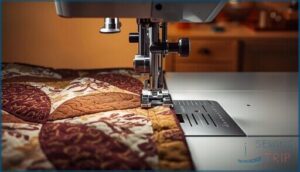
A walking foot is your best tool for quilting thick layers without shifting.
It adds its own feed teeth on top, syncing with the machine’s lower feed dogs to move all layers at the same speed.
Shank compatibility matters — match high or low shank to your machine.
Most feature metal-plastic construction for durability, plus guide bar integration for even line spacing and noise reduction.
Integrated Dual Feed Systems
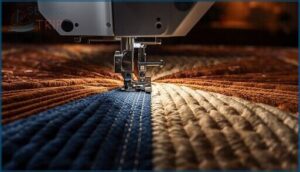
Unlike a walking foot you clip on and off, an integrated dual feed system is built right into the machine. The Top Feed Bar drops behind the presser foot and syncs mechanically with the bottom feed dogs — that’s Feed Synchronization working exactly as designed.
Key advantages for Thick Quilt Construction:
- Dual‑Feed Control engages with a lever — no foot swaps needed
- Adjustable Top Pressure grips delicate or dense layers without marking fabric
- Foot Compatibility requires designated feet (like BERNINA’s "D" series) for full top-side grip
- Consistent stitch length holds across every bulky seam intersection
Pin Feed Mechanisms
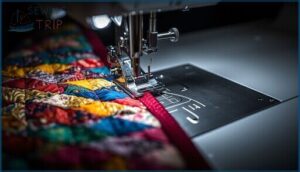
A pin is doing the heavy lifting here. The pin feed mechanism pushes a steel pin up through the needle plate, gripping all layers from underneath — quilt top, batting, backing — and advancing them together in perfect sync.
| Feature | How It Works | Quilting Benefit |
|---|---|---|
| Pin Feed Timing | Pin rises and moves with feed cycle | Consistent stitch length across bulk |
| Pin Feed Adjustment | Lever toggles pin height/engagement | Switches between delicate and thick layers |
| Pin Feed Compatibility | Requires feed dog height repositioning | Optimizes fabric feeding systems for quilting |
| Pin Feed Precision | Factory-calibrated, minimal side play | Straight seams when quilting thick layers |
| Pin Feed Materials | Fine, polished steel tip | Grips minky, velvet, synthetic suede cleanly |
Unlike a walking foot or dual feed system, pin feed goes straight into the layers — no surface grip needed.
Layer Alignment and Prevention of Shifting
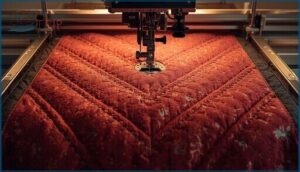
Layer alignment starts before you thread the needle. alternating vertical and horizontal patterns — dense enough to resist movement in both directions. Use frame clamps to hold backing edges tight; roller tension should be firm but not distorting.
An extension table support carries the quilt’s weight. Stitching direction matters too — work outward from center for even fabric feeding and reduced puckering.
Needle and Thread Considerations for Thick Quilts
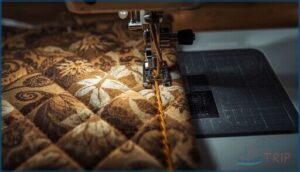
The right needle and thread can make or break your quilt — especially when you’re working through thick layers.
Getting these choices wrong leads to skipped stitches, broken thread, and a lot of frustration.
Here’s what you need to know before you start stitching.
Choosing Needle Size and Type
The right quilting needle is your first line of defense against skipped stitches and broken threads. Size-number guidelines make this simple: higher numbers mean wider diameters for thicker work.
- Layer depth matching: 80/12 manages two to three layers; 90/14 covers four to five
- Size 100/16: penetrates eight-plus layers without bending
- Needle point shape: H-Q tapered tips slide through batting cleanly
- Thread compatibility: deeper needle grooves support heavier thread passage
- Needle shank material: reinforced shanks survive seam intersections up to 12 layers deep
Wrong sizing causes real problems — mismatched needles increase breakage rates by 20 percent.
Selecting Strong Thread for Thick Layers
Thread Fiber Choice matters as much as needle size. Once you’ve matched your quilting needle to the layer count, the thread carries the load.
| Thread Type | Weight | Best Use |
|---|---|---|
| Pure Polyester | 30–40 wt | Thick batting quilting |
| Bonded Polyester | Tex 40–70 | Heavy duty sewing machines |
| Mercerized Cotton | 40 wt | Light thick fabric sewing |
| Cotton-Core Poly | 40 wt | Thread tension and control |
| Glazed Cotton | 30 wt | High-wear utility quilts |
Thread Weight Selection is straightforward — lower numbers mean thicker thread. Abrasion Resistance Rating of up to 30 for bonded polyester, versus cotton’s 3. Thread Finish Benefits like mercerized or bonded coatings reduce friction through dense layers. For thick quilts that get daily use, polyester wins.
Adjusting Thread Tension for Dense Fabrics
Strong thread only works if tension is dialed in. For quilting thick layers, start your top tension dial at 4–5, then adjust one click at a time. Use the test sandwich method — same batting, same backing — before touching your real quilt.
Watch for these tension red flags:
- Loops nesting on the backing
- Bobbin thread dotting the quilt top
- Puckering along seam lines
- Stiff, distorted stitches near bulky intersections
Turn the bobbin tension screw clockwise to tighten, counterclockwise to loosen — quarter turns only. Tension balance diagnostics get easier once you label each test row with its dial setting. Heavy duty sewing machines still need this tuning step. Layered stitch tension isn’t automatic — it’s earned.
Essential Quilting Techniques for Thick Fabrics
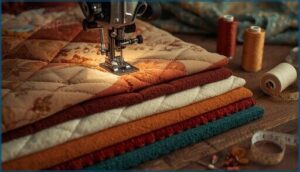
Working with thick fabrics isn’t just about having the right machine — technique matters just as much. A few key habits can mean the difference between a clean, even quilt and a frustrating mess of puckers and skipped stitches.
Here’s what you need to do before the first stitch ever hits the fabric.
Preparing The Quilt Sandwich
Start by setting up your workspace. A clean, hard floor works best for thick fabrics — enough room to spread everything flat.
Press your quilt top thoroughly, then layer in order: backing face‑down, batting centered on top, quilt top right side up.
Cut batting 2–4 inches larger than your top.
Smooth each layer from center outward.
Tape the backing taut before adding your fabric layers.
Basting Strategies for Bulk
Once your sandwich is flat and taped down, basting locks everything together. For thick fabrics, pin grid density matters — space safety pins 3–4 inches apart across the whole surface. Prefer curved pins; they close more easily through bulk.
Spray adhesive safety tip: work outdoors or near ventilation. Hybrid basting mix — light spray plus pins — cuts effort while holding quilting thick layers steady under any walking foot attachment.
Stitch Initiation and Backstitching
Before your first stitch lands, get the presser foot fully engaged — half‑on, half‑off edges pull layers apart. Enable the needle down function to anchor thick layers between stitches. Use a moderate initial speed setting.
Lock stitch placement matters: sew 2–3 tiny stitches instead of backstitching to avoid bulk. Leave 3–4 inch thread tails for burying. Stitch quality starts here.
Speed Control at Seam Intersections
Seam intersections are where most machines struggle — so don’t let yours guess.
Drop to half speed using your Digital Speed Limiter or Automatic Speed Slider before the bulk hits.
Ease off with Pedal Pressure Modulation, then use Handwheel Bump Assistance stitch‑by‑stitch if needed.
Bump your Stitch Length Adjustment to 3.0–3.5 mm.
Your walking foot attachment, thread tension, and stitch regulation stay consistent only when speed does.
Maintenance Tips for Quilting Thick Layers
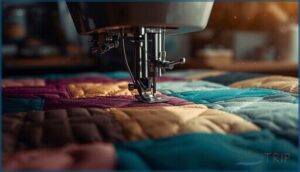
Thick quilts put real stress on your machine, and that wear adds up fast.
Staying on top of a few key habits keeps everything running smoothly, stitch after stitch.
Here’s what to focus on.
Cleaning and Oiling The Machine
Lint is the silent enemy of smooth quilting machine operation.
After every two or three bobbins, do your bobbin area cleaning — remove the case, brush out debris using lint brush techniques, then hit tight corners with vacuum dust removal.
For hook race lubrication, one drop of oil on the race is enough. More attracts lint.
Always run a few scrap stitches after oiling.
Regular Needle Checks and Replacement
A dull needle is a wrecked quilt waiting to happen.
- Every 8–10 hours of quilting — standard rule
- Each new project — even under 8 hours
- After 3–4 quilts on thick batting
- Immediately when Needle Wear Signs appear — skipped stitches, shredding thread, fabric pulls
- Before starting — Layer‑Specific Needle Selection matters: use 90/14 or 100/16 for thick fabrics
Tension Calibration for Thick Fabrics
Thick quilts fight back — tension that works on two layers fails fast on six.
Start with the Upper Tension Dial at 5–6, then sew a Test Strip Method sample using contrasting threads. Check both sides.
Adjust the Bobbin Tension Screw in quarter-turns until stitches lock cleanly in the middle. Thread Path Setup matters too — always thread with the presser foot up.
Accessory Feet Maintenance
Your walking foot attachment is the hardest-working tool in your kit — treat it that way.
Follow a Foot Replacement Schedule: clean and lightly oil pivot points every 6–8 weeks using sewing-machine-grade Lubricant Types only. Run Gear Tooth Inspection checks for rounding or bending. Confirm Foot Height Adjustment matches your manual’s spec. Always do Foot Compatibility Checks before swapping sewing machine feet for quilting mid-project.
Top Quilting Machines for Thick Fabrics
Not every machine can muscle through a double-batting quilt without complaint. Singer’s Heavy Duty lineup earns its name where it counts most — under pressure, on thick seams, with no slowdown.
Here are four models worth putting on your shortlist.
1. Singer Heavy Duty 4423 Sewing Machine
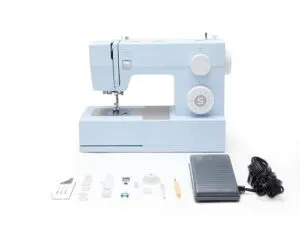
The Singer Heavy Duty 4423 punches well above its price tag. Its motor is 60% stronger than standard machines — enough to drive through 8 layers of denim without hesitation.
At 1,100 stitches per minute, you’re moving fast without sacrificing stitch quality.
The adjustable presser foot pressure manages everything from lightweight batting to dense quilt sandwiches.
Add a stainless steel bed plate that keeps fabric gliding smoothly, and you’ve got a reliable workhorse for serious quilting projects.
| Best For | Sewists of all skill levels who want a reliable, fast machine that handles everything from delicate fabrics to thick layers and heavy-duty projects. |
|---|---|
| Stitch Speed | 1,100 SPM |
| Frame Material | Full Metal |
| Needle Threader | Automatic |
| Bobbin System | Top Drop-In |
| Lighting | LED |
| Buttonhole Type | One-Step |
| Additional Features |
|
- Sews at 1,100 stitches per minute with a motor 50% stronger than standard machines — great for powering through denim, upholstery, and quilts
- Handy features like the automatic needle threader, drop-in bobbin, and one-step buttonhole make projects faster and less fiddly
- The extra-high presser foot lift and adjustable pressure handle multiple layers and a wide range of fabric weights with ease
- The manual is thin on detail, so beginners may need to look up extra guidance elsewhere
- The included needles aren’t great for tougher materials — you’ll likely want to grab better ones separately
- The foot pedal runs a bit sensitive and feels lightweight, which can take some getting used to
2. Singer Heavy Duty 4452 Sewing Machine Bundle
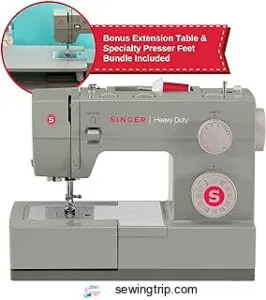
The 4452 takes everything the 4423 does well — and adds more control. You get the same 1,100 stitches per minute and full-metal frame, but the 4452 ships as a bundle with extra presser feet, an extension table, and a quilting guide foot built in.
That edge guide alone keeps your rows straight across wide quilt tops.
The adjustable presser foot pressure and extra-high foot lift handle thick batting without fuss. It’s a practical step up for quilters who want more tools from the start.
| Best For | Quilters and hobbyist sewers who want a capable, ready-to-go bundle with extra accessories built in from day one. |
|---|---|
| Stitch Speed | 1,100 SPM |
| Frame Material | Full Metal |
| Needle Threader | Automatic |
| Bobbin System | Top Drop-In |
| Lighting | StayBright LED |
| Buttonhole Type | One-Step |
| Additional Features |
|
- Screams through thick fabrics like denim and canvas at up to 1,100 stitches per minute
- Comes bundled with an extension table and extra presser feet — no hunting for add-ons separately
- Full metal frame keeps it sturdy and solid for long sewing sessions
- At nearly 15 pounds, it’s not the easiest machine to lug around
- The upright spool pin can snag thread and cause frustrating jams
- The fixed front cover makes it tricky to get in and sort out thread problems when they pop up
3. Singer Classic HD500 Sewing Machine
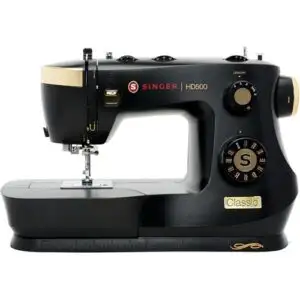
If the 4452 is about added tools, the HD500 is about raw capability in a compact frame.
Its motor punches through thick quilt sandwiches at up to 1,000 stitches per minute — fast enough to clear long seams without stalling.
Adjustable presser foot pressure lets you dial in the grip on lofty batting. Drop the feed dogs for free-motion work.
The heavy-duty metal frame keeps everything stable under load.
Solid performer for the price.
| Best For | Sewists who regularly work with heavy fabrics like denim, canvas, or thick quilt layers and want a durable, no-fuss machine that can keep up. |
|---|---|
| Stitch Speed | 1,100 SPM |
| Frame Material | Full Metal |
| Needle Threader | Automatic |
| Bobbin System | Top Drop-In |
| Lighting | LED |
| Buttonhole Type | One-Step |
| Additional Features |
|
- Powerful motor handles heavy fabrics without stalling — great for denim, canvas, and quilts
- Full metal frame keeps the machine steady and built to last
- Drop feed and free arm make it easy to tackle more complex projects like cuffs, sleeves, and free-motion work
- Some users have run into thread breaking and occasional malfunctions
- Comes with a plastic bobbin, which can be a turnoff — metal ones are sold separately
- No printed manual in the box, so you’ll need to download it from Singer’s website
4. Singer Heavy Duty 4432 Sewing Machine
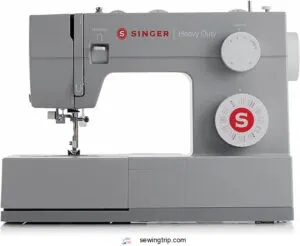
Now step up to the 4432 — this one means business.
The motor runs 60% stronger than a standard domestic machine, hitting up to 1,100 stitches per minute. That’s enough force to push through thick batting, dense seams, and multiple fabric layers without hesitation.
Adjustable presser foot pressure, extra-high foot lift, and a stainless steel bedplate keep heavy quilts feeding smoothly. The full metal frame stays rigid under load.
Solid specs, honest performance.
| Best For | Home sewers who want a sturdy, fast machine for heavy-duty projects like denim, canvas, and thick fabrics. |
|---|---|
| Stitch Speed | 1,100 SPM |
| Frame Material | Full Metal |
| Needle Threader | Automatic |
| Bobbin System | Top Drop-In |
| Lighting | LED |
| Buttonhole Type | One-Step |
| Additional Features |
|
- Powerful motor and high sewing speed make tough jobs easy.
- Easy to use for both beginners and experienced users.
- Portable and lightweight, great for classes or moving around.
- Not ideal for very thick materials like leather or heavy vinyl.
- User manual can be confusing, so some features may need online research.
- Only basic accessories included; extra feet or parts may need to be bought separately.
Troubleshooting Common Issues With Thick Quilts
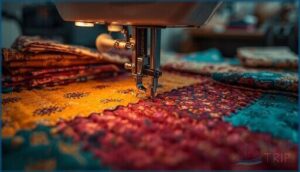
Even the best quilting machines hit a wall when thick layers fight back.
Skipped stitches, puckering, and jams aren’t signs you’re doing it wrong — they’re fixable mechanical problems with straightforward solutions. Here’s what causes each issue and how to stop it from derailing your project.
Skipped Stitches and Needle Breakage
Skipped stitches and needle breakage are the two fastest ways to ruin a thick quilt. Each has a root cause — and most are fixable in minutes.
- Needle Size Mismatch: Size 70/10 needles flex under resistance, causing skipped stitches — switch to 90/14 or 100/16.
- Thread Tension Errors: Mismatched top and bobbin tension causes 50% of skips in thick fabric sewing.
- Speed‑Induced Skips: Slow to 400 SPM at bulky seams; speeds over 800 SPM snap needles.
- Foot Pressure Issues: Low presser foot pressure lets fabric flap, deflecting your needle on every pass.
- Hook Timing Problems: Abrupt speed changes jerk quilting thick layers, causing the hook to miss thread loops entirely.
A walking foot attachment also steadies layers, reducing needle stress considerably.
Puckering and Layer Shifting
Puckering and layer shifting often trace back to one thing: uneven fabric feeding. Fix it at the source.
| Cause | Fix |
|---|---|
| Poor basting patterns | Baste center-out, 3-inch spacing |
| Excess presser foot pressure | Reduce until layers stop arcing |
| No walking foot attachment | Attach one for even fabric feeding |
| Short stitch length | Increase for Layer Stabilization |
| Loose fabric tension | Press blocks flat before layering |
Pressure Calibration and Stitch Length Adjustment solve most puckering when quilting thick layers.
Uneven Stitching and Tension Problems
Uneven stitching usually comes down to Tension Balance being off. When top thread tension is too tight, it pulls the Bobbin Tension Issues to the surface.
Check Stitch Length Variance first — increase to 3.0–3.5 mm for quilting thick layers.
Needle Deflection from a worn needle also disrupts stitch quality. Swap it out, recheck Presser Foot Pressure, and test on scrap.
Machine Jamming on Bulky Seams
Bulky seam intersections are the **‑emesis of smooth machine quilting.
When your presser foot hits a Seam Height Bump, the Presser Foot Angle tilts — feed dogs lose grip, and Thread Nest Formation starts underneath.
Needle Deflection bends the needle into the hook race.
A Walking Foot Catch makes it worse.
Slow down, use a bulky seam aid, and support your quilt’s full weight.
Frequently Asked Questions (FAQs)
Can free-motion quilting work on thick batting?
Yes — but your machine has to earn it. Motor power, needle bar strength, and proper basting methods all matter. Slow your speed, use a 90/14 quilting needle, and keep batting low-loft.
How do extension tables help with large quilts?
Extension tables give you essential Weight Distribution and Drag Reduction, keeping large quilts steady on any long arm, mid arm, or short arm quilting machine.
They boost Ergonomic Comfort, Precision Alignment, and Workspace Organization—key for smooth quilt design and planning.
What batting thickness works best for machine quilting?
Low Loft batting (1/8–1/4 inch) feeds best through domestic machines. Medium Loft works with a walking foot. Avoid High Loft — it causes puckers. Cotton suits dense stitching; polyester manages wider spacing.
How often should quilting machine servicing be done?
Think of servicing like an oil change — skip it, and things grind.
For regular quilters, annual service hits the sweet spot.
Light users can stretch to every two or three years safely.
Conclusion
simplest quilts often demand the most from your machine—and thickest ones demand everything. That’s the paradox every serious quilter faces.
Mastering how quilting machines handle thick fabric layers isn’t about fighting your equipment; it’s about understanding it well enough to work with it. Torque, feed systems, needle choice, tension—each piece connects. Get that alignment right, and bulk stops being the enemy. It becomes proof that your machine, and your skill, are built for this.
- https://www.diaryofaquilter.com/tips-for-machine-quilting-with-a-walking-foot/
- http://thenotsodramaticlife.com/effective-sewing-machine-settings-to-streamline-your-walking-foot-quilting/
- https://sewfeet.com/when-to-change-the-pressure-setting-on-your-sewing-machine/
- https://www.nebraskaquiltcompany.com/en-ch/blogs/welcome-to-nqc/quilting-sewing-machines-essential-features-for-crafters
- https://www.quiltingboard.com/main-f1/how-powerful-sewing-machine-motors-t272436.html