This site is supported by our readers. We may earn a commission, at no cost to you, if you purchase through links.
Most sewers don’t realize that a bent or dull needle—not tension settings or thread quality—causes the majority of skipped stitches and fabric snags.
A needle costs cents to replace, yet it’s the last thing most people check when something goes wrong.
That small oversight leads to puckered seams on silk blouses, runs in jersey knit, and thread that shreds mid‑project.
The right sewing machine needles for craft room setups do more than just pierce fabric—they determine whether your machine runs smoothly or fights you every step of the way.
This guide breaks down which needle types belong in your collection, how to match them to your materials, and which sets are worth keeping on hand.
Table Of Contents
- Key Takeaways
- Essential Needle Types for Craft Rooms
- Choosing The Right Needle for Your Projects
- Organizing and Storing Sewing Machine Needles
- Top 9 Sewing Machine Needles for Craft Rooms
- 1. FIVEIZERO Seam Ripper Sewing Kit
- 2. ETSPIL Beginner Embroidery Kit
- 3. Singer Sewing Machine Maintenance Kit
- 4. CKPSMS Brother Sewing Machine Bobbin Case
- 5. Sewing Machine Needles Set
- 6. Schmetz Universal Sewing Machine Needles
- 7. Singer Universal Machine Needles Sizes 80 90 100
- 8. Performore Universal Sewing Machine Needles
- 9. WILLBOND Universal Sewing Machine Needles
- Maintenance Tips for Needle Longevity and Safety
- Frequently Asked Questions (FAQs)
- Conclusion
Key Takeaways
- bent or dull needle causes most skipped stitches and fabric damage, yet it’s the last thing sewers think to check — swap it out every 8 hours of sewing or after any heavy project.
- Matching needle type to your fabric structure is non‑negotiable: sharp or universal points for wovens, ballpoint for everyday knits, and stretch needles for Lycra and spandex.
- Needle size and thread weight work as a pair — mismatching them causes tension problems, thread fraying, and uneven stitches, so always check both before you start.
- Keeping your needles organized with labeled storage, a simple project log, and a stocked inventory saves you from mid‑project scrambles and helps you spot which needles you actually reach for most.
Essential Needle Types for Craft Rooms
Not all needles are created equal, and using the wrong one can mean skipped stitches, snapped thread, or damaged fabric.
Matching needle to fabric and thread is easier once you’ve read a solid universal sewing machine needle buying guide that walks you through exactly what to look for.
The good news is there’s a needle built for just about every material you’ll run across in your craft room.
Here are the five essential types you’ll want to know.
Universal Needles for Everyday Projects
Universal needles are the workhorses of any well‑stocked sewing room. Their slightly rounded point slips between fabric fibers instead of piercing them, giving you reliable stitch consistency across light fabric performance — think quilting cotton, linen, and poly blends.
Sizes 70 through 100 cover most everyday projects, and their broad thread compatibility makes them a genuinely cost‑efficient starting point for your sewing tools collection. These universal needles are made of chromium coated carbon steel for durability.
Ballpoint Needles for Knit Fabrics
Where universal needles leave off, ballpoint needles take over — and knits are where they shine.
The rounded tip slides between fabric loops instead of piercing them, which protects knit stitch quality and prevents runs.
For fabric selection, size 80/12 manages everyday T‑shirt knits well.
Test on scraps first, store them in color‑coded containers, and label clearly to avoid mix‑ups.
For most knit projects, a Jersey Needle suitability works well.
Stretch Needles for High-Elasticity Materials
Ballpoint needles handle everyday knits well, but stretch needles are built for something tougher — think leggings, swimwear, and sports bras. Their scarf groove design lets the hook catch the thread even as fabric pulls and shifts, cutting stitch skips by roughly 40 percent.
Stretch needles, with their scarf groove design, tackle tough knits like leggings and swimwear by reducing skipped stitches up to 40 percent
Activewear applications, pair size 75/11 with polyester thread for light Lycra, or go super stretch sizes for heavier spandex layers.
Microtex Needles for Delicate Fabrics
When your fabric is silk, chiffon, or fine lace, standard needles can leave snag marks or skipped stitches. Microtex needles solve this with a slim acute point that pierces densely woven material cleanly.
For silk stitching, chiffon precision, or quilt piecing on batiks, sizes 60/8 through 80/12 cover most projects. They also nail topstitching detail on collars and delicate lace embroidery without distortion.
Denim and Leather Needles for Heavy Materials
Heavy-duty projects call for a different tool entirely.
Denim Needles use a medium ball point to slip between woven fibers, protecting your seams on canvas and thick twill.
Leather Needles carry a wedge-shaped cutting point for clean penetration on bags, straps, and belts.
- Needle Point Design protects woven structure
- Thread Compatibility guides size pairing
- Stitch Length Adjustments prevent perforation
- Fabric Thickness Testing confirms machine compatibility
Choosing The Right Needle for Your Projects
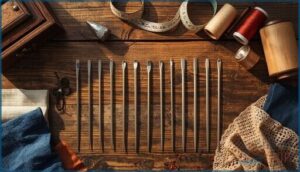
Picking the right needle isn’t guesswork — it comes down to a few key factors that work together. Once you understand them, you’ll stop second-guessing and start sewing with real confidence.
Here’s what to think about before you thread up your next project.
Matching Needle Size to Fabric Weight
Think of needle size as a bridge between your machine and your fabric — get it wrong, and the whole project suffers.
For lightweight fabric needles, sizes 60/8 or 70/10 prevent visible holes in sheers and silks. Medium weight needle selection lands at 80/12 for everyday cotton. Heavyweight needle guidelines point to 100/16 for denim.
A needle size chart makes fabric and needle compatibility easy to map.
Selecting Needle Type for Fabric Structure
Once you understand fabric weight, needle point geometry becomes your next guide.
Woven fabrics — where fabric grain direction matters — need sharp or universal points that pierce cleanly without disturbing tight weaves.
Knit fabrics, with their higher fabric stretch ratio, need ballpoint tips that push loops aside rather than cut them.
Matching fabric and needle compatibility by structure keeps stitch density impact consistent and prevents frustrating skipped stitches.
Considering Thread Type and Stitch Quality
Your thread choice shapes stitch quality just as much as your needle does. A mismatch between thread weight and needle size causes skipped stitches, fraying, or tension imbalance. Keep these thread management basics in mind:
- Match fine threads (Tex 16–35) with sizes 70/10–90/14
- Use medium threads (Tex 45–69) with sizes 90/14–110/18
- Check eye groove compatibility — tight grooves shred thread
- Balance top and bobbin thread weights to avoid loops
- Test tension on a scrap before sewing your actual project
Adapting Needle Choice for Project Requirements
Every project has its own demands.
Topstitching jeans needs a size 100/16 or 110/18 needle to push thick thread through multiple layers without skipping.
Free-motion quilting rewards a 75/11 or 80/12 quilting needle — stitch density stays clean and thread breaks drop.
Matching fabric weight, fabric stretch, thread thickness, and high-speed limits guide choosing the right needle and sewing machine needle sizes every time.
Organizing and Storing Sewing Machine Needles
Finding the right needle is only half the battle — keeping them organized is what saves you from mid-project chaos. A well-sorted needle setup means less time searching and more time actually sewing.
Here are some practical ways to store and manage your needles in a craft room.
Needle Storage Solutions for Craft Rooms

Needle clutter is a real productivity killer. The right sewing tool storage keeps your workspace calm and your points protected. Here are four reliable sewing room organization options worth knowing:
- Magnetic Holders – Secure needles in place, even during transport
- Felt Pad Organizers – Grip needles firmly without dulling tips
- Locking Compartment Cases – Access one size at a time, dust‑free
- Carousel Storage Wheels – Rotate for quick access, saving desk space
Labeling and Sorting by Type and Size
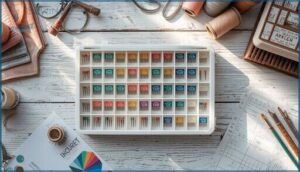
Once your storage is sorted, labeling makes the whole system click. Color‑coded labels and magnetic size strips let you spot the right needle without digging.
Adjustable divider boxes with a compartment grid system keep universal needles apart from specialty types. Printable needle charts taped inside your kit reinforce smart sewing machine needle selection and simplify needle maintenance and storage across every project.
Keeping a Needle Log for Project Reference
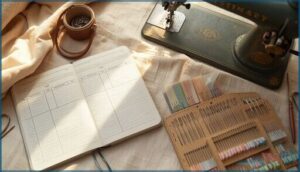
A simple needle log takes your labeling system one step further. For each sewing project, jot down the sewing machine needle type, needle size, and fabric-needle pairing you used.
Log layout design can be as basic as a notebook or a spreadsheet for digital tracking with color-coded entries. Usage frequency metrics show which needles you reach for most, sharpening your sewing machine needle selection over time.
Maintaining a Basic Needle Inventory
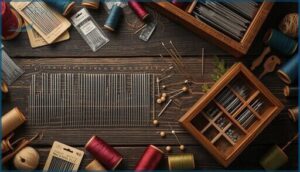
Once your log is running, keeping a stocked supply becomes second nature. A inventory tracking system prevents mid-project scrambles. Start with these stock reorder levels:
- Universal needles — 20 units across sizes 70/10 to 100/16
- Ballpoint and stretch — 5 to 10 spares each
- Denim/heavy-duty — 15 units minimum
- Specialty needles — 5 per type
- Assortment packs — 100 needles for extended supply
Top 9 Sewing Machine Needles for Craft Rooms
Finding the right needle kit or set can make a real difference in how your craft room runs day-to-day.
The nine options below cover everything from beginner-friendly kits to reliable universal needle packs that work across a wide range of projects.
Take a look and see what fits your setup best.
1. FIVEIZERO Seam Ripper Sewing Kit
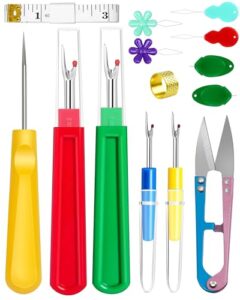
Not every kit earns a spot in your craft room, but the FIVEIZERO Seam Ripper Sewing Kit makes a solid case at just $6.99.
It comes with large (5.5-inch) and two small (3.4-inch) seam rippers, six needle threaders, a sewing awl, flexible tape measure, thimble, and scissors.
The protective ball on each ripper tip keeps you from accidentally poking yourself mid‑project.
It’s a practical starter bundle — nothing fancy, but everything you actually reach for.
| Best For | Beginners and casual crafters who want a solid all-in-one sewing kit without spending a lot. |
|---|---|
| Material | Plastic |
| Primary Use | Sewing & crafting |
| Skill Level | Beginner & expert |
| Brand | FIVEIZERO |
| Compatibility | General crafting |
| Price Range | Budget |
| Additional Features |
|
- Great value at $6.99 — you get a lot of tools for the price
- Covers the basics well: seam rippers, threaders, scissors, thimble, and more
- The protective tip balls on the rippers are a nice safety touch
- Build quality can be hit or miss depending on the unit you get
- Nothing here stands out — it’s practical, not impressive
- May not cover everything if you’re working on more specialized projects
2. ETSPIL Beginner Embroidery Kit
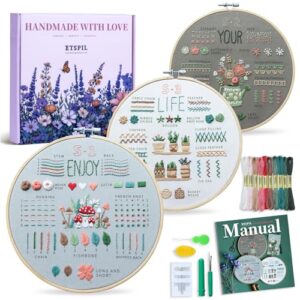
The ETSPIL Beginner Embroidery Kit is a thoughtful all-in-one starter for anyone just getting into needlework.
You get a 7.8-inch bamboo hoop, three pre-printed practice fabrics, 16 needles, 10 colors of floss, and a booklet covering 33 stitches.
QR codes link to video tutorials, which honestly make a bigger difference than written instructions alone.
It comes in elegant gift packaging, too — a nice touch if you’re buying for someone else.
A solid pick at this entry level.
| Best For | Beginners, teens, and crafters looking for a guided introduction to embroidery — or anyone hunting for a thoughtful handmade gift. |
|---|---|
| Material | Bamboo, Cotton |
| Primary Use | Embroidery |
| Skill Level | Beginner |
| Brand | ETSPIL |
| Compatibility | Hand embroidery |
| Price Range | Mid-range |
| Additional Features |
|
- Comes with everything you need out of the box — hoop, floss, needles, and pre-printed fabric
- Video tutorials make learning way easier than written instructions alone
- Arrives in a gift-ready box, so no extra wrapping needed
- Some kits have arrived missing items like needle threaders or seam cutters
- Threading the needles can be a bit of a struggle, especially for beginners
- The floss can tangle if you’re not careful with how you store it
3. Singer Sewing Machine Maintenance Kit

Singer Sewing Machine Maintenance Kit is the kind of thing you don’t know you need until your machine starts acting up mid-project.
It packs seven tools into one set: three screwdrivers, an angled lint brush, slant-tip tweezers, a needle inserter, and a serger needle threader.
The screwdrivers fit tight machine screws without stripping them, and the lint brush reaches into the bobbin area where dust loves to hide.
A vinyl cover rounds things out, keeping your machine protected between sessions.
| Best For | Sewers and serger users who want to keep their machines running smoothly without hunting down tools one by one. |
|---|---|
| Material | Nylon, Stainless Steel |
| Primary Use | Machine maintenance |
| Skill Level | Intermediate |
| Brand | Unbranded |
| Compatibility | Sewing machines & sergers |
| Price Range | Budget |
| Additional Features |
|
- Seven tools in one set means you’ve got everything you need for basic maintenance in one place
- The angled lint brush actually reaches the tight spots where dust and threads pile up
- Slant-tip tweezers make grabbing tiny thread bits and paper scraps a lot less frustrating
- Only useful if you own a sewing machine or serger—pretty niche if you don’t sew
- Won’t work with every needle or machine type, so worth checking compatibility first
- Seven loose pieces can go missing fast if you don’t have a dedicated spot to store them
4. CKPSMS Brother Sewing Machine Bobbin Case
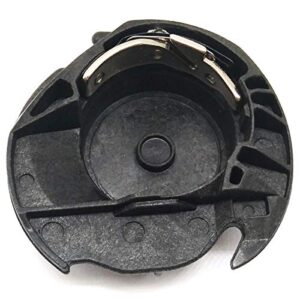
broken bobbin case can stall your whole project, and the CKPSMS replacement for Brother machines is a solid fix.
Model XC8993321 fits a wide range of Brother models — including the XL2240, XL2600, BM2700, and Comfort series.
It’s built from plastic and stainless steel, installs in one orientation, and doesn’t require adjustments.
Some users have noted occasional noise or quality variation between units, so test it on scrap fabric first before diving into your main project.
| Best For | Anyone who needs a quick, affordable replacement bobbin case for their Brother sewing machine without paying full price for an OEM part. |
|---|---|
| Material | Plastic, Stainless Steel |
| Primary Use | Machine repair |
| Skill Level | Intermediate |
| Brand | CKPSMS |
| Compatibility | Brother machines |
| Price Range | Budget |
| Additional Features |
|
- Fits a wide range of Brother models, so there’s a good chance it’ll work with yours
- Combination of plastic and stainless steel keeps it light but functional
- Easy drop-in install — no fiddling or adjustments needed
- Some units come defective, so quality isn’t always consistent
- Can run noisy during use, which gets annoying fast
- The metal piece has been known to come loose on some units
5. Sewing Machine Needles Set
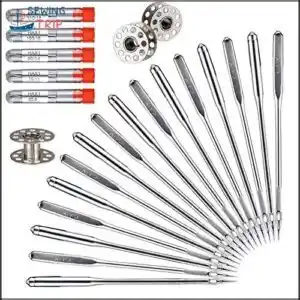
Think of this set as a starter pack that covers most of what you’ll face at the cutting table. You get 50 high-strength steel needles across five sizes — 65/9 through 110/18 — so you’re ready for everything from satin shirts to heavy coats.
Each size comes in a pack of ten, giving you room to swap needles regularly without running low. The included storage tubes and three bobbins make it easy to stay organized from day one.
| Best For | Home sewers who work with a range of fabrics and want a reliable, well-stocked needle set without breaking the bank. |
|---|---|
| Material | High-strength steel |
| Primary Use | General sewing |
| Skill Level | All levels |
| Brand | Unbranded |
| Compatibility | Singer, Brother, Janome |
| Price Range | Budget |
| Additional Features |
|
- Five needle sizes in one pack means you’re covered for everything from delicate satin to heavy denim — no need to buy multiple sets.
- The storage tubes and bobbins are a nice touch, keeping your workspace tidy right out of the box.
- Works with most popular household machines like Singer, Brother, and Janome, so compatibility usually isn’t an issue.
- Some users have run into thread fraying or breaking, which can be frustrating mid-project.
- Not built for industrial machines, so if you’re running a heavy-duty setup, these won’t cut it.
- Fit can be hit or miss depending on your specific machine model, so worth double-checking before you buy.
6. Schmetz Universal Sewing Machine Needles
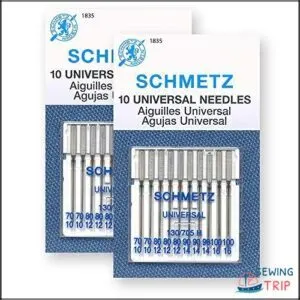
Schmetz has been the go-to needle brand for serious sewists for good reason. This two-card assortment gives you 20 universal needles across four sizes — 70/10, 80/12, 90/14, and 100/16 — so you can move between lightweight cotton and heavier upholstery fabric without missing a beat.
The slightly rounded point manages both wovens and knits cleanly, reducing skipped stitches on jersey or interlock.
Compatible with Brother, Singer, Janome, and most other home machines, it’s a practical all-rounder for any craft room setup.
| Best For | Home sewists who work with a mix of fabrics and want a reliable, no-fuss needle that fits most machines. |
|---|---|
| Material | Steel |
| Primary Use | General sewing |
| Skill Level | All levels |
| Brand | SCHMETZ |
| Compatibility | All household brands |
| Price Range | Mid-range |
| Additional Features |
|
- 20 needles across four sizes means you’re covered for everything from delicate cotton to heavier fabric
- The slightly rounded tip works on both wovens and knits, so you’re not swapping needle types constantly
- Fits most popular machines — Brother, Singer, Janome, and more — so no compatibility headaches
- The sharpness doesn’t last as long as some users would like, so you may go through them faster than expected
- The packaging can be a pain to open without bending or losing needles
- No specialty needle types included, so it’s strictly a general-purpose pack
7. Singer Universal Machine Needles Sizes 80 90 100
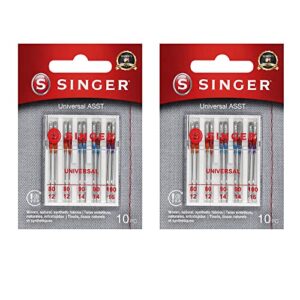
If you’re just building out your craft room needle stash, this Singer set is a solid starting point. You get 20 universal needles across three sizes — 80/12 for lightweight cotton, 90/14 for medium-weight fabrics like linen and polycotton, and 100/16 for heavier canvas or denim.
Color-coded bands make it easy to grab the right size without squinting at tiny labels. They fit most home machines, including Brother, Janome, and Kenmore, using the standard 130/705H system.
| Best For | Beginners and everyday sewers who want a reliable assortment of needles on hand for common projects like quilting, patching, and denim work. |
|---|---|
| Material | Steel |
| Primary Use | General sewing |
| Skill Level | All levels |
| Brand | SINGER |
| Compatibility | Singer, Brother, Kenmore |
| Price Range | Budget |
| Additional Features |
|
- 20 needles across three sizes means you’re covered for most fabric weights without buying multiple packs
- Color-coded bands make grabbing the right needle quick and easy — no more squinting at tiny print
- Fits most home machines, so no compatibility headaches whether you’re on a Brother, Kenmore, or Singer
- Some users have reported needles bending or breaking after just a little use, which is frustrating
- There have been occasional quality control issues — at least one buyer got an empty package
- The larger sizes may still struggle with very heavy or thick fabrics, so heavy-duty projects might need specialized needles
8. Performore Universal Sewing Machine Needles

When Singer’s three-size range feels a little limiting, the Performore set fills the gaps nicely.
You get 50 needles across five sizes — 65/9 through 110/18 — so you’re covered from sheer silk all the way up to heavy upholstery.
That’s ten needles per size, which means fewer mid‑project trips to the store.
They work with most home machines, including Singer, Brother, and Janome.
The iron alloy construction holds up well, and the flat shank keeps them secure during high‑speed sewing.
| Best For | Home sewers who work with a wide range of fabrics and want a solid stash of needles without constantly restocking. |
|---|---|
| Material | Iron alloy |
| Primary Use | General sewing |
| Skill Level | All levels |
| Brand | Unbranded |
| Compatibility | Singer, Brother, Janome |
| Price Range | Budget |
| Additional Features |
|
- Five sizes in one pack means you’re ready for everything from lightweight fabric to heavier material
- Ten needles per size gives you plenty of backups so you’re not stopping mid-project
- Works with most home machines, including Singer, Brother, and Janome
- No individual packaging makes it harder to keep sizes sorted and organized
- Size markings on the needles can be tough to read
- Some users have reported needles bending or inconsistent quality
9. WILLBOND Universal Sewing Machine Needles
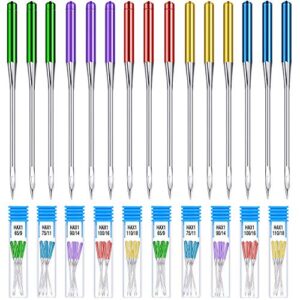
bulk, compact and color-coded.
You get 30 needles across five sizes — 65/9 through 110/18 — with six per size and each size in a distinct color, so you’re never squinting at tiny numbers mid‑project.
The titanium‑plated iron construction holds up reasonably well for everyday home sewing, and the flat shank fits Singer, Brother, and most older machines.
Just know they’re best for household projects — not heavy‑duty or industrial work.
| Best For | Home sewers who work across a range of fabrics and want a well-organized, affordable needle set that fits most standard machines. |
|---|---|
| Material | Iron, Titanium |
| Primary Use | General sewing |
| Skill Level | All levels |
| Brand | WILLBOND |
| Compatibility | Singer, Brother, older machines |
| Price Range | Budget |
| Additional Features |
|
- 30 needles across five sizes means you’re stocked up for a long time
- Color coding makes it dead simple to grab the right size without guessing
- Flat shank design works with Singer, Brother, and most older home machines
- Some users report needles breaking more often than expected
- Not built for heavy-duty or industrial sewing projects
- Quality can feel inconsistent — decent for the price, but not premium
Maintenance Tips for Needle Longevity and Safety
A needle that’s past its prime can quietly ruin a project — skipped stitches, snagged threads, and frustration you don’t need.
Knowing when to swap it out, how to store it right, and how to toss it safely makes a real difference in your sewing routine. Here’s what to keep in mind.
When and How Often to Replace Needles
Most sewists don’t realize how short a needle lifespan really is—about 8 hours of active sewing time. For fabric-specific schedules, replace after every denim or leather project.
Universal needles hold up longer on light cotton.
Quick sharpness test: drag the needle across your fingernail. Rough drag means it’s done.
Good needle maintenance keeps your sewing machine needles performing at their best.
Preventing Needle Damage During Storage
Sharp needles don’t stay sharp when they’re rattling around loose in a tin.
Use airtight needle cases with fuzzy-dot compartments to hold each needle securely and block humidity. Tuck silica gel desiccants inside for moisture control, and store everything in temperature-stable drawers away from windows or radiators.
Wool-felt pouches work great for loose needles — cushioning the tips without bending them.
Identifying Signs of Needle Wear
Catching needle wear early saves your fabric — and your patience. Run a fingernail across the tip; a dull needle scratches instead of glides. Regular sewing machine maintenance means checking these five signs:
- Stitch Quality — skipped or uneven stitches
- Thread Breaking — snagging on a worn point
- Audible Signs — thudding or popping sounds
- Fabric Damage — pulls, snags, or puckering
- Structure Checks — visible bends under close inspection
Best Practices for Safe Needle Disposal
Used sewing machine needles are sharps — treat them like it. Drop each needle directly into a rigid sharps container, never lose into the trash.
Labeling and signage on the container keeps everyone in the household informed.
Use protective gloves when handling broken pieces.
Build a disposal schedule routine into your sewing session wrap-up, and make family safety education part of keeping your craft room safe.
Frequently Asked Questions (FAQs)
What is the difference between embroidery needles and craft needles?
The main difference comes down to Tip Design and Eye Shape.
Embroidery needles have a wider eye and deeper Shaft Groove for specialty threads, while craft needles prioritize piercing strength for mixed intended-use materials.
What is a 90-14 needle used for?
A 90-14 needle works with medium-weight fabrics like cotton and linen with ease. It’s your go-to for shirt construction, quilting layers, cushion covers, light upholstery, and topstitching denim reliably.
What needle to use for heavy canvas?
For heavy canvas, use a denim needle in size 100/16 or 110/ Its reinforced shaft supports thick fabric weight without bending, making it ideal for layered canvas projects.
Does Hobby Lobby have upholstery needles?
Yes, Hobby Lobby carries upholstery needles in its Fabric and Sewing section. Curved options run $99, and straight styles suit everyday projects — solid upholstery needle availability across price and size options.
Can sewing machine needles affect thread tension?
Absolutely — every part of a sewing machine needle, from needle size and groove design to eye dimensions and point shape, quietly controls how thread flows, directly shaping tension with every stitch you sew.
Do needle brands vary in quality and durability?
Brand quality varies more than you’d think.
Schmetz and Organ hold tighter manufacturing tolerances, offering better breakage resistance and longevity benchmarks than generic options, which wear out faster and cause noticeable thread friction differences.
How do twin needles work for decorative stitching?
Twin needles hold two threads on one shank, forming parallel seam design on top with a zigzag underlay technique below.
Stitch width control and thread color pairing open up endless topstitch and embroidery possibilities.
Can the wrong needle damage a sewing machine?
wrong needle is playing with fire.
Needle Size Mismatch and Improper Needle Installation cause Timing Misalignment, Motor Strain, and Needle Point Damage — real Sewing Machine Troubleshooting headaches that cost more than a replacement needle ever would.
Are sewing machine needles interchangeable between brands?
most sewing machine needles are interchangeable across brands.
Nearly all home machines use the standard 130/705 H system, so Schmetz, Organ, and Singer needles fit Brother, Janome, Bernina, and more without issue.
Conclusion
Think of your needle collection as a toolkit for a surgeon—every instrument chosen with purpose, nothing left to chance.
The right sewing machine needles for craft room setups don’t just prevent skipped stitches; they protect your materials, your thread, and your time.
Match your needle to your fabric, replace it often, and store it with care.
Do that consistently, and your machine stops being a source of frustration and starts being a reliable creative partner.
- https://www.threadsmagazine.com/project-guides/learn-to-sew/sewing-machine-needles-an-overview
- https://www.schmetzneedles.com/pages/how-to-pick-the-correct-sewing-machine-needle
- https://www.sewingtime.co.nz/blogs/news/maintaining-your-machine-how-often
- https://example.com/
- https://www.schmetz.com/en/household-needles/knowledge/point-shapes/