This site is supported by our readers. We may earn a commission, at no cost to you, if you purchase through links.
Your vintage Singer hums to life, but instead of that satisfying mechanical rhythm, the whole table starts dancing across the floor like it’s got somewhere to be. That rattle isn’t just annoying—it’s a sign that centrifugal forces from your motor and needle bar are turning your workspace into a percussion section.
Left unchecked, excessive vibration accelerates internal wear, loosens critical fasteners, and can eventually damage both your machine and whatever surface it’s sitting on.
The good news? Most sewing machine vibration stems from fixable issues: loose components, surface resonance, or simple lack of dampening between metal and tabletop. Whether you’re dealing with an industrial workhorse that sounds like a paint shaker or a domestic machine that’s developed a shimmy, the right combination of mats, maintenance, and strategic upgrades can drop noise levels by 10 to 20 decibels and restore that smooth, controlled operation you’re after.
Table Of Contents
Key Takeaways
- Sewing machine vibration stems from three fixable sources—internal imbalances from moving parts, loose components and worn bearings, and resonance between your machine’s operating frequency and your table’s natural vibration point.
- Anti-vibration mats can reduce noise by 5–7 decibels immediately, while upgrading to a servo motor cuts noise levels in half compared to traditional clutch motors, dropping sound from 80 dB to 60–65 dB.
- Regular maintenance prevents vibration at its source: monthly lint removal, proper lubrication with sewing-machine oil (not household oil), and checking needle-hook timing stops the micro-collisions that create persistent rattling.
- Your workspace amplifies or dampens machine noise significantly—positioning your machine at least half a meter from walls cuts transmitted vibration by 20–40%, while heavy wooden or steel tables lower natural frequency by up to 40% compared to lightweight alternatives.
Common Causes of Sewing Machine Vibration
Before you can quiet down a noisy sewing machine, you need to understand what’s making all that racket in the first place. The vibration you’re feeling—and hearing—comes from three main sources that work together to shake your workspace.
Let’s break down each culprit so you know exactly what you’re dealing with.
Internal Imbalances and Moving Parts
Your sewing machine hums, clicks, and vibrates because moving parts create forces that shake the frame. Inside, rotor imbalance from uneven mass distribution generates vibration at operating speeds, while slider-crank forces from the needle mechanism push and pull with every stitch. Component misalignment between the motor and gears amplifies these effects, especially as wear defects develop over time. One common cause is foreign matter build-up on the rotor.
- Motor and crankshaft rotation produce centrifugal forces that exceed vibration limits
- Needle bar reciprocation creates shaking forces transmitted through the frame
- Friction between moving parts generates heat and accelerates internal wear
- Manufacturing tolerances and assembly gaps allow cumulative imbalance to worsen
Loose Components and Worn Bearings
Beyond internal imbalances, loose screws and worn bearings quietly ruin your sewing sessions. Operational vibration progressively loosens case screws and bedplate bolts, creating rattles that multiply with every seam.
Bearing wear signs include rising vibration levels—sometimes doubling or tripling—as surfaces pit and spall.
Regular maintenance includes essential cleaning procedures to remove lint and grime. Component tightening methods and preventative maintenance catch these issues early, before persistent sewing machine noise damages housings or requires costly professional repairs.
Resonance and Surface Transfer
Even a perfectly tuned machine can shake your workspace when its operating frequency hits your table’s natural resonance point. Laboratory tests show table vibrations can quadruple at these frequencies, amplifying sound transmission through floors and walls.
Surface mass and material stiffness determine where resonance occurs, which is why heavy steel tables outperform lightweight wood.
An antivibration mat breaks this cycle, providing vibration isolation and effective vibration dampening between machine and surface.
Simple Vibration Reduction Solutions
You don’t need to spend a fortune or break out the power tools to quiet down your machine. Some of the most effective vibration fixes are surprisingly simple, using materials you might already have around the house.
Let’s start with three straightforward solutions that can make an immediate difference in how much noise and shake your sewing setup produces.
Using Anti-Vibration Mats and Pads
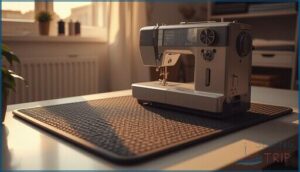
If your machine rattles like a paint-mixer, an antivibration mat placed directly underneath can drop noise by 5–7 decibels—enough to sew at midnight without waking the neighbors.
An anti-vibration mat under your sewing machine can reduce noise by 5–7 decibels—quiet enough to sew at midnight
Material selection matters: look for elastomeric pads with load capacity matched to your machine’s weight and frequency matching tuned below your operating speed.
Installation tips are simple—center the pad, distribute weight evenly—and long-term durability from quality anti vibration pads means years of vibration dampening without replacement.
DIY Dampening Methods (e.g., Yoga Mats, Quilts)
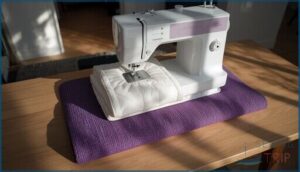
When budget matters, you don’t need commercial anti-vibration mat solutions. Repurposed yoga mats, quilted mat layers, and household linen use work just as well.
Yoga mat cores cut to size provide foam layer combos that stop vibration cold, while folded quilts dampen table rattle in apartments.
DIY design considerations are simple: cover all machine feet, extend several centimeters past the base, and layer materials for maximum vibration reduction.
Placing Rubber Mats Under The Machine
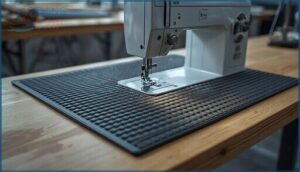
For maximum sewing machine vibration reduction, rubber mats beat most alternatives. Proper anti-vibration mat installation means centering the machine over surface grooves—those textured ribs grip your table while absorbing movement.
Material properties matter here:
- Mat thickness around 8–10 mm balances support and vibration dampening
- Rubber density near 60 Shore A addresses typical machine weight
- Full-base coverage prevents the dreaded machine “walk” during high-speed stitching
Installation practices are straightforward: grooves down, machine centered, done.
Advanced Noise and Vibration Dampening

If basic mats and pads aren’t cutting it, you’ll need to think a bit bigger. Sound-dampening enclosures, motor upgrades, and specialized mounts can drop noise levels considerably, though they do require more effort and investment.
Here’s what actually works when you’re ready to take things up a notch.
Installing Sound-Dampening Foam or Enclosures
When you want serious noise control, a soundproofing enclosure lined with acoustic foam shows results—think 10 to 20 dB reductions, sometimes more with careful DIY Sound Dampening Box builds. Commercial Enclosure Options exist, but many sewers craft cabinet enclosures from plywood and 1- to 2-inch foam panels.
Keep Ventilation Considerations in mind; baffle vents prevent overheating while blocking sound. Pair sound dampening foam with anti-vibration pads inside for maximum effect.
Upgrading to Quieter Motors
If your machine rattles at 80 dB or more, swapping to a servo motor can cut noise by half—modern servo motors run at 60–65 dB, far quieter than clutch motor drawbacks like constant belt hum. Here’s why you’ll notice the difference:
- Servo motor benefits include near-silent idle and precise speed control
- Direct-drive advantages eliminate vibration-causing belts entirely
- Brushless motors remove audible brush noise
- BLDC motor selection adds 70% energy savings while reducing heat
Anti-Vibration Mounts and Table Modifications
You’ll find anti-vibration mounts built for different load capacities—rubber types handle 3–9 kg/sq cm, while heavy-duty versions support industrial machines up to 35 kg/sq cm. Sorbothane pads deliver 94.7% vibration dampening, offering better isolation performance compared to basic foam.
For machine stability, reinforce your table with wooden bracing underneath, shifting resonance away from operating speeds. Alternatively, position the unit near table legs to minimize mid-surface wobble.
Maintenance Tips for Quieter Operation
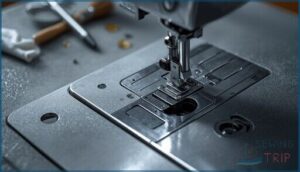
You can throw all the mats and foam in the world at your machine, but if it’s not properly maintained, you’re fighting a losing battle.
Regular upkeep tackles noise at its source, tightening up loose parts and keeping everything running smooth.
Here are three maintenance habits that’ll make a real difference in how quiet your machine operates.
Regular Cleaning and Lubrication
Think of lint as friction’s best friend—it loves to collect where motion happens. Regular cleaning and proper lubrication are your best defenses against vibration.
Here’s what works:
- Remove lint from the bobbin and hook area monthly for home machines, weekly if you’re sewing daily in dusty conditions.
- Apply 1–2 drops of sewing-machine oil to shafts and gears—never household oil, which thickens and increases drag.
- Keep maintenance logs to track cleaning frequency and catch rising vibration early.
Run scrap fabric after oil application to distribute lubricant evenly and stabilize noise levels.
Checking and Tightening Bolts and Screws
Vibration at 1.15 m/s² or higher—common when you’re running 3,000 stitches per minute—gradually loosens unsecured fasteners. Inspect accessible bolts and screws monthly, retightening to torque specifications using the correct driver.
Check your machine stand and tabletop mounts quarterly, because loose screws increase machine noise and accelerate wear.
For persistent loosening, add thread-locking adhesive or wedge-locking washers to maintain clamping force between inspection intervals.
Proper Bobbin and Needle Alignment
Securing loose parts is only half the battle—misaligned needles and bobbins generate vibration you can’t tighten away. Needle-hook timing errors cause repeated mini-collisions that increase sewing machine noise, while bobbin case damage or poor bobbin winding quality creates rotational imbalance at speed.
- Verify needle-bar fit is snug and the needle sits straight in its clamp
- Check needle-hook timing so the hook passes 1 mm above the needle eye without scraping
- Replace deformed bobbin cases and wind bobbins evenly to prevent wobble
Proper alignment restores smooth, low-vibration operation and protects thread tension balance.
Optimizing Sewing Room for Noise Control
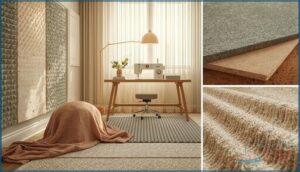
Your sewing machine isn’t the only culprit when it comes to noise—sometimes the room itself amplifies every hum and rattle. The right setup can turn a surprisingly loud workspace into a much quieter, more controlled environment.
Here’s how to address the space around your machine, not just the machine itself.
Sound-Absorbing Room Treatments
Your workspace acoustics matter more than you’d think. Acoustic panels with NRC ratings around 0.8 absorb roughly 80% of mid-frequency sound energy, while heavy curtains tackle high frequencies effectively.
Rugs reduce floor reflections, bookshelves scatter sound waves, and door seals block noise leakage.
Cover 15–25% of wall space with acoustic insulation for noticeable sound absorption without turning your sewing room into a recording studio.
Stable, Heavy Sewing Tables
Mass and stiffness work together here—adding weight to your table lowers its natural frequency by up to 40%, pushing resonance away from typical machine speeds. Heavy wooden or steel tables outperform flimsy plastic folding models, which bounce noticeably under operation.
Consider these upgrades:
- Choose thick-topped tables over lightweight frames for better vibration dampening
- Add rubber feet to improve floor contact and machine stability
- Integrate your machine into a flush cutout for even load distribution
- Place an anti vibration mat beneath the table
- Tighten bolts regularly to maintain a stable surface
Organizing Space to Minimize Vibrations
Beyond your stable surface and anti-vibration mat, where you place everything else matters. Position your machine at least half a meter from walls—you’ll cut transmitted vibration by 20–40%.
Zone heavy objects along exposed walls for added damping, separate walking paths from your workspace to avoid footfall excitation, and mount auxiliary surfaces independently rather than bolting them to your table for better vibration isolation.
Frequently Asked Questions (FAQs)
Can vibration damage my sewing machine over time?
Yes, vibration absolutely can damage your machine. Constant shaking accelerates fatigue in bearings and components, causes misalignment effects, loosens bolts, and gradually degrades performance—shortening your machine’s lifespan considerably.
Do all sewing machine models vibrate equally?
No—vibration varies wildly across models. Motor differences, material influence, and table mounting all play roles. Industrial machines with metal construction and antivibration pads often vibrate less than lightweight domestic units, though proper vibration isolation helps both.
Will slowing stitching speed reduce machine vibration?
Reducing sewing speed lowers vibration amplitude because inertial forces drop as speed decreases, helping you avoid resonance peaks.
That said, structural damping and proper maintenance deliver far more effective noise reduction and operator comfort than speed adjustments alone.
Should I avoid sewing thick fabrics at night?
Thick fabrics increase motor load and vibration, making nighttime noise limits harder to meet.
Structure-borne sound travels easily through floors during quiet hours, so schedule heavy-duty projects for daytime to avoid neighbor complaints.
Conclusion
Think of your sewing machine like a car engine: minor rattles ignored today become expensive repairs tomorrow. Implementing these sewing machine vibration reduction tips isn’t just about comfort—it’s about protecting your investment and extending machine life by years.
Start with a quality anti-vibration mat and proper maintenance schedule, then layer in acoustic treatments as needed. Your workspace should support your craft, not fight against it.
A quieter machine means better focus, cleaner stitches, and fewer headaches.
- https://www.youtube.com/watch?v=TeEJmM9Yos4
- https://madamsew.com/products/sewing-machine-muffling-mat-reduces-sewing-machine-vibrations-movement-and-slipping
- https://www.healthyquilting.com/post/protect-your-hearing-from-your-sewing-machine
- https://www.ezlaundry.co/blogs/blog-posts-relating-to-laundry-time/do-vibration-feet-for-washing-machines-really-work
- https://www.reddit.com/r/sewhelp/comments/bwlcos/have_you_done_anything_specific_to_minimize_the/