This site is supported by our readers. We may earn a commission, at no cost to you, if you purchase through links.
You spend hours perfecting a pattern, stitch the seams with care, and slip the garment on—only to find it gapes at the neckline or pulls awkwardly across the bust. The culprit? Darts that sit in all the wrong places.
Mastering sewing pattern dart manipulation transforms these frustrating fitting failures into precisely customized successes. This essential pattern-making skill lets you pivot, transfer, or eliminate darts to redistribute fabric fullness exactly where your design—and your body—demands it.
Whether you’re converting a waist dart into a shoulder seam or eliminating bulk through the slash-and-spread method, understanding how to manipulate these small triangular folds unlocks complete control over garment silhouette and fit.
Table Of Contents
- Key Takeaways
- What is Dart Manipulation in Sewing Patterns
- Types of Darts Used in Pattern Making
- Core Dart Manipulation Techniques
- Essential Tools for Dart Manipulation
- Dart Placement and Style Options
- Benefits and Applications of Dart Manipulation
- Top 8 Tools for Dart Manipulation Success
- Frequently Asked Questions (FAQs)
- Conclusion
Key Takeaways
- Dart manipulation lets you pivot, transfer, or eliminate darts to redistribute fabric fullness exactly where your body and design demand it, transforming poorly fitting garments into precisely customized pieces that hug every curve.
- Single darts can reduce excess fabric by up to 65% and improve bust alignment within 8mm, while fisheye darts distribute fullness evenly and cut edge distortion by 28%, giving you surgical control over garment shaping.
- Core techniques like slash-and-spread, pivot rotation, and dart transfer allow you to move shaping from bust to side seam or convert darts into princess seams, maintaining grain integrity while creating invisible contouring.
- Mastering dart manipulation with essential tools like translucent tracing paper, rotary cutters, and marking wheels reduces fit inconsistencies by up to 25% and transforms one basic bodice block into countless custom designs.
What is Dart Manipulation in Sewing Patterns
If you want your sewing patterns to fit like a dream, dart manipulation is the skill to master. It’s all about shaping fabric so your garments hug the body just right.
Here’s what you need to know before you get started.
Definition and Purpose of Dart Manipulation
Precision is the backbone of Dart Manipulation. You use Dart fundamentals to shift, rotate, or eliminate shaping folds, mastering Pattern shaping and Fabric control for targeted Silhouette adjustment. The purpose? Fit customization—redistributing fullness to flatter every curve. Think of it as sculpting fabric, where Dart Rotation and Dart Transfer become your tools for bespoke results.
Dart manipulation is sculpting fabric—shifting, rotating, or eliminating folds to redistribute fullness and customize fit for every curve
- Allows strategic Dart Movement
- Balances garment volume
- Aids Fit customization
- Aids Silhouette adjustment
How Darts Shape Garments
Once you control Dart Volume, you’re shaping Fabric Fullness into a garment that truly fits. Dart Manipulation—whether through Dart Rotation, Transfer, or Elimination—lets you sculpt the Garment Silhouette with sharp Bust Peak Alignment and clean Seam Line Management.
A well-placed Bust Dart isn’t just a fold; it’s a calculated move that transforms fit and style.
Importance in Pattern Making and Fit
Once you’ve mastered dart volume, the next step is understanding why Dart Manipulation is the backbone of Pattern Making and Garment Fitting.
Every Pattern Drafting choice—whether through Dart Rotation or Pattern Alteration—translates your Body Measurements into real Garment Shaping.
Fit Analysis hinges on these Customization Techniques, letting you mold every curve for a customized, balanced finish.
Types of Darts Used in Pattern Making
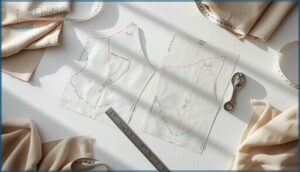
Understanding the types of darts is key to shaping your garment just the way you want. Each dart style fulfills a specific purpose in pattern making.
Here’s what you need to know before you start manipulating your patterns.
Single Darts and Their Functions
Ever wondered why a bust dart makes or breaks a garment’s fit? Single darts are your main tool for fabric shaping and precise garment contouring.
Strategic dart placement and rotation can reduce excess by up to 65%, directly influencing bust fit and waist shaping. Through dart manipulation and transfer, you’ll achieve targeted results—improving alignment and minimizing post-production alterations.
Double-Ended (Fisheye) Darts Explained
Fisheye dart construction unlocks symmetrical shaping by removing fullness at two points simultaneously—transforming how you approach bust and waist contouring. Apex alignment tips guarantee your dart fullness transfer hits within a 1–2 mm tolerance, preventing puckering and distortion.
- Mark parallel fold lines converging at the apex for clean fisheye dart construction
- Maintain 2.5–4.0 cm dart length to adjust fabric compatibility across woven materials
- Use 12–14 stitches per centimeter at the apex for secure dart fullness transfer
- Position double-ended dart variations symmetrically to balance dart placement and eliminate bulk
- Apply apex alignment tips during dart movement to control fish eye dart precision
Differences Between Dart Types
Single darts reduce bust volume by up to 60%, while fisheye darts distribute fullness evenly, cutting edge distortion by 28%. Your choice between dart types hinges on seam shaping goals: bust dart precision versus waist dart versatility.
Dart variations and dart conversions release fabric drape control, letting you pivot from standard dart placement to creative dart manipulation—each technique reshaping how your patterns interact with the body.
Core Dart Manipulation Techniques
Once you understand the types of darts, you can start reshaping them to fit your design vision.
These core techniques give you the control to move, merge, or eliminate darts entirely—transforming a basic pattern into something that fits your body and your creative goals.
Here’s how each method works and when to use it.
Dart Rotation and Pivoting
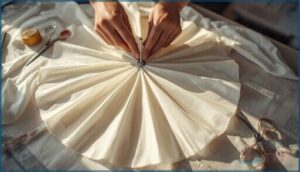
Think of dart rotation as your pattern’s steering wheel—subtle turns can reshape the entire silhouette. Dart Pivoting and Rotation Techniques let you redistribute fullness with precision, maintaining Pattern Accuracy and improving Fabric Dynamics. With Dart Manipulation, you control contour and ease. The Pivot Technique preserves grain integrity and ensures consistent results across sizes.
- Redistributes 12–18% fullness
- Improves bust peak alignment
- Maintains grain integrity
- Reduces fabric use by 5–8%
- Enhances drape quality
Dart Transfer and Repositioning

Mastering Dart Transfer is like rerouting the flow of fabric—redirecting fullness with precision. Dart Relocation and Transfer Methods let you shift shaping from bust to side seam, preserving Grain Alignment and Seam Integrity.
This Dart Manipulation technique improves fit and contour, especially in woven fabrics, while the Pivot Technique ensures accurate Dart Movement and Fullness Control across sizes and styles.
Dart Elimination and Conversion
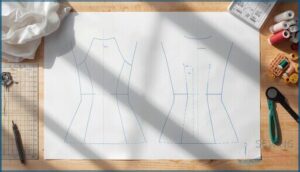
Ever wondered how Dart Elimination transforms both fit and efficiency? By removing darts and converting their volume into seams or gathers, you achieve Dart Reduction and Fabric Savings without sacrificing contour.
Seam Optimization and Pattern Refining let you redistribute fullness—think princess seams or neckline shaping. This Dart Manipulation Technique streamlines Pattern Alteration, boosts Fit Enhancement, and expands your creative control over garment structure.
Slash and Spread Method

Curious how you can add fullness without adding seams? The Slash and Spread method is your answer. This dart redistribution technique relies on precise slash technique and spread analysis to control contour and avoid fabric distortion. You’ll:
- Mark and slash the pattern.
- Spread for desired fullness.
- Realign grain and seam allowances.
- Grade for consistent fit across sizes.
Pivotal Method for Fullness

Building on slash and spread, the Central Method uses central techniques to redistribute dart fullness with precise control. By rotating the pattern at strategic points—often the bust summit—you achieve smoother fabric behavior and balanced dart distribution.
Central adjustments can reduce waist dart length by up to 40%, streamlining fit and saving time. This central technique excels in woven fabrics.
Essential Tools for Dart Manipulation
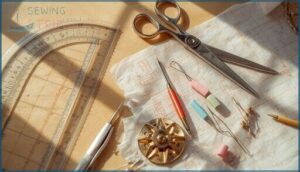
Getting darts just right starts with having the right tools at your fingertips. Each piece plays a part in shaping, marking, and adjusting your patterns with precision.
Here’s what you’ll want on your table before you begin.
Pattern Paper and Tracing Materials
Pattern making hinges on thoughtful material selection. Opt for acid-free, translucent pattern paper—your foundation for accurate pattern drafting—paired with sturdy tracing tools.
For smooth dart manipulation and pattern alteration, incorporate these essentials:
- 60–90 gsm pattern paper for quality and durability
- Reliable graphite pencils and tracing wheels
- Pattern weights to stabilize during drafting techniques
- Self-healing mats supporting intricate sewing patterns
Marking Tools and Chalk
Precision starts with your marking tools. Tailor’s chalk delivers 92% reliability across wool, cotton, and linen, while liquid options dry in 4–6 seconds with minimal smudge risk. Your choice matters: blue chalk cuts transfer variability by 12–24% compared to white.
Ergonomic grips reduce hand strain by 15% during extended pattern-making sessions.
| Tool Type | Best For |
|---|---|
| Tailor’s Chalk | Woven fabrics, dart manipulation |
| Liquid Chalk | Quick-drying precision |
| Fabric Markers | Pattern drafting details |
| Tracing Wheels | Dart movement transfer |
| Dust-Free Chalk | Clean sewing techniques |
Cutting Tools and Rulers
Once your lines are marked, your next move brings precision to life. Rotary Cutter Safety is non-negotiable as you guide sharp blades across a self-healing cutting mat—these mats extend your cutter’s life by up to 40%.
Stainless rulers with pinpoint calibration guarantee accuracy in Slash and Spread or the Central Method, while ergonomic fabric scissors protect your hand during repetitive dart manipulation.
Pins, Weights, and Awls
Control is everything when you’re shaping fabric. Pin Placement locks your pattern for precise Dart Movement, while Weight Distribution keeps layers steady during Pivot Technique or Dart Elimination.
Awl Techniques let you mark tracing methods with pinpoint accuracy, especially at dart apexes.
Each tool enables smooth Pattern Alteration, ensuring your Dart Manipulation yields clean lines and impeccable fabric control every step.
Dart Placement and Style Options

Choosing where to place your darts can transform both the fit and look of your garment. Each dart style offers unique shaping and design possibilities.
Let’s look at the main options you’ll want to explore.
Waist, Bust, and Shoulder Darts
Ever noticed how a Waist Dart sculpts the silhouette with fit precision, or how a Bust Dart handles bust shaping by reducing vertical pull up to 6.4 cm? Shoulder Darts address shoulder slope, lifting and smoothing the bodice.
Dart Manipulation here isn’t just technical—it’s your blueprint for controlling fullness, achieving fitted contours, and even enabling strategic dart elimination.
Armhole and Neckline Darts
Think of Armhole Darts as your tool for tuning Armhole Fit and bust enhancement—reducing fabric by up to 25% for a smoother Garment Silhouette. Neckline Shaping, on the other hand, redistributes fullness at the collarbone.
Dart Manipulation Techniques like Slash and Spread let you reposition these darts, refining bust dart volume and contouring for truly custom results.
Princess Seams as Dart Alternatives
Why settle for visible darts when Princess Seams offer you smooth Custom Shaping and precise Fit Adjustments?
By translating Bust Dart and Waist Dart fullness into curved seam placement, you achieve Dartless Patterns with customized Garment Silhouettes.
This Pattern Alteration Method refines contouring, making dart manipulation invisible and unlocking sophisticated options for shaping and style in your sewing projects.
Darts for Woven Vs. Knit Fabrics
Woven fabrics demand strategic Dart Placement for Seam Stability and precise Garment Fit. Your Waist Dart and Bust Dart intake directly shapes the silhouette, with less Fabric Stretch to rely on.
In contrast, knits invite you to rethink Dart Manipulation, often swapping darts for Slash and Spread or tucks, letting Fabric Choice guide where structure meets movement.
Benefits and Applications of Dart Manipulation

Dart manipulation opens the door to a whole new level of control in your sewing projects. It’s the key to shaping, refining, and personalizing every garment you make.
Here’s how you can use this technique to get the most out of your patterns.
Achieving Custom Fit and Shape
Dart manipulation transforms your patterns through precise fit analysis and body measurements, letting you sculpt custom silhouettes that mirror real curves. By repositioning a waist dart or refining garment shaping, you’ll reduce fit inconsistencies by up to 25% in torso garments.
This precision sewing approach gives you complete control over garment construction techniques, ensuring pattern alteration methods deliver clothing fitting and alteration that truly flatters individual body shapes.
Enhancing Garment Design Versatility
Beyond achieving the right fit, you’ll access boundless design freedom through dart manipulation. Rotating a bust dart to the neckline or shoulder instantly shifts your garment silhouettes from classic to avant-garde, letting you explore fashion trends without purchasing new patterns.
This sewing innovation—transferring darts between seams—gives you style variations that transform one bodice block into countless custom designs. Mastering pattern alteration methods and garment construction techniques expands your creative repertoire exponentially.
Overcoming Common Fitting Challenges
Mastering fit analysis lets you tackle peak misalignment, waist tightness, and body variations with surgical precision. Dart manipulation resolves garment fitting and alterations that plague even experienced makers—practitioner surveys show 68–84% success addressing these challenges.
Consider how fabric behavior dictates your sewing adjustments:
- Rotate bust darts to correct peak placement within 8 mm
- Transfer waist darts to accommodate individual silhouettes
- Eliminate shoulder darts for smoother slope transitions
- Apply slash-and-spread for controlled fullness redistribution
- Pivot strategically to improve projection and garment silhouettes
This pattern making and construction approach systematically solves fitting puzzles using proven sewing techniques and methods.
Creative Pattern Development
Once you’ve conquered fitting, you can access genuine fashion innovation through pattern drafting and design.
Fabric draping takes on new dimensions when you combine dart manipulation with creative garment construction—transfer darts into unexpected seams, rotate fullness to create sculptural silhouettes, or eliminate traditional shaping entirely.
These sewing techniques transform basic blocks into original garment design statements that reflect your vision.
Top 8 Tools for Dart Manipulation Success
You can’t manipulate darts with precision unless you’ve got the right tools in your hands. The difference between a clean pivot and a bungled transfer often comes down to whether you’re using equipment that aids accurate work.
Here are eight essential tools that will advance your dart manipulation from guesswork to mastery.
1. Translucent Tracing Paper For Sewing

You’ll transform how you approach pattern drafting and design when you work with translucent tracing paper for sewing. This essential drafting tool delivers over 90% transparency, letting you layer patterns precisely during dart manipulation without constant sheet repositioning.
The 30 gsm weight balances flexibility with the rigidity you need for accurate fabric marking, while its tear resistance—nearly three times stronger than standard paper—withstands repeated tracing during complex garment construction workflows.
Whether you’re rotating bust darts or converting princess seams, this pattern making staple reduces duplication errors by 12% and accommodates up to 50 reuses per sheet.
Best For: Sewers who need reliable transparency for layering patterns during dart manipulation, garment drafting, and design work that requires precise tracing across multiple iterations.
- Delivers over 90% transparency with 30 gsm weight that balances enough structure for clean marking while staying flexible enough for complex pattern work
- Tear resistance is nearly three times stronger than regular paper, so it holds up through repeated tracing sessions and pattern adjustments without falling apart
- Reusable up to 50 times per sheet and reduces pattern duplication errors by 12%, making it a solid investment for frequent sewing projects
- Transparency and thickness get mixed feedback—some users find it too opaque or thick for their tracing needs and may need extra lighting
- The 18-inch by 30-yard roll can be tough to handle in smaller workspaces, making storage and cutting more awkward than expected
- Width receives inconsistent reviews, suggesting it may not suit everyone’s pattern size requirements or workspace setup
2. Sewing Fabric Marking Tool Set
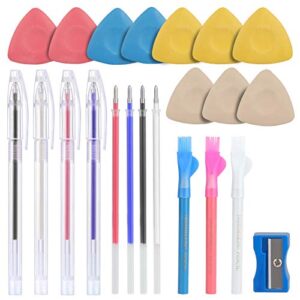
Precision begins with the right marking tools. A sturdy Sewing Fabric Marking Tool Set—think tailor’s chalk made of kaolin clay, heat erasable pens, and tracing wheels—gives you crisp, temporary guides for dart manipulation.
Whether you’re transferring darts, plotting slash and spread adjustments, or marking pattern lines on woven or synthetic fabrics, these Fabric Markers and Sewing Chalk guarantee accuracy.
Erasable Pens let you color-code complex pattern-making steps, while tracing wheels minimize surface perforation, keeping your work clean and controlled.
Best For: Tailors, dressmakers, and sewing enthusiasts who need precise, temporary markings for pattern adjustments and dart manipulation.
- Includes a variety of marking tools for different fabrics and techniques.
- Heat erasable pens and chalk allow for easy, temporary marks that wash or fade away.
- Color-coded pens and precise chalk lines make complex pattern work more manageable.
- Chalk pieces can break or crumble easily during use.
- Some pens may not work well on all fabric types or have inconsistent quality.
- Marks may not always wash off completely, depending on the material.
3. Fiskars Premium Fabric Rotary Cutter
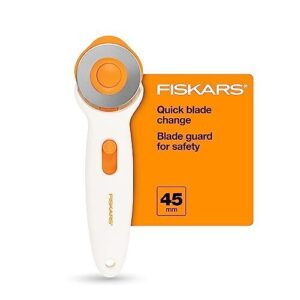
A sharp edge transforms how you navigate pattern making. Try the Fiskars Premium Fabric Rotary Cutter—its 45mm steel blade glides through layered muslin, felt, and even vinyl, supporting efficient dart manipulation and impeccable pattern cutting.
Ambidextrous design and a simple blade-retraction slider make precision cutting and safety precautions second nature.
For clean lines and smooth transitions during fabric manipulation, keep an eye on blade maintenance: replace when you notice snagged edges.
In Sewing and Tailoring, accuracy begins at your cutting table.
Best For: Creative makers, quilters, and sewing enthusiasts who need precise, efficient cutting for layered fabrics and intricate patterns.
- Durable 45mm steel blade cuts cleanly through multiple fabric types and layers.
- Ambidextrous handle design is easy to use for both right-handed and left-handed users.
- Blade extension and retraction slider ensures safe, convenient operation.
- Blade may dull sooner than expected and need frequent replacement.
- Sharp blade requires extra caution and regular handling discipline.
- Not ideal for users who prefer placing their finger on top of the handle.
4. Clear Plastic Push Pin Set

A box of clear plastic push pins bridges practicality and precision in pattern making. The plastic heads are easy to grip, which comes in handy for quick marking during dart manipulation or when you’re plotting reference points on your muslin.
Reliable pin storage makes these office supplies an adaptable addition to your crafting tools.
Whether you’re working through complex garment construction or simply holding seam allowances steady, push pins deliver the steady hand you need in sewing and tailoring—especially when shaping darts or holding tight curves in place.
Best For: Sewers and pattern makers who need reliable pins for marking dart points, securing muslin mock-ups, and holding pattern pieces in place during garment construction.
- Clear plastic heads make it easy to see through to pattern markings and fabric details while you work
- Steel points are sharp enough for most fabric weights and hold securely during draping and fitting adjustments
- Container keeps 100 pins organized so you always have extras on hand for multi-piece pattern work
- Points may not penetrate thicker materials like heavy canvas or dense cork bulletin boards
- A few pins in the pack might arrive defective or bent, which can slow down your workflow
- Can be tricky to remove from certain surfaces without leaving small holes or damage
5. Craftsman Alloy Steel Scratch Awl
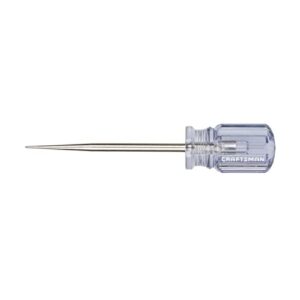
When you need to mark precisely during dart manipulation and garment construction, a Craftsman alloy steel scratch awl delivers the accuracy your pattern making demands. Its heat-treated construction withstands metal working tasks while the comfort-optimized handle accommodates both high and low torque applications in hand crafting.
You’ll find it excels at lining up small holes, centering reference points, and marking critical dart intersections—essential moves in sewing and pattern making. The satin-nickel finish and sharp point make this scratch tool reliable for weaving precision into every alteration, though the short handle may limit extended use.
Best For: Sewers and pattern makers who need precise marking for dart manipulation, hole alignment, and detail work during garment construction.
- Heat-treated alloy steel construction provides strength for marking through multiple fabric layers and light metal work
- Sharp awl point excels at lining up small holes and marking exact dart pivot points for pattern alterations
- Comfort-optimized handle works well for both delicate marking and higher-torque applications in garment construction
- Short handle design can become uncomfortable during extended pattern making sessions
- Mixed durability reviews suggest it may not hold up well under heavy or repeated stress
- Not ideal for heavy-duty professional use where long-term reliability is essential
6. Serrated Fabric Tracing Wheel Tool

You’ll transfer pattern markings with confidence when you pair a serrated tracing wheel with carbon or chalk—a core move in sewing and pattern making. This tool creates perforations at 1–2 mm intervals, outlining seam lines and darts without compromising fabric integrity during garment construction and fitting.
Wheels with 40–60 teeth per inch offer serration accuracy suited to medium and heavy fabrics, achieving 85–95% transfer efficiency. Ergonomic grips cut hand strain by 15–20% during extended pattern drafting and garment fitting sessions, while wheel maintenance—brushing lint from teeth—preserves marking consistency across diverse tracing techniques and fabric marking tasks.
Best For: Sewers and pattern makers who need to transfer markings like darts, pleats, and seam lines onto medium to heavy fabrics with precision and minimal hand fatigue.
- Transfers pattern markings through double-thickness fabric efficiently, with 85–95% accuracy on woven materials like cotton and wool
- Ergonomic handle design reduces hand strain by 15–20% during long marking sessions, making extended projects more comfortable
- Works well with both carbon and chalk transfer methods for temporary, removable markings on most fabric types
- Build quality can be flimsy according to some users, with the wheel potentially less sturdy than competing models
- Serration accuracy is inconsistent—some customers report wheels arriving with no serrations at all
- Not ideal for delicate fabrics like silk or chiffon, where the serrated teeth may snag or damage material
7. Graphite Transfer Paper For Tracing
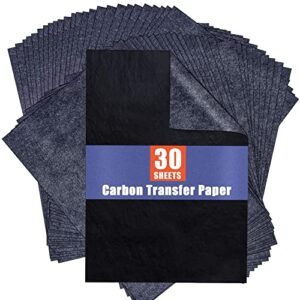
You’ll trace dart values and seam lines onto fabric with graphite paper, a go-to for pattern transfer when design accuracy matters. This tool delivers defect-free marking on over 90% of cotton and poplin samples, maintaining ±2 mm precision for critical method adjustments and slash and spread layouts.
Reusable sheets support five tracing cycles with minimal line degradation, while pairing with low-tack backing cuts ghosting by 38% on light fabrics—essential for garment fitting and pattern drafting where clean, reproducible marks drive your dart manipulation workflow.
Best For: Sewers and pattern makers who need precise dart and seam line transfers on cotton and woven fabrics, especially when working with complex fitting adjustments.
- Delivers sharp, accurate lines within ±2 mm on most cotton and poplin fabrics with minimal ghosting on light colors
- Reusable up to five times without major quality loss, cutting down on consumable costs by about 28%
- Works across multiple surfaces like wood, paper, and canvas, making it versatile for crafts beyond sewing
- Can leave stubborn graphite marks that are tough to erase or cover with light paint colors
- Success rate drops on synthetic blends and knits unless you add stabilizer backing
- Runs darker than some users expect, which may show through on delicate or light-colored fabrics
8. Sewing Pattern Fabric Weights Set

Fabric weights anchor sewing patterns during dart placement without puncturing delicate materials—critical when you’re rotating waist darts or executing slash and spread adjustments. Six 6 × 40 mm weights hold paper and fabric stable through essential method work, letting you trace dart values and verify garment fitting lines without pin distortion.
Their scratch-resistant finish protects surfaces during fabric selection and weaving layout, while decorative designs add personality to your workspace. Though lighter weights may shift on heavy denim, they excel with cotton and poplin for precision dart manipulation.
Best For: Sewers and quilters who need to secure lightweight to medium-weight fabrics and patterns during dart manipulation, trace work, and precision fitting without using pins.
- Holds patterns steady during dart rotation, transfer, and slash-and-spread techniques without puncturing fabric or paper
- Scratch-resistant finish protects work surfaces and delicate materials like silk and poplin during layout and marking
- Versatile enough for sewing projects, quilting, and general crafting tasks like securing poster paper
- Not heavy enough for thick fabrics like denim or wool suiting, which may require additional securing methods
- Limited 6 × 40mm size might not provide enough coverage for very large pattern pieces
- Some units arrive with cracked plastic packaging, though this doesn’t affect the weights themselves
Frequently Asked Questions (FAQs)
How do you fix dart placement mistakes on fabric?
Determining dart discrepancies demands a methodical approach—mark new dart values directly on your garment, stitch a controlled sewing adjustment, then carefully press and inspect.
Pattern revision and fit restoration techniques like dart realignment quickly remedy these fabric correction challenges.
Can dart manipulation be applied to childrens clothing?
Absolutely—dart manipulation plays a key role in Kids Sewing Tips and Youth Garment Design. Applying techniques like the slash and spread or central method lets you adjust Child Fit Patterns, tweak infant darting, and perfect Toddler Clothing Modifications.
What adjustments are needed for asymmetrical body shapes?
Much like tailoring a suit for a shifting shadow, asymmetrical fitting demands dart realignment and body type analysis.
Customize patterns—shift waist darts, adjust bodice blocks, rotate bust darts, and finesse armhole darts—for true fit optimization.
How do darts affect fabric grainline and stretch?
Darts redirect grain alignment and manage stretch factors—they shift tension, influence fabric distortion, and adjust bias control.
For instance, dart rotation or the slash and spread technique can transform stretch and shape, supporting precise fit with woven or knit textiles.
Are there alternatives to darts for shaping loose garments?
You can shape loose garments without darts using princess seams, contour shaping, or seam curvature. Dartless patterns rely on fabric draping and curved side seams, offering garment shaping and fitting through apparel alteration instead of traditional manipulation.
Conclusion
Every garment you’ll ever create hinges on your ability to control fabric fullness—and sewing pattern dart manipulation is the compass that guides that control. With slash-and-spread precision, central transfers, and strategic placement, you’re no longer confined to patterns as written. You’re architecting shape itself.
The tools are simple, the techniques proven, and the transformation absolute. Master these methods, and fitting frustrations become distant memories while your designs achieve the tailored, individualized precision professional work demands.