This site is supported by our readers. We may earn a commission, at no cost to you, if you purchase through links.
Silk slips under your needle like water, bunching and puckering the moment you lose control. Chiffon floats off the cutting table, voile stretches sideways without warning—delicate fabrics seem to resist every move you make. That resistance isn’t random.
Thin fabrics expose every flaw in your process, from a dull needle dragging through fibers to pins that leave permanent holes in georgette.
The good news: hand sewing thin fabrics rewards preparation and the right tools far more than it demands raw skill. A 0.4 mm glass-head pin, a size 70/10 needle, thread weighted at 60–80 wt—these specifics aren’t overthinking, they’re the difference between clean seams and fabric that puckers at the hem.
Getting the details right before you make your first stitch changes everything that follows.
Table Of Contents
Key Takeaways
- The right tools — a 0.4 mm glass-head pin, a size 70/10 needle, and 60–80 wt thread — do more for your results than raw technique ever will.
- Prep work before your first stitch (pre-washing, pressing flat, stabilizing with tissue paper) is what keeps delicate fabrics from shifting, puckering, or shrinking later.
- Small, even stitches at 1.5–2 mm with relaxed tension give you control over thin fabric; pulling or rushing is how seams go wrong.
- Slowing down and testing everything on scraps first — needle, thread, tension — is the habit that separates clean results from costly mistakes.
Top 3 Tools for Delicate Fabric Work
The right tools make all the difference when you’re working with delicate fabrics. Without them, even careful hands can end up with snags, puckers, or fabric that won’t stay put.
A good starting point is learning how to prepare delicate fabrics before you cut—it saves a lot of frustration later.
These three essentials are worth keeping close every time you sit down to sew.
1. Ultra Fine Glass Head Pins
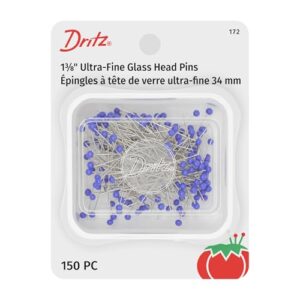
When you’re working with silk or chiffon, the wrong pin leaves a mark you can’t undo. That’s why ultra fine glass head pins — like this nickel-plated size 22 set — are worth keeping on your work table.
At just 1⅜ inches long with a 0.4 mm shaft, they slide through delicate weaves without snagging or stretching. The heat-resistant glass heads mean you can press directly over pinned seams — no stopping, no shifting, no stress.
| Best For | Sewists working with delicate fabrics like silk, chiffon, or voile who need precision pinning without leaving marks or interrupting their pressing workflow. |
|---|---|
| Primary Use | Delicate fabric pinning |
| Fabric Compatibility | Silk, chiffon, voile |
| Durability Concern | Pins bend on heavy fabric |
| Best Project Type | Pinning and pressing seams |
| Package Quantity | 150 pins |
| Material | Nickel-plated steel |
| Additional Features |
|
- Heat-resistant glass heads let you iron right over pinned seams — no fussing, no removing pins mid-press
- Ultra-fine shaft slides through delicate weaves cleanly, leaving virtually no needle marks
- Comes in a handy storage box with a curved edge so grabbing pins is quick and easy
- Thin pins bend and break more easily, especially on heavier fabrics or thick layers
- Blue glass heads can disappear on dark fabric, making them tricky to spot and retrieve
- 150 pins sounds like a lot until you’re deep in a quilting project — restocking comes up faster than you’d expect
2. Sharp Sewing Machine Needles Set
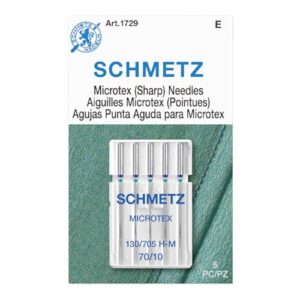
Pins protect the surface — but the needle does the real work. For microfibers, silk, and tightly woven fabrics, the Schmetz Microtex 70/10 sharp needle is hard to beat.
Its fine acute point pierces clean holes without pulling threads or distorting the weave. You’ll notice the difference immediately: fewer skipped stitches, no snagging, just smooth, accurate placement.
A pack of five is enough to start, though replace your needle often — a fresh point is everything on delicate fabric.
| Best For | Sewers working with delicate fabrics like silk, microfiber, or tightly woven materials who need clean, precise stitching without snags or distortion. |
|---|---|
| Primary Use | Precision needle stitching |
| Fabric Compatibility | Silk, microfiber, wovens |
| Durability Concern | Needles snap under pressure |
| Best Project Type | Embroidery and quilting |
| Package Quantity | 5 needles |
| Material | Steel needle |
| Additional Features |
|
- The fine acute point slides through delicate fabrics cleanly, reducing skipped stitches and thread pulls
- Works great for detailed embroidery, beadwork, and precision quilting where stitch placement really matters
- Schmetz is a trusted name — you know you’re getting consistent quality needle to needle
- Fine-gauge needles are fragile and can snap under pressure, especially if you push them on heavier fabric
- Five needles per pack goes fast on big projects, so you’ll be reordering more often than you’d like
- The 70/10 size is niche enough that it can be hard to find in local stores
3. Brother Walking Foot Sewing Accessory
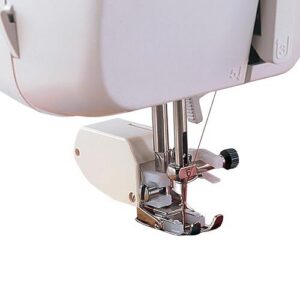
Now pair that sharp needle with a tool that controls how the fabric moves: the Brother SA107 Walking Foot.
Where a standard presser foot can let slippery layers drift, this foot feeds fabric from both the top and bottom simultaneously — think of it as two hands guiding the cloth instead of one.
It’s especially useful for chiffon or satin, where shifting ruins your seam alignment.
Set your stitch length to about 5 mm and test on a scrap first.
| Best For | Quilters, sewists working with slippery or layered fabrics, and anyone tackling heavyweight materials who needs even, consistent feeding through their Brother low-shank machine. |
|---|---|
| Primary Use | Even fabric feeding |
| Fabric Compatibility | Woven and knit fabrics |
| Durability Concern | Occasional failure after extended use |
| Best Project Type | Quilting and layered projects |
| Package Quantity | 1 foot |
| Material | All-metal construction |
| Additional Features |
|
- Feeds fabric from top and bottom at the same time, so layers stay aligned instead of shifting or bunching.
- Handles a wide range of materials — silky fabrics, thick layers, knits, and even heavy canvas or sail cloth.
- All-metal build and comes with a longer screw, so installation doesn’t require removing your existing hardware.
- Only fits low-shank machines, so if you have a high-shank model or a brand like Juki, it won’t work.
- The manual locks you into a 5 mm stitch length, and performance can get inconsistent outside that setting.
- Some users find it feels a bit flimsy and have had it wear out after heavy use — it’s not built for years of daily heavy-duty work.
Preparing Thin Fabrics for Stitching

Before your needle ever touches the fabric, a little prep work makes all the difference. Thin fabrics like chiffon, charmeuse, and satin are unforgiving — skip a step and you’ll pay for it later with puckers, shifting, or stretched seams.
If you want to build confidence with tricky fabrics, practicing on beginner-friendly adult sewing projects is a great way to sharpen your prep habits before tackling something delicate.
Here’s what to do before you sew your first stitch.
Pre-wash Lightweight Fabrics to Reduce Shrinkage
Skipping the pre-wash is one of the fastest ways to ruin a finished garment. This step removes manufacturing chemicals(https://sewfrenchcrossstitch.com/how-to-pre-wash-fabric-before-sewing/) that can affect stitch penetration.
Lightweight fabric sewing tips always start here: shrinkage happens, and it’s better to let the fabric relax before you cut. Use a Cold Water Wash with an Enzyme-Free Detergent, then practice Flat Air Drying to protect the fibers. Before cutting, run a Shrinkage Test Swatch through the same process:
- Measure a 4-inch square before washing
- Wash gently with cold water and mild detergent
- Air dry flat under Humidity Control conditions, then re-measure
Prewashing is non-negotiable when preparing thin fabrics before sewing — it keeps your hand stitching and final fit exactly where you planned.
Handle Silk and Chiffon With Extra Care
Silk and chiffon aren’t forgiving — one careless tug can distort the drape permanently. Gentle Stretch Prevention starts with how you hold the fabric: always support the full panel, never let it hang mid-stitch.
Minimal Handling Technique matters here, too. Lay both flat to dry, rely on silk pins, and finish with Cool Dark Storage to protect color and shape.
Press Fabric Flat With Low Heat and a Cloth
Before you cut a single thread, your fabric needs to lie perfectly flat — and that means pressing it right.
Set your iron to low heat settings and always place a muslin pressing cloth between the iron and the fabric.
Pressing cloth choice matters: muslin breathes without trapping heat.
minimal steam use, lift rather than slide, and allow cooling before handling.
Keep your soleplate maintenance consistent to avoid residue transfer.
Use Tissue Paper or Pattern Weights for Cutting
Keeping slippery fabric from shifting mid-cut is half the battle. Slide tissue paper beneath your fabric as backing — Tissue Paper Benefits are real: it grips, stabilizes, and protects sheer layers without holes.
For weight placement strategies, set non‑marking weights at the corners and along the edges on your cutting mat setup. Stabilizing curves gets easier when you combine both methods with a fresh rotary blade.
Mark Seams Without Stretching The Fabric
Marking seams on thin fabric is where precision grain alignment really earns its keep. Work from the wrong side using translucent tracing or tailor’s chalk with a light hand — never press down hard.
A tissue backing underneath prevents dye transfer and keeps fibers stable. A quick mist of micro-stabilizer spray before you trace locks everything in place without distortion.
Choosing Needles, Pins, and Thread
Getting your tools right before you sew a single stitch makes all the difference with thin fabrics. The wrong needle or a heavy thread can snag, pucker, or leave marks that are impossible to fix.
Here’s what to keep in mind when choosing needles, pins, and thread.
Select The Right Hand Sewing Needle Size
Think of your needle as a guest — it should slip through the fabric without leaving a trace.
For most thin wovens, size 9 to 11 fine, sharp needles hit the sweet spot.
Ultra-delicate organza calls for a size 7 needle, while heavier sheers handle a size 11 needle comfortably.
Match thread weight to needle gauge, and always run a scrap test technique before committing.
Use Glass-head or Fine Steel Pins
Your pins matter more than you’d think on sheer fabric. Glass-head pins offer heat-resistant heads that won’t melt under a quick press check, plus sharp pin shaft elasticity that resists bending.
Fine pins and silk pins glide through without tearing.
Use color-coded pins for pattern sections, pin perpendicular to the seam, and pin within seam allowances.
A magnetic pincushion keeps pin visibility high.
Match Thread Weight to Sheer, Lightweight Fabric
Once your pins are in place, thread choice becomes the next quiet decision that shapes everything. For sheer fabrics like chiffon or silk, reach for 60–80 wt thread — lightweight thread nearly disappears into the weave.
Thread Weight Ratios matter here: keep your bobbin balance within 2–4 wt of your top thread. Fiber Compatibility and Tension Matching together determine seam visibility, so choose cotton or polyester threads in the 70–90 wt range to preserve natural drape.
Test Needle and Thread on Scraps First
Before you touch your actual fabric, run a Scrap Stitch Evaluation — it takes two minutes and saves hours. Cut a matching scrap, then test your chosen needle and thread together. Check for Stitch Length Optimization (aim for 8–12 stitches per centimeter), Thread Tension Calibration, and Fabric Feed Consistency. Needle Point Matching matters too — here’s what to confirm on every scrap test:
- Sew a straight line and flip the scrap over to check for puckering or thread pull-through.
- Verify Thread and needle selection for silk and chiffon by checking that 60–80 wt thread lies flat with no bunching.
- Confirm choosing the right needle for thin fabrics — size 9 to 12 keeps sheer weaves intact.
- Compare hand stitching vs machine stitching on thin fabric to see which gives cleaner edges on your specific material.
- Test selecting appropriate needles for delicate fabrics by trying both sharp and ballpoint variants, then sticking with whichever leaves no snags.
Replace Dull Needles Before Finishing The Project
Once your scrap test confirms the right setup, don’t let a worn needle ruin the final stretch.
Watch for Needle Wear Indicators like increased resistance, Skipping Stitch Symptoms, or thread shredding near the eye — these signal that it’s time to swap.
Fine Needle Insertion with a fresh size 9 needle or microtex needle restores clean Post-Needle Tension, protecting your fabric through Project Completion Timing.
Hand Sewing Stitches That Work
The right stitch makes all the difference when you’re working with thin, slippery fabric. Hand sewing gives you control that a machine sometimes can’t — but only if you’re using the right techniques.
Here are the stitches that actually hold up on lightweight fabrics.
Make Small, Even Stitches for Control
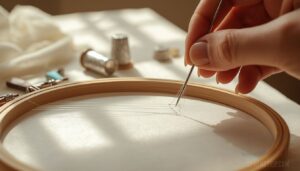
Even stitching is everything on thin fabric. Keep your stitch length calibration tight — 1.5 to 2.0 mm gives you the control you need without puckering.
Focus on thread tension balance as you work: hold the thread firm but relaxed. Steady hand guidance matters more than speed here.
Fabric feeding rhythm and micro needle handling together create that clean, confident line you’re after.
Use Basting Stitches for Accuracy
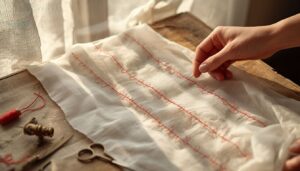
Before you commit to a single permanent stitch, basting stitches give you a safety net. Use a contrasting thread for Basting Thread Contrast — which Alignment Mark Visibility makes Seam Line Correction easy.
Temporary Fit Testing on delicate fabric is just smarter sewing. Layer Tension Control keeps everything flat and true.
- Hold layers together without distortion
- Test fit before final stitching
- Remove cleanly, leaving no trace
Sew French Seams to Hide Raw Edges
French seams are one of the most rewarding hand sewing techniques you can master for sheer and lightweight fabrics.
Seam Allowance Ratio is key — start with wrong sides together at ⅜ inch, trim to ⅛ inch, then enclose with a ¼‑inch Finishing Stitch Choice.
Follow this Pressing Sequence and Edge Folding Technique throughout.
| Step | Detail |
|---|---|
| First seam | Wrong sides together, ⅜ in. allowance |
| Trim | Cut down to ⅛ in. evenly |
| Press flat | Set the stitch before folding |
| Fold | Right sides together, align edges |
| Second seam | Stitch ¼ in. from fold to enclose |
Stabilizer Spray before stitching to reduce slipping.
With the right needle types for lightweight materials, your seam finishing techniques will look impeccably clean inside and out.
Create Rolled Hems for Airy Fabrics
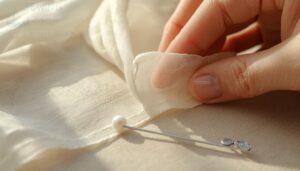
A rolled hem is your best friend when working with chiffon or any airy thin fabric.
Keep Fold Width Precision tight — just 1 to 2 millimeters — for true Hem Bulk Reduction. Thread Color Matching keeps stitches invisible, while Stitch Length Control at 1 to 2 mm prevents puckering.
Always respect Fabric Grain Awareness so the edge rolls smoothly without distortion.
Finish Edges With Slip Stitch or Whip Stitch
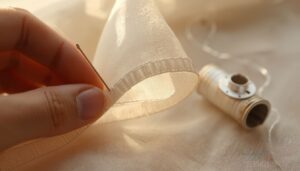
Both stitches earn their place depending on what you need.
Slip Stitch Visibility is nearly zero — tiny catches of thread create an Edge Smooth Finish that looks untouched from the front, ideal for hems.
Whip Stitch Strength shines on textured or layered edges, adding Decorative Edge Contrast.
Thread Tension Control steady throughout — too tight and the edge waves, too loose and it gaps.
Preventing Snags, Fraying, and Puckers
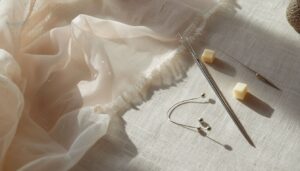
Even the most careful stitching can unravel quickly if you skip a few key steps along the way. Thin fabrics are unforgiving — one snag, one pulled thread, one rushed seam can undo hours of work.
With thin fabrics, one snag or rushed seam can undo hours of careful work
Here’s what to do at each stage to keep your project clean and intact.
Stabilize Slippery Fabric Before Stitching
Slippery fabric has a way of moving the moment you look away. Before you stitch a single thread, lock it down using one of these stabilizing methods:
- Tissue Paper Method – Sandwich fabric between two tissue layers for clean, shift-free cutting.
- Fusible Interfacing Layer – Fuse a sheer, lightweight interfacing to the wrong side for grip.
- Gelatin Stiffening – Soak briefly, air-dry flat, then sew with control.
- Light Starch Spray or Spray Adhesive Hold – A quick mist firms up slippery fibers instantly.
Avoid Pulling or Stretching While Sewing
Your hands are the real variable here. Even slight tugging throws a seam off.
Focus on the Hand Guidance Technique: rest your wrists with a Relaxed Elbow Position, let the machine lead with Controlled Fabric Feed, and never rush.
Slow Stitch Pace keeps tension even. Regular Tension Balance Checks catch puckering early — before it ruins an otherwise ideal seam.
Use Fray Prevention Methods on Raw Edges
Raw edges don’t have to unravel your hard work. A zigzag edge stitch — set to 3–4 mm wide — is your quickest fix for finishing raw edges to stop fraying.
Prefer hand work? A hand sewn overcast stitch does the same job.
Liquid fray sealant or fray check seals cut ends invisibly, while bias tape binding and pinking shears edge offer clean, durable alternatives.
Press Seams Carefully After Each Stage
Once your raw edges are secure, pressing each seam right after you sew it keeps everything crisp and controlled — that’s your Pressing Sequence Timing at work. Use a pressing cloth as your Cloth Buffer Usage layer between iron and fabric, set a low heat setting, and work with an Opposite Side Press technique.
Skip steam entirely — Steam Avoidance protects delicate fibers. Always allow a Cool Down Interval before moving on.
Store Finished Pieces Flat or Rolled
Once your seams are pressed and cooled, how you store the finished piece matters more than most sewists expect.
Flat Storage Benefits pieces like structured bodices — lay them in acid-free tissue, single layer, no sharp folds.
Rolled Storage Advantages shine for chiffon or a rolled hem; keep rolls loose to respect fabric drape considerations and grainline alignment.
Control humidity with silica packets and cedar blocks.
Frequently Asked Questions (FAQs)
What is the best stitch for thin fabric?
A short running stitch — kept to about 2 mm — gives you the most control on thin fabric. It distributes tension evenly, so seams lie flat without pulling or puckering.
Do thinner fabrics need higher tension?
No — thinner fabrics actually need lower tension. High tension causes fabric puckering and thread imbalance.
For delicate sheers, aim for a tension setting between 1 and 3, then test on a scrap first.
How do you repair snags in delicate silk?
A snag in silk is like a crack in fine porcelain — act fast and gently.
Use invisible darning with silk thread, feather stitch edges, and a silk patch underneath for clean, lasting repairs.
What stitch tension works best for chiffon?
Set your tension between 2 and 3 for chiffon. Start at 3, then drop to 2 if the top thread pulls through. Always do Tension Testing on scraps first.
Can you hand sew stretchy lightweight fabrics?
Yes, you can — and a ballpoint needle with fine polyester thread makes all the difference. Keep stitch density light, let the fabric relax naturally, and always test on scraps first.
How do you prevent puckering around curves?
Pin curves every half inch, baste first, and ease the fabric gently as you stitch. Keep stitches short, tension light, and always guide — never pull — around the bend.
Whats the best way to store thin fabrics?
Store thin fabrics in a cool dry closet inside breathable garment bags, folded along the grain with acid-free tissue between layers. Cedar moth deterrent blocks pests without chemicals.
How do I thread a needle for thin fabric?
Cut your thread at a 45° angle, keep your hands dry, and use a needle threader if the eye resists. A fine sharp needle makes threading smoother and protects delicate fibers.
Can I hand sew chiffon without a hoop?
Absolutely — chiffon doesn’t need a hoop. Use finger guidance to control fabric, tissue backing to prevent slipping, and keep tension management light.
Small, even stitches guarantee smooth edge folding without puckering or tearing.
What knots work best on delicate materials?
For delicate materials, reach for a surgeon knot, square knot, or chain knot — each lies flat and holds cleanly.
A slip knot buys you flexibility, while a double overhand knot stops fraying fast.
Conclusion
It’s no coincidence that the sewists who get the cleanest results with delicate fabrics are also the ones who slow down the most. Hand sewing thin fabrics isn’t about fighting the material—it’s about learning its rhythm.
The right needle glides, the right thread follows, and the right stitch holds without pulling.
Once your tools and preparation align, the fabric stops resisting.
That’s not luck. That’s what happens when you stop guessing and start sewing with intention.