This site is supported by our readers. We may earn a commission, at no cost to you, if you purchase through links.
The first seam you sew will probably be crooked. That’s not a warning — it’s almost a rite of passage.
Sewing has one of the steepest early learning curves of any craft, not because it’s complicated, but because there are so many small things nobody tells you upfront. Which needle goes with which fabric. Why your thread keeps snapping. What "right sides together" even means.
The good news? Once you understand a handful of essential concepts, everything else clicks into place faster than you’d expect. These beginner sewing tips cover exactly that.
Table Of Contents
- Key Takeaways
- Sewing Basics for Complete Beginners
- Essential Sewing Tools and Supplies
- Top 4 Beginner Sewing Items
- Choose Your First Sewing Machine
- Set Up Your Sewing Machine
- Choose Fabric, Thread, and Needles
- Practice Basic Sewing Stitches
- Cut and Prepare Fabric Correctly
- Start With Easy Sewing Projects
- Avoid Common Beginner Mistakes
- Frequently Asked Questions (FAQs)
- Conclusion
Key Takeaways
- Your first seam will probably be crooked, and that’s fine — learning a handful of key terms and basic stitches is all it takes before everything else starts clicking.
- Cotton fabric, polyester thread, and the right needle for your project are the three material choices that save you the most frustration early on.
- Starting with simple, finished projects like tote bags or pillow covers builds real confidence faster than any tutorial ever will.
- The habits that trip up most beginners — skipping test stitches, pulling fabric, ignoring thread tension — are easy to fix once you know to watch for them.
Sewing Basics for Complete Beginners
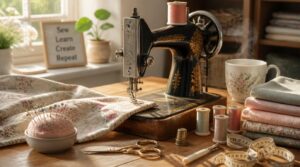
Everyone starts somewhere, and sewing is one of those skills that gets easier the moment you stop overthinking it. Before you touch a machine or cut into fabric, a few basics will save you a lot of frustration. Here’s what every complete beginner should know first.
Once you nail the fundamentals, easy sewing project layout tips can help you move from picking the right fabric to reading patterns with a lot more confidence.
Learn Common Sewing Terms
Sewing has its own little language, and picking it up early saves a lot of head-scratching later. Before you cut a single piece of fabric, get familiar with these five terms:
- Seam allowance — the gap between your stitch line and the fabric edge, usually 5/8 inch
- Right sides together — fabric faces touching before you sew
- Grainline — runs parallel to the selvage and tells you how to place your pattern
- Basting stitch — a long temporary stitch that holds pieces in place
- Press — iron a seam flat without sliding, just lift and place
Think of it as your sewing glossary. Once these click, pattern symbols and machine stitches start making sense too.
Keep in mind the right side of fabric is the decorative face that should be shown outward.
Start With Simple Projects
Now that you’ve got the vocabulary down, it’s time to actually make something. Your first sewing project should be small, useful, and forgiving — think envelope pillow covers or a simple tote bag.
These use straight seams and basic shapes, so there’s nowhere to get lost. A finished item in your hands does more for your confidence than any tutorial can.
A finished item in your hands builds more sewing confidence than any tutorial ever could
Practice Before Real Fabric
Before you cut into that fabric you just bought, test on scrap fabric first. A quick run on an offcut reveals tension problems, stitch length issues, or the wrong needle — before any real damage is done.
It also builds muscle memory for seam control, so your hands and your machine get acquainted without anything valuable at stake.
Build Skills Gradually
Think of it like building a house — you lay the foundation before the walls. Start with straight seams, then add hemming, then zippers.
Aim for 20–30 minutes of daily practice rather than long sporadic sessions.
Two or three completed projects at each stage build the consistency your hands need before moving on.
Essential Sewing Tools and Supplies
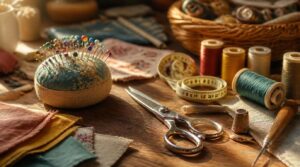
Before you sew a single stitch, you need the right tools within arm’s reach. Nothing slows you down faster than hunting for a pin or realizing your scissors are blunt halfway through cutting. Here’s what every beginner should have on hand.
Needles, Pins, and Thread
Every little project lives or dies on these three things: needles, pins, and thread.
- Universal needles handle most woven and knit fabrics well
- Ballpoint needles slide between knit yarns without snagging
- Quilting pins hold multiple layers firmly during assembly
- Polyester thread resists breakage and suits nearly any fabric
Match your needle size to your fabric weight — mismatches cause skipped stitches.
Fabric Scissors or Rotary Cutter
When you think about cutting fabric, you’ve got two main options: fabric scissors or a rotary cutter.
| Tool | Best For |
|---|---|
| Fabric scissors | Curves and tight corners |
| Rotary cutter | Long, straight cuts |
| 45mm rotary blade | Standard cotton layers |
| Scissor sharpening | Restoring a dull edge |
| Blade guard | Rotary cutter safety |
Keep your scissors for fabric only.
Measuring Tape and Markers
A good measuring tape does more than mark a distance — its end hook catches the fabric edge and compensates for its own thickness, so your measurements start exactly where they should. Lock the tape in place before you read it.
For marking, erasable fabric pens and chalk markers are your safest bets. Both disappear without staining.
Seam Ripper and Weights
A seam ripper is the tool you’ll reach for more than you’d expect. The pointed blade slips under stitches cleanly — work in short, deliberate motions and hold the fabric flat so you don’t stretch it out. Some models have a small ball on one prong to protect your fabric as you slide through threads.
Pattern weights keep fabric from shifting while you cut, no pins needed.
Needle Threader for Beginners
Threading a needle by hand can feel like a minor battle — that’s where a needle threader comes in.
- Wire loop threaders slip through the eye and pull your thread along with them
- Automatic threaders do the whole job hands-free
- Compact pocket threaders tuck neatly into your kit
It’s one of the cheapest sewing essentials for beginners.
Top 4 Beginner Sewing Items
Having the right tools makes everything easier, especially when you’re just finding your feet. A few well-chosen items can take the frustration out of early projects and help you actually enjoy the process. Here are four beginner-friendly picks worth adding to your kit.
1. Lepro Clamp LED Desk Lamp
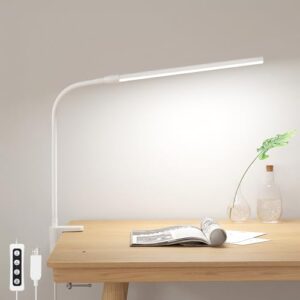
When you’re sewing at night or in a dim corner of a room, bad lighting is your worst enemy.
The Lepro Clamp LED Desk Lamp clips right onto your desk or workbench, leaving your whole surface free. Its flexible gooseneck bends to aim light exactly where you need it, and three color temperature modes let you dial in the right brightness for fabric work.
It runs off USB, so a laptop or power bank is all you need.
| Best For | Sewers, crafters, and detail-focused hobbyists who need flexible, space-saving task lighting in small or dimly lit workspaces. |
|---|---|
| Primary Use | Task lighting |
| Skill Level | All levels |
| Portability | Highly portable |
| Power Source | USB powered |
| Material | Aluminum and titanium alloy |
| Maintenance | Minimal upkeep |
| Additional Features |
|
- Flexible gooseneck lets you aim light exactly where you need it, making it great for precise work like sewing or crafting
- Three color temperature modes with ten brightness levels each give you real control over your lighting
- USB-powered design means you can run it off a laptop or power bank — no outlet required
- No AC adapter or built-in battery included, so you’ll always need an external power source nearby
- The fixed height may feel too low if you need light positioned higher above your workspace
- No beam-shaping guard, so the light spreads wide — which can feel too diffuse for very close-up detail work in dark rooms
2. Dual Size Seam Ripper Set
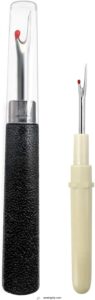
Every sewist — beginner or not — unpicks a stitch eventually. A dual size seam ripper set gives you two tools in one: a 3.5-inch blade for fine, delicate work and a 5-inch blade for bulkier seams and tight buttonholes.
Both rippers have non-slip ergonomic grips and protective caps, so your fingers and fabric stay safe. At just 10g combined, they’re light enough to use for long stretches without tiring your hand.
| Best For | Sewists of all skill levels who want precise, damage-free stitch removal for everything from delicate embroidery to bulky seams and buttonholes. |
|---|---|
| Primary Use | Stitch removal |
| Skill Level | Beginner-friendly |
| Portability | Pocket-sized |
| Power Source | Manual, no power |
| Material | Hardened steel |
| Maintenance | Blade sharpening |
| Additional Features |
|
- Two sizes in one set means you’re covered for both fine, detailed work and larger, tougher seams
- Ergonomic non-slip handles with protective caps make extended use comfortable and safe
- Lightweight at just 10g combined, and versatile enough to handle non-sewing tasks like clearing vacuum rollers or cutting tape
- Sharp tips require careful storage and handling, especially around children
- The blade dulls faster on thick or hard materials, so it’s not ideal for heavy-duty projects
- Plastic handles can crack under too much force — leather and upholstery work is better left to sturdier tools
3. Dritz Compact Needle Assortment
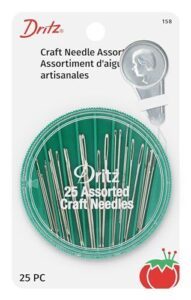
A good needle set is one of those things you won’t appreciate until you have the wrong needle in your hand. The Dritz Compact Needle Assortment packs 30 needles — betweens, sharps, darners, and embroidery types — into a slim case that fits in your project bag without bulk.
Each needle slot is labeled, so you’re never guessing. A small aluminum needle threader is included too, which is a genuine lifesaver when you’re starting out.
| Best For | Sewers and crafters who work across multiple needle-dependent techniques — patchwork, embroidery, tapestry, and crewel — and want one organized, travel-friendly kit to cover them all. |
|---|---|
| Primary Use | Needle storage |
| Skill Level | All levels |
| Portability | Travel-friendly |
| Power Source | Manual, no power |
| Material | Alloy steel |
| Maintenance | Occasional cleaning |
| Additional Features |
|
- Holds 25 assorted needles across six types (Betweens, Sharps, Milliners, Chenille, Tapestry, and Crewel), so you’re covered for almost any hand-sewing project
- The case back is printed with needle sizes and styles, making it easy to grab the right one without guessing
- Compact size fits neatly in a purse or craft bag for sewing on the go
- The rotating case can be stiff and may need a careful touch to avoid forcing it
- The plastic housing has been known to crack or separate with heavy repeated use
- The needle threader clips on externally rather than storing inside the case, so it’s easier to lose
4. Janome Treadle Sewing Machine
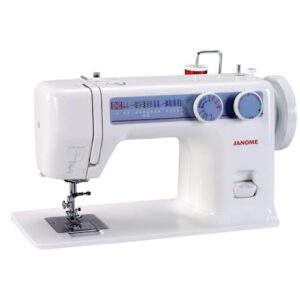
The Janome 712T is a different beast entirely. While your needle set controls hand work, this machine controls everything without a single electrical outlet. Treadle-powered sewing means your foot drives the mechanism — no cord, no motor, no power bill.
It comes with 10 built-in stitches and a four-step buttonhole, which covers most beginner projects comfortably. The metal frame keeps it steady, and the extra-high presser foot controls thick layers without complaint.
Off-grid sewing, finally sorted.
| Best For | Off-grid sewers, homesteaders, and anyone who wants reliable, electricity-free sewing for garments, repairs, or quilting. |
|---|---|
| Primary Use | Garment sewing |
| Skill Level | Intermediate and up |
| Portability | Stationary |
| Power Source | Treadle, no power |
| Material | Metal and wood |
| Maintenance | Regular servicing |
| Additional Features |
|
- Works anywhere — no power outlet needed, making it perfect for cabins, outages, or off-grid living
- Smooth, consistent stitching thanks to the 5-piece feed dog system and full rotary hook bobbin
- Quiet, rhythmic operation that’s almost meditative — plus a gentle leg workout while you sew
- The treadle cabinet isn’t included, so you’ll need to source one separately before you can use it
- Setup can be fiddly — getting the belt tension right and the flywheel spinning the correct direction takes patience
- No built-in light, so you’ll want a lamp nearby for detailed or evening work
Choose Your First Sewing Machine
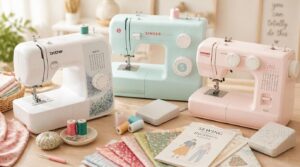
Picking your first sewing machine doesn’t have to feel overwhelming. The right one for a beginner comes down to a handful of features that make learning easier from day one. Here’s what to look for.
Straight and Zigzag Stitches
Two stitches do almost all the heavy lifting on a beginner machine: the straight stitch and the zigzag stitch.
Straight stitch runs a clean single line — perfect for seams on stable fabrics like cotton.
Zigzag moves side to side, which lets it stretch and prevent raw edges from fraying.
Between the two, you can handle most beginner projects with confidence.
Buttonhole Function Basics
Most beginner machines include a buttonhole function — and it’s more useful than you’d expect. Some do it in one automatic cycle; others walk you through four to six steps. Either way, the machine controls the dense stitching and bartack ends that keep the opening from tearing.
Size your buttonhole to match your button’s diameter, with a little extra room so it actually opens.
Easy Threading Features
Threading a machine can feel fiddly at first, but modern features make it much easier. Look for these time-savers:
- Automatic needle threader that hooks thread through the eye in seconds
- Drop-in bobbin you load from the top without fuss
- Clear bobbin cover so you can see thread levels
- Built-in thread guides that keep tension consistent
- Self-cleaning thread path that reduces lint buildup
Beginner-friendly Machine Controls
The controls on a basic sewing machine are simpler than they look. A tension dial — usually numbered 0 to 9 — balances your top and bottom threads. Most cotton projects sit happily around 4 or 5.
A speed control slider lets you lock in a comfortable pace, which beats wrestling a foot pedal when you’re still finding your rhythm.
Read Your Machine Manual
Most people treat the manual like fine print. Don’t.
Your machine’s manual lists model-specific features, safety warning symbols, and troubleshooting error codes — the kind of detail no YouTube video covers. It even includes a maintenance schedule so you know exactly when to clean or oil. When your machine starts making odd noises, the manual is the first place to look.
Set Up Your Sewing Machine
Getting your machine ready before you sew a single stitch makes everything go smoother. There are a few key setup steps that trip up a lot of beginners — but they’re easier than they look. Here’s what to take care of first.
Thread The Upper Thread
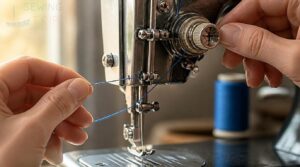
Getting this step wrong is the fastest way to ruin a project before it starts. Your thread must follow an exact path — from the spool, through each guide, around the tension disc, and up through the take-up lever before reaching the needle eye.
- Miss one guide and you’ll get tangles
- Wrong tension means loopy, uneven seams
- Skipping the take-up lever causes thread nests underneath
- Threading back to front jams the needle
Always thread front to back through the needle eye.
Wind and Insert Bobbin
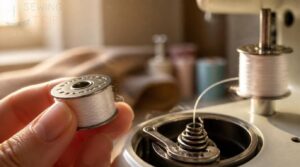
The bobbin is the lower thread — and if you wind or insert it wrong, bird nesting happens fast. That’s the messy tangle on your fabric’s underside that makes you want to quit on day one.
Wind slowly, keeping the thread taut so it layers evenly. Check the bobbin spins freely before inserting. Drop it in with the thread feeding the correct direction for your machine.
Adjust Stitch Length
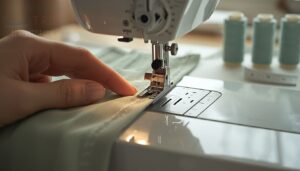
Once the bobbin is sorted, stitch length is next. On most machines, stitch length runs from 0.5 to 4.0 mm.
For everyday cotton, try 2.5 to 3.0 mm — it’s your sweet spot. Shorter stitches grip tighter; longer ones reduce puckering on heavier fabric.
For basting, push it to 4.0 mm so the stitches pull out easily later.
Test Tension on Scraps
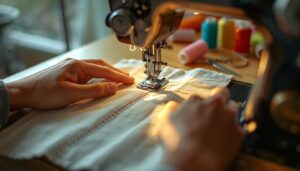
Stitch length dialled in? Good. Now sew a few lines on a scrap before touching your real fabric.
Cut a piece about 4 by 6 inches — same fabric you plan to use. Press it flat. Then sew a straight line and flip it over. Even stitches on both sides means your tension is balanced. Loops or puckering? Adjust in small increments and test again.
Replace Dull Needles Often
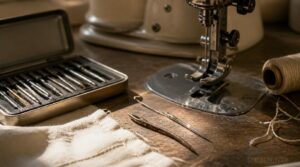
A dull needle is sneaky. You won’t always see the damage — just skipped stitches, puckering, or thread that keeps snapping.
Swap your needle every 6–8 hours of sewing, or after each project. It’s a 30-second fix that saves real frustration.
Universal needles suit most cotton; ballpoint works for knits. Keep a few types on hand.
Choose Fabric, Thread, and Needles
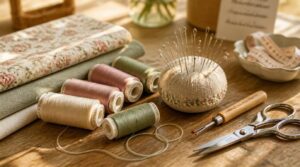
Your fabric, thread, and needle choices matter more than most beginners expect. Getting these three things right from the start saves you a lot of frustration later. Here’s what to know before you buy anything.
Start With Cotton Fabric
Cotton is your best friend when you’re just starting out. It’s easy to handle, holds its shape well, and doesn’t shift under your hands while you sew. It breathes naturally and absorbs moisture, which matters when you’re wearing what you make. Sensitive skin? Cotton’s hypoallergenic for most people. Wash it a few times and it gets softer, too.
Avoid Slippery Fabrics First
Satin, silk, and viscose might look beautiful, but they’re a nightmare to control when you’re new to sewing. These fabrics have low friction, which means they slide around constantly — shifting under pins, wandering during cutting, and feeding unevenly through your machine.
Stick with stable, grippy fabrics like cotton until you’ve built real confidence.
Use Polyester Thread
When you’re just starting out, thread might seem like a minor detail. It isn’t.
Polyester thread is the go-to choice for beginners because it’s strong, flexible, and forgiving. It resists UV exposure, endures repeated washing without fading, and won’t snap mid-seam.
A standard size 50 weight works well on most beginner fabrics.
Match Needle to Fabric
The needle you choose matters more than you’d think. Using the wrong one leads to skipped stitches, snags, or even fabric tears.
- Universal 70/10 or 80/12 — everyday cotton or linen
- Ballpoint or stretch 75/11–90/14 — knits and jersey
- Sharp or Microtex — silk, satin, or fine weaves
- Denim 90/14–100/16 — heavy canvas or denim
- Leather 90/14–110/18 — faux or real leather
Pre-wash Fabric Before Cutting
Skip this step and you’re gambling with your finished project.
Pre-washing removes shrinkage, softens stiff fibers, and reveals any color bleed before you cut. Cotton can shrink 3 to 8 percent — enough to ruin sizing. Wash with warm water, dry on standard heat, then press to restore the grain before cutting.
| What Pre-washing Does | Why It Matters | How To Do It |
|---|---|---|
| Removes shrinkage | Keeps sizing accurate | Warm wash, standard dry |
| Tests color bleed | Prevents dye transfer | Soak 30 min, check water |
| Softens texture | Improves drape and feel | Gentle cycle, air or tumble dry |
Practice Basic Sewing Stitches
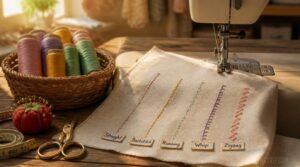
Getting comfortable with a few key stitches makes everything else click into place. You don’t need to master dozens of them — just five will carry you through most beginner projects. Here’s what to start with.
Straight Stitch for Seams
The straight stitch is your bread and butter. It’s a single row of evenly spaced stitches that joins two fabric edges cleanly.
Set your stitch length to 2.0–3.0 mm for woven fabrics and keep your raw edges aligned to a 1 cm seam allowance. Once sewn, press the seam flat — it makes everything look intentional.
Backstitch for Strong Repairs
Think of the backstitch as your repair kit’s secret weapon. Each stitch loops back into the previous one, creating a strong, interlocking seam that won’t quit under pressure — perfect for stressed spots like elbows or pocket openings.
For hand stitching, double your thread on heavy fabrics. Lock things off with a small backward stitch at the end, then trim close to the knot.
Running Stitch for Gathering
The running stitch pulls double duty — and gathering fabric is where it really earns its place.
Sew two parallel rows of long stitches along the fabric edge, then gently pull the thread tails to bunch the fabric evenly. Use strong polyester thread so it won’t snap mid-pull. Distribute the fullness by sliding the fabric along before stitching it down.
Zigzag Stitch for Edges
Fraying edges are a quick way to undo good work. That’s where the zigzag stitch comes in — it loops over the raw edge to lock fibres in place and keep them from unravelling.
Set your stitch width between 2 and 5 mm and keep the length short. Test on a scrap first so the edge lies flat, not wavy.
Topstitching for Neat Finishes
Once you’ve locked those raw edges down, topstitching puts the finishing touch on your work. It runs 1–2 mm from the edge — use your needle as the guide, not the presser foot. Press seams flat first, then sew in one continuous line. The result looks clean, deliberate, and genuinely professional.
Cut and Prepare Fabric Correctly
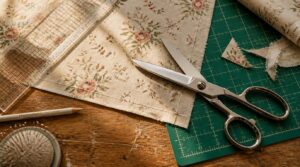
Cutting fabric sounds simple until you end up with a wonky piece that throws off your whole project. Getting this step right makes everything that follows so much easier. Here’s what to keep in mind before your scissors hit the cloth.
Follow The Fabric Grainline
The grainline is the invisible backbone of every piece you cut. On woven fabrics, it runs parallel to the selvage — that finished, non-fraying edge along the side of your fabric. Get this wrong and your project will twist, pull, or hang unevenly.
Every pattern piece has a grainline arrow. Align it with the selvage before you pin or cut.
| Grain Type | Direction | Best Used For |
|---|---|---|
| Lengthwise grain | Parallel to selvage | Main seams, structured pieces |
| Cross grain | Perpendicular to selvage | Waistbands, borders |
| True bias | 45° diagonal | Binding, drape, decorative edges |
Cutting on the true bias lets fabric stretch diagonally. That’s useful for binding or decorative elements — but it makes main seams unstable, so save it for the right job.
Use Sharp Fabric Shears
Dull shears are one of those beginner traps nobody warns you about. A sharp blade glides clean; a dull one drags, frays edges, and throws off your seam allowances before you’ve even started.
Keep these habits in mind:
- Wipe blades after use to remove fiber residue
- Use shears only on fabric — never paper
- Choose 8–10 inch blades for straight, efficient cuts
- Check the pivot screw regularly and tighten if loose
- Book professional sharpening when edges start snagging
Cut on a Flat Surface
Your table needs to be level, smooth, and clutter-free — full stop.
| Factor | Why It Matters | Quick Fix |
|---|---|---|
| Surface height | Elbow-level reduces fatigue | Adjust with a cutting board riser |
| Texture | Rough surfaces shift fabric | Use a self-healing cutting mat |
| Stability | Wobble causes miscuts | Clamp mat or clear the table fully |
Store sharp tools in a sheath between sessions.
Mark Patterns Clearly
Tailor’s chalk and erasable fabric markers are your best friends here. Before you sew a single stitch, mark the fabric clearly.
- Transfer dart points and notches precisely
- Use removable tools on thin fabrics
- Mark all layers when cutting multiple pieces
- Cut small V-shapes at notches — never deep slits
- Recheck every mark after pinning
Keep Scissors for Fabric Only
One rule is worth making early: fabric scissors are for fabric only. Cutting paper or tape dulls the blades fast and can leave adhesive residue that snags delicate threads.
Store your sewing scissors separately — a hook or dedicated pouch works well. Sharpen them regularly to keep cuts clean.
Dull shears fray edges and make everything harder.
Start With Easy Sewing Projects
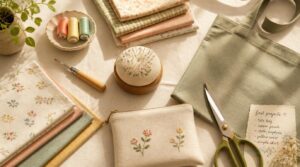
The best way to build confidence is to make something you can actually use. A few simple projects will teach you the essential skills without overwhelming you. Here are five great ones to start with.
Envelope Pillow Covers
An envelope pillow cover is one of the best beginner sewing projects you can start with — no zipper, no fuss.
- Standard sizes: 16×16, 18×18, or 12×20 inches for a lumbar shape
- Closure: overlapping back panels create a clean, no-zipper look
- Best fabric: cotton or linen blends wash well and feed smoothly
- Key stitch: straight stitch with a topstitch finish along edges
- Pre-wash first: always shrink your fabric before cutting
Simple Tote Bags
A tote bag might just be the most satisfying beginner project out there. It’s practical, fast, and you’ll actually use it.
Durable cotton canvas is the go-to fabric — strong, washable, and easy to sew. A boxed bottom squares off the base so your bag holds its shape. Keep straps 20 to 24 inches long for comfortable shoulder carry.
Fabric Bunting
Bunting is one of those projects that looks impressive but is secretly very simple. You’re just cutting triangles and sewing them to a length of bias tape or ribbon.
- Cut triangles 3–6 inches wide
- Pick 3–5 coordinating colors
- Attach with a ¼-inch seam
- Pre-wash scraps before cutting
Cushion Covers
Cushion covers are a great next step. You’re working with simple rectangular shapes, which means less measuring stress and more sewing time.
Linen blends give a natural texture and soften beautifully after washing. Cotton fabrics are the easiest to handle and machine washable at 40°C. For something that takes heavier use, canvas holds its shape well over time.
Basic Mending Projects
Once you’ve got cushion covers down, mending is the natural next move. It teaches you real problem-solving skills on fabric you already own.
Three repairs worth starting with:
- Patch a hole using woven cotton or iron-on fabric
- Darn worn areas by weaving threads across the damage in a grid
- Resew a loose button using a simple cross-stitch pattern
Avoid Common Beginner Mistakes
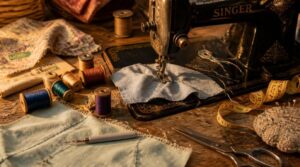
Every beginner makes a few predictable mistakes — and the good news is they’re all easy to fix once you know what to watch for. Most of them come down to small habits that sneak in early and stick around longer than they should. Here are the ones worth catching now before they become second nature.
Skipping Test Stitches
Think of a test stitch like a dress rehearsal — skip it and you’re improvising on opening night. Before you cut into your actual fabric, sew on a scrap piece first.
This catches tension errors, skipped stitches, and needle mismatches before they waste your real material. Sixty words saved can save an entire project.
Pulling Fabric While Sewing
Pulling fabric through the machine feels helpful but actually fights the feed dogs doing that job for you. Let the machine feed the fabric at its own pace.
- Use a walking foot to keep layers feeding evenly.
- Reduce presser foot pressure on slippery or stretchy knits.
- Sew slowly — speed is where misalignment starts.
Ignoring Thread Tension
Thread tension is one of those things that quietly wrecks your project before you notice.
Loops on the underside usually mean your upper tension is too loose. Thread showing on top means it’s too tight.
Either way, run a test strip on scrap fabric and adjust tension in small increments until stitches lie flat on both sides.
Using The Wrong Needle
The needle you pick matters more than most beginners expect. Wrong needle type on the wrong fabric causes skipped stitches, snagging, and thread breaks — sometimes all at once.
A universal needle suits most woven fabrics fine. But use it on knits and you’ll get laddering and missed stitches. Match the needle to what you’re sewing. And change it often — dull needles snag fabric fast.
Forgetting to Press Seams
Skipping the iron is one of those beginner habits that quietly ruins good work.
Pressing seams as you go keeps edges flat, helps pattern pieces line up, and sets your stitches properly. Without it, seams shift and bulk up at corners.
Use the right heat for your fabric — too hot scorches, too cool does nothing.
Frequently Asked Questions (FAQs)
What is the easiest way to learn sewing?
Start small. Pick one simple project like a tote bag, practice on scraps first, and learn a few basic terms. Building stitching confidence comes from doing, not just watching sewing tutorials online.
What do you need to know about sewing?
Sewing blends hand skills and machine work with a bit of patience. You’ll need to learn basic stitches, choose the right fabric, and understand how tension affects every seam you sew.
How do I learn to sew for the first time?
Pick up a needle and thread, start with something simple like a cushion cover, and practice on scrap fabric first. Follow beginner sewing tutorials online to build confidence at your own pace.
Is it time to practice sewing for beginners?
Yes — and sooner than you think. Dedicating just 15 to 30 minutes per session, three to five times a week, builds muscle memory fast and keeps fatigue from derailing your progress.
Are there any sewing Tips & Tricks?
There are plenty of tricks worth knowing. Test on scrap fabric before cutting into your main piece. Pre-wash cotton to avoid shrinkage surprises. Replace needles regularly and always press your seams flat.
What Fabrics and Materials Are Best for Beginners?
Think of fabric like a dance partner — the right one makes learning feel smooth. Cotton is your best starting point. It’s stable, easy to cut, and forgives small mistakes.
How Do I Thread a Sewing Needle?
Pinch the thread close to the tip, cutting it cleanly so it doesn’t fray. Wet it slightly to stiffen the end, then push it straight through the needle’s eye from front to back.
What Are Some Common Mistakes Beginners Make?
Every beginner makes a few of the same slip-ups. The big ones: skipping test swatches, wrong needle for the fabric, ignoring thread tension, pulling fabric through the machine, and forgetting to press seams.
Where Can I Find Sewing Patterns for Beginners?
You’ll find beginner sewing patterns on free sites like Craftsy, paid subscription pattern libraries, and local sewing shops. Many come as downloadable PDF formats you can print at home.
How Do I Finish Seams Properly?
Pressed seams look clean and lie flat. A zigzag or overlock stitch stops raw edges from fraying. For lightweight fabrics, a French seam hides everything neatly inside.
Conclusion
seams you sew today will tell a story later—crooked lines becoming straighter, hesitant cuts turning confident. Every sewing tips for beginners resource gives you a starting point, but your hands build the real knowledge.
Press your seams. Test your tension. Pick up your seam ripper without frustration—it’s just part of the process.
One stitch at a time, you’re not just learning a craft. becoming someone who makes things.
- https://weallsew.com/basic-sewing-tools-for-beginners
- https://blog.wawak.com/post/essential-sewing-supplies-for-beginners
- https://www.doinaalexei.com/understanding-stitch-length-and-tension.html
- https://lindas.com/blogs/tips-and-tricks/sewing-machine-tension-settings
- https://www.superiorthreads.com/education/tension-guide