This site is supported by our readers. We may earn a commission, at no cost to you, if you purchase through links.
Your first sewing project shouldn’t end with tangling thread, jammed fabric, and a machine that sounds like it’s about to launch into orbit. Most beginners sit down at a sewing machine expecting it to work like a stapler—press down, get a stitch—but sewing machines need a partnership between you and the mechanics.
The needle won’t magically know where to go, and the bobbin won’t thread itself (though that would be nice). Learning how to use a sewing machine means understanding what each part does and following a clear sequence every time you sit down to sew.
Once you know the basics—threading the machine correctly, adjusting your settings, and guiding fabric without fighting it—you’ll move from frustration to finished seams faster than you think.
Table Of Contents
Key Takeaways
- Successful sewing starts with understanding your machine’s core components—needle, presser foot, feed dogs, bobbin, and thread path—and how they work together to create balanced stitches.
- Threading your machine correctly is the single most critical step: follow the exact path from spool pin through tension discs to needle, and always double-check before sewing to prevent 90% of common problems.
- Mastering basic technique means guiding fabric gently while the machine does the work, selecting appropriate stitch length for your fabric weight, and securing seams with backstitching at the start and end.
- Regular maintenance—cleaning lint from the bobbin area every 2-3 uses, replacing needles every 6-8 hours of sewing, and matching needle type to fabric—prevents jams and keeps your machine running smoothly for years.
Essential Sewing Machine Parts and Functions
Before you can start sewing, you need to know what you’re working with. Your machine might look complicated at first, but once you understand the main parts and what they do, everything clicks into place.
Once you’re comfortable with the basics, you can dive into fun sewing machine project tutorials that put your new skills to work.
Let’s walk through the essential components that’ll get you from threading to stitching.
A clear serger thread guide tutorial can help you visualize how each spool feeds through the loopers and needles in the right sequence.
Identifying Key Components
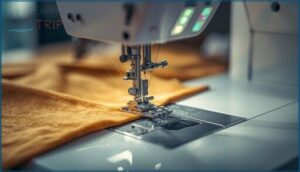
Your sewing machine has several essential parts you need to know. The needle clamps into the needle bar above the presser foot, which holds fabric against the feed dogs. Thread flows from the spool pin through guides to reach the needle. Below, the bobbin supplies lower thread. The needle plate beneath covers mechanisms while providing seam guides for accurate stitching.
For hands-on guidance on using these parts together, check out these beginner-friendly sewing machine tutorials that walk you through your first projects step by step.
Understanding the sewing machine components is vital for effective operation.
Understanding Stitch Selectors and Controls
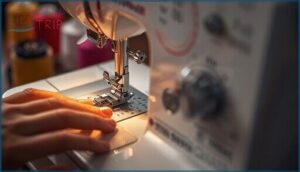
Once you know where everything is, you’re ready to take control of what your machine actually does with those parts. Understanding the basics of sewing machine components is essential for effective operation.
Your stitch selector determines what pattern the needle creates. Most machines offer several sewing modes—straight stitches for seams, zig-zag for stretch fabrics, and decorative options. The stitch length dial controls how far apart each puncture sits, while stitch width adjusts the side-to-side motion.
- Stitch selection: Choose straight for basic seams or zig-zag for finishing edges
- Stitch length: Shorter stitches (1.5-2mm) for delicate fabrics, longer (3-4mm) for heavy materials
- Thread tension: Higher numbers tighten upper thread, lower numbers loosen it
- Speed control: Some machines have speed limiters separate from the foot pedal
The Role of The Bobbin and Spool Pin
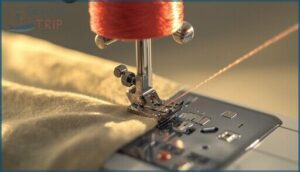
Two small parts work together to create every stitch: the bobbin and spool pin. Your spool pin holds the main thread supply on top. The bobbin (a tiny cylinder tucked underneath) carries the lower thread. When you sew, upper and lower threads interlock inside the fabric to form balanced stitches. Getting both threaded correctly is where stitch quality begins.
| Component | Location | Primary Function |
|---|---|---|
| Spool Pin | Top of machine | Holds and orients upper thread supply |
| Bobbin | Underside compartment | Supplies lower thread for lockstitch formation |
| Thread Interlock | Inside fabric layers | Creates secure, balanced seam |
Presser Foot and Feed Dogs Explained
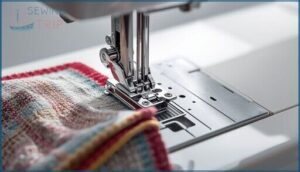
Beneath the needle, two components control how fabric moves. Feed dogs are toothed metal bars that rise through the needle plate, grip your material, and pull it forward with each stitch. The presser foot holds fabric flat against those teeth so everything feeds smoothly. Together, they prevent puckering and keep stitches even—your fabric control techniques start here.
- Feed dogs rise and grip fabric between stitches
- Presser foot pressure keeps layers stable and aligned
- Synchronized motion advances material at consistent intervals
- Adjustable settings accommodate light silk or heavy denim
Setting Up Your Sewing Machine
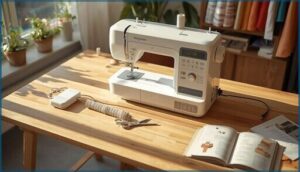
Before you start stitching your first project, you need to get your machine ready for action. A proper setup makes everything run smoother and helps you avoid frustrating mistakes down the line.
Let’s walk through the key steps to position your machine, power it on correctly, and get all the right pieces in place.
If you’re working with the Singer 7258, check out this complete Singer 7258 setup and feature guide to avoid common needle and threading mistakes.
Positioning and Powering On
Before you thread a single stitch, you’ll want to set up your workspace so you’re not hunching over or wrestling with tangled cords. Place your sewing machine on a sturdy table at elbow height.
Plug the power cord into a nearby outlet (avoid extension cords when possible), then connect the foot pedal. Locate the on switch—usually on the right side or back—and flip it on. You’re ready to roll.
Choosing The Right Needle and Thread
Your fabric type drives everything—pick the wrong needle size or thread weight, and you’ll face weak seams or skipped stitches. Match these three elements for solid sewing performance:
- Lightweight fabrics (silk, chiffon): Use a 60/8 or 70/10 needle with fine 100-weight thread
- Medium cottons and quilting fabrics: Pair an 80/12 needle with standard 50-weight thread
- Heavy denim or canvas: Choose a 100/16 or 110/18 denim needle with thicker 30- to 40-weight thread
- Knits and jerseys: Grab a ballpoint needle to prevent runs and fabric damage
Proper needle selection keeps thread management smooth and your sewing machine humming.
Installing The Foot Pedal and Accessories
Once your needle’s seated, locate the foot pedal’s dedicated port on your machine’s side or back—most modern units use a single combined cable assembly for power and control. Plug the connector firmly until it clicks, ensuring accessory compatibility and preventing power loss.
Position the pedal under your dominant foot on a stable surface, routing the cord away from walkways for safe sewing machine operation. Check that rubber pads grip the floor before testing speed control.
Threading and Preparing The Machine
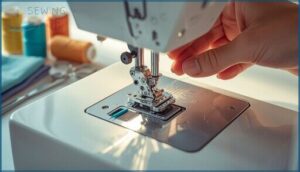
Threading a sewing machine is where most beginners hit their first real snag, but it’s easier than it looks once you know the route. Your thread needs to follow a specific path from spool to needle, and skipping even one guide can throw everything off.
Let’s walk through each step so you can thread your machine correctly and start sewing with confidence.
Winding and Inserting The Bobbin
Your bobbin is the thread workhorse beneath your fabric, and mastering winding techniques unlocks perfect stitches. First, place your bobbin on the winder spindle and push it right until it clicks. Guide thread from the spool through the thread guides and tension disk—this step controls bobbin tension and prevents loose, spongy winding.
- Wind at moderate speed to avoid stretching thread or creating uneven layers
- Stop after a few turns to trim the tail close, preventing tangles
- Leave 1–2 mm below the rim when full to avoid jamming
- Unplug before inserting your bobbin for sewing safety
For drop-in systems, place the bobbin so thread unwinds counterclockwise, then pull it through the slot. Front-loading machines require inserting the bobbin into a case first.
Always match bobbin sizes to your sewing machine—wrong sizes cause tension nightmares and jams during sewing machine operation.
Threading The Upper Thread Path
Once your bobbin’s ready, upper threading connects the final link in your sewing machine setup and operation chain.
Turn the handwheel to raise the needle to its highest position, then lift the presser foot so tension discs open.
Guide thread from the spool pin through each thread guide—right slot down, around the bottom hook, up through the take-up lever, left slot down, through needle guides, and finally through the needle eye front-to-back for proper needle alignment.
Adjusting Thread Tension
Perfect stitches hinge on thread balance between upper and bobbin threads—when tension’s right, they lock in the fabric center without visible loops. Start with your dial at 4 (default on most machines), then test-stitch on scrap fabric matching your project:
- Loops underneath = loosen upper tension control (turn dial lower)
- Bobbin thread on top = tighten upper tension (turn dial higher)
- Puckered fabric = reduce tension to prevent fabric stretch
- Perfect flat stitches = you’ve nailed stitch quality
- Still struggling = check bobbin settings and tension plates engagement
Adjust in small quarter-turn steps, testing after each change—this threading precision transforms your sewing machine setup and operation into professional results every time.
Double-Checking Threading for Errors
Before you press that pedal, take thirty seconds to trace your thread’s entire path—one missed guide or twisted loop will unravel all that tension work you just perfected.
Run your finger along the route from spool pin to needle, confirming each checkpoint:
| Check Point | What to Verify | Common Threading Issues |
|---|---|---|
| Spool Pin | Thread unwinds counterclockwise | Backward spool causes tangles |
| Thread Guides | Thread sits inside each notch | Skipped guides = loose stitches |
| Tension Discs | Thread caught between plates | Thread outside = zero control |
| Take-Up Lever | Thread fully seated at top | Missed lever = thread breaks |
| Needle | Threaded front-to-back | Wrong direction jams machine |
This error detection ritual prevents 90% of sewing mistakes before they happen—your sewing machine basics mastery starts with threading precision, not speed.
Basic Sewing Techniques for Beginners
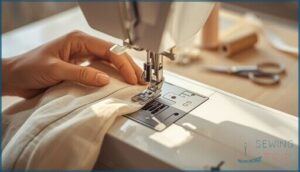
You’ve got your machine threaded and ready—now it’s time to actually sew. Master these four fundamentals, and you’ll have the foundation for nearly every project you tackle. The techniques in this section will take you from positioning your first piece of fabric to finishing a clean, secure seam.
Placing and Guiding Fabric
Once your machine is threaded and ready, slide your fabric under the presser foot so the needle starts about 3 to 6 mm from the edge—this prevents tangling right at the start. Lower the presser foot to hold everything in place, then guide (don’t pull) the fabric as the feed dogs do the work:
- Fabric alignment: Line your raw edge against a seam guide marking on the needle plate (commonly 5/8 inch) to keep your seams straight and consistent.
- Fabric movement: Place one hand in front and one behind the presser foot, lightly steering while the machine advances the layers forward naturally.
- Pucker prevention: If your fabric starts bunching, ease up on thread tension and use a shorter stitch length—around 2.0 to 2.5 mm works beautifully for most weaving and fabric handling situations.
Let the sewing machine do the heavy lifting while you provide gentle direction. Your job is to steer, not wrestle.
Guide the fabric lightly and let the machine do the work—you’re steering, not forcing
Selecting Stitches and Adjusting Length
Your stitch selector dial or buttons hold the keys to every sewing technique. Start with a straight stitch—most machines default to a 2.5 mm length, perfect for general seaming. Adjust shorter (1.5–2 mm) for delicate fabrics, longer (3–3.5 mm) for denim or topstitching. Zigzag stitches need both length and stitch width settings—narrower widths finish edges neatly, while wider patterns work beautifully for appliqué.
| Fabric Type | Recommended Stitch Length | Best Stitch Choice |
|---|---|---|
| Lightweight cotton | 1.5–2 mm | Straight stitch |
| Medium woven fabrics | 2–3 mm | Straight stitch |
| Denim or heavy materials | 3–3.5 mm | Straight or longer zigzag |
Using The Foot Pedal for Speed Control
Your foot pedal is where speed modulation happens—gentle pressure for slow stitches, firmer for faster runs. Practice on scrap fabric first: start with feather-light pressure (keeping foot control smooth prevents jerks), then gradually increase. Modern electronic pedals give you steadier low-speed power than older models.
Position the pedal close enough to keep your knee slightly bent—good pedal ergonomics prevents fatigue during longer projects.
Securing Seams With Backstitching
Seam security starts with a simple backstitch—your thread anchoring insurance against unraveling. When you begin sewing, stitch forward about half an inch, then hold your sewing machine’s reverse lever and backstitch to the edge. Repeat this lockstitch method at your seam’s end.
Three to six reverse stitching passes lock everything tight without bulk, especially vital on stress areas like armholes where backstitching techniques prevent future failures.
Safety, Maintenance, and Troubleshooting
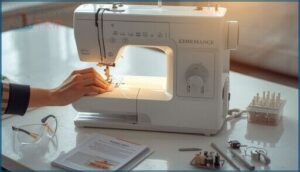
Your sewing machine will serve you well when you treat it right. You’ll need to follow a few simple safety rules, keep things clean, and know how to fix common hiccups along the way.
Here’s what you need to know to keep your machine running smoothly and safely for years to come.
Safe Sewing Practices
Your fingers are just inches from a needle moving faster than you can blink—that’s why accident prevention starts before you press the pedal. Master these sewing safety and precautions to protect yourself:
- Unplug before threading or changing needles to prevent electrical safety hazards and sudden starts.
- Wear eye protection when sewing at high speeds to shield against flying needle fragments.
- Set up proper workspace ergonomics with good lighting, a clutter-free table, and supervised learning for beginners.
Keep hands behind the presser foot always.
Routine Cleaning and Care
Between projects, your sewing machine needs regular care to perform reliably. Remove lint from the bobbin and feed dog area every 2 to 3 bobbin changes using a small stiff brush—lint buildup causes skipped stitches and jams.
If your machine requires oil lubrication (check your manual), apply lightweight sewing machine oil sparingly to specified points every 5 to 10 hours of sewing.
Common Sewing Machine Problems
Even with proper care, every beginner encounters the same frustrating issues—thread bunching underneath, needles breaking mid-seam, or fabric that refuses to feed smoothly.
Thread breakage and tension issues usually mean your machine isn’t threaded correctly or the tension dial needs adjustment. Machine jamming happens when lint clogs the bobbin area.
Needle damage occurs from hitting pins or using the wrong needle type for your fabric.
When to Consult The User Manual
Your sewing machine manual isn’t just a dusty booklet—it’s your safety net. Consult it whenever error codes flash on digital displays, before attempting maintenance schedules like lubrication, or when troubleshooting steps don’t resolve problems.
The manual outlines warranty conditions, safety precautions specific to your model, and machine maintenance requirements that beginners often overlook. Ignoring it can void your warranty or risk injury.
Frequently Asked Questions (FAQs)
What are the best practices for maintaining a sewing machine?
Keep your machine in top shape by regularly cleaning lint from the bobbin area and feed dogs, oiling moving parts per your manual, and replacing bent needles—these simple habits prevent jams and guarantee smooth stitching.
What kind of fabric should I use for a particular project?
Your textile choice depends on what you’re making. Cotton works for quilts and garments. Knits suit stretchy clothing. Denim manages heavy-duty projects.
Match fabric weight and thread types to your sewing project’s purpose.
What kind of needle should I use for a certain type of fabric?
Match your needle to your fabric weight and type. Use a ballpoint needle for knits, sharp points for wovens, and heavier sizes (90/14–110/18) for denim. Lighter fabrics need finer needles (60/8–70/10).
How do I adjust the tension on my sewing machine?
Think of thread tension as the handshake between your machine’s upper thread and bobbin—when they meet perfectly in the fabric’s center, you’ve found balance.
Turn the numbered tension dial one step at a time, test-stitch on scrap fabric, then fine-tune.
What are the differences between different types of stitches?
Each stitch fulfills a unique purpose. Straight stitch builds seams on woven fabric, zigzag stitch stretches with knits, overlock stitch prevents fraying, blind hem hides thread, and satin stitch adds decorative flair.
What fabric types work best for beginners?
Start with stable woven cotton fabrics like quilting cotton or broadcloth—their nonstretch weave prevents distortion.
Linen blends and muslin practice fabrics also work beautifully.
Avoid stretchy knits and slippery synthetics until you’ve mastered basic seams.
How do I fix skipped stitches?
Replace your needle first—dull or bent needles cause most skipped stitches.
Next, rethread both upper thread and bobbin with quality thread.
Can I sew leather or heavy materials?
You can’t force a square peg into a round hole—domestic machines handle light leather up to 5 mm with proper needles and walking feet, but heavier hides demand industrial power and specialized techniques beyond beginner capacity.
How often should I replace the needle?
Change your needle every 6 to 8 hours of sewing or after completing 8 projects. Thread breakage, skipped stitches, or fabric snags signal immediate replacement.
Fresh needles maintain stitch quality and prevent costly machine damage.
Whats the difference between universal and specialized needles?
Universal needles handle everyday woven and knit fabrics with a slightly rounded point.
Specialized needles—stretch, denim, leather, quilting—feature unique shapes and strengths designed for specific fabric types, improving stitch quality and preventing damage.
Conclusion
You might think mastering a sewing machine takes months of practice, but most beginners start stitching confidently within their first few sessions. The difference comes down to patience with the setup and attention to threading—not natural talent.
Once you’ve worked through the steps in this guide, you’ll know exactly how to use a sewing machine without second-guessing every stitch. Your first finished project is closer than you realize.