This site is supported by our readers. We may earn a commission, at no cost to you, if you purchase through links.
A serger sits on thousands of sewing tables, mostly used for one thing—finishing raw edges—while its full stitch vocabulary goes untouched.
That’s a significant amount of capability left idle.
The machine trims, stitches, and overcasts in a single pass, and depending on how many threads you engage, it produces results a standard sewing machine simply can’t replicate: flat seams that move with a stretch knit, paper-thin rolled hems on silk, and four-way stretch seams built for activewear.
Understanding basic serger sewing machine stitches means knowing which stitch to reach for, how to set your tension, and why thread count changes everything.
Each section ahead breaks down exactly that.
Table Of Contents
- Key Takeaways
- What Serger Stitches Do
- Serger Vs Sewing Machine Stitches
- Parts That Form Serger Stitches
- Threading for Balanced Stitches
- 4. Thread Overlock Basics
- 3. Thread and 2-Thread Stitches
- Rolled Hem Stitch Techniques
- Flatlock and Decorative Finishes
- Tension and Differential Feed Settings
- Fixing Common Stitch Problems
- Frequently Asked Questions (FAQs)
- Conclusion
Key Takeaways
- Your serger’s thread count — 2, 3, or 4 threads — isn’t just a setting; it’s the single biggest factor controlling seam strength, stretch, and bulk for any given fabric.
- The 4-thread overlock is your everyday workhorse for knits and activewear, but switching to a 2-thread stitch on silk or chiffon keeps seams clean without crushing delicate fabric under unnecessary bulk.
- differential feed and tension work as a team — dial the differential feed above 1.0 for stretchy knits to stop wavy seams, and always adjust one tension dial at a time, testing on scrap fabric between each change.
- serge your raw edges and knit seams first, then move to your sewing machine for zippers, buttonholes, and topstitching, and you’ll get professional results neither machine could pull off alone.
What Serger Stitches Do
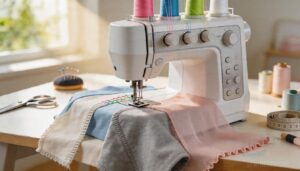
A serger does a lot more than just finish a raw edge. Once you understand what these stitches are actually built to do, choosing the right one for your project becomes much easier.
From seam allowances to rolled hems, each stitch has a purpose — and finding the right serger for your sewing style makes all the difference in how confidently you can use them.
Here’s what serger stitches bring to the table.
Edge Finishing and Fray Prevention
cut fabric edge is a ticking clock — left alone, it frays. overlock stitching wraps threads tightly around the edge, stopping fabric fraying before it starts.
For delicate fabrics, rolled hems and seam tape keep things neat without bulk.
Sturdier projects may call for bias binding or a French seam.
Even edge paint and ultrasonic sealing handle synthetic edges cleanly.
Choosing tightly woven fabrics can greatly reduce edge fraying.
Trimming, Stitching, and Overcasting Together
What makes a serger genuinely useful is Blade Sync — the cutting blade, overlock stitch, and overcasting all happen in one pass. That’s Trim Integration at its best.
The knife trims excess fabric just ahead of the stitch line, while Stitch Path Alignment ensures the overcast wraps cleanly around the edge.
Feed-Trim Harmony and differential feed keep the fabric moving evenly, delivering Overcast Trim Precision every time.
Why Serger Stitches Stretch Better
Unlike a regular lockstitch, serger stitches are built to move with your fabric. The loopers create Elastic Loop Geometry — threads that wrap around the edge and flex under tension. That’s Knit Stretch Compatibility in action.
Serger stitches flex with your fabric, wrapping threads around every edge to stretch under tension without breaking
Here’s what makes seam stretchability work:
- Thread Material Elasticity keeps threads from snapping when knit fabrics extend
- Seam Allowance Mobility lets seams bend without pulling
- Fabric Recovery Alignment helps stitches return to shape after stretching
Pair this with proper serger tension and 4‑thread overlock settings, and your differential feed does the rest.
Projects Best Suited for Serging
That stretch-friendly stitch structure is exactly what makes a serger shine for certain projects. Activewear and swimwear rely on those strong, flexible seams — try a flatlock stitch on knit fabrics for gym wear that moves without popping.
A rolled hem works beautifully on scarves and Baby Blanket Seams.
You can also serge Curtain Trim Projects, Decorative Pillow Edges, and Upholstery Slipcovers with clean, durable results.
Serger Vs Sewing Machine Stitches
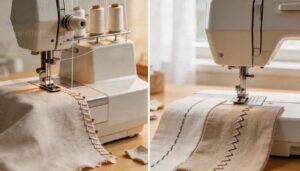
serger and a regular sewing machine each have their strengths, and knowing the difference helps you get better results from both. They’re not competitors — they’re built for different jobs.
Here’s how they stack up across the situations that matter most to your sewing.
Overlock Stitch Vs Lockstitch
Think of it this way: a regular sewing machine locks two threads together in a straight line, while a serger weaves three to five threads around your fabric’s edge all at once.
That Thread Count Difference is what separates a Trimless Seam Finish from raw, fraying edges.
| Feature | Overlock Stitch | Lockstitch |
|---|---|---|
| Thread Count | 3–5 threads | 2 threads |
| Edge Finishing | Built-in | Separate step |
| Stretch | Yes | Minimal |
When a Serger Works Better
When you’re sewing knit fabrics, activewear, or swimwear, a serger pulls ahead fast. It manages stretch-resistant seams, lightweight fabric handling, and high-speed bulk sewing in one motion — no extra steps.
| Situation | Serger Wins Because |
|---|---|
| Knit fabrics | Overlock stitch flexes with movement |
| Activewear and swimwear | Seams stretch without breaking |
Serging techniques for knit fabrics keep everything smooth and professional.
Tasks a Serger Cannot Replace
A serger is fast and capable, but it can’t do everything. Buttonhole sewing, zipper installation, and topstitching precision all require a regular sewing machine. Embroidery detailing, heavy-duty pockets, and coverstitch finishes need tools that a serger simply wasn’t built for.
| Task | Right Tool |
|---|---|
| Zipper installation | Regular sewing machine |
| Buttonhole sewing | Regular sewing machine |
| Embroidery detailing | Regular sewing machine |
Knowing your serger vs regular sewing machine limits saves real frustration.
Using Both Machines in One Project
Both machines together are a powerhouse team. Use workflow sequencing to plan each step: serge raw edges first, then move to your sewing machine for topstitching and assembly. Seam allowance alignment keeps everything lining up during the machine process. Thread compatibility matters too — mismatched threads cause puckering. Keep project documentation simple, like a quick step list, so you can repeat results every time.
| Step | Serger Task | Sewing Machine Task |
|---|---|---|
| 1 | Overcast raw edges | Straight stitch seams |
| 2 | Trim seam allowance | Topstitch for durability |
| 3 | Finish knit hems | Install zippers |
| 4 | Rolled hem on lightweight fabric | Add buttonholes |
| 5 | Edge finishing on curves | Embroidery detailing |
Parts That Form Serger Stitches
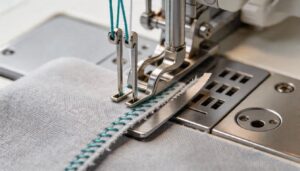
Before you can sew a single stitch, it helps to know what’s actually doing the work inside your serger.
Each part plays a specific role in forming that clean, looped edge you’re after.
Here’s a closer look at the key components that make it all happen.
Needles and Loopers Explained
Your serger has two key players: needles and loopers. Needle Size Selection matters — sizes 9 to 16 match thread weight to fabric, with heavier fabrics needing larger numbers.
Serger needles have a specially shaped scarf for multi-thread paths, so standard needles won’t work. The upper looper and lower looper work in sync through Looper Timing Sync, wrapping threads around your fabric edge.
Looper Height Adjustment and Needle Alignment Tips keep stitches even and prevent skipped seams.
Thread Paths and Tension Discs
Each thread on your serger follows its dedicated route — from cone to guide peg to tension disc to needle or looper. Think of these color-coded threading paths as lanes on a highway: cross one, and everything jams.
Tension discs grip each thread just enough to keep stitches balanced.
Thread Path Cleaning and Tension Disc Maintenance prevent buildup that causes Path Routing Issues and uneven tension.
Feed Dogs and Differential Feed
Just below those tension discs, small toothed bars called fabric feed dogs grip your fabric and move it steadily forward. Your serger actually uses two sets — front and rear — and the differential feed dial controls their relative speeds. Raise the front dog speed for knits to prevent wavy seams; lower it slightly for wovens.
- Front Dog Speed controls how fast fabric enters the stitch zone
- Rear Dog Speed determines how quickly it exits
- Differential feed prevents stretching on knit fabrics
- Fabric Slip Prevention depends on proper presser foot pressure and Dog Alignment
- Feed Dog Maintenance — brushing lint after each use — keeps movement smooth and consistent
Cutting Blade and Stitch Width
Right alongside those feed dogs sits your cutting blade — and it works in perfect sync with stitch formation.
Blade angle impacts how cleanly the edge trims, while stitch width adjustment (generally 3 mm to 7 mm) controls how much fabric gets cut.
For heavier fabrics, widen it; for delicate knits, narrow it down.
Regular blade replacement keeps your edge cleanliness control sharp and consistent.
Threading for Balanced Stitches
Threading a serger correctly is what separates a clean, professional finish from a tangled mess. Get it wrong, and your stitch will look balanced — no matter how good your fabric is.
Here’s what you need to know to thread with confidence.
Correct Threading Order
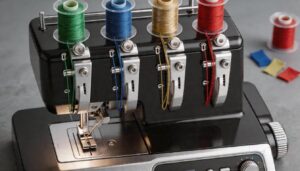
Getting serger threading wrong from the start means every stitch that follows will fight you. Always unplug your machine first — that’s your Threading Safety Protocol.
Then follow this thread guide sequence carefully:
- Confirm Spool Pin Alignment so the thread pulls smoothly.
- Route the upper looper thread through every Looper Thread Routing guide.
- Follow the lower looper path completely.
- Run the Needle Thread Path front to back.
- Test on scrap fabric before sewing.
Color-Coded Threading for Beginners
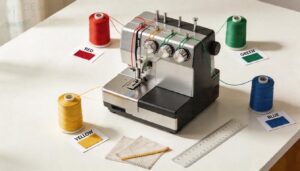
Color-Coded Threading for Beginners turns your serger thread setup into a visual map you can actually follow.
Assign each thread a distinct color — red for needles, green for the upper looper — then note those paths on Color Guide Cards kept near your machine.
This Visual Thread Mapping approach makes Thread Path Labels easy to cross-check, and Color Contrast Tips help you spot a misrouted thread before it ruins your seam.
Choosing 2, 3, or 4 Threads
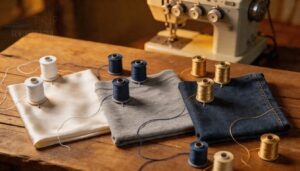
Picking the right thread count comes down to your fabric. Think of it as a Fabric Weight Guide: 2Thread Overlock manages delicate silks with minimal bulk, 3Thread Overlock suits medium-weight knits for Seam Stretch Balance, and 4Thread Overlock delivers strength for denim or activewear.
Thread Count Impact shapes durability and stretch — your serger thread setup and thread tension adjustment determine the Cost Performance Tradeoff and Thread Compatibility.
Common Threading Mistakes to Avoid
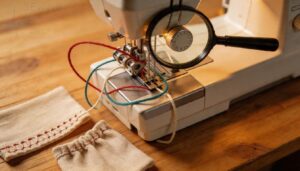
small missteps in your serger thread setup can unravel everything.
Misaligned Tension Discs throw off stitch balance, while Incorrect Thread Order causes skipped threads and uneven seams.
Skipped Looper Thread leaves loose loops along the edge, and Needle Thread Mismatch breaks threads mid-seam.
Don’t forget Tension Reset Omission after rethreading — it’s the silent culprit behind puckered knits.
4. Thread Overlock Basics
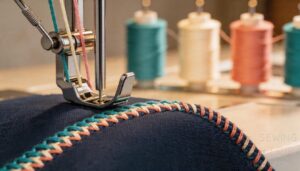
The 4-thread overlock is the workhorse stitch you’ll reach for most often, and understanding how it works makes everything else click into place. It uses two needles and two loopers to build a seam that’s both strong and flexible — exactly what most fabric projects demand.
Here’s what you need to know to start using it with confidence.
How The 4-Thread Stitch Forms
Think of the 4-thread overlock stitch as a tiny weaving machine running along your fabric edge. Here’s how it comes together:
- Upper Looper Wrap sweeps across the top edge, locking fabric plies in place.
- Lower Looper Anchor secures the underside, completing the Loop Interlock Mechanics.
- Needle Pair Alignment drives two parallel stitch lines through both layers.
- Stitch Curl Control uses serger tension and differential feed to keep edges flat.
Your serger thread setup ties everything together seamlessly.
Best Fabrics for 4-Thread Overlock
The 4-thread overlock thrives on stretch fabrics. polyester jersey, cotton jersey, spandex blend knits, bamboo viscose, and lightweight ponte all respond beautifully — edges stay flat, seams hold their stretch, and knit garment construction stays clean.
For activewear especially, this stitch is your best friend.
delicate fabrics like silk or chiffon? Skip it. Those need the gentler 2-thread approach instead.
Joining Seams on Knits
Joining knit seams with a 4-thread overlock stitch gives you strength and stretch in one pass. Set your differential feed above 1.0 to prevent the fabric from stretching out as you sew. Keep your seam allowance at ¼ inch to avoid bulk.
For hand-knit pieces, mattress stitch and weft insertion through the seam line lock fibers neatly.
Always finish with seam pressing to smooth everything flat.
When to Use It for Activewear
Activewear lives or dies by its seams. Use the 4-thread overlock on high-stretch panels, compression garment edges, and moisture-wicking fabrics that take real punishment during workouts. Set your differential feed for knit fabrics above 1.0 to handle fabric stretching prevention on the fly.
- Lightweight performance tops need stitch durability without added bulk
- Continuous construction reduces chafing on race-day gear
- Leggings and compression tights demand stretch at every seam
- Running panels require consistent overlock coverage across curved edges
3. Thread and 2-Thread Stitches
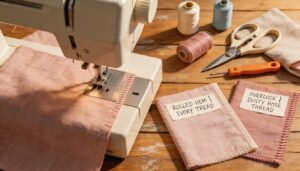
Not every project needs the full muscle of a 4-thread overlock — sometimes fewer threads means better results.
The 3-thread and 2-thread stitches each have a sweet spot, and knowing which to reach for makes a real difference in how your finished seams look and hold up.
Here’s what you need to know about each option.
3. Thread Overlock for Edge Finishing
Finishing raw edges cleanly is where the 3-thread overlock stitch truly earns its place. Using one needle and two loopers, it wraps around the fabric edge with a seam allowance width of 0.5–0.8mm, locking fibers in place so nothing unravels after washing.
| Fabric Type | Thread Tension Balance | Edge Trim Accuracy |
|---|---|---|
| Cotton Jersey | Slightly loose needle | Clean, flat finish |
| Cotton Poplin | Balanced needle/looper | Precise, fray-free edge |
| Lightweight Denim | Moderate looper tension | Stable, even trim |
This basic serger stitch type delivers impressive fabric edge stability and stitch longevity across most everyday projects.
2. Thread Overlock for Delicate Fabrics
When the 3-thread stitch feels like too much for your sheerest fabrics, two threads step in quietly.
The 2-thread overlock uses one needle and one looper for Minimal Bulk Seam results on Silk Edge Trim and chiffon.
Set Chiffon Stitch Tension slightly lower on the needle, use a Fine Needle Choice (size 60/8–70/10), and practice Delicate Fabric Prep by prewashing before you serge.
Strength Differences Between Both
So how do they actually stack up?
The 3-thread overlock wins on Seam Shear Strength and seam durability — its Load Distribution across three threads manages everyday stress well.
The 2-thread trades some of that Durability Under Stress for Bulk vs Flexibility, giving you better Elastic Recovery on delicate work.
For knits, a 4-thread overlock remains the strongest overall choice.
Choosing The Right Stitch by Fabric
Now that you know how strength differs, matching the stitch to your fabric makes everything click.
- Knit Stretch Compatibility: Use a 4-thread overlock for jersey and activewear.
- Woven Edge Strength: A 3-thread overlock works with cotton and linens cleanly.
- Sheer Fabric Sensitivity: Choose 2-thread for chiffon to avoid bulk.
- Heavyweight Denim Durability: A wide 4-thread stitch holds without fraying.
Rolled Hem Stitch Techniques
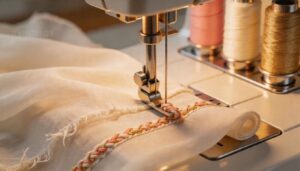
The rolled hem stitch is one of those techniques that looks complicated but becomes second nature once you understand how it works. Getting it right comes down to knowing your fabric, your settings, and a few tricks that keep those edges clean and flat.
Here’s what you need to know.
How a Rolled Hem Works
rolled hem is one of those edge finishing techniques that looks complicated but is really just clever folding.
The Rolling Hem Technique on Light Fabrics works by folding the raw edge twice — each fold about 1/8 inch — creating a Roll Width so narrow that it practically disappears.
Fold Formation locks the edge, Needle Size 70/10 keeps stitches clean, and a good Pressing Technique sets everything flat.
Best Fabrics for Rolled Hems
Not every fabric plays nice with a rolled hem — but the ones that do look absolutely beautiful. Lightweight, tightly woven, or fine‑knit materials are your best friends here.
The Rolling Hem Technique on Light Fabrics shines brightest on:
- Sheer chiffon and silk organza — both roll neatly into a 1–1.5mm edge without added bulk
- Lightweight voile and linen lawn — hold a crisp, clean roll with minimal fraying
- Fine knit jersey — finishes smoothly with balanced tension and a ballpoint needle
Fabric edge finishing works best when the fabric is thin enough to fold without creating stiff ridges.
Settings for Narrow, Clean Edges
Getting a crisp rolled hem comes down to dialing in a few key settings before you start.
Set your stitch length to 1.0–2.0mm and select a fine thread weight (60–90) to keep edges clean.
Balance your thread tension and differential feed, align your edge guide, and always start with the needle down.
Blade clearance should be minimal — just enough to trim without cutting into the seam.
Preventing Wavy or Uneven Hems
Wavy hems almost always trace back to two culprits: loose thread tension or fabric that shifts as you feed it through.
Before you sew, clip and press your hem firmly, then apply a light Underlay Interfacing for extra Fabric Stabilization.
Set your differential feed just above 1.0 for fabric stretching prevention, and use a Walking Foot to keep layers moving evenly.
Your Pressing Technique after stitching seals everything flat.
Flatlock and Decorative Finishes
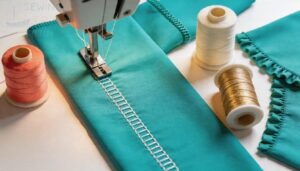
Serging isn’t just about clean seams and finished edges — it’s also one of the most creative tools in your sewing kit. From flat, sporty joins to decorative borders that look store-bought, your serger can do more than you might expect.
Here’s what’s worth knowing about flatlock stitches and decorative finishes.
Flatlock Stitch for Sportswear
Flatlock stitching for sportswear construction is the go-to choice when you need seams that disappear against the skin. This stitch joins edges flat, creating a four-way stretch seam that moves with the body — no bulk, no chafing.
It’s ideal for moisture wicking fabrics and delivers a smooth silhouette with a skin friendly finish, perfect for leggings, compression tops, and color block contrast activewear panels.
Decorative Edges With Serger Thread
Your thread choices are where creativity meets function. The right decorative serger stitches transform ordinary edge finishing into a design detail people actually notice.
- Metallic Shine threads add glamour to costumes and formal pieces
- Gradient Edge effects come from variegated thread in a single overlock stitch pass
- Two-Tone Outline uses contrasting upper and lower threads simultaneously
- Color Harmony ties your thread selection directly to fabric tone
Picot, Blanket, and Specialty Looks
Beyond thread color, the actual stitch shape changes everything.
A Picot Stitch creates tiny loops — usually 2 to 4 millimeters wide — that give baby blankets and lightweight wraps a soft, lacy border.
For bolder impact, try a Double Picot Border or add Bead Embellishment accents.
Chain Stitch Accents, Fiber-Specific Picot variations, Color Contrast Edges, Two Blanket Stitches, and Flatlock stitch combinations all expand your decorative serger stitches toolkit beautifully.
When Decorative Stitches Are Practical
Decorative serger stitches aren’t just for show — they pull real weight in everyday sewing.
Use color-coded seam cues to track orientation during construction, or add textured grip seams to slipcovers so they stay put.
Monogrammed pockets and patterned fabric panels get a polished edge with a Picot Edge or Shell tuck finish.
Even concealed repair stitches and Flatlock stitch combinations count as using decorative stitches and finishes, practically.
Tension and Differential Feed Settings
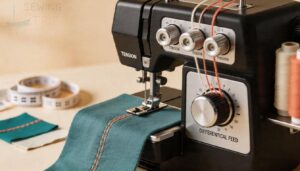
Getting your tension and differential feed right is what separates a clean, professional seam from one that puckers, stretches, or falls apart. Once you know what to look for and which dial to reach for, these adjustments become second nature.
Here’s what you need to understand to dial things in.
Signs of a Balanced Stitch
When serger tension is right, everything just looks clean. You’ll see even stitch length across the seam, a flat seam edge with no curling, and no visible loops on either side of the fabric.
Consistent tension means uniform thread take-up — both loopers pulling equally.
Run a quick scrap test first. That single pass tells you whether your stitch formation and seam finishing are truly balanced.
Adjusting Looper and Needle Tension
Once your scrap test confirms something’s off, start with Looper Tension Balance before touching the needles. Set your upper looper and lower looper loosely — around 2 to 3 — then test again.
- Loosen loopers first, tighten needles second
- adjust one dial at a time
- test on scrap after each change
- watch where loops — face or back
- tighten needle tension if thread shows on top
That sequence is the heart of Needle Tension Fine-tuning. Sample Stitch Testing removes all the guesswork.
Differential Feed for Knit Fabrics
Knit fabrics love to stretch — and that’s exactly where the differential feed dial becomes your best tool. For knit stretch control and wave reduction technique, set the dial between 1.5 and 2.0 on stretchy jerseys.
This edge flatness optimization keeps seams from rippling.
Lighter knits need only 1.2 to 1.4 for smooth stitch balance adjustment without over-gathering.
Preventing Stretching, Puckering, and Gathering
Three problems — stretching, puckering, and gathering — usually trace back to mismatched serger tension and differential feed settings.
For stretchy fabric handling, raise the differential feed above 1.0 and check your Thread Weight Choice against needle size. Fabric Pre-stretching before cutting helps too.
Fine-tune Feed Dog Pressure and Needle Position Calibration together, then test Stitch Density Settings on a scrap swatch until seams lie flat.
Fixing Common Stitch Problems
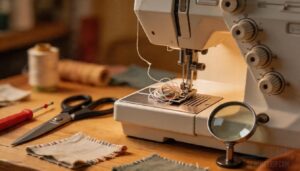
Even the best serger throws a tantrum sometimes — skipped stitches, loopy edges, threads snapping mid-seam.
Most problems come down to a handful of fixable causes, and once you know what to look for, troubleshooting gets fast.
Here’s what to check when things go wrong.
Skipped Stitches and Broken Threads
Skipped stitches usually trace back to one of four culprits: Thread Path Misrouting, Needle Wear, Lint Accumulation, or Blade Sharpness issues.
For serger troubleshooting, start by re-threading completely with the presser foot raised — this seats every tension disc correctly. Replace dull needles often, as Needle Wear is a quiet troublemaker.
Clear lint from feed dogs to eliminate Thread Breakage Points hiding in debris.
Loose Loops and Uneven Edges
Loose loops usually mean your thread tension is off — check looper tension first, then needle tension, making small adjustments and testing on scrap fabric each time.
Use differential feed to control how knits move through the machine, especially stretchy fabrics prone to wavy edges.
Regular edge loop inspection and serger maintenance keep your overlock stitches tight and your edge finishing consistently clean.
Needle Changes and Correct Insertion
A dull needle is one of the sneakiest culprits behind skipped stitches. When Choosing and Changing Serger Needles, follow these steps:
- Power off and unplug — basic safety precautions before touching serger needles.
- Apply proper Needle Removal Technique: twist slightly, then pull straight out.
- Do a quick Sharpness Inspection — discard bent or burred needles immediately.
- Match Needle Gauge Selection and Insertion Angle Guidelines to your fabric weight before needle threading.
Cleaning, Oiling, and Blade Care
Think of your serger like a car — skip the oil changes, and things break down fast.
Your serger maintenance routine starts with Lint Removal Techniques: brush out the feed dogs, looper area, and cutting blade after every project.
For Blade Lubrication Routine, apply one drop of manufacturer-approved serger oil every 8–12 hours, then run Blade Alignment Checks on scrap fabric.
Always unplug first — that’s your non-negotiable safety precaution.
Frequently Asked Questions (FAQs)
What is the most common serger stitch?
If sergers had a workhorse, it’s the four-thread overlock — the industry standard stitch used in nearly every ready-to-wear garment. It joins and finishes seams in one efficient pass.
What are the 7 basic stitches?
There are 7 basic serger stitch types: 4-thread overlock, 3-thread overlock, 2-thread overlock, rolled hem, flatlock stitch, chain stitch, and coverstitch — each built for specific fabric compatibility and seam strength.
Can you sew regular stitches with a serger?
Sure, technically — but it’s a bit like using a chef’s knife to butter toast.
A serger can attempt a mock straight stitch, yet straight stitch feasibility stays limited compared to a regular sewing machine’s precision.
Can serger stitches be used for quilting projects?
Yes, serger stitches work well for quilt block assembly, seam finishing, and serger binding techniques.
Overlock stitches trim bulk, and fusible thread use simplifies binding — making fabric handling faster across multiple layers.
What threads work best with serger machines?
Polyester thread strength makes it the top pick for most serger projects. Nylon stretch compatibility suits knits, while cotton wrapped softness works well on wovens.
Core spun durability and merrowed lint reduction keep your machine running smoothly.
How do you clean and oil a serger?
Start by unplugging the machine, then brush out lint from the loopers and knife area.
Oil only manufacturer-marked points sparingly.
Run a test swatch to confirm smooth, balanced stitches before sewing.
Are specialty serger feet necessary for certain stitches?
Specialty feet aren’t always required, but a blind hem foot, elastic foot, zipper foot, or piping foot makes specific stitches far cleaner and more consistent — especially when precision matters most.
Can you use a serger for gathering fabric?
Absolutely — a serger manages fabric gathering well.
Set a Long Stitch Length, boost differential feed to around 2, then use a Gathering Foot Attachment for even results.
Finish with a Post-Serger Pull on the needle threads to tighten.
Can a serger replace a coverstitch machine entirely?
No, a serger can’t wear all the hats. It finishes edges fast, but a cover stitch machine creates flat, professional hems on knits that a serger simply can’t replicate.
How do thread cone weights affect stitch quality?
Heavier cones increase Thread Path Friction and Inertia Impact, tightening thread tension and affecting Loop Formation Balance.
Lighter cones reduce friction, risking loose stitches, Fabric Puckering, and uneven Stitch Width Consistency — so matching cone weight to your fabric type matters.
Conclusion
Unlocking your serger’s full potential is like finding the missing piece of a puzzle—suddenly, everything fits together seamlessly.
With basic serger sewing machine stitches at your fingertips, you’ll transform raw edges into professional-looking finishes. Practice makes perfect, so experiment with different threads, tensions, and fabrics.
As you master these stitches, you’ll discover a world of creative possibilities. Your serger will become an indispensable tool, helping you achieve perfect results with every project, every time.