This site is supported by our readers. We may earn a commission, at no cost to you, if you purchase through links.
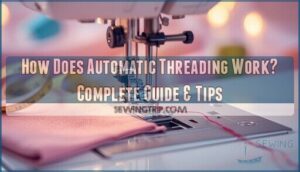
Threading a needle by hand used to eat up precious minutes of every sewing session, and for anyone working with intricate fabrics or aging eyes, those minutes could stretch into frustrating quarters of an hour. Automatic threading mechanisms changed that equation entirely by introducing a spring-loaded hook or wire that captures your thread and pulls it through the needle’s eye in one swift motion.
You activate a lever, the threader swings into position, loops your thread around a guide point, and retracts—leaving you with a perfectly threaded needle in under three seconds. This mechanical shortcut doesn’t just save time; it transforms accessibility for sewists who once struggled with fine motor control or visual precision, turning what was once a barrier into a barely noticeable step.
Understanding the mechanics behind automatic threading reveals why modern machines can deliver such consistent results, and knowing how these components interact helps you troubleshoot issues before they derail your next project.
Table Of Contents
Key Takeaways
- Automatic threading mechanisms use a spring-loaded hook or wire that captures your thread and pulls it through the needle’s eye in under three seconds, eliminating the frustrating manual process that once consumed precious minutes of every sewing session.
- The system relies on three core components working together—a precision-engineered threading hook made from corrosion-resistant materials, a thread guide that ensures proper alignment, and activation levers or buttons positioned near the presser foot for instant access.
- These mechanisms deliver measurable efficiency gains, including a 50% reduction in setup time and a 30-60% decrease in threading mistakes, while dramatically reducing eye strain and making sewing accessible for people with limited dexterity or vision challenges.
- Proper maintenance requires weekly lint removal from the threading hook using compressed air, sparing application of manufacturer-approved lubricant to moving components, and immediate replacement of bent wires to preserve that three-second threading advantage for years.
What is Automatic Threading in Sewing Machines?
Automatic threading represents one of those small breakthroughs that transforms the sewing experience, eliminating the frustration of squinting at a tiny needle eye while your thread refuses to cooperate. This feature, which you’ll find in both standalone tools and integrated sewing machine systems, uses a mechanical hook or wire mechanism to guide thread through the needle’s eye in seconds rather than minutes.
Understanding what automatic threading actually is, how it evolved, and which types you’ll encounter helps you make informed decisions about the tools that’ll give you more control over your craft. Most modern machines rely on key needle threader components like the wire hook and capture mechanism to handle threading automatically.
Definition and Purpose
Threading basics get a serious upgrade with automatic threading systems, which simplify the entire needle threading mechanism by establishing a pre-set path for your thread. This automated stitching feature eliminates tedious manual steps, letting you skip the squinting and fumbling that wastes time.
Instead, you gain precision guidance and thread control from the start, accelerating sewing efficiency and giving you consistent tension initiation across every stitch. The accuracy of automatic threading can be further improved by understanding scientific study methods to enhance the process.
Brief History of Automatic Threading
You’ve seen how the automatic needle threader transforms needle threading systems, but this sewing machine technology has a compelling evolution timeline. Early mechanical innovations emerged in the 1930s and 1940s, when patent history shows manufacturers linking threading aids to broader reliability upgrades.
The electrification era brought sensor-based triggers by the 1980s, while standardization trends in the 1990s made automatic threading systems a mainstream feature, reshaping innovations in sewing technology and liberating sewists from manual drudgery.
Common Types of Automatic Threaders
Now that you understand the innovation timeline, you’ll find several threader designs across modern sewing accessories. The automatic needle threader remains the most common, using a threading hook and thread guide to pull thread through the eye. For deeper setup steps and maintenance tips, check out these industrial embroidery machine guides to keep your equipment running smoothly.
You’ll also encounter automatic tension systems, bobbin threaders, addressable thread guides, and integrated thread cutters—each threader tool offering distinct advantages in threading speed and precision.
Key Components of Automatic Threading Systems

Understanding how automatic threading systems work starts with knowing what’s actually under the hood. These mechanisms rely on a few essential parts working together to make needle threading feel almost smooth. Modern machines often pair these features with built-in stitch adjustments and tension controls that keep everything running consistently.
Let’s break down the key components that transform this once-tedious task into a simple, simplified process.
Threading Hook or Wire Mechanism
At the heart of every Automatic Needle Threader sits a delicate threading hook—a precision-engineered wire that demands respect. This hook design employs corrosion-resistant wire materials chosen for rigidity, enabling the Sewing Machine Feature to achieve consistent threading speed through proper hook alignment.
When you activate the threader tool, the threading hook executes a precise arc to achieve reliable thread capture without snagging or cutting your thread. If you travel often with your sewing machine, knowing which sewing tools you can bring on a plane helps you pack your threading hook and other essentials without TSA hassles.
Thread Guide and Positioning
Precision begins with proper Thread Guide placement, because even the smallest deviation throws off Thread Alignment and compromises Threading Precision. Your Thread Guide directs the thread straight to the Needle Eyes, ensuring the Threading Hook captures it cleanly on every pass. If you’re tired of squinting and fumbling with thread, a sewing machine with an automatic needle threader makes the whole process effortless and keeps your focus on the actual stitching.
When you maintain accurate Guide Placement, you’re guaranteeing consistent Stitch Quality—the Automatic Needle Threader can only perform as well as the path you’ve given it.
Activation Levers and Buttons
Lever Design and Button Placement define how smoothly you engage your Automatic Needle Threader, with most controls positioned near the presser foot for instant access. Modern Electronic Controls often include LED indicators confirming completion, while Safety Features prevent accidental activation during Sewing Machine operation.
This User Interface evolution represents genuine Sewing Machine Innovation, transforming Thread management:
- Mechanical levers redirect thread through precise guide paths
- Push-buttons initiate electronic threading sequences with visual feedback
- Ergonomic positioning accommodates both left- and right-handed sewers
- Universal icons guarantee cross-language usability across different Sewing Machine models
Proper understanding of these controls streamlines your Sewing Machine Maintenance routine and maximizes threading efficiency.
How Does Automatic Threading Work?
Now that you understand the core components, let’s break down exactly how automatic threading mechanisms work in practice. Whether you’re using a mechanical lever or a fully electronic system, the underlying process follows a similar sequence of steps that pulls thread through the needle eye without manual effort.
We’ll walk through the step-by-step threading process, compare mechanical and electronic approaches, and explore how these systems integrate into modern sewing machines.
Step-by-Step Threading Process
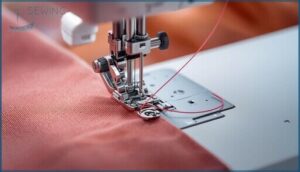
Threading your sewing machine correctly sets the stage for perfect stitches, so you’ll want to master the sequence. Start by raising your needle to its highest point, then guide the thread through each tension disc and the threading hook.
Your automatic needle threader will catch the thread and pull it through the needle’s eye, establishing proper needle alignment.
Always run a quick test on scrap fabric to verify thread tension and stitch quality before diving into your project.
Mechanical Vs. Electronic Threaders

Your sewing machine’s automatic needle threader operates through one of two fundamental approaches, each with distinct trade-offs. Mechanical reliability comes from lever-actuated hooks that depend on your timing and alignment, while electronic precision relies on motor-driven sensors to control threading speed and thread quality consistently. Consider these core differences:
- Mechanical threaders use physical cables and pivots you activate manually
- Electronic systems employ motors and circuitry for programmed sequences
- Mechanical designs offer simpler repairs with basic tools
- Electronic threading reduces dexterity requirements through automation
Motor efficiency and maintenance complexity often determine which threading hook mechanism best fits your workflow.
Integration in Modern Sewing Machines

Modern sewing machines now build automatic needle threaders into mid-range and premium models as standard equipment, transforming sewing automation from luxury to expectation.
Your machine compatibility spans common spool management sizes—1,000 to 5,000 yards—while maintaining thread tension through coordinated presser feet and low-shaft controls, ensuring sewing efficiency with one-touch automatic engagement that eliminates thread management frustration and sewing machine troubleshooting headaches.
| Feature | Mid-Range Models | Premium Models |
|---|---|---|
| Automatic Engagement | Single-touch activation | Sensor-assisted precision |
| Thread Tension Control | Manual adjustment | Auto-calibrated systems |
| Spool Management | Standard 1,000-5,000 yd | Extended capacity compatible |
Advantages of Automatic Threading Features

Automatic threading isn’t just a convenience feature—it’s a tool that fundamentally changes how you approach your sewing projects, whether you’re stitching a single garment or running through dozens of items in a day. The benefits extend beyond simply getting thread through a needle, touching on efficiency, comfort, and accessibility in ways that matter to sewers at every level.
Automatic threading transforms sewing from a tedious, eye-straining chore into an efficient, accessible craft for sewers at every skill level
Here’s what automatic threading brings to your workspace and why it might be worth considering for your next machine.
Time-Saving and Efficiency
When you’re racing against deadlines or switching threads constantly, automatic needle threaders become your secret weapon for sewing efficiency and productivity. These sewing machine innovations deliver measurable efficiency gains and time management benefits:
- Threading speed jumps dramatically: setup time drops by roughly 50% compared to manual methods
- Error reduction kicks in: threading mistakes decrease by 30–60%, saving you from frustrating do-overs
- Thread management gets smoother: projects requiring frequent changes benefit from re-threading cycles that are twice as fast
The productivity tips here are simple—let sewing automation handle the tedious work while you focus on creating.
Reduced Eye Strain and Fatigue
Beyond saving time, you’ll protect your vision health with automatic needle threaders that dramatically cut down the repetitive close-up focus required during manual threading. User studies show lower reported eye strain when using automated sewing tools compared to manual methods, which translates directly to fatigue reduction and better ergonomic sewing practices.
Your visual comfort matters—especially during long sessions where sewing efficiency and productivity depend on maintaining sharp focus without burning out your eyes.
Accessibility for All Skill Levels
Comfort and confidence meet when automatic needle threader systems embrace inclusive design principles, transforming sewing accessibility for beginners and enthusiasts alike. These adaptive tools improve user experience through assistive technology that levels the playing field:
- Large activation controls eliminate frustration for users with limited dexterity, accelerating skill building.
- Visual indicators confirm correct thread placement without guesswork.
- Step-by-step prompts guide new sewers through essential sewing techniques effortlessly.
Troubleshooting and Maintenance Tips
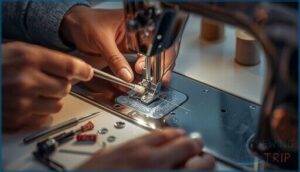
Even the most reliable automatic threading mechanism won’t perform at its best without proper care, and knowing how to address common issues can save you hours of frustration and keep your projects on track.
You’ll find that most threading problems stem from simple causes like lint buildup, misaligned components, or worn parts that you can fix yourself with the right approach.
Let’s walk through the practical steps to troubleshoot issues, maintain your threading system for peak performance, and recognize when it’s time to call in a professional for repairs.
Common Issues and Solutions
Why does your automatic needle threader suddenly refuse to cooperate? Thread tangles and machine errors often stem from user mistakes like activating the mechanism with the needle lowered or selecting incompatible needle sizes. Debris buildup along the threading hook disrupts sewing techniques, while worn components signal repair options ahead.
Verify correct presser foot height, inspect sewing accessories and tools for alignment issues, and address maintenance tips before frustration sets in.
Cleaning and Caring for Threading Mechanisms
Once you’ve tackled the quick fixes, shift your focus to preventive care that keeps your automatic needle threader in fighting shape. Thread lubrication and mechanism cleaning aren’t optional—they’re sewing kit essentials that protect your investment and guarantee textile tools perform when inspiration strikes.
Make fiber removal part of your routine with these threading hook maintenance practices:
- Brush away lint buildup from the threading hook weekly using compressed air or a soft bristle tool, preventing debris from sabotaging your next project
- Apply manufacturer-approved lubricant sparingly to moving components, ensuring sewing accessories and tools glide smoothly without attracting dust
- Schedule regular servicing at recommended intervals to maintain alignment and catch wear before your automatic needle threader fails mid-seam
When to Seek Professional Repair
Knowing when your DIY fixes reach their limits protects your entire sewing kit and preserves your sewing experience. Machine noise like grinding or clunking, persistent thread tension failures, electrical issues including power interruptions, and visible wear detection on hooks or guides all signal it’s time for professional sewing techniques.
Repair costs pale against fabric damage or safety risks that sewing enthusiasts face when ignoring textile technology breakdowns.
Frequently Asked Questions (FAQs)
Can automatic threaders work with all needle sizes?
Most automatic threaders handle standard needle sizes 60–110 reliably, but you’ll run into size restrictions with very small or oversized needle eyes that exceed your threading mechanism’s reach and thread compatibility limits.
Are handheld threaders better than built-in ones?
Built-in threaders deliver faster threading speed and consistent thread quality for single-machine workflows, while handheld devices offer device portability across sewing projects—user preference depends on your sewing experience and cost comparison priorities.
Do automatic threaders work with specialty threads?
Most automatic threaders handle standard polyester or cotton just fine, but metallic, thick embroidery, or textured specialty threads often snag or break. Test first, adjust tension, or thread by hand to avoid needle damage.
How much do automatic threading devices typically cost?
You get what you pay for, but handheld threading devices start around $20, while built-in machine systems add $60 to $500 depending on features.
Budget Options exist, though Cost Factors like brand and compatibility influence Purchase Decisions for Sewing for Beginners.
Can you retrofit older machines with automatic threading?
Retrofit feasibility hinges on machine compatibility—mounting points, threading path clearance, and electric actuation requirements matter most. Aftermarket devices exist for some models, but safety concerns and inconsistent results make professional assessment essential before modifying your sewing setup.
Conclusion
The simplest innovations often hide the most elegant engineering, and that paradox defines how automatic threading work has evolved from a luxury into a necessity.
Once you understand the spring-loaded hooks, guide channels, and lever mechanics that eliminate manual threading, you’ll recognize why these systems rarely fail when maintained properly.
Clean your threader monthly, replace bent wires immediately, and you’ll preserve that three-second advantage for years—turning every project start into a smooth, frustration-free launch.
- https://www.scribd.com/document/683678057/Academic-Research-Manual-V1-1-April-2016
- https://www.sciencedirect.com/science/article/pii/S0749208123000268
- https://x.com/godofprompt/status/1990526288063324577
- https://academichelpexpress.blog/2024/08/please-use-the-bulleted-points-and-the-rubric-below-to-guide-your-work-your-pa/
- https://pmc.ncbi.nlm.nih.gov/articles/instance/9553038/bin/pone.0275964.s005.docx