This site is supported by our readers. We may earn a commission, at no cost to you, if you purchase through links.
Packing a sewing needle in your carry-on feels about as risky as smuggling a toothpick—but TSA treats sharp objects with serious scrutiny, and the rules aren’t always obvious. Plenty of crafters have had their needle cases pulled at the checkpoint, not because needles are banned, but because the packing was wrong.
The good news: you can bring a sewing needle on a plane, and most domestic carriers allow it in your carry-on with a few conditions. Get those conditions wrong, though, and a screening officer has full authority to confiscate your kit on the spot.
Knowing exactly what TSA requires—and what your airline adds on top—keeps your needles in your bag and your trip on schedule.
Table Of Contents
- Key Takeaways
- Can You Bring Sewing Needles?
- TSA Rules for Sewing Needles
- Packing Needles for Carry-On
- Checked Bag Needle Rules
- Airline Policies Can Differ
- International Needle Restrictions
- Sewing Pins and Machine Needles
- Other Sewing Tools Allowed
- Sharp Tools Not Allowed Onboard
- Top 5 Travel Sewing Picks
- Frequently Asked Questions (FAQs)
- Conclusion
Key Takeaways
- You can bring sewing needles in your carry-on as long as you keep the count at 12 or fewer and store them in a closed, hard-shell container inside a clear zip bag.
- The TSA screening officer always has the final say, so smart packing—capped tips, labeled case, visible contents—is your best defense against having your kit confiscated on the spot.
- Checked baggage skips the quantity limit entirely, making it the easier choice if you’re traveling with a full sewing kit or multiple needle types.
- Airline rules and international customs laws can be stricter than TSA’s, so always check your carrier’s specific policy and your destination’s import rules at least 72 hours before you fly.
Can You Bring Sewing Needles?
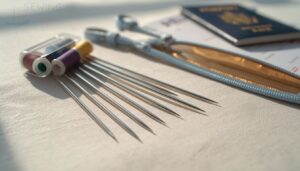
Yes, you can bring sewing needles on a plane — and the rules are simpler than you might expect. TSA covers everything from carry-on limits to what happens at the checkpoint.
If you’re traveling with a full setup, packing a sewing machine for a flight comes with its own set of tips worth knowing before you head to the airport.
Here’s what you need to know before you pack.
TSA Carry-on Allowance
Good news — TSA regulations for sewing needles are pretty traveler‑friendly. You can pack them in your carry‑on baggage, as long as you follow the rules:
- Stay within the 12-needle quantity limit
- Meet the container transparency requirement with a clear, closed case
- Understand that screening discretion applies — the final call belongs to the officer
Note that sharp objects over four inches are prohibited, but sewing needles are well within the allowed size.
Think of it as your travel kit checklist starting point.
Checked Baggage Allowance
Checked baggage is honestly the easier route. TSA regulations for sewing needles place no quantity limit there — bring your whole kit.
Just stay mindful of airline policies on sharp travel items: pack needles securely to avoid punctures and keep within standard weight limits to dodge overweight fees.
Extra bag charges and size restrictions vary by carrier, so check those checked vs carry-on baggage rules before you fly.
Final Decision at Screening
Even with TSA policy on sharp objects clearly on your side, the final call still belongs to the screening officer. That’s officer discretion in action — and it’s real.
TSA rules may allow sewing needles, but the screening officer always has the final word
Their documentation review happens fast, so having your needles labeled and visible speeds things along. No formal appeal process exists at the checkpoint, so smart packing truly is your best eligibility criteria for getting through without a hitch.
TSA Rules for Sewing Needles
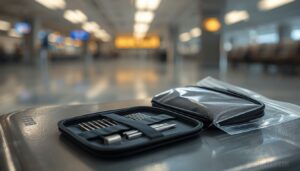
TSA does have a few specific rules you’ll want to know before tossing needles into your bag. They’re straightforward, but skipping them could mean losing your needles at the checkpoint.
Here’s exactly what the rules say.
12. needle Carry-on Limit
Think of 12 as your magic travel needle count — it’s the sweet spot that keeps you sewing-ready without raising eyebrows at security. TSA guidelines suggest this as your passenger needle quota for carry-on bags.
Smart packing quantity guidance makes compliance easy:
- Bring only what you’ll actually use
- Leave extras in checked baggage
- Keep your compliance checklist simple
No Listed Length Restriction
Here’s something that might surprise you — TSA guidelines don’t list a specific length restriction for sewing needles. That’s real Length Flexibility in your favor.
The focus is Packaging Focus: how you store them matters more than their size. Officer Discretion still applies, so a proper needle case or protective case keeps sharp items looking non‑threatening and helps you breeze through without a second glance.
Closed Container Requirement
TSA guidelines require your needles to be stored in a closed container — one with no gaps, a secure closure mechanism, and full seal integrity. A hard-shell needle case tucked inside a clear resealable plastic bag works perfectly.
It signals to screeners that sharp items are contained and handled responsibly. Some travelers add tamper-evident seals for extra peace of mind during inspection procedures.
Packing Needles for Carry-On
Knowing the rules is one thing — packing smart is another. few simple steps can keep your needles safe and help you breeze through the checkpoint without any hold-ups.
Here’s what works.
Use a Hard-shell Case
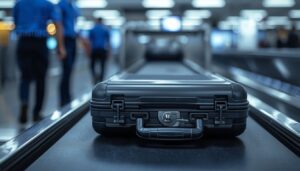
A hard shell needle case is your best line of defense at the checkpoint. Its Reinforced Corner Design absorbs drops, while Impact Absorbing Foam keeps needles exactly where you packed them. Many models even include a TSA Compatible Lock and Pressure Relief Valve for altitude changes.
Here’s what to look for:
- Rigid polycarbonate or ABS outer shell
- Pick-and-pluck Impact Absorbing Foam interior
- Water Dust Seal with rubber gasket lining
- Built-in Pressure Relief Valve for cabin pressure
- Lockable latches meeting TSA regulations for sharp objects
Place in a Clear Zip Bag
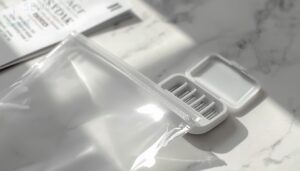
Once your hard-shell case is packed, slip it into a clear plastic bag — it’s that simple. A zip top plastic bag with a Double Zipper Seal keeps everything snug and allows a Quick Visual Inspection without opening anything. TSA officers appreciate the transparency, literally.
| Feature | Why It Matters |
|---|---|
| Reinforced Polyethylene Construction | Resists punctures from needle tips |
| Writable Label Panel | Identifies contents quickly |
| Standard Travel Size | Fits TSA regulations for sharp objects |
Keep Tips Capped or Covered
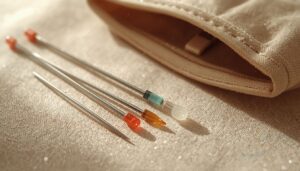
A bare needle tip is an accident waiting to happen. Capping every needle before packing isn’t just about following TSA guidelines — it’s smart, protective needle storage.
Caps prevent corrosion control issues, block dust prevention problems, and act as a safety visual cue that the needle isn’t ready for use.
Color-coded caps help you spot sizes fast. Always do quick cap integrity checks before you zip up.
Label The Container Clearly
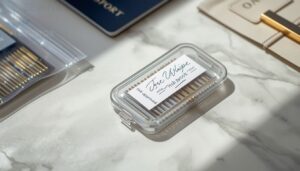
A clearly labeled needle case saves you from awkward explanations at security screening. Write sewing needles in bold contrasting text on a waterproof, smudge-resistant label. Follow basic label placement guidelines — flat side, facing up, readable upright. Add safety pictograms if you have them.
TSA guidelines and airline policies on sharp travel items move faster when your Ziploc bag is honest about what’s inside.
Checked Bag Needle Rules
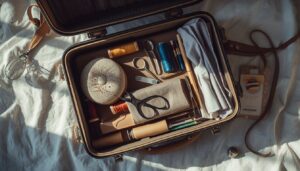
Checked bags are honestly the easier route for needles. There’s no quantity limit, so you can pack your full sewing kit without counting or worrying. Here’s what to keep in mind when loading up your checked luggage.
No Quantity Limit in Checked Luggage
Regarding checked baggage, TSA sets no quantity limit on sewing needles — pack as many as you need. Most airlines cap Weight Capacity at 50 pounds per bag, so bulk packing works fine within that range.
Watch for Overweight Charges and know your airline’s Multiple Bag Policy before loading up. Checked vs carry-on baggage rules for needles differ considerably here.
Best for Larger Sewing Kits
If you’re hauling a full travel sewing kit, checked baggage is your best friend. TSA quantity caps mean you can pack Modular Needle Organizers, Integrated Thread Spools, and multiple needle sizes without stress.
- Choose Durable Case Materials like hard-shell ABS plastic
- Apply Weight Distribution Strategies to protect delicate needles
- Use Compact Storage Solutions with labeled compartments
- Separate sharp objects from thread to avoid tangles
Pack to Prevent Punctures
Even in checked bags, a little care goes a long way.
Wrap your needle case in a padded pouch or cushion it with fabric scraps. Foam inserts or bubble wrap keep sharp items from shifting. Use Ziploc bags to separate metal items from thread.
Needle safety packaging protects both your travel sewing kit and the baggage handlers.
Airline Policies Can Differ

TSA rules are just one piece of the puzzle — your airline gets a vote too. Some carriers have their own needle policies that don’t always match what TSA says.
Here’s what you need to know before you book.
Some Airlines Require Checked Baggage
Not every airline sees sewing needles the same way. Lufthansa, Brussels Airlines, and Qatar Airways require you to check them — full stop.
Their Security Risk Assessment places sharp craft tools in the same category as other cabin hazards.
Before you pack, review your airline baggage policy carefully. Remember to factor in Checked Baggage Fees and Weight Limit Implications, and follow Passenger Notification Procedures if asked at check-in.
Some Allow Secure Carry-on Packing
Packing smart makes all the difference. Delta, British Airways, and Air India let you bring sewing needles in your carry-on — as long as they’re secured properly.
Think Rigid Plastic Containers, Dual-layer Packing with Cushioning Fabric Wrap, and Security-friendly Color Coding on your case.
Some travelers even use Pre-checked Declaration Tags to speed through security screening without a second glance.
Verify Carrier Rules Before Flying
Before you zip up that bag, take five minutes to confirm airline’s needle policy — it could save you a real headache at the gate. Carrier Rule Updates happen with little warning, and Flight Restrictions vary more than you’d think.
- Check the airline’s official site for Airline Needle Allowance specifics
- Review Carryon vs Checked Baggage Needle Policies for your route
- Research International Airline Restrictions on Sewing Accessories if flying abroad
- Confirm Customs Import Limits at your destination
- Save Travel Documentation and Airline Compliance screenshots to your phone
International Needle Restrictions
TSA rules are just one piece of the puzzle — once you cross borders, the rules can change quickly. Some countries ban sewing needles entirely, and certain airlines outside the U.S. have their own restrictions that catch travelers off guard.
Here’s what you need to know before you fly internationally.
Country-specific Import Bans
Some countries treat sewing needles the same way they treat agricultural bans or technology sanctions — as genuine security concerns. Afghanistan, Iran, North Korea, Syria, and Yemen prohibit needle imports entirely.
Country-specific import bans on needles can catch travelers off guard at customs.
Before you fly internationally, check your destination’s restrictions. What’s routine craft gear at home can become a confiscated item abroad.
Airline Rules Outside The U.S
TSA rules are clear, but once you leave U.S. airspace, international airline restrictions on sewing accessories get complicated quickly.
European carrier allowances tend to mirror TSA guidelines, so most needles are fine in carry-on.
Asian airline restrictions are stricter — Air China and Singapore Airlines usually require needles in checked bags.
Middle East bans and customs declaration rules vary widely, so always verify before you fly.
Check Destination Security Policies
Before you land, know what’s waiting on other side of customs.
Some destinations enforce strict customs declaration rules, local quota restrictions, and even import permit needs for sewing tools. Labeling requirements and destination bag inspection procedures vary widely.
International variations in baggage rules for needles catch travelers off guard, so check your destination’s policies at least 72 hours before departure.
Sewing Pins and Machine Needles

Sewing needles aren’t the only sharp items you might toss in your bag before a flight. Pins, machine needles, and embroidery needles each come with their own quirks at the checkpoint.
Here’s what you need to know about each one.
Sewing Pins in Carry-on
Sewing pins are allowed in carry-on baggage under TSA guidelines — good news for anyone mid-project. The key is smart packing. Here’s what works:
- Capped Pin Safety: Keep tips covered in a rigid container.
- Clear Bag Labeling: Mark contents clearly for fast Security Bin Strategy.
- Container Material Choices: Hard cases beat soft pouches every time.
Longer pins may get extra scrutiny, but honest answers move things along.
Sewing Machine Needles on Planes
Machine needles pack just like regular hand needles — carry‑on is fine when secured properly. Keep them in a hard case with safety caps on, and your Needle Security Scanning moment at the checkpoint stays quick and clean.
For Travel Kit Optimization, tuck them inside a labeled clear bag.
Always check Airline Specific Guidelines, since some carriers require checked baggage instead.
Embroidery Needles and Scrutiny
Embroidery needles draw a second look at security — not because they’re on the TSA prohibited items list, but because their variety raises questions. A tapestry needle’s blunt tip and large eye differ wildly from a beading needle’s slender profile.
Eye size impact and fabric piercing risk affect how screeners read them. Pack them labeled and capped, and security screening considerations for small sharp objects stay simple.
Other Sewing Tools Allowed
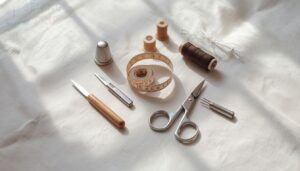
Needles aren’t the only sewing tools you can bring through security. TSA gives the green light to several other essentials that make in-flight stitching or quick repairs totally doable.
Here’s what you’re allowed to pack in your carry-on.
Small Scissors Under 4 Inches
Good news for crafters: scissors less than 4 inches are welcome in your carry‑on baggage and won’t land you on the TSA prohibited items list.
Look for titanium or stainless blade material types, ergonomic handle designs that reduce hand fatigue, and locking mechanisms for safer transport.
Safety cap variants and compact travel cases keep your sewing needles and sharp objects organized and screener‑friendly.
Needle Threaders and Thimbles
Beyond scissors, a needle threader and thimble round out any travel sewing kit — and TSA has no issue with either in carry-on bags.
Here’s what to pack smart:
- Choose a pocketable threader design with a compact case to protect the wire loop.
- Compare thimble material — metal for durability, silicone for comfort.
- Try a magnetic threader for easier handling mid‑flight.
- Store both in a clear zip bag for quick screening.
Measuring Tape and Fabric Markers
Both a measuring tape and fabric marker sail through TSA regulations without a second glance. Tape Material Choices matter here — fiberglass or retractable styles pack flat and won’t bulk up your bag. Most offer Metric Imperial Scales on both sides, handy for international trips. Durability Coatings keep markings readable after heavy use. Retractable Tape Benefits include compact storage.
Just choose water-based Marker Ink Types — airport security won’t bat an eye.
Embroidery Kits for Travel
If you love to stitch on the go, travel embroidery kits are TSA-friendly and genuinely worth packing. Look for ones with Compact Hoop Designs — usually four to six inches — that fit your quart-sized bag without drama.
Magnetic Needle Keepers prevent lost needles mid-flight. Color-Coded Floss saves hunting through tangles.
Some kits even offer Digital Pattern Access and include Portable Lighting Solutions for late-night hotel stitching.
Sharp Tools Not Allowed Onboard

Not everything in your sewing bag gets a free pass through security. Some tools are sharp or blade-like to bring into the cabin, no matter how neatly you pack them.
Here’s what TSA says you need to leave out of your carry-on.
Rotary Cutters and Blade Tools
Rotary cutters are a hard no in your carry-on — TSA and most airlines ban them outright as prohibited items. It doesn’t matter if yours has safety guard features or a compact blade size; the sharp tools classification overrides everything. Blade material types like high-carbon steel and edge geometry options make them simply too dangerous for cabin use.
Pack them in checked baggage only.
Scissors Over 4 Inches
Scissors with blades longer than 4 inches are TSA prohibited items — full stop. Their Leverage Advantage for cutting fabric is exactly what makes them a no‑go in carry‑on baggage. Airport security will pull them every time.
- Blade Material Choices like stainless or carbon steel don’t change the rule
- Ergonomic Handle Design won’t earn them a pass either
- Protective Sheath Options help in checked bags, not carry‑ons
- Pack scissors less than 4 inches instead — those sharp objects fly freely
Seam Rippers and Similar Items
Seam rippers are banned from carry-on bags — and yes, that includes checked baggage too, according to TSA guidelines.
forked blade design and its Blade Variants make it a flagged sharp object at security screening.
thread removal alternatives, try a small pin or your fingernail.
Safety packaging won’t change the rule.
Leave yours home.
Top 5 Travel Sewing Picks
Now that you know what’s allowed, having the right gear makes the whole thing easier. These five picks are TSA-friendly, practical, and worth throwing in your bag before your next trip.
Here’s what made the cut.
1. Fiskars Compact Travel Sewing Kit
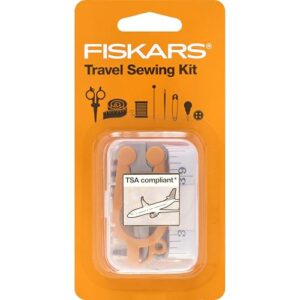
The Fiskars Compact Travel Sewing Kit packs a surprising amount into a tiny case. For just $4.89, you get 27 pieces — including three hand needles, folding stainless-steel scissors, ten colored threads, buttons, pins, and a needle threader — all tucked into a clear hard-plastic case weighing barely 1.3 ounces.
The scissors are TSA-compliant and lock safely inside. It won’t replace your home kit, but for a quick button fix at the airport gate, it’s hard to beat.
| Best For | Travelers, commuters, and campers who need a lightweight, no-fuss kit for quick clothing fixes on the go. |
|---|---|
| TSA Compliant | Yes |
| Material | Stainless steel |
| Travel Friendly | Yes |
| Weight | 41g |
| Price (USD) | $4.89 |
| Protective Case | Hard plastic case |
| Additional Features |
|
- 27 pieces for under $5 — seriously great value for what you get
- TSA-compliant scissors mean no hassle at airport security
- Tiny and light enough to toss in any bag without a second thought
- The scissors can feel stiff, which gets annoying when you’re already in a rush
- Thread is just okay — not great if you need something heavy-duty
- Only a handful of buttons and short thread lengths, so it’s strictly for small emergency fixes
2. Wrights Magnetic Needle Keeper
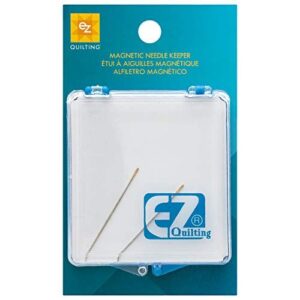
If you’re traveling with your own needles instead of a kit, the Wrights Magnetic Needle Keeper is worth the $4.85. It’s a small amethyst-colored plastic case with a magnetic strip that holds your needles in place and a clear lid so you can see exactly what’s inside.
At just 1.6 ounces, it slips into any bag without a second thought.
Just note that some units ship with weak magnets or cracked lids — check yours before you pack.
| Best For | Crafters who travel with their own needles and want a lightweight, easy-access storage option that keeps things organized and safe. |
|---|---|
| TSA Compliant | Yes |
| Material | Plastic |
| Travel Friendly | Yes |
| Weight | 45g |
| Price (USD) | $4.85 |
| Protective Case | Clear plastic cover |
| Additional Features |
|
- Magnetic strip keeps needles secure and easy to grab — no digging around
- Clear lid lets you see what’s inside at a glance
- Tiny and light at 1.6 oz, fits in any bag or purse without taking up space
- Magnets can be weak and the insert has been known to detach after minimal use
- Plastic lid is prone to cracking, which can break the whole closure
- Some units ship with missing magnetic inserts or arrive with adhesive residue on the packaging
3. Fiskars Travel Folding Scissors Mountain Haze
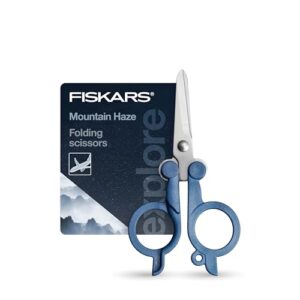
Need to cut a stray thread mid-flight? These Fiskars folding scissors in Mountain Haze are built for exactly that.
The 1-inch stainless steel blades are sharp enough for thread, fabric, and yarn — and at just 15 grams, you won’t even notice them in your bag.
They fold down under 4 inches, keeping you TSA-compliant without a second thought.
One heads-up: grips can feel stiff at first, so give them a few test folds before you fly.
| Best For | Sewers, crafters, and frequent flyers who need a reliable little pair of scissors on the go. |
|---|---|
| TSA Compliant | Yes |
| Material | Stainless steel |
| Travel Friendly | Yes |
| Weight | 15g |
| Price (USD) | $6.20 |
| Protective Case | Folding body |
| Additional Features |
|
- TSA-compliant and folds under 4 inches — no stress at security
- Sharp stainless steel blades handle thread, fabric, and yarn with ease
- Weighs just 15 grams, so it disappears in any bag or kit
- Stiff handles can make opening and closing frustrating, especially at first
- 1-inch blades aren’t up to the task for thicker fabrics or heavy cords
- A bit pricier than some comparable folding scissors out there
4. Rounded Tip Facial Hair Scissors
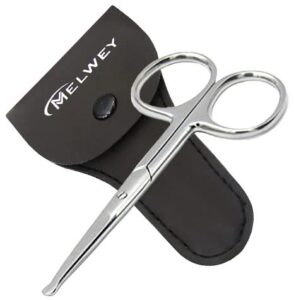
Not every sharp thing in your bag is for fabric. These rounded tip facial hair scissors pull double duty — they trim nose hair, brows, and mustache with precision, and work just as well for snipping a loose thread on the go.
At 3.7 inches and under half an ounce, they clear TSA’s carry-on rules with room to spare. The rounded tip keeps things safe near skin. Compact, lightweight, and under $10 — honestly a smart grab for any travel kit.
| Best For | Travelers, parents of young kids, and anyone who wants a safe, no-fuss tool for keeping facial hair and baby nails tidy on the go. |
|---|---|
| TSA Compliant | Yes |
| Material | Stainless steel |
| Travel Friendly | Yes |
| Weight | 9g |
| Price (USD) | $9.99 |
| Protective Case | Included case |
| Additional Features |
|
- Rounded tip makes it genuinely safe to use near eyes, nostrils, and baby fingers
- Tiny and light enough to toss in a toiletry bag and forget about until you need it
- Under $10 for a solid stainless steel build that holds up over time
- Too small to handle thick beards or serious facial hair shaping
- Not ideal if you have larger hands — the grip can feel a little fiddly
- Manual scissors mean more effort than an electric trimmer, which some people just prefer
5. Pafason Travel Embroidery Scissors Set
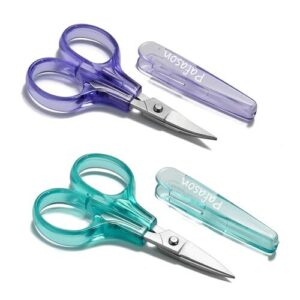
If you’re serious about embroidery on the road, the Pafason Travel Embroidery Scissors Set is worth a look.
You get two scissors in one pack — a straight-tip and a curved-tip — both with 3.5-inch stainless-steel blades that sail through TSA carry-on limits.
The curved blade is especially handy for snipping tight stitches without nicking the fabric around them.
Safety caps protect the tips in your bag, and at roughly 20g each, you’ll barely notice them.
| Best For | Embroiderers and stitchers who travel frequently and need compact, TSA-friendly scissors for detailed needlework on the go. |
|---|---|
| TSA Compliant | Yes |
| Material | 304 Stainless steel |
| Travel Friendly | Yes |
| Weight | 40g |
| Price (USD) | Not listed |
| Protective Case | Hard plastic sheath |
| Additional Features |
|
- Two blade styles in one pack — straight for clean cuts, curved for snipping tight stitches without damaging surrounding fabric
- TSA, CAA, and CASA compliant, so they’re safe to toss in your carry-on without a second thought
- Lightweight (about 20g each) and come with safety caps, making them easy and safe to carry in a project bag
- The 3.5-inch blades are too short for cutting bulk fabric or anything beyond small-scale tasks
- Plastic handles and budget-friendly build may not hold up well with heavy daily use over time
- Safety caps are easy to misplace, and without them, the small sharp blades become a real injury risk
Frequently Asked Questions (FAQs)
Will TSA stop you for needles?
Needles are tiny, but the rules around them aren’t as sharp as you’d think.
TSA generally won’t stop you — as long as they’re packed securely and you stay within the carry-on limit.
Will TSA confiscate my tweezers?
TSA won’t confiscate your tweezers. Standard tweezers are allowed in carry-on bags.
Just pack them in a clear bag so officers can spot them fast. final call still belongs to the officer at the checkpoint.
Is a sewing kit allowed in check-in baggage?
Yes, a sewing kit is allowed in checked baggage with no quantity limit.
Pack needles in a hard-shell case, cover all sharp tips, and wrap tools securely to prevent punctures during handling.
Can you bring sewing needles on a plane?
You can bring sewing needles on a plane. TSA allows them in both carry-on and checked bags. Just pack them safely in a closed container, and you’re good to go.
Are sewing needles allowed in Carry-On & checked luggage?
Like slipping a library card into your wallet, sewing needles fit easily into your carry-on or checked bag. TSA allows both, so you’re covered either way you pack.
Can you bring sewing tools on a plane?
Most small sewing tools are welcome in your carry-on. Needles, thread, thimbles, and needle threaders all get the green light. Just pack them neatly, and you’re good to go.
Can you take sewing kits on a plane?
Funny enough, most pre-made travel sewing kits are already TSA-approved. They usually include needles, thread, and a small case — everything neatly contained, which is exactly what security wants to see.
Can you carry sewing needles on a plane?
Yes, you can carry sewing needles on a plane. TSA allows them in both carry-on and checked bags, as long as they’re packed safely in a closed, protective container.
Can I bring needles through TSA?
TSA does allow sewing needles through security checkpoints. Pack them in a secure, closed container, and you’re good to go. Just keep your count at 12 or fewer in your carry-on.
Does TSA allow scissors?
Blades under four inches from the pivot point get the green light in your carry-on. Longer ones belong in checked baggage. Blunt tips pass more smoothly than pointed ones.
Conclusion
A sewing needle weighs almost nothing, yet getting it through security takes real preparation. So yes, can you bring a sewing needle on a plane?—absolutely.
But knowing the rule and surviving the checkpoint are two different things. Pack it right: hard case, clear bag, covered tips. Check your airline before international flights.
The needle itself was never the problem; how you carry it always was. Get that part right, and it flies with you every time.