This site is supported by our readers. We may earn a commission, at no cost to you, if you purchase through links.
Pick up any piece of fabric and look closely — what you’re seeing isn’t random. Every thread follows a deliberate path, locked into a structure that determines how the fabric feels, drapes, and holds up over time. Most people touch fabric and think “smooth” or “rough,” but a textile designer sees something closer to a fingerprint.
Learning how to identify weave patterns turns that vague impression into something you can actually read, like sheet music hidden in the cloth. Once you know what to look for, the difference between a twill and a plain weave becomes obvious — and fixing weaving errors or adapting a draft to your loom stops feeling like guesswork.
Table Of Contents
Key Takeaways
- Every weave pattern is built on threading sequences, treadling orders, and pattern repeats — master these three and you can read any fabric like a map.
- Plain, twill, and satin weaves each have a distinct fingerprint: plain is a tight grid, twill runs diagonal, and satin glides smooth with long warp floats.
- A weaving draft is your blueprint — the threading diagram, treadling sequence, and drawdown work together to show exactly how your finished fabric will look before you weave a single row.
- When patterns go wrong, the fix is usually simple: diagonal breaks mean a missed treadle, long floats signal treadling errors, and distorted motifs point to tension problems.
Key Elements of Weave Patterns
Before you can identify any weave pattern, you need to understand what’s actually going on beneath the surface. Every pattern is built on a handful of key elements that work together like instruments in a band.
Here’s what to look for.
Threading Sequences and Warp Arrangement
Threading sequences are basically your loom’s GPS — they tell each warp thread exactly where to go. Every warp end gets assigned to a specific shaft, and that shaft assignment shapes your entire weaving pattern.
Just like shaft assignments lock in your pattern, choosing the right presser foot locks in your stitch quality — explore how different sewing feet handle various fabric types to get the most from every project.
Getting your warp density right matters too; uneven spacing causes visible errors across the fabric. Master your threading sequence first, and loom setup optimization becomes so much easier!
For additional tips on interpreting drafts and troubleshooting setup, check out these essential weaving skills articles.
Treadling Orders and Shaft Lifting
Once your warp is set, treadling mechanics take over — and this is where the real magic happens! Treadling sequences tell you exactly which treadles to press and when, controlling shaft lifting to open the shed for each weft pick.
Think of tieup charts as the translator between your feet and the loom settings, connecting treadles to shafts and shaping your weave dynamics beautifully.
Understanding different is essential for interpreting and executing patterns accurately.
Pattern Repeats and Consistency
Now that treadling clicks into place, pattern repeats become your best friend! A repeat unit size is simply the smallest block that tiles across your fabric — plain weave repeats every 2×2, while a twill needs 4×4.
Solid weave pattern consistency means motifs line up perfectly at every seam.
Track picks carefully using bead counters — those simple loom tracking methods genuinely save you from costly do-overs!
Recognizing Pattern Symmetry and Variation
Once your pattern repeats feel solid, it’s time to spot symmetry at play! Mirror symmetry means one half of your design flips perfectly across a central axis — like a butterfly’s wings. Rotational axis patterns spin identically around a point.
Watch for directional motifs, broken patterns that zigzag intentionally, and color harmony shifts. These details reveal a deeper understanding of weaving patterns, making pattern symbol interpretation and weave structure feel natural.
Decoding Weaving Draft Notations

Think of a weaving draft as the blueprint behind every pattern — once you can read it, everything clicks.
It breaks down into a few key parts that work together to map out exactly how your fabric will look.
Here’s what you need to understand to decode it with confidence.
Interpreting Threading Diagrams
Think of a weaving draft as your loom’s blueprint — and threading diagrams are the foundation. Reading from right to left, each column controls one warp end, telling you exactly which shaft it belongs to.
Mastering draft analysis and warp end control makes loom setup so much easier. Once you crack threading notations, understanding weaving patterns finally clicks!
Understanding Treadling Sequences
Every row in your weaving draft tells a story — and treadling sequences are how you read it pick by pick. Treadling Basics come down to one idea: each marked square shows which treadle to press, lifting specific shafts for Weft Interlacing.
Nail your Pick Orders and Loom Mechanics fall into place. That’s the secret to reading weaving patterns with real confidence!
Drawdown and Visual Pattern Representation
Clarity is everything when you’re reading weaving patterns — and that’s exactly what a drawdown delivers. Think of it as a pixel-style map of your fabric’s surface, where every square tells you whether the warp or weft sits on top.
Drawdown Analysis makes Pattern Mapping and Fabric Visualization surprisingly straightforward:
- Black squares show warp over weft; white squares flip that.
- Diagonal runs reveal twill structures; checkerboard zones signal plain weave.
- Repeating rows help you reconstruct interpreting threading and treadling sequences fast.
This Visual Representation inside your weaving draft is your Weave Simulation before a single yarn hits the loom — understanding fabric weaves has never felt more hands-on!
Types of Common Weave Patterns
Now that you’ve got a handle on draft notations, it’s time to meet the actual patterns you’ll be working with.
Each weave type has its own personality — from super simple to surprisingly complex.
Here are the most common ones you’ll want to know.
Plain Weave Characteristics
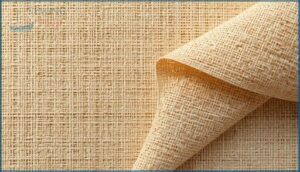
Plain weave is the fundamental starting point for understanding fabric weave. It follows a simple over-one, under-one interlacement basics pattern — that’s it!
The result? A balanced grid with identical front and back faces, smooth texture, and impressive structural stability. Density permeability stays consistent too, since yarns lock tightly at every crossing.
Recognizing these visual features makes identifying weaving patterns so much easier.
Twill Weave Identification

Twill weave is where things get exciting! That signature diagonal line running across the fabric is your biggest clue. Run your fingers along it — you’ll feel subtle ridges from the wales.
Twill balance matters too: a 2/2 twill feels even on both sides, while a 3/1 sits warp-heavy. Float length and broken twill variations make reading weaving patterns and identifying fabric weaves genuinely fun.
Satin, Basket, and Rib Weaves
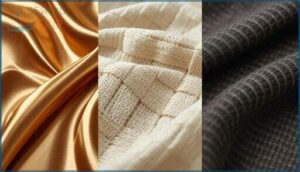
Now here’s where things get glamorous — literally! Satin fabric glides through your fingers like liquid glass, thanks to long warp floats covering most interlacing points.
Basket weave groups yarns into satisfying checkerboard blocks, while rib texture creates bold ridges you can feel immediately.
Three quick identifiers:
- Satin weave — glossy face, dull back, superb fabric drape
- Basket weave — visible woven blocks, airy weave density
- Rib weave — raised cords running one direction
Advanced Patterns: Leno, Oxford, Jacquard, Crepe
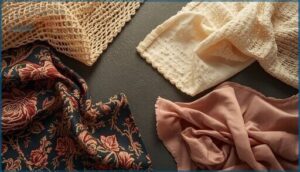
Ready to level up your fabric identification game? Sophisticated weaving techniques like leno weave, oxford weave, jacquard weave, and crepe weave each have distinct fingerprints.
Leno weaving locks weft with twisted warp pairs — you’ll spot the open mesh instantly. Oxford shows a pebbled dot effect. Jacquard flips to reversed colors on the back. Crepe feels like fine sandpaper.
Pattern recognition gets easier with every swatch you handle!
Step-by-Step Guide to Identifying Weave Patterns

Now comes the fun part — actually identifying what you’re looking at! Whether you’re holding a mystery fabric or staring down a loom draft, a simple process can make it click.
Here’s how to work through it step by step.
Examining Fabric Structure and Texture
Start your weave analysis by getting hands-on with the fabric. Surface inspection tells you so much before you even grab a magnifier!
- Run your fingers across the surface — smooth means floats, rough means tight interlacing
- Check fabric texture for bumps, slubs, or ridges
- Assess fabric density by holding it to light
- Count thread count using a pick glass
Spotting Repeat Units and Motifs
Once you’ve felt the texture, it’s time to find the repeat unit — the smallest block that tiles across the whole cloth. Look for where the over-under sequence resets, that’s your pattern boundary.
Are motifs stacked in a straight grid or offset diagonally? That tells you everything about motif placement.
Repeat unit analysis and symmetry detection are your best tools for reading weaving patterns confidently.
Comparing Front and Back of Fabric
Now that you’ve mapped your repeat units, flip the fabric over — the back tells a whole story! Comparing fabric sides is one of the easiest visual clues for identifying weave structure.
- Texture Differences: Satin weaves feel glossy on front, matte on back.
- Finishing Effects: Brushed or napped surfaces appear only on the face.
- Twill Lines: Clearer diagonal on front, softer on back.
- Print Saturation: Brighter colors always face forward.
Using Magnification and Digital Tools
When your naked eye just isn’t enough, that’s where optical tools and digital tools for weavers really shine. A simple linen tester gives you 5x–10x magnification to count threads fast.
For deeper image analysis, USB digital microscopes hit up to 1000x. Smartphone apps with AI classification can even identify weave families instantly — making understanding weaving diagrams and interpreting weaving drafts genuinely exciting!
Troubleshooting and Adapting Weave Patterns
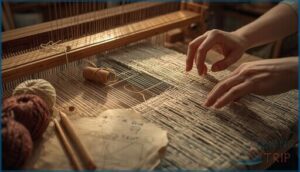
Even the best weavers hit snags — a pattern that won’t cooperate, a loom that doesn’t quite match the draft, or yarn that throws everything off.
The good news is that most of these problems have straightforward fixes once you know what to look for. Here’s what to keep in mind when things don’t go as planned.
Recognizing Pattern Interruptions or Errors
Even seasoned weavers hit a snag — and that’s totally okay! Sharp error detection starts with knowing what to look for in your fabric. Here are three common weave faults to watch:
- Diagonal breaks in twill lines signal a missed treadle press.
- Long floats skipping three or more threads point to treadling mistakes.
- Distorted motifs reveal tension issues causing fabric distortion.
Pattern analysis saves the day!
Adjusting Patterns for Different Looms
Not every weaving draft plays nicely with every loom — and that’s where draft adaptation saves you! Loom conversion starts by matching your draft notations to your loom type.
Table looms need a lift plan instead of treadling sequences. Shaft reduction helps squeeze eight-shaft patterns onto four. Pattern scaling trims warp ends by full repeats.
Smart weave optimization keeps your design intact while your loom setup and operation runs smoothly.
Factoring in Yarn Size and Color
Yarn size and color can make or break how clearly your weave pattern reads. Thicker yarns highlight twills and checks beautifully, while fine yarns blur small repeats together. Strong color contrast — think white warp, black weft — sharpens pattern blocks instantly.
Yarn weight and color contrast are the silent architects of how clearly your weave pattern speaks
Watch out for variegated yarns, though! They can camouflage your interlacement completely. Fiber takeup and weft dominance also shift your pattern’s proportions after wet finishing.
Frequently Asked Questions (FAQs)
How to identify weave type?
To nail Weave Type Analysis, start with a quick Fabric Inspection — flip it over, feel the texture, and look for diagonals or shine. Those surface clues tell you almost everything.
How to identify fabric by touching?
Run your fingers across the fabric — surface feel tells a lot! Plain weaves feel matte and slightly coarse, twills offer diagonal ridges, and satin glides smooth. Tactile inspection reveals fabric textures instantly.
How to identify a woven fabric?
Fabric inspection starts with a simple tug test. Woven fabrics resist stretching along the grain direction and fray at cut edges — classic signs of yarn interlacement at work.
What are the five common weave patterns?
There are practically hundreds of weave structures out there, but five rule the textile world: plain weave, twill, satin, basket weave, and leno — each with its own fabric weave personality and feel.
How does fiber content affect weave pattern appearance?
Fiber content totally changes how a weave pattern looks and feels! Fiber smoothness, yarn texture, color absorbency, and fabric drape all shift based on fiber types — making the same draft look completely different depending on your yarn content.
Can weave patterns be identified from a photo?
You can identify weaving patterns from a photo — but image resolution matters a lot.
A clear, close-up shot revealing fabric texture and structure makes weave recognition through digital tools surprisingly reliable.
How do cultural traditions influence weave pattern styles?
Weaving patterns look purely technical, yet they carry centuries of meaning. Cultural Symbolism, Traditional Motifs, and Regional Identity shape every thread — from Sacred Patterns in Navajo diamonds to Ethnic Textiles defining community and status.
When should you consult a professional textile analyst?
When identifying fabric weaves gets complex — think Jacquard, forensic cases, or heritage authentication — consult a professional textile analyst.
They handle performance testing, digital modeling, and precise textile analysis that goes far beyond what textile enthusiasts can manage solo.
Conclusion
Every thread tells a story, every pattern holds a logic, and every fabric you touch is now a puzzle you know how to solve. Learning how to identify weave patterns isn’t just a technical skill — it’s a new way of seeing.
You’ll catch twills in your jacket lining, spot plain weaves in your kitchen towels, and finally understand why some fabrics drape like water while others hold their shape like armor. That’s a real superpower.
- https://pigeonwishes.com/what-is-the-different-between-plain-weave-twill-and-satin-weave/
- https://www.fabricsight.com/blogs/posts/understanding-fabric-weaves-plain-dobby-twill-jacquard-crepe-more
- https://jardina.com/blogs/all/exploring-the-different-weaving-techniques-in-woven-rope-outdoor-furniture
- https://www.bolianfiltration.com/how-to-identify-plain,-twill-and-satin-patterns.html
- https://www.onlineclothingstudy.com/2012/02/how-to-determine-warp-and-weft-in-woven.html