
This site is supported by our readers. We may earn a commission, at no cost to you, if you purchase through links.
A separating zipper—the kind that splits completely apart at the bottom, like on a jacket or hoodie—looks intimidating until you understand one thing: it’s just two zippers sharing a slider. That mental shift changes everything.
Most installation problems come down to skipped prep steps, wrong foot choice, or a zipper that doesn’t match the fabric weight. Get those three things right, and the rest is mostly patience and straight stitching.
These separating zipper installation tips walk you through tools, prep, and technique so your finished seam looks like it came off a professional’s machine—not a first attempt.
Table Of Contents
Key Takeaways
- matching your zipper type and tooth material to your fabric weight is the single most important decision you’ll make before sewing a single stitch.
- Basting both sides before permanent stitching isn’t optional busywork — it’s the only reliable way to catch misalignment before it’s locked in.
- An adjustable zipper foot, proper pressing, and consistent 5/8-inch seam allowances are what separate a wobbly result from a clean, professional finish.
- Securing zipper ends with backstitching and bar tacks protects high-stress points from unraveling long after the garment leaves your hands.
Essential Tools for Separating Zipper Installation
Before you sew a single stitch, your tools will make or break the whole installation. Getting the right ones in your corner isn’t complicated, but it does matter more than most beginners expect.
If you’re tackling a tricky closure, brushing up on lapped zipper hand sewing techniques can save you a lot of frustration before you even thread your needle.
what you’ll want to have ready before you start.
Choosing The Right Zipper Foot
Choosing the right zipper foot can make or break your separating zipper installation.
First, check your shank height — low shank measures about ½ inch, high shank is 1 inch or more.
For material compatibility, Teflon-coated feet handle leather and vinyl beautifully.
Adjustable feet beat fixed ones hands‑down since left/right positioning lets you sew both sides cleanly.
Always confirm machine‑specific fit before buying. The adjustable zipper foot allows stitching on both sides of the zipper.
Selecting Appropriate Zipper Types
Once your zipper foot is sorted, the next decision is picking the right zipper itself.
Tooth material choice matters more than most beginners expect — nylon coil suits lightweight fabrics under 300 g/m², while metal teeth handle heavier garments above 500 g/m².
For fabric weight match, size up when in doubt.
Length, pull style, and aesthetic color options all feed into clean garment construction, so choose intentionally.
Consider using two-way zippers for jackets to allow flexible opening.
Gathering Marking and Measuring Tools
With your zipper type locked in, grab your measuring tools before touching the machine. A flexible measuring tape performs Measuring Tape Calibration for exact zipper length along your opening.
Use Acrylic Ruler Usage with clear 1/4‑inch lines for marking stitch paths, then apply Erasable Pen Techniques or Tailor Chalk Selection for clean placement lines. A tracing wheel follows ruler edges precisely for Tracing Wheel Tips on longer openings.
Using Fabric Glue, Tape, or Pins
With your marks in place, it’s time to hold that zipper still — and your method matters more than you’d think. For Separating Zippers, here’s what works:
- Glue vs Tape: Fabric glue survives 50+ wash cycles; basting tape eliminates puckering entirely.
- Glue Application Tips: Use a Q-tip, skip the teeth, let Adhesive Dry Time hit 2 minutes.
- Tape Width Selection: Match tape width to your seam allowance — ¼", ⅜", or ½".
- Pin Placement: Insert pins horizontally, every inch, for clean Fabric Stabilization.
Preparing Your Zipper and Fabric
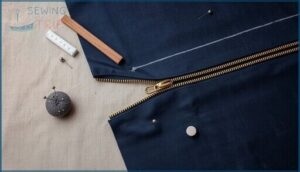
Before you sew a single stitch, the prep work is what separates a polished result from a frustrating redo. Getting your zipper and fabric ready the right way takes just a few focused steps, and each one pulls real weight.
Pairing the right thread with your zipper foot makes all the difference, as this centered zipper sewing technique guide shows with practical, stitch-by-stitch detail.
Here’s exactly what you need to do before the needle ever touches the tape.
Measuring and Marking The Zipper Placement
Getting your measurements right is the difference between a zipper that glides and one that puckers. Start with a measuring tape — measure your separating zipper from the top stop down to the retainer box, then add 5/8‑inch for seam allowance calculation.
Use a ruler for length measurement and a fabric marking pen or chalk marking technique for bottom stopper positioning. Symmetry verification matters too: transfer five key points onto both fabric pieces so everything lines up perfectly.
Aligning Zipper Tape With Fabric Edges
Once your marks are set, it’s time to line everything up. Lay each zipper tape face-down along the raw fabric edge, checking grainline matching — the tape should run parallel to a straight fabric thread, not drift diagonally.
- Edge pinning precision: Pin perpendicularly every 1–2 inches for separating zippers, starting from the top stop downward.
- Seam allowance consistency: Maintain a steady 5/8-inch allowance on both sides.
- Fabric glue placement: Apply a thin glue-stick line for slippery fabrics before foot position adjustment.
Pressing Fabric Before Installation
Pressing before you sew isn’t optional — it’s the step that separates a polished zipper from a wobbly one. Seam Flattening sets your stitches and removes puckers so fabric preparation actually holds.
Pressing before you sew isn’t optional — it’s what separates a polished zipper from a wobbly one
Use a Pressing Cloth to protect your fabric, and match your Iron Temperature to your fiber.
| Tool | Purpose |
|---|---|
| Tailor’s Ham | Holds curved seams |
| Seam Roll Alignment | Opens narrow allowances flat |
| Pressing Cloth | Shields delicate fibers from heat |
| Iron Temperature | Prevents melting or scorch marks |
Separating and Orienting Zipper Halves
Before you pin anything, separate the two halves and identify them. One side carries a small box at the bottom, the other has a pin — that’s your Box‑Pin Identification sorted.
Lay both halves flat, teeth facing up, and do a quick Teeth Alignment Check to confirm they match evenly. Mark your Bottom‑Stop Marking, align each tape edge using Fabric Edge Matching, and keep your Slider Direction Consistency from bottom to top on both sides.
Step-by-Step Separating Zipper Installation
This is where the real work begins — needle down, zipper in hand.
Getting a separating zipper to sit straight and open smoothly comes down to a few key moves done in the right order. Here’s exactly how to work through each stage.
Basting and Pinning Techniques for Accuracy
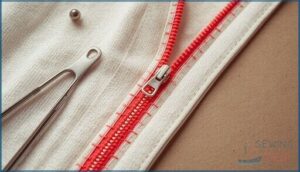
Think of basting as your safety net before committing. Use your machine’s longest stitch length — around 4–5 mm — and choose a contrast thread basting color so misaligned spots are obvious.
For pin spacing strategy, place pins every 2–3 cm, perpendicular to the tape. After final stitching, basting removal tips are simple: use a seam ripper while the zipper stays closed.
Attaching The First Zipper Side

Place the first side of your separating zipper face‑down, focusing on tape edge alignment — align the zipper tape exactly with your fabric’s raw edge.
Set your stitch length settings to 2.5 mm, snap your zipper foot to the right ankle, and adjust needle positioning one step left of maximum.
For slider handling, stop an inch before it, lift the foot, slide it back, then finish.
Ensuring Seam Alignment on The Second Side
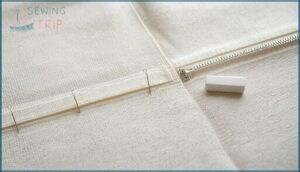
With the first side basted, zip it closed and lay the second half over — horizontal edge matching moment. Transfer seam marks using chalk, then pin perpendicular through the tape into the fabric.
Stitch direction consistency matters here: sew bottom to top, just like the first side. Baste verification is your safety net — zip up, check alignment within 1 mm, then commit.
Switching to a Zipper Foot for Final Stitching

Once both sides are basted and aligned, swap your regular foot for a zipper foot — it sits narrower, giving you better visibility and pressure control right along the teeth.
Set your stitch length to 2.5–3 mm, position the needle 3–6 mm from the coils, then sew slowly.
When you hit the pull, needle down, foot up, slide it past, and keep going.
Finishing Touches for a Professional Look

The zipper is in — now it’s time to make it look like it was always meant to be there.
A few small steps at the end are what separate a homemade result from a clean, finished piece.
Here’s what to focus on.
Topstitching Along The Zipper Tape
Topstitching along the zipper tape is what separates a rushed job from a polished one.
Run your stitching about 1/4 inch from the teeth, working from bottom to top for consistent fabric stability. This edge stitching flattens the tape, prevents rolling, and adds real seam reinforcement to your separating zipper installation.
Keep your thread tension even, and that zipper tape stays put wash after wash.
Matching Thread for Clean Results
Thread color matching is the quiet detail that makes or breaks your seam finishing. For fabric-zipper harmony, pick thread that blends with your fabric — not the teeth.
- Slightly darker always beats lighter for blending.
- Test under natural light before committing.
- Match thread weight to fabric weight to avoid puckering.
Polyester thread wins for fiber compatibility around separating zippers — strong, flexible, built to last.
Pressing After Installation
Pressing after installation is the step most sewists rush—don’t. Use a pressing cloth to protect hardware and synthetic fabrics from shine or warping.
For cotton, medium heat around 150–180°C works well; drop lower for polyester.
Press along the length of separating zippers using smooth direction technique, flattening seams from the wrong side first. Keep the iron moving.
Done right, seam finishing looks sharp.
Securing Zipper Ends and Edges
Loose zipper ends are where garments fall apart — literally. Backstitching Ends across the tape at both the top and bottom locks everything in place, while Fabric Triangle Stops give you a clean, raw-edge-free finish without bulk.
For high-stress spots, Bar Tacking Reinforcement adds dense horizontal stitches that hold up to daily use. These Zipper Installation Tips are what separate a finished piece from a professional one.
Troubleshooting and Pro Tips
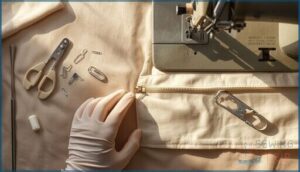
Even careful sewers run into snags — a wavy seam here, a stubborn zipper pull there.
The good news is that most problems have a quick fix once you know what to look for.
Here’s what to watch out for and how to handle it.
Avoiding Common Mistakes
Even experienced sewists trip over the same avoidable mistakes when installing a separating zipper. Nail these five sewing tips, and your garment construction techniques will level up fast:
- Stitch direction — always sew hem to neckline on both sides to keep seam tension even.
- Pin placement — pin horizontally so the tape doesn’t shift.
- Foot pressure — ease up on stretch fabrics to prevent fabric puckering.
- Alignment checks — zip closed and confirm seams match within 1 mm before permanent stitching.
- Zipper installation tips — baste first, always.
Using Fabric Stabilizers for Tricky Fabrics
Tricky fabrics aren’t impossible — they just need a little backup.
Stabilizing fabric before zipper installation is the difference between a clean edge and a wavy mess.
| Fabric Type | Stabilizer Types | Why It Works |
|---|---|---|
| Knits/Jersey | Knit Stay Tape | Prevents stretch without stiffness |
| Sheer Fabric Prep | Mesh vs Fusible (no-show mesh) | Invisible support, zero ghosting |
| Slippery Satin | Wash‑away Application | Disappears after stitching, stays crisp |
Interfacing materials should be cut to match the zipper’s exact length — no guessing.
Fixing Zipper Misalignment
Misalignment mid-project? Don’t panic — it’s fixable.
Start with tooth realignment: fully unzip, then gently tug the longer tape side through the slider until teeth click into place.
For seam precision, re-mark both tapes with tailor’s chalk before re-pinning.
If the bottom stop has shifted, remove it with pliers, realign manually, and resew.
Slider adjustment with needle-nose pliers tightens a loose grip fast.
Frequently Asked Questions (FAQs)
How do I shorten a separating zipper at home?
Measure, mark, and remove teeth down to your new length, then secure new Whipstitch Stops, singe synthetic tape edges, and test the slider.
Done — perfectly shortened separating zippers, ready for clean zipper installation.
Can I install a zipper without a sewing machine?
Yes, you can. Hand basting, fabric glue, or the prick stitch method all work beautifully for zipper installation without a machine — keeping your DIY sewing clean, controlled, and surprisingly professional.
How do I replace a broken zipper slider?
Slide the old slider down, pop off the top stop with pliers, and swap in a matching slider size. Crimp the new top stop, test it, and you’re done.
What stitch length works best for zipper tape?
For basting, use 5–4 mm so you can pull it out easily. Drop to 5 mm for permanent zipper tape attachment. Topstitch at 3–5 mm for clean, visible results.
How do I wash garments with metal separating zippers?
Zip it fully, use cold water settings, a gentle spin cycle, and pH‑neutral detergent.
Air‑dry preservation keeps metal zippers intact. Finish with post‑wash lubrication — paraffin wax works perfectly.
Conclusion
Picture the moment you zip up a finished jacket for the first time—both halves catching cleanly, the slider gliding smoothly from bottom to top without a single snag. That’s what solid separating zipper installation tips actually deliver: not just a functional closure, but proof that you did it right.
Nail your prep, sew close to the teeth, and press every seam. The technique isn’t magic—it’s just careful work, repeated until it becomes second nature.
- https://www.heyjunehandmade.com/zip-tips-how-to-shorten-and-install-a-separating-zipper/
- https://gooberpeadesigns.com/separatingzippertutorial/
- https://creativiu.com/sewing-posts/how-to-install-separating-zippers-in-sewing-projects-in-9-minutes-or-less/
- https://www.doinaalexei.com/beginnersewingtutorialblog/how-to-sew-a-separating-zipper-top-stitching-and-faced-method-for-beginners
- https://www.zipperstop.com/